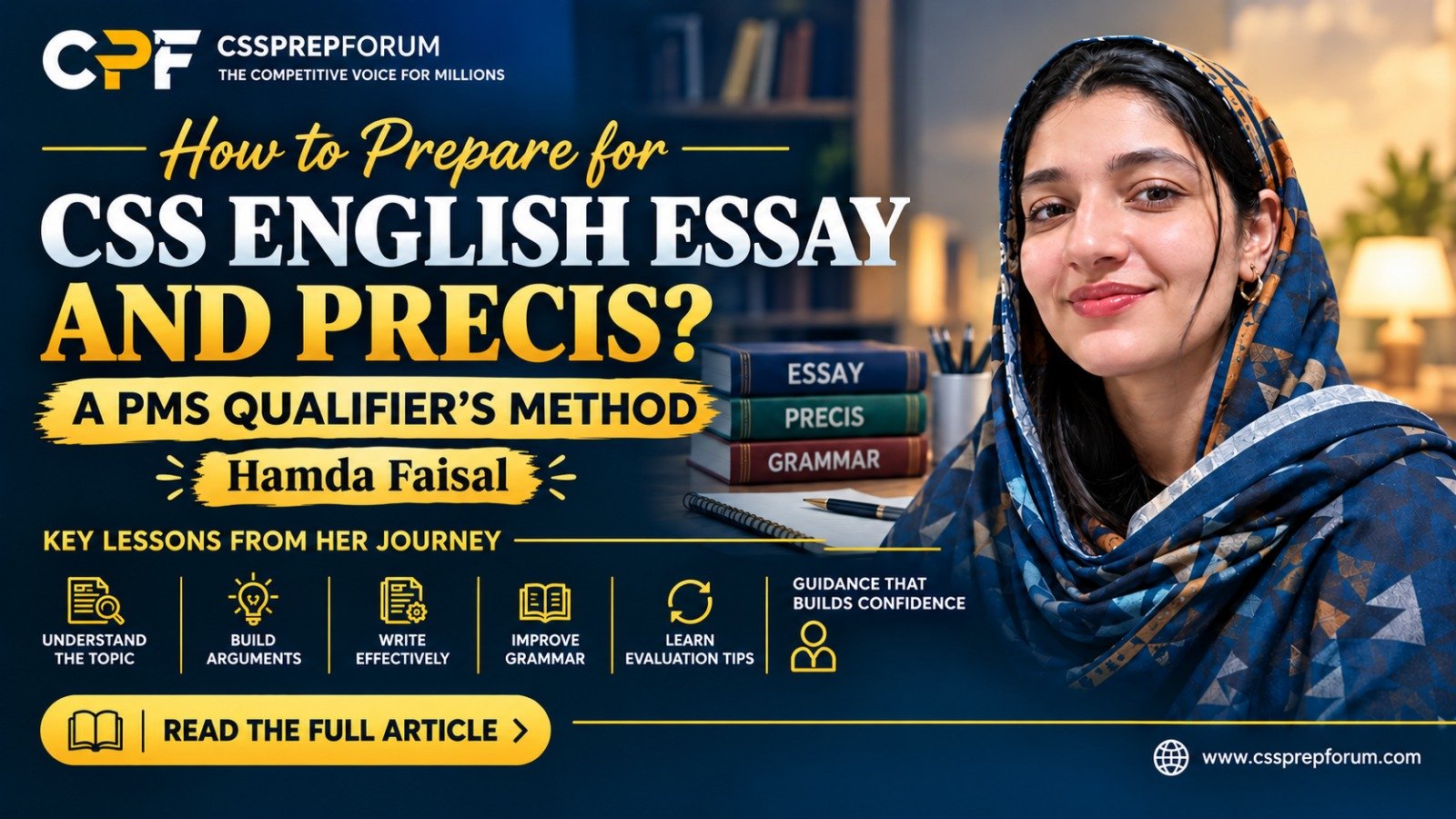
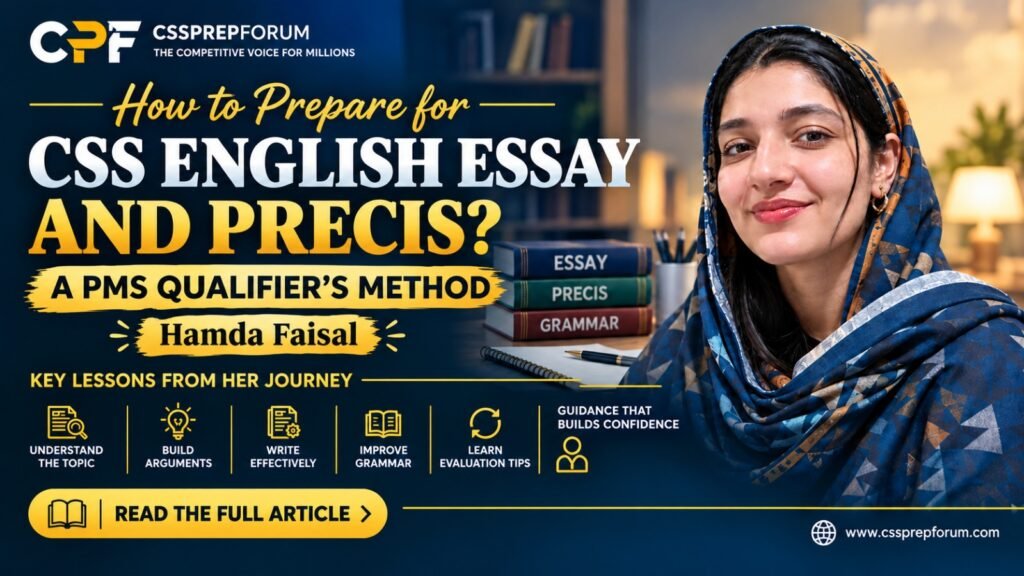
Studying hard for CSS or PMS but still unable to write an exam-quality essay? Here is a PMS Punjab 2025 written qualifier’s method for CSS English Essay and Precis preparation and evaluation.
There is a particular frustration that CSS and PMS aspirants rarely say out loud. You are studying. You read the newspaper every morning, you have filled notebooks with current affairs, and you have sat through the lectures and worked through the vocabulary lists. Then you sit down in front of a blank page with an essay topic printed at the top of it, and none of what you have collected seems to know what to do with itself.

The gap is not knowledge. It is the ability to turn knowledge into an examination-quality essay, precis, or subjective answer. Aspirants in this position usually find themselves circling the same set of questions
- What exactly is the topic asking?
- How should I interpret it?
- What should my thesis be?
- How do I develop arguments?
- Where should I use examples and evidence?
- How should I structure the essay?
- How can I improve my grammar and punctuation?
- How should I prepare Precis and Composition alongside Essay?
Hamda Faisal’s PMS Punjab 2025 written qualification is a useful case study precisely because she did not arrive at this problem from a position of weakness. She holds a bachelor’s degree in English Literature and Language; she had been reading and writing seriously for years, and she had a genuine interest in prose and fiction. None of it gave her a method for competitive-examination writing. In her own account of that period, what she was missing was not vocabulary or ideas but a way of converting both into something an examiner could mark.
That distinction is the whole subject of this article. CSS and PMS English preparation is not really about knowing English or knowing current affairs. It is about learning to think, organize, and communicate under examination conditions.
Why Do CSS and PMS Aspirants Struggle Despite Studying English?
An English background helps, but competitive examinations ask for a specific kind of writing, and it is not the kind most graduates have practised.
Hamda had written academic essays throughout her undergraduate degree. When she began preparing for CSS and PMS, she found that those years of writing had not taught her how to approach a competitive essay or a subjective question. She knew how to sustain an argument across pages for a literature seminar. What she wanted to know was how to work through a syllabus, read a question’s demand, build an outline from it, and present her material in a way that scored.
Academic writing and competitive-examination writing are not the same skill, and treating them as though they were is one of the quietest ways to waste a preparation year. An aspirant can know a subject thoroughly and still be unable to interpret the exact demand of a topic, narrow a broad subject to something arguable, formulate a thesis, develop arguments that connect to one another, use evidence so that it actually proves something, organise an outline that holds, maintain grammatical accuracy under time pressure, or fit all of it inside the constraints of an examination hall.
If that list describes you, reading more will not fix it. The first real step in CSS English Essay and Precis preparation is not acquiring more material. It is identifying, honestly and specifically, what you currently cannot do on paper.
What Happens When CSS Essay Preparation Has No Direction?
Hamda’s early months show what directionless study actually looks like from the inside, and it is worth describing in detail because so many aspirants are living in it right now without recognising it.
Before joining Sir Syed Kazim Ali, she attended a local academy. Her essay classes were largely discussions of current affairs. She left them better informed about foreign relations and domestic issues, and no closer to knowing how to integrate an example, a case study, a piece of evidence, or a quotation into an essay. She had come across the term “thesis statement,” but nobody had shown her how to construct one. The feedback she received amounted to being told to practise more.
The result is a situation that will be familiar to thousands of aspirants: she was preparing topics, but she had no idea how to convert those topics into written examination responses. She describes attempting the CSS 2024 essay paper in the classroom as a dreadful experience, and the word is well chosen. Sitting in front of a paper you have technically prepared for, knowing you cannot write it, is a specific kind of dread.
What that moment exposes is a preparation mistake that hides in plain sight: collecting information is not the same as learning how to use information.
An aspirant can have thirty topics prepared and remain entirely unprepared for the essay paper, because the paper does not test whether you have the material. It tests whether you can interpret, organize, argue, and write.

How Can You Give Direction to CSS English Preparation?
Direction begins the moment random study is replaced by a defined process. For an essay, that process runs roughly like topic understanding → narrowing the topic → creating a question → brainstorming → thesis development → argument building → outline → evidence → paragraph development → complete essay → evaluation → correction.
Each stage feeds the next, and a weakness at any point shows up further down the chain. A vague interpretation produces a vague thesis; a vague thesis produces arguments that do not converge; arguments that do not converge produce a conclusion that restates rather than resolves.
For Precis and Composition, the process has to address the components of the paper individually, because that paper is not one skill but several sitting in the same three hours: grammar, punctuation, sentence structure, precis, comprehension, and the rest.
Hamda found the roadmap she was looking for at the January 2024 orientation she attended after coming across past-paper CSS solved essays on CSSPrepForum while searching online. What she received there was guidance on how to prepare the essay, which domains to cover, and which components of English Precis and Composition needed attention across the week.
The broader lesson holds regardless of where you find your roadmap. An aspirant needs to know more than what to study. You need to know what to study, why you are studying it, how to practise it, and how to tell whether the practice is producing improvement. Preparation without that fourth element is just activity.
How to Learn CSS Essay Topic Analysis
The most consequential thing Hamda learned was how to understand a topic before writing a word about it.
In her account, Sir Kazim taught students to read a topic and identify its demands, narrow broad subjects through a set of questions and rules, convert the narrowed topic into an outline, and then communicate the material they had gathered from their reading and notes. The order matters. Most aspirants attempt those steps in reverse, beginning with the material they already have and hoping the topic will accommodate it.
Broad topics are where this goes wrong most visibly. Take something as wide as “Globalization.” The instinct is to write everything you know about globalization, which produces four pages of accurate, well-informed, unscored prose. What the topic requires instead is a series of decisions: which dimension of globalization is relevant here, what the topic is actually asking, how wide the discussion should be, what position can be defended within that scope, which arguments directly support that position, which examples and evidence genuinely belong to those arguments, and how the whole thing should be sequenced so that a reader follows it.
The objective is never to write everything you know. It is to write what the question demands. And the difference between the two is usually the difference between qualifying and not.
How to Develop a Thesis for CSS Essay
Knowing what a thesis statement is and knowing how to write one are separate pieces of knowledge, and most aspirants only have the first. Hamda identified this precisely: she had met the concept before, but she had not been taught to execute it.
A thesis does one job. It gives the essay direction. The most practical way to arrive at one is to stop looking at the topic and ask yourself a blunt question: “What exactly am I trying to establish through this essay?”
If you cannot answer that in a sentence, you are not ready to outline. Once the central position is clear, every argument that follows has to pass a test: does it move the reader toward that position, or is it simply relevant to the subject?
The full progression looks like essay topic → interpretation → central position → thesis → arguments → evidence → analysis → conclusion
Break the chain anywhere, and the essay stops being an argument and becomes a collection of relevant information. Examiners can tell the difference immediately, because a collection has no reason to end where it ends.

How to Improve CSS Essay Writing Through Practice
Writing practice is necessary. Writing practice on its own is not sufficient, and the gap between those two statements is where a great deal of preparation time disappears.
Practice is only useful if it exposes weaknesses and tells you what to correct. Hamda describes three months of focused essay preparation running alongside work on the Precis paper, with grammar instruction, topic breakdowns, and structural lectures layered into the writing practice rather than learned separately from it. That integration is the point: the grammar lesson meant something because it arrived attached to a sentence she had actually written.
A practice cycle that works looks like write → evaluate → identify mistakes → understand the correction → rewrite → apply the lesson again.
The step people skip is evaluation, and skipping it makes the rest of the cycle decorative. If you write ten essays and repeat the same five problems in all ten, you have not practised ten times. You have practised one thing ten times, and that thing was wrong. After every serious attempt, force yourself to answer a specific set of questions rather than a general one.
- What did I do correctly?
- Where exactly did my argument become weak?
- Was my thesis clear, or did I only think it was?
- Did my outline actually support the thesis, or did it drift?
- Were my paragraphs logically connected?
- Did the evidence prove the claim it was attached to?
- Were my sentences grammatically accurate under time pressure?
- What single mistake will I consciously avoid in the next attempt?
Timed work against real papers is what makes this interrogation honest, which is why working through past PMS Essays under examination conditions is more valuable than an unhurried evening of writing. Pressure surfaces weaknesses that comfort conceals.
Why Grammar Matters in CSS and PMS English
Grammar is not a theoretical subject that you clear once and set aside. In a competitive examination, it is the mechanism through which everything else reaches the examiner. An excellent argument expressed in a broken sentence arrives as a broken sentence.
Hamda’s experience is instructive here precisely because it is counterintuitive. She had considerable literary and linguistic understanding, yet she still had gaps in grammar and punctuation because most of her learning had come indirectly through reading rather than correction. Structured evaluation is what closed those gaps. It taught her to recognise mistakes in her own writing, a different and much harder skill than recognising them in somebody else’s.
This matters for every student who assumes that reading a lot of English guarantees accurate English. Reading exposes you to correct language. Active correction is what lets you recognize and reproduce that accuracy in your own writing. The two are not the same process, and only one of them is being tested in the examination hall.
Grammar preparation for CSS and PMS should therefore cover sentence structure, punctuation, parts of speech, the errors that recur most often in competitive papers, contextual application, and regular correction of mistakes in your own writing rather than in a textbook’s.
Hamda also describes learning grammatical concepts through their function inside real sentences rather than through formal definitions, and this is the part most self-preparing aspirants get wrong. Learning that a participial phrase modifies a noun is trivia. Learning to spot the moment your own participial phrase has attached itself to the wrong noun is an examination skill.
How to Prepare Precis and Composition Alongside Essay
CSS English preparation has a habit of quietly collapsing into essay preparation alone, with Precis and Composition postponed until it is too late to build anything.
Hamda worked on both together from the beginning, following a structured roadmap that covered the components of the Precis and Composition paper alongside her essay practice. A balanced plan divides your writing time deliberately rather than by default.
Essay
Essay time should be spent moving through the whole chain rather than rehearsing fragments of it. That means reading topics for their demand, brainstorming against that demand rather than against the subject in general, developing a thesis you can defend, converting it into an outline that holds, building arguments that connect to one another, supporting them with evidence that proves rather than decorates, sustaining paragraph structure across the full length of the paper, and then writing complete essays under time before submitting them for evaluation and rewriting. Practising outlines alone will not prepare you, and neither will reading indefinitely about essay technique. The complete cycle, from topic to corrected rewrite, is the unit of practice.
Precis and Composition
The second paper rewards a different rhythm, because it is really several small papers stacked inside one. Grammar, sentence structure, and punctuation form the base and need short, frequent attention rather than occasional long sessions, since accuracy is a habit rather than a body of knowledge. Precis writing sits on top of that base and demands its own training in compression, title construction, and faithful summary. Comprehension rewards careful reading and disciplined answering in your own words. Vocabulary grows steadily through use rather than through memorised lists, and the remaining syllabus components deserve scheduled slots rather than whatever time is left over.
The weekly split will vary with your level and how much time you have left, but the principle does not move: do not leave one English paper until the final weeks of preparation. Both papers test writing, and writing is the slowest thing on your syllabus to improve.
Can a Weak English Student Improve for CSS and PMS?
This question usually carries more anxiety than any other, so it deserves a careful answer rather than an encouraging one.
Hamda describes watching difficult concepts being simplified for weaker students, and notes that aspirants at very different levels were able to use the same techniques. Regular practice, grammar lessons, topic breakdowns, and structural lectures worked together rather than as separate tracks, which is what allowed students to enter the process at different points.
However, none of this means improvement is automatic. The student still has to write, and keep writing, and absorb corrections that are uncomfortable to receive. The evidence supports something more modest and more useful: your current level is a starting point, not your final examination level.
When weaknesses are identified accurately rather than vaguely, and then addressed through deliberate practice and honest feedback, improvement stops being a matter of hope and becomes a matter of sequence.

Should CSS Aspirants Memorize Model Essays?
Hamda’s preparation points firmly in the other direction. The methodology she learned centred on brainstorming, analysis, argument structure, and thesis presentation rather than on reproducing prepared essays.
The reasoning is practical rather than principled. Memorized material gives you information and examples, which is genuinely valuable. What it cannot give you is a response to unfamiliar wording. You may have prepared climate change exhaustively and then find the paper asking you to argue that climate insecurity is fundamentally a failure of political responsibility. Your material is still relevant. Your prepared essay is not.
A more durable model runs: learn ideas → understand concepts → practise analysis → develop arguments → organize them → write independently.
The purpose of preparation is to make you capable of answering a topic you have never seen, because that is the only kind of topic the examination reliably provides.
Why Evaluation Is Important in CSS English Preparation
Evaluation is the strongest theme running through Hamda’s account, and the most transferable.
She describes group evaluation as unexpectedly valuable, because it let students learn from mistakes they had not personally made. Sitting through someone else’s essay being taken apart showed her which errors were common rather than individual, and which techniques consistently avoided them. That is difficult to replicate alone, and it is one of the strongest arguments for evaluated practice over private practice.
Treated properly, evaluation stops being a score and becomes a diagnostic instrument. For every evaluated essay, sort what went wrong into categories rather than leaving it as a general sense of disappointment.
- Language errors: grammar, punctuation, sentence construction
- Structural errors: weak organization or poor paragraph sequencing
- Analytical errors: superficial or irrelevant arguments
- Thesis problems: an unclear or unsupported central position.
- Evidence problems: examples that do not actually support the claim.
- Coherence problems: ideas that do not connect.
- Question-demand problems: writing around the topic instead of answering it.
Categorizing an error is what converts it into something you can work on. An uncategorized mistake just becomes a mood.
What Can PMS Aspirants Learn From Hamda Faisal’s Journey?
Hamda qualified the PMS Punjab 2025 written examination after moving from substantial exposure to English and current affairs without a competitive-examination method to a position where she could analyze a topic, structure an argument, control her grammar, and apply a system she trusted. Several lessons come out of that transition.
1. An English background does not eliminate the need for exam-specific training.
Literature degrees and academic writing build a real foundation. Competitive examinations still have demands of their own, and they have to be learned separately.
2. Current affairs knowledge must be converted into arguments.
Knowing what happened is not enough. You have to know how what happened supports the position you have chosen to defend.
3. Preparation requires direction.
A roadmap connects study to practice, practice to evaluation, evaluation to correction, and correction back to application. Remove any link and the loop stops turning.
4. Grammar should be learned contextually.
Definitions are of limited use if you cannot find and fix the error in your own sentence under time pressure.
5. Practice should be evaluated.
Unevaluated writing lets mistakes harden into habits, and habits are far more expensive to remove than errors.
6. Learn a method instead of memorizing a product.
An unfamiliar topic demands thinking. A reusable method survives the encounter; a memorized answer does not.

A Practical CSS English Preparation Roadmap
Drawing the above together, preparation can be organized into eight stages that build on one another.
Stage 1: Diagnose Your Current Level
Write a short essay and attempt a few Precis and Composition questions. Do not ask whether the result “looks good,” because it will always look reasonable to the person who wrote it. Ask where specifically it stops working.
Stage 2: Build Your Language Foundation
Work systematically through grammar, punctuation, sentence construction, and the errors that recur in competitive papers. This is unglamorous, and it is the stage most aspirants skip.
Stage 3: Learn Topic Analysis
Before brainstorming anything, establish the topic’s demand, scope, and direction. Brainstorming an unread topic just generates material you will later have to discard.
Stage 4: Learn Argument Building
Stop listing facts. Connect claims to explanations, explanations to examples, examples to analysis, and analysis back to the thesis.
Stage 5: Practise Thesis and Outlining
Train the movement from a topic to a defensible position to a logical outline until it becomes quick, because in the examination hall you will have very little time for it.
Stage 6: Write Regularly
Ideas held in your head feel more organized than they are. Putting them into sentences is what reveals the gaps.
Stage 7: Get Your Work Evaluated
Find out what is wrong, why it is wrong, and what the correct version looks like. All three, not just the first.
Stage 8: Rewrite and Apply
A correction you understand but never apply changes nothing. The next piece of writing is where the learning actually happens.
Final Takeaway: Preparation Needs a Method, Not Just More Material
Hamda Faisal’s PMS Punjab 2025 journey answers a question a great many aspirants are quietly carrying.What do you do when you are studying constantly and still cannot write for the examination?
Her experience separates two things that are easy to confuse. Possessing information is one. Possessing a writing method you can apply to information is another, and only the second is tested. She began with an English academic background, years of reading and writing, and a working knowledge of current affairs, and she still needed a system for interpreting topics, building essays, correcting her grammar, and presenting material so that it counted. Structured instruction, sustained writing practice, evaluation, and analysis under the mentorship of Sir Syed Kazim Ali are what closed the distance.
The detail worth holding onto is what she says about sitting the PMS Punjab written papers. She was not recalling model answers. She was applying a method.
That is the more useful goal for any CSS or PMS aspirant. The point of CSS English Essay and Precis preparation is not to accumulate unlimited notes. It is to build the ability to read a question, think it through, organize what you know, express it accurately, and repeat that sequence reliably under examination conditions.
Prepare the skill. Practise the method. Evaluate the output. Correct the weaknesses. Then apply the method again.
Frequently Asked Questions
Can I prepare for CSS English Essay and Precis without a teacher?
You can, provided you are able to diagnose your own writing accurately. That is the harder half of self-study. Most aspirants can tell that an essay felt weak without being able to say whether the problem was the thesis, the sequencing, the evidence, or the sentences, and until you can name the fault, you cannot fix it. If you can read your own work the way an examiner would, independent preparation works well; if you cannot, reliable feedback is worth more than additional material.
How long does it take to improve CSS English writing?
There is no fixed period, because the answer depends on where your writing currently stands rather than on how many months remain. An aspirant with reasonable language control who needs structure and examination technique can progress noticeably within a few months of evaluated practice. Someone still struggling with sentence construction and grammar needs to spend the early part of that time on foundations. What consistently shortens the timeline is regular writing with correction, not longer study hours.
Is an English literature background enough for CSS English?
No, though it helps. A literature degree develops reading, vocabulary, and the ability to sustain an argument, all of which transfer. It does not teach topic interpretation, thesis construction for a competitive paper, outlining under time constraints, or the specific components of the Precis and Composition paper. Those are exam-specific skills and have to be learned as such.
How many essays should I write before the CSS exam?
The number matters far less than what happens after each one. Writing twenty essays that nobody corrects can leave you exactly where you started, while writing eight and working carefully through the faults in each will move you. Treat every attempt as a diagnostic exercise, identify the recurring weaknesses, and deliberately target them in the next piece.
What should I do first if I don’t know where to start with CSS English?
Write something and find out where it breaks. Attempt a short essay and a few Precis and Composition questions, then identify precisely which stage fails: understanding the topic, forming a position, organizing arguments, or expressing them accurately. Beginning with a diagnosis prevents you from spending months strengthening skills that were never your weakest.
Can I prepare for CSS and PMS English at the same time?
Largely, yes. Both examinations test essay writing, precis, comprehension, grammar, and composition, so the underlying skills overlap heavily and practice for one feeds the other. The differences lie in paper patterns, topic tendencies, and marks distribution, which you should study separately for each examination even while training the writing skills together.
How do I know whether my CSS essay practice is improving?
Track faults rather than feelings. Keep a record of the specific weaknesses identified in each evaluated essay, then check whether the same ones keep reappearing. Improvement shows up as old errors disappearing and new, more advanced problems taking their place, which is a sign of progress rather than failure. If the same five faults recur across every attempt, the practice method needs changing, not the effort.
Should I focus on vocabulary or grammar for CSS English?
Grammar first, in almost every case. Sophisticated vocabulary inside a broken sentence reads worse than plain vocabulary inside a controlled one, and examiners notice structural accuracy before they notice word choice. Build sentence construction, punctuation, and grammatical control first, then let vocabulary grow through reading and use rather than through memorized lists.