Have enough CSS knowledge but still struggle to write good answers? Learn why notes alone are not enough and how a CSS 2026 qualifier transformed knowledge into examination-quality writing.
You have read the books, attended the lectures, and filled your phone and laptop with CSS notes. You follow current affairs, understand national and international issues, and can discuss most topics confidently with friends. Yet the moment you sit down to write an essay, precis, or examination answer, something goes wrong: the ideas that felt perfectly clear in your mind become scattered on paper, your sentences fail to communicate what you actually know, your arguments seem ordinary, and your paragraphs refuse to connect. When you attempt a mock examination, your performance bears little resemblance to the amount of preparation you have put in.

This leads many CSS and PMS aspirants to a deeply frustrating question: “Why can’t I write good CSS answers despite having enough knowledge?”
The answer is uncomfortable but important: knowing something and being able to write it effectively in a competitive examination are two different abilities. CSS does not reward knowledge merely because it exists in your mind; the examiner can only assess what reaches the answer sheet: how accurately you understand the question, how intelligently you select relevant knowledge, how logically you organize it, and how clearly you express it.
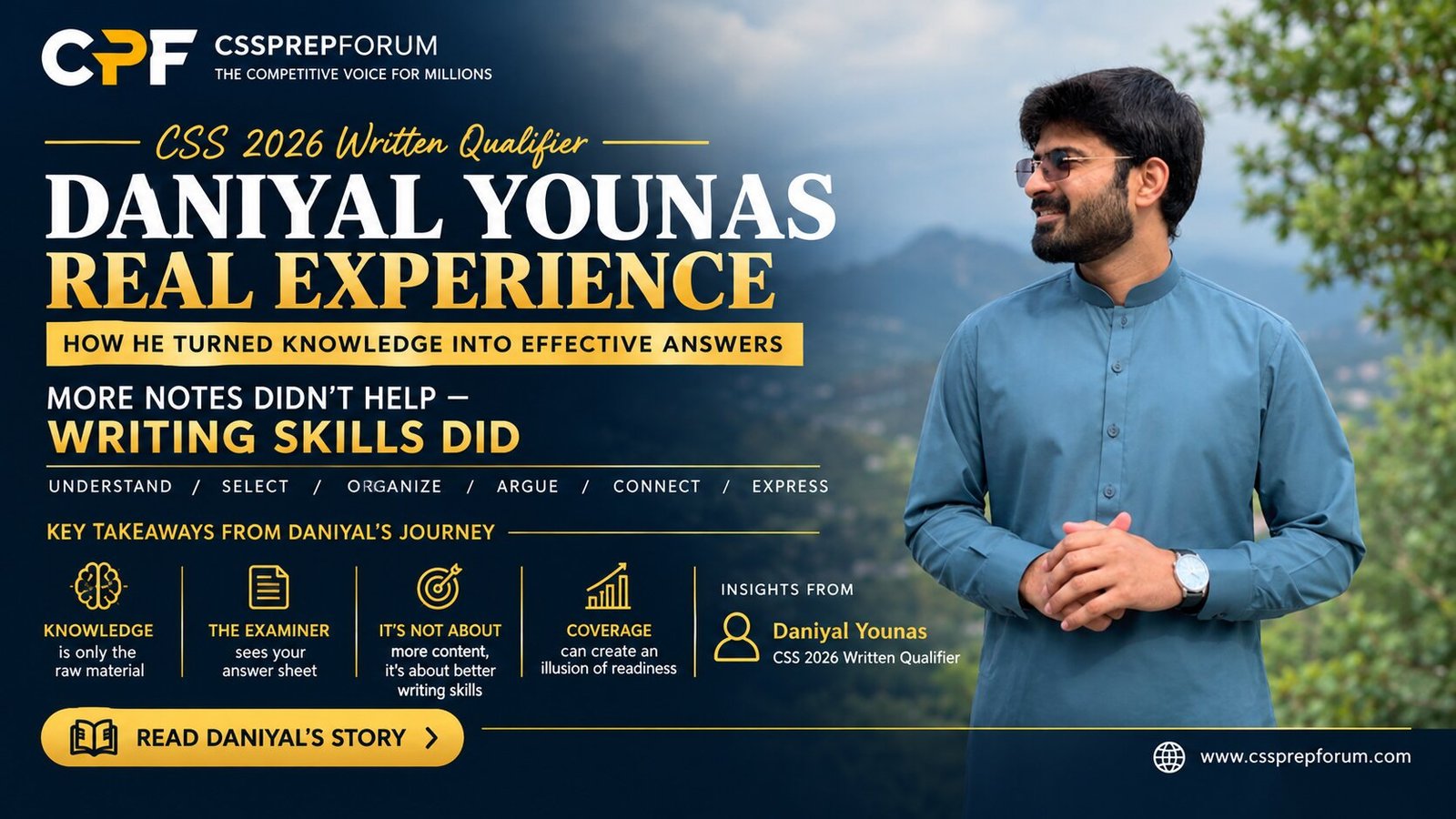
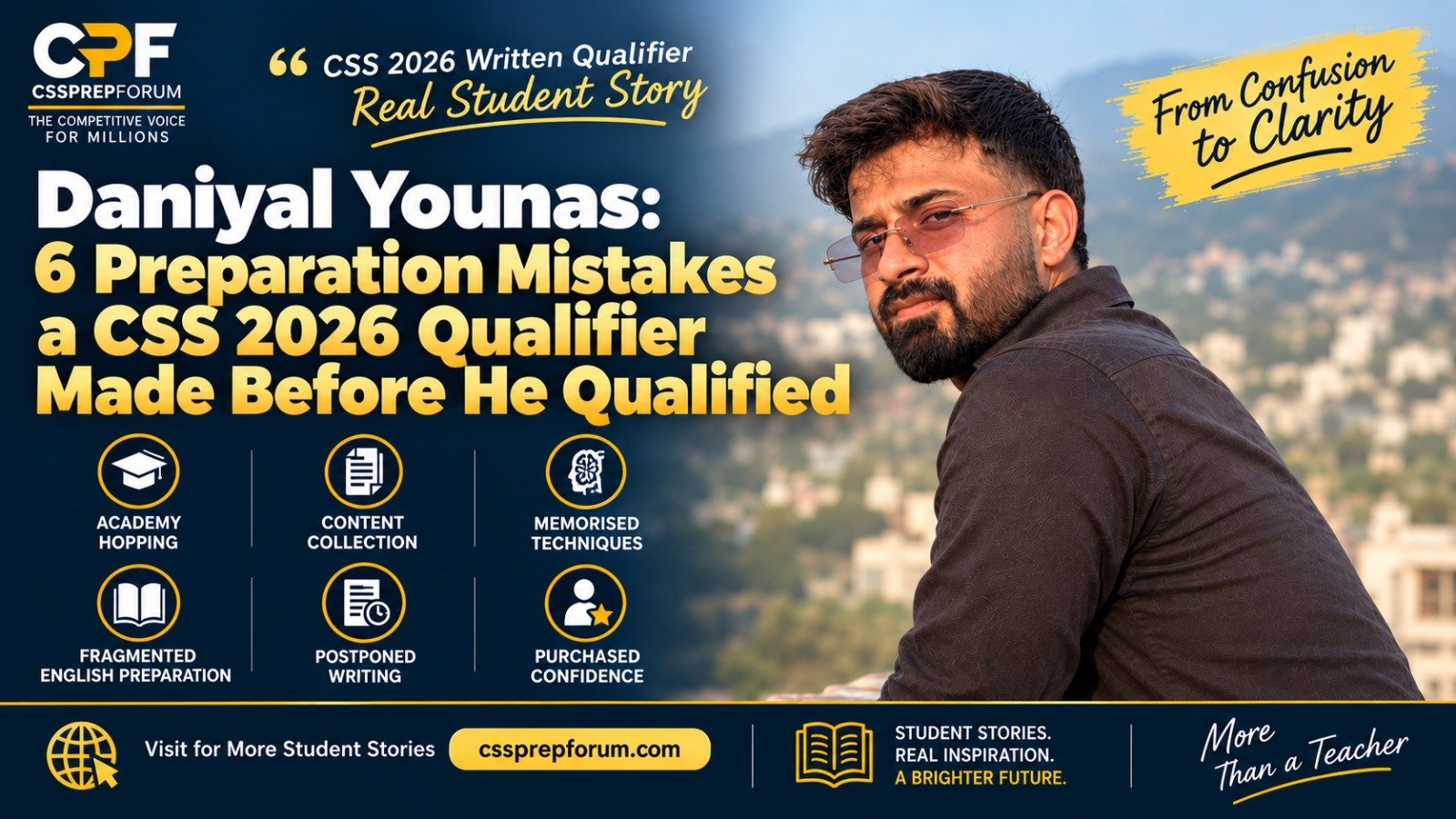
The experience of Daniyal Younas, a CSS 2026 Written Qualifier, illustrates this problem exceptionally well. Before qualifying CSS, he went through a phase familiar to thousands of aspirants: more academies, more teachers, more notes, and more content were producing greater preparation on paper, but not better writing. His eventual breakthrough came when he stopped asking “How much more do I need to study?” and began confronting a more important question: “Why am I unable to use what I already know?”
Why Does Having More Knowledge Not Automatically Produce Better CSS Answers?
Because knowledge is only the raw material of an examination answer. Imagine giving the same bricks, cement, steel, and wood to an architect and to someone who has never constructed a building: both possess identical materials, yet the results will not be the same.
CSS writing works similarly. Evidence, facts, statistics, quotations, examples, theories, current affairs, and historical references are your raw materials, but you still need the intellectual and linguistic ability to understand, select, organize, argue, connect, and express them.
Daniyal’s early preparation was rich in material. He attended academies, listened to different teachers, collected notes, and followed multiple strategies, so from the outside his preparation appeared substantial. But his mock tests exposed the weakness: he knew things, yet he could not convert what he knew into an effective examination response.
This is why a student with fewer notes but stronger writing control can sometimes outperform another aspirant who has studied far more. The examination does not see your library; it sees your answer sheet.
The “I Have Covered Everything” Trap in CSS Preparation
One of the most dangerous sentences a CSS aspirant can say is: “I have covered this topic.” But what exactly does “covered” mean? Have you read about democracy, or can you respond to an unfamiliar argumentative statement about it? Have you studied climate change, or can you distinguish between an essay asking about its economic consequences and one questioning the effectiveness of international climate governance? Have you prepared women empowerment, or can you respond when the examiner narrows the issue to economic autonomy, institutional representation, or cultural resistance? These are very different abilities.
Aspirants often measure their preparation through input, i.e., lectures watched, books completed, notes collected, topics covered, newspaper articles read, PDFs downloaded, whereas the examination measures output: questions understood, arguments developed, relevant information selected, paragraphs structured, ideas connected, and answers completed.
Daniyal’s experience reflects precisely this mismatch. More content initially gave him the feeling that his preparation was expanding, but writing revealed that the underlying skill had not expanded proportionately. This is why coverage can create an illusion of readiness.
Why Do You Understand a Topic but Struggle to Write About It?
Because understanding exists at different levels. Suppose someone asks: “Is social media damaging democracy?” You may immediately understand the discussion: you know about misinformation, polarization, political campaigns, algorithms, freedom of expression, and public opinion. That is subject familiarity.
Now you are asked to write a serious argumentative response, and suddenly additional questions arise: What exactly is my position? What does “damaging democracy” actually mean? Which dimensions are relevant, and which arguments genuinely prove my position? Which information should I exclude, and in what order should the arguments appear? How does one paragraph lead into another, and what counterargument deserves consideration? Now you require analytical control.
And finally, you must express all of that through grammatically controlled, precise, and coherent sentences, which requires linguistic control.
Knowing the subject is not the same as understanding the question, which is not the same as building an argument, which is not the same as expressing that argument. A CSS aspirant needs all four.

How Weak English Can Hide Strong Knowledge
This was particularly significant in Daniyal’s case. His academic background was in Microbiology and Biotechnology, and he was not struggling because he lacked the intellectual capacity to understand ideas. His difficulty was that his sentences lacked structure, his grammatical foundation was weak, and he could not express ideas as effectively as he understood them.
This distinction is crucial. Consider an aspirant who thinks: “Pakistan’s weak institutional continuity causes policies to change whenever governments change, which prevents long-term reforms from producing results.” The thought itself is perfectly reasonable, but if the student cannot transform it into a controlled academic sentence, the examiner never receives its full value.
This is why grammar in CSS preparation should not be reduced to MCQs or isolated rules. Grammar is the engineering of meaning: a misplaced modifier can distort an idea, a faulty pronoun can create ambiguity, weak coordination can confuse relationships between ideas, poor punctuation can damage clarity, and incorrect sentence construction can make an intelligent argument appear intellectually immature.
Therefore, when an aspirant says, “Sir, I know what I want to say, but I can’t write it,” the problem may not require another current affairs lecture; it may require better control over language.
Why More Notes Often Fail to Solve a Writing Problem
If the problem is inadequate knowledge, more relevant reading helps. If the problem is weak writing, more notes alone cannot fix it, and this distinction can save months of CSS preparation.
Suppose an aspirant writes: “Education is very important for a country because when education is good then people become educated and because of educated people country progresses in many ways.” Giving that aspirant another 50-page PDF on education will not necessarily solve the problem, because the underlying deficiencies lie in sentence control, precision, argument development, and articulation. The student may already know considerably more about education than the sentence demonstrates. What he needs is to learn how to convert thought into controlled expression.
That was one of the major realizations in Daniyal’s journey. His problem was not simply that he needed more things to say; he needed the linguistic clarity to say effectively what he already knew.
Why Following Too Many CSS Teachers Can Make Preparation Worse
Another important lesson from Daniyal’s experience concerns methodological confusion. Before finding a systematic approach, he had studied at different academies and encountered different techniques, and instead of producing clarity, some of these contradictory methods left him more confused, particularly about English Precis and Comprehension.
This does not mean aspirants should never learn from multiple sources. Instead, it means they should distinguish between multiple sources of knowledge and multiple conflicting systems of execution. You can read ten historians to understand an issue, but learning ten contradictory methods for writing a precis shortly before the examination may leave you unable to trust any of them.
One teacher says, “Do this.” Another says, “Never do this.” A YouTube video presents a third formula, and a successful candidate recommends a fourth. The aspirant eventually possesses enormous advice but no stable method.
Competitive preparation requires exploration initially, but eventually an aspirant must establish a coherent system and practise it long enough to evaluate whether it works. Constantly changing methods can prevent any method from becoming a skill.
What Changed When English Became a System Instead of Separate Topics?
One of the strongest aspects of Daniyal’s account is his realization that English Essay, Precis, Grammar, Comprehension, Sentence Correction, and other components should not be treated as completely isolated subjects.
Under Sir Syed Kazim Ali, his preparation returned to fundamentals: sentence construction was connected with expression, grammar was connected with actual writing, comprehension was connected with understanding, precis was connected with identifying and preserving meaning, and essay was connected with interpretation, argumentation, and organization.
This interconnected approach matters. When you improve sentence control, your essay improves. When comprehension improves, your ability to interpret complex essay statements improves. When you learn to distinguish central ideas from supporting details in a precis, you also become better at deciding what information belongs in an answer. When your vocabulary becomes more precise, your arguments become easier to communicate, and when you learn the logical relationships among sentences, paragraph coherence improves.
Thus, CSS English is not merely a collection of separate examination questions. At a deeper level, all these components are training the same fundamental ability: to understand language accurately and use it deliberately.
Why CSS Essay Is Not a Test of How Much You Can Remember
Daniyal’s earlier essay strategy was straightforward: read the topic, recall information about it, prepare an outline, and start writing. It sounds reasonable, but something crucial is missing: what exactly does the topic demand?
Consider these two topics: “Democracy in Pakistan” and “Democracy without strong institutions is merely electoral ritual.” Both involve democracy, but they are not the same essay. The first is broad; the second demands engagement with a specific proposition connecting democratic substance with institutional strength. Dumping everything you know about democracy into the second essay would demonstrate information, not necessarily relevance.
A mature CSS essay process therefore looks more like a sequence: topic, meaning, scope, direction, central question, position, thesis, arguments, evidence, organization, and finally writing. This is how knowledge becomes usable. The objective is not to display everything you know; it is to select what the examiner’s question requires from everything you know.
Precis Writing Shows the Same Difference Between Knowledge and Skill
Daniyal’s experience with precis writing offers another useful example. He had previously been taught an almost mechanical approach: break sentences, replace words, and reconstruct them in shorter form. The procedure gave him something to do, but it did not give him genuine control over the passage.
His later training reversed the process: understand first, shorten later. That seemingly simple distinction changes precis writing completely. Before reducing a passage, the writer must determine what the author’s central idea is, which ideas support it, which details merely illustrate those ideas, how the ideas are connected, and what can be removed without damaging meaning. Only then can compression begin.
Technique without understanding creates dependence; understanding creates adaptability. This principle extends far beyond precis. CSS papers inevitably present unfamiliar material, so methods that teach students to think are more durable than formulas that work only when the question resembles something previously practised.
How Do You Convert Knowledge into Examination-Quality Writing?
The process requires deliberate transformation.
1. Understand Before You Write: Never begin merely because the subject looks familiar. Ask: What exactly is being asked?
2. Decide What You Want to Establish: Every analytical answer needs direction. Before writing, complete this sentence mentally: “My answer will demonstrate that…” If you cannot complete it clearly, your answer may lack direction.
3. Select Knowledge Instead of Dumping Knowledge: Not everything you know belongs in every answer. Relevance is an intellectual skill.
4. Convert Information into Arguments: A fact becomes valuable when it performs a function. Do not merely write what happened — explain why it matters to the question, and support it with evidence that a demanding examiner would find convincing.
5. Organize Before Expanding: Determine which argument comes first, which logically follows, and what progression the reader should experience.
6. Control the Sentence: An excellent idea expressed ambiguously loses force. Practise writing precise sentences before chasing ornamental vocabulary.
7. Build Complete Paragraphs: Every paragraph should perform a definable argumentative function. If you cannot explain why a paragraph exists, reconsider it.
8. Connect Ideas: A high-quality answer should read as one developing argument rather than several mini-answers placed together.
9. Evaluate the Output: Do not judge writing by how difficult it felt to produce; judge what actually appears on the page.
10. Rewrite: This is where many aspirants stop, and where serious improvement often begins.
Why Evaluation Can Matter More Than Another Lecture
Daniyal identifies evaluation as perhaps the most significant element of his improvement. His first detailed evaluation was uncomfortable: sentence weaknesses were exposed, expressions he considered acceptable were questioned, logical gaps were identified, arguments were challenged, and structural problems were highlighted.
But there was an important difference: he was not merely told what was wrong; he was taught why it was wrong. That is the purpose of serious evaluation. If a teacher circles a sentence and writes “Expression?”, the student knows something is wrong. If the teacher explains that the sentence contains an ambiguous pronoun, faulty coordination, or an unclear logical relationship, and demonstrates how to repair it, the student acquires a principle that can improve future sentences. This distinction separates checking from teaching through evaluation.
After evaluation, Daniyal was frequently given an instruction students rarely enjoy: rewrite it. This may be one of the most important lessons in his entire story.
Aspirants often follow an unproductive cycle: write, get checked, read comments, start something new. A more productive cycle is: write, evaluate, diagnose, correct, rewrite, re-evaluate, and apply. Why? Because recognizing a mistake is passive, while correcting it yourself is active. Suppose an evaluator tells you that your paragraph lacks analysis. Understanding the comment is good, but only when you rewrite the paragraph and actually produce the missing analysis have you practised the corrected skill.
Practice does not automatically make perfect; Practice repeatedly reinforces whatever you practise, including your mistakes. This explains why writing twenty unchecked essays is not necessarily superior to writing fewer pieces that undergo rigorous correction and rewriting.
How Do You Know Whether Your CSS Preparation Is Actually Working?
Stop measuring only how much you have studied. Measure what you can now produce.
Take something you wrote two months ago and compare it with something you write today. Ask yourself: Are my sentences clearer? Can I interpret questions faster? Are my thesis statements more precise? Do my arguments directly answer the question? Can I develop paragraphs without depending on memorized material? Are my transitions logical? Can I identify irrelevant information myself? Do I repeat the same grammatical mistakes? And can I hold that quality together under timed mock tests at Howtests and genuine exam pressure?
If the answer to most of these questions remains no despite months of preparation, more of the same preparation may not be the solution; your strategy requires diagnosis. This was precisely the turning point in Daniyal’s journey: months of conventional preparation had given him material, while systematic writing practice and evaluation began giving him control.
Are Notes Useless for CSS Preparation?
Absolutely not. The lesson is not “stop making notes”; the lesson is not to mistake notes for preparation itself. Good notes save time, organize information, and support revision, but notes should eventually feed into output.
A useful preparation cycle looks like this: read, understand, make selective notes, recall, apply to a question, write, and evaluate. If your preparation permanently stops at “notes,” the most examination-relevant stage never begins. The examiner will not ask, “How many pages did you prepare on governance?” The examiner will give you a question about governance and expect you to construct a relevant response within limited time.
A Simple Test: Do You Have a Knowledge Problem or a Writing Problem?
Choose a CSS topic you have studied extensively. Now, without opening your notes: explain its central issue in two sentences, take a clear position on it, generate five distinct arguments, arrange those arguments logically, write one 150-word analytical paragraph, read it after thirty minutes, and ask whether another educated reader could understand exactly what you wanted to prove.
If you cannot perform these tasks despite knowing a great deal about the subject, your immediate bottleneck may no longer be knowledge acquisition; it may be interpretation, organization, argumentation, or expression. And that changes what you should practise tomorrow.
What Daniyal Younas’s CSS 2026 Success Actually Teaches
Daniyal Younas eventually became a CSS 2026 Written Qualifier. But the most useful part of his story is not the result alone. It is the misconception that preceded the result.
He had once equated preparation with collecting content. He had moved among academies, notes, lectures, and different strategies. His knowledge increased, yet his confidence declined whenever writing tested whether that knowledge could actually be used.
Under the mentorship of Sir Syed Kazim Ali, the direction changed. He moved from weak sentence construction towards controlled expression, from random information towards structured argumentation, from mechanical precis techniques towards genuine comprehension, from correction towards rewriting, and from collecting more material towards learning how to use the material he already possessed.
Eventually, he developed something no ready-made notes could give him: the ability to perform independently on the examination paper.
Frequently Asked Questions
Why can’t I write good CSS answers even though I have enough knowledge?
Because knowledge acquisition and written expression are separate skills. You may understand the subject but still struggle with question interpretation, argument selection, organization, paragraph development, or sentence construction. Diagnose which stage is preventing your knowledge from reaching the answer sheet effectively.
How can I convert my knowledge into good CSS answers?
Practise applying knowledge to specific questions. Identify the question’s demand, establish a position, select only relevant information, convert that information into arguments, organize those arguments, and express each one through controlled paragraphs. Regular evaluation and rewriting help identify where this process is breaking down.
Are notes enough to pass CSS?
No. Notes are preparation resources, not examination performance. They help organize knowledge, but CSS ultimately requires you to interpret unfamiliar questions and produce coherent answers independently under time constraints.
Why am I not improving despite studying for CSS every day?
The issue may be the type of practice rather than the number of hours. If most of your time goes into passive activities, like watching lectures, reading, and collecting material, you may be strengthening knowledge without sufficiently training retrieval, analysis, and writing.
How can I improve CSS answer writing?
Start by writing individual analytical paragraphs rather than immediately attempting complete answers. Work on question interpretation, topic sentences, argument development, evidence, analysis, coherence, and sentence clarity. Have your writing critically evaluated, and rewrite weak attempts.
Should I follow multiple CSS teachers?
Multiple sources can broaden knowledge, but constantly switching between contradictory writing systems can create confusion. Once you find a method that is logically sound and produces measurable improvement, practise it consistently enough to develop mastery.
Is evaluation necessary for CSS preparation?
It is particularly valuable when you cannot diagnose your own weaknesses. Effective evaluation should identify the error, explain why it is an error, and show how to prevent it in future writing. The purpose is not merely to award marks but to develop self-correction.
Does rewriting really improve CSS writing?
Yes. Evaluation tells you what needs improvement; rewriting forces you to produce the improved version yourself. The repeated cycle of writing, correction, and rewriting can gradually convert consciously learned principles into writing habits.

Final Takeaway
If you have been preparing for CSS or PMS for months and still feel unable to write what you know, do not automatically conclude that you need more knowledge. You may already possess enough raw material; the real problem may be that nobody has taught you how to process that material into an examination answer.
CSS demands more than knowing. It demands that you understand the question, select intelligently, think critically, organize logically, and express precisely.
That is why Daniyal Younas’s journey from confusion and weak writing to becoming a CSS 2026 Written Qualifier carries an important message for serious aspirants: do not measure your preparation by how much information has entered your notebooks. Measure it by how effectively that information can leave your mind and reach the examiner.
The notes you collect can support your preparation. The lectures you attend can expand your knowledge. The books you read can deepen your understanding. But ultimately, the examination will judge the one thing that remains after all of them: what can you independently produce on a blank sheet of paper?