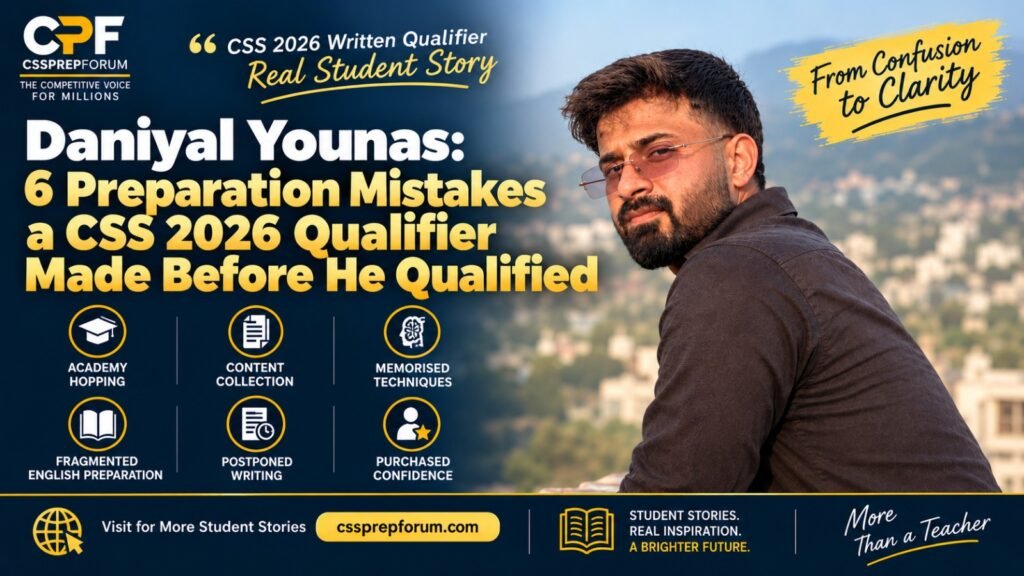
CSS preparation mistakes are rarely catalogued by those who avoided them; the most honest record comes from an aspirant who made every one of them and still qualified. Daniyal Younas, a student of Sir Syed Kazim Ali and now a CSS 2026 Written Qualifier, has published a review of his journey that reads, on close inspection, as a confession of six mistakes: academy dependence, content collection, memorised techniques, fragmented English preparation, postponed writing, and purchased confidence. This article examines each mistake, the price he paid for it, and the correction that finally replaced it, so that current aspirants can recognise their own preparation in his.
By every visible measure, Daniyal Younas was prepared. He had joined the academies, collected the notes, followed the teachers, and covered the syllabus more than once; a Microbiology and Biotechnology graduate from Abbottabad, he had given the FPSC CSS examination everything the preparation industry told him it required. Then the mock examinations placed a blank page before him, and the blank page disagreed. What followed, by his own admission, was the lowest question an aspirant can ask: whether he was capable of qualifying at all.
Today, his name stands among the CSS 2026 Written Qualifiers, and the review he has published of Sir Syed Kazim Ali, the one he credits, does not read like the story of a talent discovered. It reads like the record of six mistakes, corrected one by one.
Those six CSS preparation mistakes deserve naming, because each cost him months and each is being repeated by thousands of aspirants this very cycle: he treated academies as the starting point, mistook collecting content for preparing, memorised techniques he never understood, prepared English as separate papers, postponed writing until the end, and kept buying confidence instead of correction. This article examines each in turn, because the cheapest way to pay for a mistake is to let someone else make it first.
Mistake 1: He Treated Academies as the Starting Point
Of all CSS preparation mistakes, the first is the most instinctive. For most aspirants, preparation does not begin with a question; it begins with an enrolment. Daniyal followed the same reflex. He joined academies, listened to different teachers, and adopted multiple strategies at once, assuming that guidance accumulates the way notes do. It does not. Contradictory methods do not average into clarity; they compound into confusion. His understanding of precis, by his own admission, grew more confused with every technique added to it, because each institution taught a different mechanical procedure and none taught the reasoning underneath.
The mistake was never that he sought teaching; it was that he never tested it. Enrolment was treated as the act of preparation itself, when the only question that matters about any teacher is narrower and harder: what weakness of yours has this person demonstrably fixed? A crowd in a hall is not an answer to that question. A corrected page is.
Mistake 2: He Mistook Collecting Content for Preparing
From the outside, his preparation looked substantial: notes, lectures, books, and plans, a syllabus “covered” more than once. From the only side that matters, the examiner’s, none of it yet existed, because nothing he had collected could travel from his files onto a blank answer sheet. Every mock told him so. Possessing information and communicating it are two different abilities, and the CSS examination tests only the second; content collection had given him the first and the comfortable illusion that the second would follow on its own.
It never does. The illusion of coverage is precisely why most students fail CSS and PMS examinations while feeling thoroughly prepared: their libraries grow while their writing stands still. Daniyal’s account gives that pattern a face, a timetable, and a cost measured in months. Preparation is not what an aspirant has gathered; it is what an aspirant can produce under invigilation, and the gap between the two is where CSS attempts quietly die.
Mistake 3: He Memorised Techniques He Never Understood
Nowhere is the damage of borrowed authority clearer than in his experience of precis. A well-known academy had taught him to shorten a passage mechanically: break the sentences, replace the words, reconstruct the remains. The technique never made intellectual sense to him, and he followed it anyway, on the reasoning that an established institution must know better. That deference is its own mistake, and a widespread one: aspirants routinely outsource their judgment to reputation, then practise, for months, a method their own mind has already rejected.
The correction reversed the entire order of the exercise. Precis, he learned, is understanding before shortening: identify the central idea, separate the essential from the supporting, preserve the author’s message while compressing its expression. A method that begins with comprehension can face any passage; a method that begins with word-replacement collapses the moment the passage resists it. Aspirants who wish to see the difference on paper can study the CSS solved precis by Sir Syed Kazim Ali attempted under this approach, and those who want the craft itself taught from its foundations will find it treated at length on PrecisWritingLet.
Mistake 4: He Prepared English as Separate Papers, Not One Skill
Like most aspirants, he kept grammar in one drawer, precis in another, and essay in a third, as though the syllabus’s divisions were the language’s. They are not. Sentence construction, punctuation, vocabulary, comprehension, and argumentation are one interconnected command of language and thought, and a weakness in any of them surfaces in all of them: an essay cannot argue above the quality of its sentences, and a precis cannot compress what its writer has not fully understood.
This is why his months of fragmented CSS English preparation produced no compound effect: he was repairing components in isolation while the system that connects them stayed broken. The rebuilding that worked began at the foundation, at sentence structure and subject-verb agreement, and let each layer strengthen the next, until English stopped being a set of separate papers and became, in his words, a system. Skills integrate; papers merely coexist.
Mistake 5: He Postponed Writing Until the End
Beneath all the other mistakes ran the quietest one. He read, collected, planned, and attended, and left actual writing for last, treating it as the formality that would present his preparation once the preparation was complete. Then the blank page arrived and delivered its verdict. In his own words, writing exposed everything: the unstructured sentences, the missing thesis, the arguments that could not hold a paragraph together. What he had deferred was not the presentation of his preparation; it was the preparation itself.
The principle his journey proves is one every aspirant should write above their desk: writing is not the final step of CSS preparation but its daily medium, and every week spent without producing evaluated pages is a week of unverified progress. Reading the CSS solved essays of qualifiers shows what the destination looks like; only regular, corrected writing of one’s own moves an aspirant toward it.
Mistake 6: He Kept Buying Confidence Instead of Correction
The preparation industry sells what aspirants want to feel, not what they need to hear: motivation, predicted essays, “sufficient” notes, techniques that promise to compensate for weak writing. Daniyal bought his share of it, and the purchase always delivered, briefly, because sold confidence works until the first honest test. What no academy had ever given him, across all those enrolments, was the one commodity that changes writing: rigorous evaluation of his own work, explained line by line.
His first real evaluation removed his confidence within seven lines, and then rebuilt it on better foundations. The distinction he draws deserves to be memorised by every aspirant choosing a mentor: a teacher who merely circles an error tells you that you failed; a teacher who explains the error gives you the ability never to repeat it. And for Daniyal, Sir Syed Kazim Ali is that teacher. Behind his explanation came the instruction he disliked the most: rewrite it, repeated until the cycle of writing, evaluation, correction, and rewriting had done what months of collected notes could not. Confidence that is sold evaporates in the examination hall; confidence that is earned on corrected pages walks in with the candidate.
What Daniyal Younas Did Differently, Once
The turn in his story required no new academy, no new notes, and no new predictions; it required three decisions that reversed the six mistakes at their root. He tested before trusting: rather than enrolling on reputation, he and a friend attended Sir Syed Kazim Ali’s free orientation specifically to judge the teaching themselves, and joined only when a single session clarified what months of academy hopping had not. He allowed his foundation to be rebuilt from the sentence upward instead of demanding shortcuts to the essay. And he submitted to the discipline of evaluation, writing and rewriting under scrutiny until the improvement was visible on paper rather than promised on a poster.
Today, that is the standard his review sets before every serious aspirant, and the standard behind the English Essay and Precis Course through which he prepared. His closing observation compresses the whole journey into a single measure: a true teacher does not hand a student answers but develops in him the ability to find direction in confusion, to see his own weaknesses, and, eventually, to perform without depending on anyone. Six mistakes taught Daniyal Younas what preparation is not. One decision, tested with his own judgment, taught him what it is.

FAQs
Who is Daniyal Younas?
Daniyal Younas is a CSS 2026 Written Qualifier from Abbottabad, Khyber Pakhtunkhwa. A Microbiology and Biotechnology graduate of Superior University Lahore and a student of Sir Syed Kazim Ali, he has published a detailed review of his preparation journey, on which this article is based.
Is joining an academy necessary to qualify CSS?
No. Daniyal Younas’s journey shows that the academies he joined added confusion rather than clarity; what qualified him was foundational teaching, disciplined writing practice, and rigorous evaluation under one mentor. Guidance is necessary; enrolment for its own sake is not.
Can a science-background student clear the CSS English papers?
Yes. Daniyal is a Microbiology and Biotechnology graduate whose sentences once lacked basic structure, and he qualified the CSS 2026 written examination. The deficit for non-English backgrounds is method and practice, not capability.
What is the biggest mistake CSS aspirants make in English preparation?
Postponing writing. Most aspirants collect content for months and treat writing as a final formality, when writing is the very skill the examination measures. Regular, evaluated, and rewritten work, started early, is what converts knowledge into examination performance.