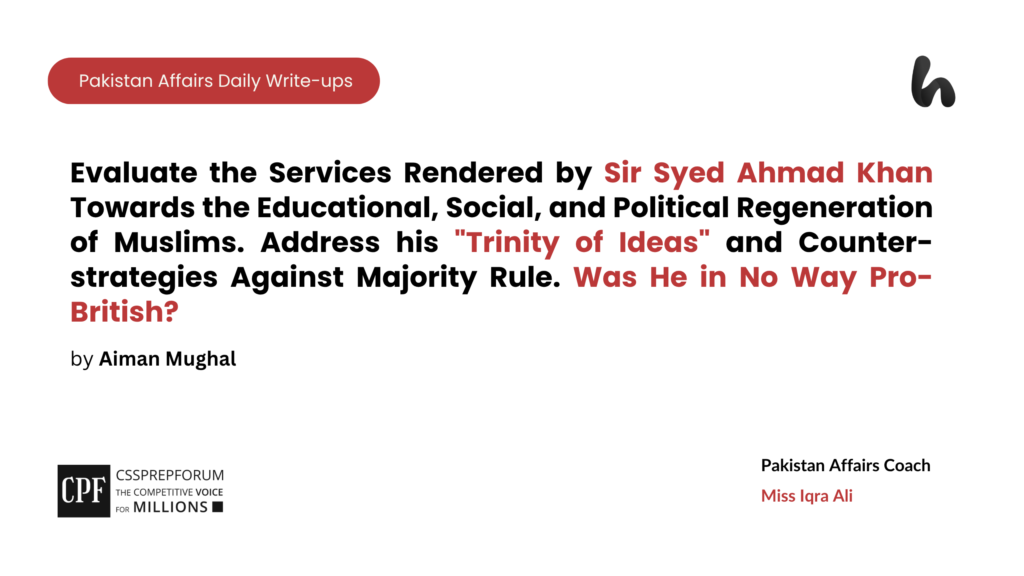
CSS Pakistan Affairs | Services of Sir Syed Ahmad Khan Towards the Regeneration of Muslims.
The following article explains the services of Sir Syed Ahmed Khan in detail to uplift Muslims through his Trinity of Ideas and reasons why Sir Syed was Not Pro-British.

Introduction
The decline of the Muslims after the War of Independence of 1857 marked one of the darkest phases in the history of the Indian subcontinent. Politically dispossessed, educationally backward, economically weakened, and socially fragmented, Muslims found themselves excluded from the new colonial order. At this critical juncture, Sir Syed Ahmad Khan emerged as a visionary reformer who recognized that the revival of Muslims could not be achieved through emotional resistance but through intellectual awakening, social reform, and political pragmatism. Therefore, he launched the Aligarh Movement to modernize Muslim education, reform social attitudes, and formulate a realistic political strategy. His philosophy, commonly known as the Trinity of Ideas, loyalty to the British, devotion to modern education, and aloofness from premature politics, was intended to secure Muslim survival in an unfavorable political environment rather than to promote colonial interests. Although his policies have often been criticized as pro-British, a balanced assessment reveals that his loyalty was a strategic response to contemporary realities, making him one of the most influential architects of Muslim regeneration in South Asia.
Historical Context: Why Did Muslims Need Regeneration?
The failure of the Indian Rebellion of 1857 fundamentally altered the political and social position of Muslims in India. Since the British largely blamed Muslims for instigating the revolt, they were subjected to political exclusion, confiscation of property, and administrative discrimination. Simultaneously, many Muslims rejected English education due to religious and cultural apprehensions, whereas other communities rapidly embraced Western learning and occupied positions in government services. According to the historian K. K. Aziz, Muslims faced not merely political defeat but a profound crisis of confidence and leadership after 1857. This environment convinced Sir Syed that unless Muslims accepted modern education and adapted to changing realities, they would remain permanently marginalized. Thus, the Aligarh Movement emerged as a comprehensive programme of Muslim regeneration rather than merely an educational campaign.
Sir Syed Ahmad Khan’s Services for the Regeneration of Muslims
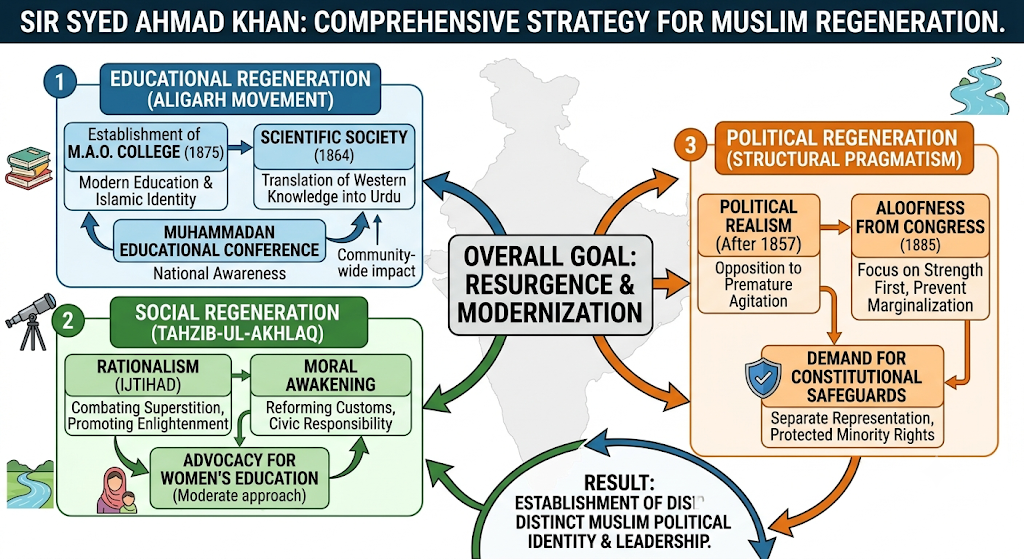
✓Educational Regeneration
- Promotion of Modern Education through the Aligarh Movement
Sir Syed Ahmad Khan regarded educational backwardness as the root cause of Muslim decline and believed that modern education was essential for their revival. Through the Aligarh Movement, he encouraged Muslims to embrace English education, science, and modern disciplines while preserving their Islamic identity. By removing misconceptions about Western education, he transformed Muslim attitudes towards learning and prepared them to compete in the colonial administration. Thus, the Aligarh Movement became the driving force behind the educational regeneration of Indian Muslims.
- Establishment of the Muhammadan Anglo-Oriental College
To institutionalize his educational vision, Sir Syed founded the Muhammadan Anglo-Oriental College at Aligarh in 1875, which later became Aligarh Muslim University. Modeled on Oxford and Cambridge, it combined modern education with Islamic values. It produced an educated Muslim leadership that later played a crucial role in protecting Muslim political and social interests. Therefore, the college became the cornerstone of Muslim educational advancement in British India.
- Formation of Scientific Society and the Translation Movement
To bridge the intellectual gap between Muslims and the West, Sir Syed established the Scientific Society in 1864, which translated modern scientific and literary works into Urdu. According to historian K.K. Aziz, it served as a bridge between traditional Islamic scholarship and Western knowledge. By making scientific literature accessible, the Society encouraged Muslims to adopt modern learning and participate in intellectual progress. Hence, it significantly contributed to the intellectual revival of Indian Muslims.
- Reconciliation of Islam with Modern Science through Tahzib-ul-Akhlaq
Through Tahzib-ul-Akhlaq, Sir Syed sought to reform Muslim society by promoting rational thinking, moral values, and social awareness. He also argued that Islam and modern science were compatible because both originated from the same Creator. As historian Francis Robinson observes, his reinterpretation of Islam enabled Muslims to embrace modern education without compromising their faith. Thus, his intellectual reforms laid the philosophical foundation for Muslim modernization.
✓Social Regeneration
- Elimination of Social Stagnation through Rationalism (Ijtihad)
Sir Syed believed that intellectual stagnation was a major obstacle to Muslim progress. Therefore, he promoted Ijtihad (independent reasoning) and discouraged blind imitation, arguing that Muslims should reinterpret Islamic teachings in light of contemporary challenges. His rational approach reduced resistance to modern education and encouraged intellectual revival. Hence, Ijtihad became a key instrument of Muslim social regeneration.
- Reform of Muslim Social Customs and Moral Awakening
Sir Syed sought to reform Muslim society by discouraging superstition, sectarianism, and social evils while promoting honesty, discipline, tolerance, and civic responsibility. Through Tahzib-ul-Akhlaq, he inspired Muslims to adopt progressive social values necessary for national development. Therefore, his moral reform movement strengthened both the character and social cohesion of the Muslim community.
- Promotion of Women’s Education Within Contemporary Social Limits
Although Sir Syed adopted a cautious approach towards women’s rights, he recognized that educated women were essential for the progress of society. He supported female education within the social norms of his time, believing that educated mothers would nurture educated generations. Thus, his moderate advocacy laid the foundation for the future expansion of women’s education among Indian Muslims.
✓Political Regeneration
- Political Realism after 1857 and Opposition to Premature Political Agitation
Recognizing the political weakness of Muslims after the War of Independence (1857), Sir Syed adopted a policy of political realism instead of confrontation with the British. He believed that a community deprived of education and economic strength could not succeed in active politics. Therefore, he advised Muslims to postpone political agitation and focus first on acquiring modern education and rebuilding their socio-economic position. Historian K.K. Aziz observes that Sir Syed viewed education as the prerequisite for effective political participation. Hence, his policy of political realism enabled Muslims to prepare themselves for future political leadership through intellectual empowerment rather than emotional resistance.
- Opposition to the Indian National Congress and Development of Muslim Political Consciousness
Sir Syed advised Muslims not to join the Indian National Congress, believing that its demand for representative government based on numerical majority would politically disadvantage the Muslim minority. Instead, he encouraged Muslims to strengthen their educational and political capacity before participating in national politics. At the same time, he cultivated a distinct Muslim political consciousness by emphasizing their separate historical, cultural, and religious identity. This awareness later inspired organized Muslim politics and influenced the leadership of the Aligarh Movement. Thus, Sir Syed’s political strategy protected Muslim interests while laying the intellectual foundation for their future political organization.
- Advocacy of Constitutional Safeguards for Muslims
Sir Syed believed that India’s religious and cultural diversity required constitutional arrangements that protected minority rights rather than unrestricted majority rule. He argued that Muslims, being a numerical minority, should receive adequate political representation and constitutional safeguards to prevent domination by the majority community. Although he did not formally propose separate electorates, his ideas later influenced constitutional reforms, particularly the Indian Councils Act of 1909 (Morley-Minto Reforms). Therefore, Sir Syed emerged as one of the earliest advocates of constitutional protection for Muslim political rights in British India.
Sir Syed Ahmad Khan’s Trinity of Ideas
- ✓Loyalty to the British Government
Sir Syed advocated loyalty to the British Government because he believed that another confrontation after 1857 would further weaken the already devastated Muslim community. However, his loyalty was based on political pragmatism rather than blind support as he openly criticized British administrative failures in his book Asbab-e-Baghawat-e-Hind. By promoting constitutional cooperation, he sought to restore British confidence in Muslims and secure opportunities for their educational and economic advancement. Hence, his loyalty was a strategic policy aimed at Muslim rehabilitation rather than unconditional allegiance to colonial rule.
- ✓Devotion to Modern Education
Sir Syed regarded modern education as the foundation of Muslim regeneration and consistently argued that political influence could only be achieved through intellectual progress. Through the Aligarh Movement, the Muhammadan Anglo-Oriental College, and the Scientific Society, he encouraged Muslims to acquire modern scientific and professional knowledge without abandoning their religious identity. His educational philosophy produced a new generation of educated Muslims who later became administrators, scholars, and political leaders. Thus, devotion to modern education became the central pillar of Sir Syed’s reform programme and the key to Muslim progress.
- ✓Aloofness from Active Politics
Sir Syed advised Muslims to remain aloof from active politics until they became educationally and economically strong enough to compete effectively. He feared that premature political participation would expose an unprepared Muslim community to permanent political marginalization in a representative system dominated by the majority. Therefore, he emphasized education, social reform, and institutional development before political activism. Although some nationalists criticized the policy, it reflected his realistic assessment of contemporary circumstances. Hence, his political aloofness was a temporary strategy for strengthening the Muslim community rather than a rejection of political participation itself.
Sir Syed Ahmad Khan’s Counter-Strategies against Majority Rule
- ✓Rejection of Pure Numerical Democracy and Recognition of Muslims as a Distinct Political Community
Sir Syed Ahmad Khan strongly opposed the introduction of pure numerical democracy in British India, arguing that it was unsuitable for a multi-religious and multi-cultural society where one community significantly outnumbered the others. He maintained that representative institutions based solely on majority rule would inevitably lead to the political domination of Muslims by the Hindu majority. Therefore, he emphasized that Muslims constituted a distinct political community with their own religion, history, culture, and socio-political interests, which required separate political recognition. Historian Ayesha Jalal observes that Sir Syed’s political thought was rooted in the need to protect Muslim interests within India’s plural society rather than to create communal division. Thus, by rejecting numerical democracy and asserting a separate Muslim identity, Sir Syed laid the intellectual basis for safeguarding Muslim political rights.
- ✓ Demand for Constitutional Safeguards and Foundation for Future Muslim Constitutional Politics
To prevent the political marginalization of Muslims, Sir Syed advocated constitutional safeguards that would ensure fair representation and protect minority rights within the future political system. He believed that constitutional arrangements should guarantee justice for all communities rather than allow the majority to dominate the minority through electoral strength. Although he did not explicitly propose separate electorates, his ideas profoundly influenced later constitutional developments, particularly the Simla Deputation (1906), the Morley-Minto Reforms (1909), and the constitutional demands advanced by the All-India Muslim League. Historian Stanley Wolpert regards Sir Syed as the intellectual architect of modern Muslim political thought in British India. Hence, his constitutional vision not only safeguarded Muslim interests in his own time but also provided the ideological foundation for future Muslim constitutional politics.
Was Sir Syed Ahmad Khan Really Pro-British?
Although Sir Syed Ahmad Khan has often been criticized as being pro-British because he advocated loyalty to the colonial government, discouraged Muslims from joining the Indian National Congress, and opposed anti-British political agitation, such a view overlooks the historical circumstances in which he worked. After the War of Independence (1857), Muslims were politically marginalized, economically devastated, and educationally backward. Realizing that confrontation with the British would further worsen their condition, Sir Syed adopted a pragmatic policy of cooperation to secure educational opportunities, government employment, and political rehabilitation for Muslims. Moreover, his book Asbab-e-Baghawat-e-Hind openly criticized British administrative policies and explained the real causes of the 1857 uprising, demonstrating that his loyalty was neither blind nor unconditional. Therefore, Sir Syed’s cooperation with the British should be viewed as a strategic and realistic approach for Muslim regeneration rather than ideological support for colonial rule.
Conclusion
Sir Syed Ahmad Khan emerged as the foremost architect of Muslim regeneration in the Indian subcontinent by addressing the educational, social, and political challenges that confronted Muslims after 1857. Through the Aligarh Movement, he transformed Muslim attitudes towards modern education, promoted social and intellectual reform, and introduced a pragmatic political philosophy centered on his Trinity of Ideas. His opposition to premature politics, rejection of unrestricted majority rule, and advocacy of constitutional safeguards reflected his determination to protect Muslim interests in a pluralistic society. Although his policy of cooperation with the British has generated considerable debate, it was fundamentally a strategic response to the realities of his time rather than an expression of unconditional loyalty. Therefore, Sir Syed Ahmad Khan’s visionary leadership not only revived the Muslim community but also laid the intellectual, educational, and constitutional foundations for the future political development of Muslims in South Asia.

Important Note for CSS and PMS Aspirants
For aspirants preparing for competitive examinations, exploring solved past papers is essential to understand examiner expectations, analytical answer writing, and paper trends. Therefore, candidates are strongly encouraged to read the following comprehensive solved papers available on CSSPREPFORUM.
- CSS Solved Pakistan Affairs Past Papers
- CSS Solved Current Affairs Past Papers
- CSS Solved Islamiat Past Papers
- CSS Solved General Science and Ability Past Papers
Moreover, aspirants searching for the most credible and result-oriented teachers for CSS and PMS preparation can benefit from the following detailed guidance articles
- Who is the Best CSS PMS Islamiat Teacher in Pakistan?
- Who is the Best CSS PMS Pakistan Affairs Teacher in Pakistan?
- Who is the Best CSS Current Affairs Teacher in Pakistan?
- Who is the Best CSS GSA Teacher in Pakistan?
- Who is the Best CSS PMS English Essay and Precis Teacher in Pakistan?
- Who is the Best English Grammar Teacher in Pakistan?