You have studied Current Affairs. You have prepared Pakistan Affairs, Islamiat and your optional subjects. You have collected facts, reports, quotations and case studies. Perhaps you have already attempted CSS or PMS once or twice.
Now, only a few months separate your preparation from the examination.
At this stage, the question is no longer:
“How much have I studied?”
The question is
“Can I convert everything I know into an Essay and Precis paper that the examiner can qualify?”
Because Essay does not fail only those who lack knowledge. It also fails candidates who misunderstand the topic, develop a weak thesis, confuse information with arguments, produce disconnected outlines, write descriptive paragraphs instead of analytical ones, use evidence without establishing what it proves, or cannot sustain one controlling direction throughout the essay.
And Precis & Composition does not become safe merely because you have solved past papers. A difficult passage can still expose weak comprehension, inability to identify the central thought, poor inference, mechanical paraphrasing and faulty compression. Sentence Correction can expose grammar you thought you knew. Translation can reveal unnatural expression. Punctuation can expose weak syntax. Synonyms and antonyms can expose vocabulary learnt without context.
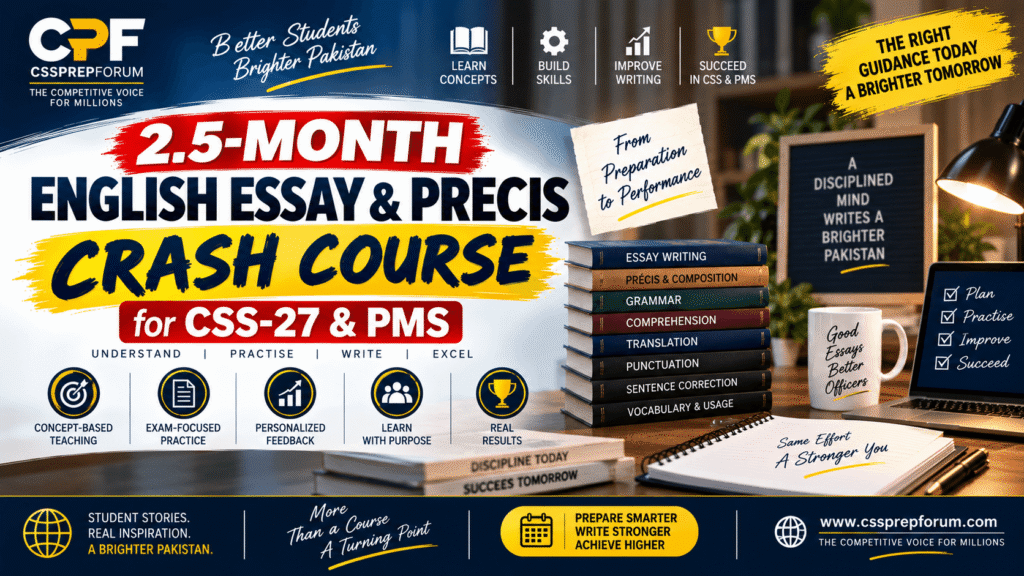
When CSS 2027 is approaching, discovering these weaknesses in the examination hall is too late. That is precisely why Sir Syed Kazim Ali’s 2.5-Month English Essay & Precis Crash Course for CSS 2027 & PMS exists. This transformative online crash course is your definitive solution to learning and preparing for the CSS and PMS English papers. It does not just teach tricks; it builds the foundational skills necessary to overcome the 95% failure rate and write with clarity, logic, and persuasive power.
Who Is This Crash Course Actually For?
This is not primarily a leisurely English-learning programme.
It is an intensive final-preparation course for serious aspirants who have limited months left and want to take their English papers from their present level to competitive-examination level through systematic learning, writing, evaluation and practice.
The course is particularly suitable if
- You are appearing in CSS 2027 or an upcoming PMS examination.
- You are a second or third attempter and cannot afford to repeat your previous English mistakes.
- You have prepared most compulsory and optional subjects, but Essay or Precis remains your biggest uncertainty.
- You previously failed Essay or Precis despite being well prepared in other subjects.
- You know grammar rules but still make mistakes while writing.
- You possess considerable knowledge but struggle to transform it into relevant arguments.
- You can generate points but cannot develop a convincing thesis, outline or analytical paragraph.
- You have practised Precis repeatedly but still struggle with central ideas, supporting ideas, implied meanings, inference and paraphrasing.
- You have studied English before but need intensive examination-oriented practice and evaluation.
- You want to rebuild weak areas from the foundations and progress rapidly towards advanced CSS/PMS application.
If your problem is “I know nothing and have years to learn,” an extensive programme may suit you better.
But if your problem is “I have prepared seriously. My attempt is approaching. I cannot allow English to remain uncertain.” This Crash Course has been designed for that urgency.
What This Crash Course?
A crash course should not mean teaching less. It should mean removing what you do not need, identifying what you do need, and concentrating your remaining time on the skills that can directly affect your examination performance.
Therefore, you will not merely collect ready-made essays, memorise thesis statements or learn a few Precis tricks The training follows a deliberate progression:
Learn → Practise → Diagnose → Rebuild → Apply → Write → Evaluate → Correct → Rewrite → Test
You first understand where your English is weak. Then you strengthen the foundations responsible for those weaknesses. Then you apply those foundations to CSS/PMS questions. Then you write. Your writing is evaluated. Your errors are identified. You correct and rewrite. And finally, you test those skills under examination conditions.
The objective is not to make you dependent on prepared material. It is to make you capable of handling what you have not prepared.
Interestingly, this is exactly how one of Sir Kazim’s recent students approached him. CSS 2026 Written Qualifier Daniyal Younas had already attended academies, collected notes and tried different preparation strategies, yet his mocks exposed weak sentence construction, confused Precis concepts and an inability to transform information into focused Essay arguments. Instead of immediately joining another course, he and a friend decided to attend Sir Kazim’s orientation first and judge the teaching themselves. Daniyal recalls that concepts that had remained unclear for months began making sense during that first session. He subsequently joined the course.
This course is specially designed for aspirants who are either appearing in CSS or wish to elevate their writing skills to the next level. Through this program, you will
- Identify your strengths and weaknesses in essay and precis writing
- Develop the clarity, fluency, and precision required to excel
- Strengthen your core English communication skills
- Gain the confidence needed to perform at your best in the exam
The CSS & PMS English Essay & Precis Crash Course focuses on enhancing your ability to think critically, write persuasively, and express your ideas fluently, coherently, and grammatically correctly. Sir Syed Kazim Ali’s unique teaching methodology ensures that every aspirant builds a strong foundation in structured writing and logical reasoning.
What sets this course apart is Sir Kazim’s personalized evaluation and feedback system. Through comprehensive assessments, constant monitoring, and step-by-step guidance, you’ll develop the confidence and writing competence needed to qualify for the CSS and PMS English papers.
Whether you need in-depth write-up evaluations, targeted feedback, or intensive coaching to take your writing skills to the next level, Sir Syed Kazim Ali’s English programs are designed to meet your specific needs and prepare you for success in Pakistan’s most competitive examinations.
Although hundreds of aspirants want to join Sir Kazim for their English papers preparation monthly, the available seats are only 60. To secure admission to the course, aspirants must submit an online form and a paragraph on the given topics. As you know, getting admission to the course introduced by Sir Kazim has always been challenging; your entry is strictly based on paragraph writing.
If you qualify for the admission process, written at the bottom of the course details, you can reserve your seat for a session coming in the months mentioned above. Kindly contact the admin on WhatsApp to know more about advanced reservations: 0332-6105842 | 0300-6322446.
Studying Competitive English with Sir Syed Kazim Ali Always Makes A Difference
Crash Course Details
| Course Name |
| 2.5-Month English Essay and Precis Crash Course for CSS-2027 |
| Course Available |
| October (sometimes in December also) |
| English Coach |
| Sir Syed Kazim Ali |
| Registration Deadline |
| Wednesday, September 30, 2026 (Contact Admin – Whats App 0300-6322446) |
| Course Starts On |
| Thursday, October 1, 2026 |
| Course Duration |
| 2.5 Months (15 Days for Mock Exams) |
| Lecture Modality |
| Online (Via Zoom) |
| Lectures per Week |
| 3 to 4 Lectures |
| Online Class Timings |
| 6 pm to 8:45 pm / 9 pm to 11:45 pm |
| Mocks Included |
| 4 to 5 Mocks |
| Evaluation |
| 10 Plus Essays, Precis, and Comprehension Included |
| Available Seats |
| 50 Seats Only |
| How to Join Orientation? |
| WhatsApp: 0300-6322446 or 0332-6105842 the following particulars: 1– Name 2– Age 3– City 4– Qualifications 5– Profession 6– Email 7– Contact Number 8– Number of CSS & PMS Attempts 9– DMC if Any 10– Aspiring for (CSS 2025 or PMS 2024) |
| Crash Course Fee |
| Rs. 15,000/Month |
Interested aspirants wanting to secure their seats in advance must apply for the course and qualify for paragraph writing. If you qualify, the admin will contact you for further process to secure the seat. Contact Mam Zaineb at WhatsApp 0300-6322446 & Get Your Seat Reserved Now.
What will you learn in this course?
This comprehensive crash course covers every aspect of the English Essay and Precis papers, building from the basics to advanced levels.
PHASE 1: Build Control over English Expression
Before writing an Essay or Precis, you must be able to control a sentence. Students therefore work on the areas of English that directly influence competitive writing:
- Complete thought and sentence construction
- Sentence structures and their practical application
- Clauses, phrases and logical relationships
- Grammar from examination perspective
- Tenses and contextual application
- Subject-verb relationships
- Pronouns, modifiers, articles and prepositions
- Coordination and subordination
- Parallel construction
- Punctuation through sentence structure
- Appropriate vocabulary and word choice
- Conciseness and precision
- Formal versus conversational expression
- Common structural errors in CSS/PMS writing
The purpose is not to turn grammar into a separate academic subject. Every grammatical concept must eventually improve what you write.
PHASE 2: Learn to Read Before You Learn to Compress
A weak Precis often begins with weak reading. Before asking, “How can I reduce this passage to one-third?”, you must be able to answer:
“What is this writer actually saying?”
Students are trained to identify
- Subject of a passage
- Central idea
- Controlling thought
- Supporting ideas
- Relationship among supporting ideas
- Essential versus non-essential information
- Examples, illustrations and repetitions
- Explicit meaning
- Implied meaning
- Valid inference
- Writer’s attitude and direction
- Logical progression of thought
- Contextual vocabulary
The aim is to move from: Reading Words → Understanding Sentences → Connecting Ideas → Discovering the Writer’s Thought Only then does serious Precis writing begin.
PHASE 3: Master Precis Writing
Students then learn how to transform understanding into an accurate Precis:
- How to approach unfamiliar passages
- How to extract the central thought
- How to preserve essential supporting ideas
- How to remove examples and unnecessary elaboration
- How to infer without inventing
- How to paraphrase ideas rather than mechanically replace words
- How to combine related thoughts
- How to compress without mutilating meaning
- How to maintain coherence after compression
- How to maintain the writer’s original intention
- How to write an appropriate title
- How to control length
- How to revise a Precis
- How to diagnose why a Precis loses marks
The goal is not “Make it shorter.” The goal is “Preserve the maximum essential meaning in the minimum accurate language.”
PHASE 4: Prepare the Entire Precis & Composition Paper as One Integrated Skill Set
Precis is only one part of the paper. The course systematically prepares you for the following
Comprehension
Learn how to read critically, understand explicit and implicit meanings, identify exactly what a question demands and answer from the passage without unnecessary information.
Sentence Correction
Move beyond memorised rules. Learn how to identify the error, understand why it is an error and correct the sentence grammatically and structurally.
Punctuation
Learn punctuation through syntax and meaning rather than merely memorising where commas and semicolons are placed.
Translation
Learn to transfer meaning, not the original language’s word order, into natural, grammatically controlled English.
Synonyms & Antonyms
Develop contextual vocabulary rather than treating every dictionary synonym as interchangeable.
Vocabulary in Writing
Learn not only what a word means but where it fits, what it collocates with and whether it expresses the intended thought precisely.
PHASE 5: Learn to Crack Any Essay Topic Before Writing It
Many essays are lost before the introduction is written.
Why?
Because the candidate starts brainstorming before understanding exactly what the topic demands.
Students therefore learn a systematic topic-cracking method:
Select → Narrow → Re-narrow → Determine Direction → Establish Demand
You learn
- How to identify the subject
- How to determine the exact scope
- How to recognise limiting words
- How to determine WHAT the examiner is asking
- How to determine HOW the topic should be approached
- How to determine WHY a particular direction matters
- How to distinguish argumentative and expository topics
- How to approach abstract and philosophical topics
- How to avoid writing on the general subject instead of the actual topic
By the end of this phase, the question should no longer be: “Do I have material on this topic?”
It should become: “What exactly must I establish, and what material can help me establish it?”
PHASE 6: Build a Thesis That Controls the Entire Essay
A thesis is not a decorative sentence at the end of an introduction.
It is the intellectual contract of your essay.
Students learn how to
- Take a clear position
- Answer the complete topic
- Establish the essay’s direction
- Incorporate principal reasoning
- Avoid vague and generic claims
- Build argumentative thesis statements
- Develop thesis statements for expository essays
- Test whether every major argument logically serves the thesis
A 2,500-word essay should ultimately feel like one argument, not twenty disconnected paragraphs.
PHASE 7: Build Outlines That Think Before You Write
An outline is not a table of contents.
It is the architecture of the argument.
Students learn
- Logical hierarchy of ideas
- Contextual background
- Main arguments
- Supporting ideas
- Counterarguments and refutation
- Causes and consequences
- Challenges and opportunities
- Solutions and recommendations
- Case studies where appropriate
- Logical sequencing
- Maintaining one direction throughout the outline
- Eliminating irrelevant headings
- Converting information into argumentative headings
The examiner should be able to look at your outline and understand: What you are arguing, how you intend to prove it, and where your essay is going.
PHASE 8: Stop Writing Points. Start Developing Arguments.
“Education”, “poverty”, “corruption”, “technology” and “political instability” are not arguments.
They are labels.
Students learn how to transform an idea into a defensible assertion and then answer: How? Why? Through what mechanism? With what consequence? What does this prove?
Argument development includes
- Assertion
- Reasoning
- Explanation
- Cause-effect mechanism
- Evidence
- Analysis
- Relevance to thesis
- Implication
This is where information begins becoming competitive writing.
PHASE 9: Master the CSS Essay Body Paragraph
Students practise the architecture of a complete analytical paragraph:
Topic Sentence → Support → Evidence → Explanation/Analysis → Micro-Conclusion
You learn how to write and conclude paragraphs according to their actual purpose:
- Argument
- Cause
- Impact
- Challenge
- Opportunity
- Solution
- Recommendation
- Implication
- Prospect
- Limitation
- Success or failure
You also learn why merely adding a World Bank report, quotation, statistic or country example does not automatically strengthen an argument.
Evidence becomes useful only when you explain what it proves.
PHASE 10: Counterarguments, Critical Thinking & Intellectual Maturity
Argumentative Essay requires more than repeatedly insisting that your position is correct.
Students learn to
- Identify credible opposing positions
- Present them fairly
- Understand their underlying logic
- Recognise limitations in their own stance
- Refute opposing arguments logically
- Qualify claims where necessary
- Avoid contradictions
- Develop analytical rather than emotional writing
The objective is to train you not merely to have an opinion, but to defend a position intellectually.
PHASE 11: Introduction, Conclusion & Complete Essay Construction
Once the intellectual architecture is ready, students learn to bring the essay together:
Introduction
- Opening without clichés
- Establishing context
- Introducing the precise issue
- Building towards the thesis
- Maintaining relevance from the first paragraph
Conclusion
- Synthesising rather than mechanically repeating
- Reinforcing the established position
- Drawing together the essay’s reasoning
- Providing intellectual closure
- Ending without introducing unrelated new arguments
Then individual skills are integrated into complete essays.
PHASE 12: Intensive Writing, Evaluation & Rewriting
This is where the course must become different from passive preparation. You do not improve writing merely by listening to lectures about writing.
You improve by writing—and discovering exactly why your writing is not yet working.
Evaluation therefore focuses on problems such as
- Topic misinterpretation
- Irrelevance
- Weak thesis
- Faulty outline
- Poor argumentation
- Unsupported assertions
- Evidence without analysis
- Weak paragraph development
- Grammar and sentence errors
- Awkward expression
- Repetition
- Poor coherence
- Weak transitions
- Precis distortion
- Incorrect inference
- Poor paraphrasing
- Faulty compression
The learning cycle becomes
Write → Get Evaluated → Identify the Error → Understand It → Correct It → Rewrite → Improve
Because feedback has little value until it changes the next piece of writing.
PHASE 13: Final Mock Examination Phase
The final stage is not about learning another technique.
It is about answering one question:
Can you reproduce what you have learned when the clock is running?
Students therefore move towards timed, examination-oriented practice and mock evaluation.
The purpose of mocks is to expose:
- Time-management problems
- Slow brainstorming
- Weak topic selection
- Inconsistent performance
- Grammar under pressure
- Poor revision habits
- Precis timing
- Essay planning under examination conditions
- Last-stage weaknesses requiring correction
The course should end not when the syllabus finishes, but when students understand how to perform what they have learned under examination pressure.
What You Should Be Able to Do by the End of the Course
The objective is that a serious student should progressively become able to:
- READ an unfamiliar passage critically.
- UNDERSTAND explicit and implied thought.
- INFER without inventing.
- PARAPHRASE without distorting.
- COMPRESS without destroying meaning.
- CORRECT sentences through grammatical understanding.
- TRANSLATE thoughts into natural English.
- CRACK unfamiliar Essay topics.
- THINK before brainstorming.
- THESIS a position clearly.
- OUTLINE an argument logically.
- ARGUE rather than list information.
- EVIDENCE assertions purposefully.
- ANALYSE what the evidence proves.
- WRITE coherent analytical paragraphs.
- REFUTE counterarguments intelligently.
- REVISE critically.
- PERFORM under examination conditions.
That is the difference between knowing English and having examination control over English.
You cannot predict the exact Essay topic that CSS 2027 will give you. You cannot predict the Precis passage. You cannot predict every sentence FPSC may ask you to correct.
So, a course built primarily around predictions, templates and memorized material can leave you helpless the moment the examination becomes unfamiliar. In fact, the safer preparation is to develop transferable skills:
- If the topic changes, you can still crack it.
- If the passage changes, you can still understand it.
- If the sentence changes, you can still diagnose it.
- If the question changes, you can still think.
- The aim is not to prepare answers. It is to prepare the aspirant who can produce answers.
Live Classes Matter Because Writing Cannot Be Taught Passively
The course is conducted through live online classes, not merely handed over as a collection of recordings.
Why?
Because serious writing instruction requires questions.
A student must be able to ask:
- “Sir, why is this argument irrelevant?”
- “Why can’t this be my thesis?”
- “How did you infer this meaning from the passage?”
- “Why is this sentence grammatically correct but stylistically weak?”
- “Why does this evidence not prove my claim?”
And the discussion that follows is often where real learning occurs. Writing is not merely information to be consumed. It is a skill to be demonstrated, questioned, practised and corrected.
How to Secure Admission to the Crash Course?
The course will commence after the 2 or 3 Day Free Orientation Session. There is generally a test after the orientation session based on what is taught in orientation; and all those who qualify for the test (if applicable) are generally granted admission to the course. However, if you are interested in getting admission directly into the course, you need to contact Sir Kazim’s assistant(s) on WhatsApp at 0332-6105842 or 0300-6322446. They will let you know the proper procedure for admission with Sir Syed Kazim Ali.
However, there are two possible ways to secure your admission to the 2-Month CSS English Essay and Precis Crash Course.
Way-1
You register for the online orientation session and attend two or three days of classes. At the end of the session, Sir usually sets a test for those who want admission to the course. The test syllabus is the same as whatever you are taught in the orientation. So, whoever qualifies for the test is offered admission to the course.
Way-2
As you know, whenever Sir Kazim introduces an English Session for CSS and PMS preparation, hundreds of aspirants start applying to secure admission to the course. However, Sir grants admission to a limited number of students. This time, there are just 60 seats in the current crash course, and 15 seats are already filled. So, you are advised to follow the process to secure your admission to the course in advance.
How do you secure admission to the course in advance?
You can apply for the course before the orientation session, where you must write a paragraph of around 200 words. Sir judges your English skills through this paragraph. If your basic English (usually at an intermediate level) is OK, the main admin—Miss Zaineb—contacts you for further processing, and you are granted admission to the course.
To secure your admission, Kindly write 100 to 200 words paragraphs on any of the following topics.
- 1- How can Pakistan counter corruption?
- 2- Is gender equality a myth?
- 3- Bureaucracy Doldrums
- 4- Or any topic of your choice
After writing the paragraph, you have to send it to any of the following WhatsApp numbers
- 0300-6322446
- 0332-6105842
Next Process
If your paragraph is not plagiarized, has little English articulation, and does not contain basic writing errors, Miss Zaineb will contact you for further details and ask for fee submission.
- Name
- Age
- City
- Qualifications
- Designation (if any)
- Contact Number
- Any CSS or PMS Previous Attempt
- Crossed Copy of ID Card
Your seat is reserved in the course as soon as your particulars are completed and the fee is submitted.
So, the best option you have is to apply before the orientation session. If you think your English basics are OK and you can quickly learn advanced English writing and communication skills, you can apply for the course now.