CSS Pakistan Affairs | Federal Constitutional Courts and Pakistan’s Judicial Architecture
The following assignment question for CSS Pakistan Affairs is solved by Bushra Rizwan under the supervision of Howfiv’s Pakistan Affairs and Current Affairs Coaches: Miss Iqra Ali and Sir Ammar Hashmi. She learnt how to attempt 20 marks question and essay writing from Sir Syed Kazim Ali, Pakistan’s best CSS and PMS English essay and precis teacher with the highest success rate of his students. This solved question is attempted on the pattern taught by Sir to his students, scoring the highest marks in compulsory and optional subjects for years.

Outline
1-Introduction
2-Overview of 26th and 27th Constittional Amendments
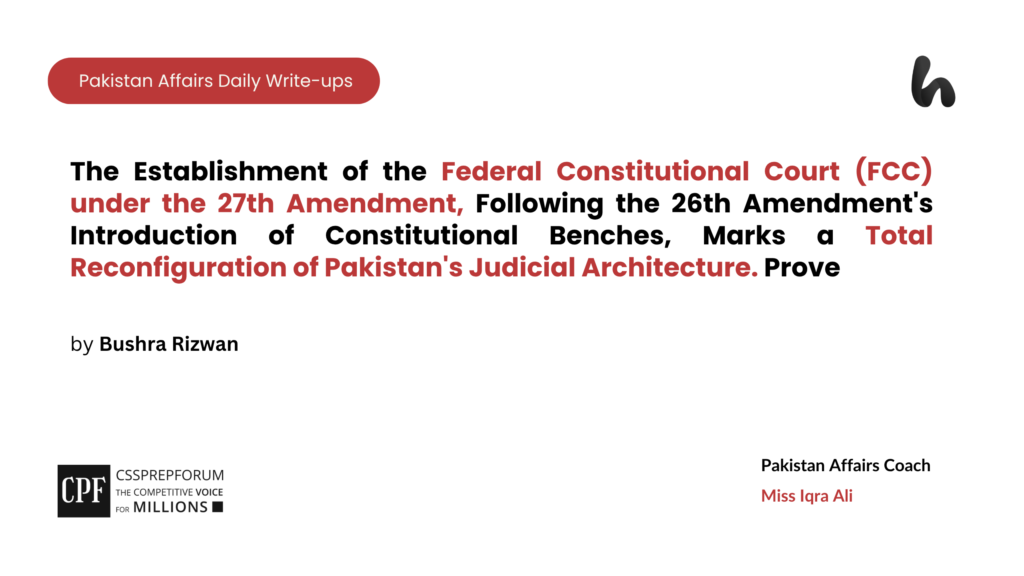
3-How the Establishment of the Federal Constitutional Court (FCC) under the 27th Amendment, Following the 26th Amendment’s Introduction of Constitutional Benches, Marks a Total Reconfiguration of Pakistan’s Judicial Architecture
- Shift of Apex court status from the Supreme Court to the Federal Constitutional Court
- Transfer of constitutional interpretation and judicial review powers from SC to FCC
- Chief Justice of Federal Constitutional Court (FCC) as Pakistan’s new highest judicial rank and increase in retirement age limit for FCC judges
- Issuance of legally binding decisions from FCC rather than SC
- Direct executive involvement in selection of the first batch of FCC judges
4-Conclusion
Answer to the question
Introduction
The 26th and 27th Amendments have altered the very foundation of the judicial system in Pakistan. By shifting the constitutional jurisdiction from the Supreme Court (SC) to the Constitutional Bench and later to the Federal Constitutional Court (FCC), the status of SC has been reduced to an appellate court. Moreover, the executive involvement in judicial appointment has increased through an increase in the number of executive members in the Judicial Commission of Pakistan (JCP) under the 26th Amendment and through the appointment of the first batch of FCC judges by the President without JCP involvement. Therefore, the changes cannot be considered minor as they have altered the foundation of Pakistan’s judiciary.
Overview of 26th and 27th Constitutional Amendments
The 26th constitutional amendment, passed in an extraordinary overnight parliamentary session in October 2024, introduced sweeping changes to the judicial appointment mechanism. This Amendment reconstituted the Judicial Commission of Pakistan (JCP) to add two members from the National Assembly, two from the Senate, and one minority member nominated by the Speaker of the National Assembly, leading to a reduction in judicial members in the JCP. Additionally, the amendment created a Special Parliamentary Committee (SPC) empowered to choose from among the three most senior Supreme Court judges, replacing the previously established convention of automatic seniority-based succession. Subsequently, the 27th Amendment, passed in November 2025, constituted the most fundamental restructuring of Pakistan’s judicial architecture since 1973. This constitution created a Federal Constitutional Court, a parallel to the Supreme Court of Pakistan. Moreover, it increased the retirement age of FCC judges along with providing lifetime immunity to executives, including army high officials and the president of Pakistan. Moreover, the judicial review powers and constitutional jurisdiction have been transferred to FCC. Furthermore, legally binding decisions are now issued by FCC rather than SC. Hence, these changes in the basic judicial structure of Pakistan under these Amendments prove that the constitutional architecture of Pakistan has been reconfigured.
How the Establishment of the Federal Constitutional Court (FCC) under the 27th Amendment, Following the 26th Amendment’s Introduction of Constitutional Benches, Marks a Total Reconfiguration of Pakistan’s Judicial Architecture
- Shift of Apex Court Status from Supreme Court (SC) to Federal Constitutional Court (FCC)
First, the 26th and 27th amendments stripped the Supreme Court of its constitutional jurisdiction. This limited the Supreme Court’s role to criminal hearings. Twenty-Sixth Amendment, which made the most far-reaching changes to Article 175-A since 2010, shifted the constitutional jurisdiction from the Supreme Court to Constitutional Benches, limiting the former to Apellate work. Moreover, jurisdiction related to fundamental rights was also transferred to the Supreme Court. Subsequently, the Twenty-Seventh Amendment superseded the constitutional bench model with a wholly distinct apex tribunal. This 27th Amendment led to the creation of the Federal Constitutional Court, under new Chapter 1A inserted in the Constitution, that now exercised constitutional jurisdiction previously exercised by the Supreme Court, leaving the former as an Apellate forum. Therefore, the jurisdiction of the Supreme Court has been completely changed through the creation of the new Federal Constitutional Court.
- Transfer of Constitutional Interpretation and Judicial Review Powers from SC to Constitutional Bench and Later to FCC
Second, the 26th Amendment led to the formation of constitutional benches, which were given principal powers of constitutional adjudication, including the residual suo motu powers and advisory functions, that were previously vested in the Supreme Court. Under Article 191A, constitutional benches of the Supreme Court and, under Article 202, benches of High Courts were created in the 26th Constitutional Amendment. Furthermore, the stripping away of the Supreme Court’s constitutional powers was strengthened by the creation of the Constitutional Court that had the said powers. Under Article 175-E, the FCC is vested with exclusive jurisdiction over questions of constitutional interpretation and disputes between the federation and the province. Moreover, the FCC may also take up , on its own motion, any case involving a substantial question as to the interpretation of the Constitution. Hence, this transfer of powers related to constitutional interpretation, from the Supreme Court to constitutional benches and then to FCC, has led to major judicial changes.
- Chief Justice of the Federal Constitutional Court (FCC) as Pakistan’s New Highest Judicial Rank and Increase in Retirement Age Limit for FCC judges
Third, as the Apex court status has been moved from the Supreme Court to the Supreme Court of Pakistan, the Chief Justice of Pakistan is no longer the highest judicial rank in Pakistan. The practical effect of the 26th constitutional amendment is that the Chief Justice of Pakistan-previously the most powerful figure in Pakistan’s judicial hierarchy, with control over bench composition and case assignment- has been weakened. Moreover, the structure of the retirement age limit has been changed under the 27th constitutional amendment, which has resulted in longer tenures of preferred nominees. Under the 27th Constitutional Amendment, the retirement age for FCC judges is 68 years as against 65 years for Supreme Court judges. Hence, this increase in the age of FCC judges while maintaining SC judges’ age at the same limit proves the reconfiguration of the judicial hierarchy in Pakistan.
- Issuance of Legally Binding Decisions from FCC Rather than SC
Fourth, previously any appeal filed against High Court decisions was handled by the Supreme Court, but through the 26th constitutional amendment, this authority has been changed. Under Article 191A of the 26th constitutional amendment, all pending petitions, appeals, and review applications challenging High Court orders previously handled by the Supreme Court will be transferred to these constitutional benches. Moreover, now this authority has been transferred to the Federal Constitutional Court(FCC) under the 27th Constitutional Amendment. This has led to a reduction in the Supreme Court’s powers. The Twenty-Seventh Amendment has led to the transfer of judicial review applications and appeals from the constitutional bench to the FCC. Hence, through these amendments, the Supreme Court no longer has constitutional jurisdiction.
- Direct Executive Involvement in Selection of the First Batch of FCC Judges
Fifth, executive penetration into judicial matters, negatively impacting judicial independence, has increased. The Chief Justice of the FCC was appointed through the SPC mechanism established in the 26th Constitutional Amendment. According to Dawn News, on 14th November 2024, the first batch of FCC judges, including the Chief Justice, Justice Aminuddin Khan, was directly appointed by the President on the advice of the Prime Minister rather than the Judicial Commission. Hence, this decision draws questions on whether true judicial independence exists in Pakistan or not.
Conclusion
In conclusion, the 26th and 27th Amendments have not only led to the creation of Constitutional Benches and then FCC, but they have also changed the status and jurisdiction of SC. From the creation of a new highest judicial rank in Pakistan to the issuance of legally binding decisions from FCC rather than SC, the judicial architecture has been completely changed. Moreover, the quick passage of these two Amendments has also raised suspicion about their motive behind them. Therefore, the two Constitutional Amendments have not only reconfigured the country’s judicial system but also reshaped the essence of its judicial independence.

CSS Solved Past Papers’ Essays
Looking for the last ten years of CSS and PMS Solved Essays and want to know how Sir Kazim’s students write and score the highest marks in the essays’ papers? Then, click on the CSS Solved Essays to start reading them.
CSS Solved Essays
CSS Solved Islamiyat Past Papers
Want to read the last ten years’ Islamiyat Solved Past Papers to learn how to attempt them and to score high? Let’s click on the link below to read them all freely. All past papers have been solved by Pakistan’s top CSS Islamiyat coaches having the highest score of their students.
CSS Solved Islamiyat
CSS Solved General Science & Ability Past Papers
Want to read the last ten years’ General Science & Ability Solved Past Papers to learn how to attempt them and to score high? Let’s click on the link below to read them all freely. All past papers have been solved by Pakistan’s top CSS GSA coachez having the highest score of their students.
CSS Solved General Science & Ability
CSS Solved Pakistan Affairs Past Papers
Want to read the last fifteen years’ Pakistan Affairs Solved Past Papers to learn how to attempt them and to score high? Let’s click on the link below to read them all freely. All past papers have been solved by Pakistan’s top CSS Pakistan Affairs coaches having the highest score of their students.
CSS Solved Pakistan Affairs
CSS Solved Current Affairs Past Papers
Want to read the last fifteen years’ Current Affairs Solved Past Papers to learn how to attempt them and to score high? Let’s click on the link below to read them all freely. All past papers have been solved by Pakistan’s top CSS Current Affairs coaches having the highest score of their students.
CSS Solved Current Affairs