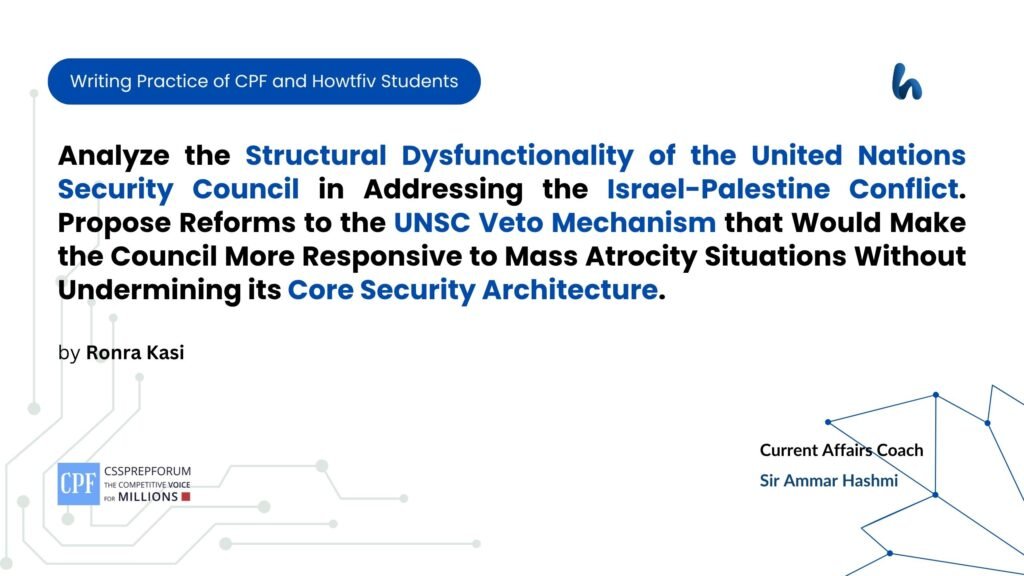
CSS Current Affairs | Structural Dysfunctionality of the United Nations Security Council in Addressing the Israel-Palestine Conflict
The following assignment question for CSS Current Affairs is solved by Ronra Kasi under the supervision of Howfiv’s Pakistan Affairs and Current Affairs Coaches: Miss Iqra Ali and Sir Ammar Hashmi. She learnt how to attempt 20 marks question and essay writing from Sir Syed Kazim Ali, Pakistan’s best CSS and PMS English essay and precis teacher with the highest success rate of his students. This solved question is attempted on the pattern taught by Sir to his students, scoring the highest marks in compulsory and optional subjects for years.
Outline
1-Introduction
2-A Panoramic Overview: Current Dynamics of the UNSC’s Role in Addressing the Israel-Palestine Conflict
3-Structural Dysfunctionality of the UNSC in Addressing the Israel-Palestine Conflict
- Single-State Veto Capture
- Case in Point: According to the UN General Assembly press coverage, a single permanent member can override the collective will of 14 other Council members; the United States has used this power on Israel-Palestine issues at least 45 times since 1972, vetoing three Gaza ceasefire drafts within five months.
- Enforcement Vacuum Between International Law and Council Action
- Case in Point: According to the ICJ Advisory Opinion, “Legal Consequences of the Construction of a Wall”, International Court of Justice rulings declared Israel’s West Bank barrier illegal in 2004 and its occupation unlawful in July 2024, yet the Security Council took no binding enforcement action on either ruling, exposing international law’s enforcement gap.
- Legitimacy: Representativeness Gap
- Case in Point: According to the UN General Assembly’s press coverage, in September 2025, 142 UN member states endorsed the New York Declaration’s two-state roadmap, with only 10 opposing votes. However, the Security Council itself remains structurally controlled by five permanent members, whose individual vetoes can still block implementation.
- No Mandatory Trigger Between Atrocity Findings and Council Action
- Case in Point: According to the ICJ Press Release, OPM, 26 January 2024 (South Africa v. Israel), despite South Africa’s genocide case and the ICJ’s January 2024 provisional measures ordering Israel to prevent genocide and ensure aid, the Security Council has no binding mechanism requiring it to act on ICJ provisional measures or atrocity findings.
4-Reforms to the UNSC Veto Mechanism: Making the Council More Responsive to Mass Atrocities
- To Convert Voluntary Veto-Restraint Pledges into Binding Council Practice
- To Strengthen the General Assembly’s Veto-Accountability Mechanism
- To Introduce a Dual-Veto Threshold for Humanitarian Resolutions
- To Institutionalize Article 99 as a Mandatory Atrocity-Response Trigger
5-Conclusion
Answer to the question
Introduction
The United Nations Security Council was established in 1945 to maintain international peace and security through collective enforcement, yet in the Israel-Palestine conflict, it has repeatedly failed this mandate. This failure validates Realist theory, which posits that international institutions are ultimately captive to the strategic calculations of powerful states. Ultimately, a single permanent member’s veto, an unenforced body of international law, a widening legitimacy gap with the General Assembly, and the absence of any mandatory link between atrocity warnings and Council action together expose a Council that is structurally unfit for mass atrocity situations.
A Panoramic Overview: Current Dynamics of the UNSC’s Role in Addressing the Israel-Palestine Conflict
The UN Security Council’s adoption of Resolution 2803 on 17 November 2025, passed with 13 votes and two abstentions, endorsed the US Gaza plan and authorised a Board of Peace stabilisation force. However, critics argue this intervention sidesteps the ICJ’s 2024 occupation ruling rather than enforcing it. Despite the Board convening its inaugural meeting on 19 February 2026, the issue of Hamas disarmament remains entirely unresolved. As a consequence, this ongoing dysfunction demonstrates that the Council acts decisively only when the coalescence of the permanent members harmonizes, prioritizing political expedience over international law.
Structural Dysfunctionality of UNSC in Addressing the Israel-Palestine Conflict
| Dysfunction | Core Mechanism |
| 1. Single-State Veto Capture | One P5 vote overrides 14 other Council members |
| 2. Enforcement Vacuum | No binding link between ICJ rulings and Council action |
| 3. Legitimacy–Representativeness Gap | Council composition frozen since 1945 vs. shifting global consensus |
| 4. No Mandatory Atrocity Trigger | Atrocity warnings carry no automatic procedural consequence |
Single-State Veto Capture
One must not overlook the fact that the first and foremost structural dysfunctionality of the UNSC is that a single permanent member can override the collective will of the other fourteen Council members, which, undoubtedly, exposes a basic flaw in the Council’s design. Accordingly, this flaw becomes especially visible when one examines how often the veto has been used specifically to shield Israel from Council action. As an illustration, according to the UN General Assembly press coverage, the United States has used this power on Israel-Palestine matters at least 45 times since 1972, the heaviest veto pattern recorded in UN history; three separate ceasefire resolution vetoes were cast between October 2023 and February 2024 alone, including one rejecting a draft already backed by 13 of the Council’s 15 members. As a direct consequence, such repeated obstruction shows the veto functioning less as a safeguard for collective security and more as unilateral cover for a single ally state. Hence, until this mechanism is reformed, mass casualty situations will remain hostage to one capital’s political interest rather than the Council’s collective judgment.
- Enforcement Vacuum Between International Law and Council Action
In addition to the above, the Security Council’s authority to enforce international law depends entirely on its willingness to act on the International Court of Justice’s own binding determinations. Certainly, this dependency becomes a weakness whenever the Council simply chooses not to follow through on what the Court has already ruled. In particular, the ICJ’s Advisory Opinion (2004) declared Israel’s separation barrier illegal, and its July 2024 Opinion went further by calling the entire occupation unlawful. Notwithstanding this, in neither case did the Council pass a binding enforcement resolution, and the gap is compounded by the fact that any such resolution could itself be vetoed. What is more, this pattern is not unique to Israel-Palestine, since comparable inaction followed ICJ rulings on Russia’s conduct in Ukraine, which confirms a systemic Council weakness. In brief, without a binding link between judicial findings and Council follow-through, the International Law’s deterrent value in this conflict remains largely symbolic rather than operative.
- Legitimacy: Representativeness Gap
In the same vein, the General Assembly represents the broadest expression of international consensus available within the UN system, since it comprises all 193 member states. In fact, this breadth of representation stands in sharp contrast to the much narrower body that actually holds binding power over the Israel-Palestine conflict. For instance, according to the UN General Assembly’s press coverage, in September 2025, 142 states endorsed the New York Declaration’s two-state roadmap, with only 10 voting against it. Yet the Security Council, whose five permanent members have remained unchanged since 1945, can still allow a single one of them to block what this overwhelming majority supports. On this account, the United States, by opposing a position backed by 142 states, increasingly stands diplomatically isolated, which erodes both its own credibility and that of the Council it sits on. As a result of persistent neglect, the Council routinely diverges from near-universal Assembly consensus and risks becoming representative of the world in name only, while remaining exclusionary in function.
- No Mandatory Trigger Between Atrocity Findings and Council Action
Compounding this further, Article 99 allows the Secretary-General to bring any threat to international peace and security directly to the Council on his own initiative. Likewise, the strength of this tool was tested directly in the Gaza war, when Guterres chose to invoke it for the first time in his tenure. In fact, he invoked Article 99 on 6 December 2023, the first such invocation since 1989, citing the scale of civilian deaths in Gaza. As an illustration, despite this formal warning, the Council still failed to pass a binding ceasefire resolution that same month, and separately, the ICJ’s January 2024 provisional measures ordered Israel to prevent genocide and ensure humanitarian access. In no uncertain terms, neither the Article 99 warning nor the ICJ’s binding order carried any automatic procedural consequence inside the Council, which reveals a deeper structural disconnect. To put it succinctly, the UN system can formally recognise atrocity risk through multiple channels, yet it possesses no mechanism compelling the Council to act once that recognition has been made.
Reforms to the UNSC Veto Mechanism: Making the Council More Responsive to Mass Atrocities
| Reforms to the UNSC | Mechanism | Charter Impact |
| 1. To Convert Restraint Pledges into Binding Practice | Tie veto restraint to a formal Secretary-General atrocity certification | Article 27(3) untouched |
| 2. To Strengthen the UNGA’s Veto-Accountability Mechanism | Mandatory written veto justification + recorded GA “majority finding” | Article 27(3) untouched |
| 3. To Introduce a Dual-Veto Threshold | Require 2 P5 “No” votes to block strictly humanitarian drafts | Narrow carve-out only |
| 4. To Institutionalize Article 99 as a Mandatory Trigger | Automatic Council session within 72 hrs of an SG atrocity warning | Strengthens existing provision |
- To Convert Voluntary Veto Restraint Pledges into Binding Council Practice
In the first instance, France and Mexico’s 2015 Political Declaration asks the permanent members to voluntarily withhold the veto during certified mass atrocities. Namely, the seriousness of this initiative is reflected in the scale of support it has gathered since its launch. Moreover, the ACT Group’s parallel Code of Conduct, also from 2015, has secured backing from over 120 member states, urging the same restraint. Accordingly, both initiatives remain politically rather than legally binding, which leaves compliance entirely to the discretion of the state casting the vote. Consequently, tying activation of this restraint to a formal Secretary-General atrocity determination would remove the current ambiguity around what counts as credible, while requiring any vital interest exception to be published in writing. Therefore, this converts a moral pledge into a procedural expectation carrying real reputational cost, without touching the Charter’s legal veto power itself.
- To Strengthen the General Assembly’s Veto Accountability Mechanism
At this juncture, UNGA Resolution 76/262, adopted in April 2022, already requires the Assembly to convene within ten working days whenever any veto is cast. Certainly, this existing mechanism, often called the veto initiative, emerged directly from international frustration over Russia’s veto on its own invasion of Ukraine. Nevertheless, at present, it only guarantees a debate, with no requirement for the vetoing state to justify its position in writing. Of critical importance here, requiring a formal, recorded justification addressing the specific provisions blocked, submitted before debate begins, would close this gap, and the resulting Assembly session could adopt a non-binding but formally recorded finding on the veto’s consistency with the Council’s mandate. Similarly, this raises the diplomatic cost of vetoing humanitarian resolutions without creating any binding legal override of the veto itself. Admittedly, strengthening transparency in this way keeps the reform compatible with the Charter, while making unaccountable vetoes politically far more expensive.
- To Introduce a Dual Veto Threshold for Humanitarian Resolutions
Current Council practice treats every resolution identically, which lets one permanent member’s objection block even narrowly humanitarian measures. This uniform treatment is precisely what allowed the single-state vetoes documented earlier to repeatedly halt ceasefires during active mass casualty periods. A targeted reform would apply only to resolutions strictly limited to ceasefires, hostage or prisoner releases, and humanitarian aid corridor access. For this narrow category alone, a resolution would require two permanent members voting against it to fail, rather than just one, while broader political or territorial resolutions would remain governed by the existing single veto rule. This distinction reflects a recognised principle in reform literature that life-saving measures merit a higher threshold for obstruction than political settlements do. Since this proposal has no adopted UN text behind it yet, it should be cited as a proposed mechanism rather than an existing one.
- To Institutionalize Article 99 as a Mandatory Atrocity Response Trigger
Above all, Article 99 currently functions as a discretionary tool, one that the sitting Secretary-General has used only once since taking office in 2017. In the same way, its limits became clear in practice, since Guterres’s December 2023 invocation demonstrated symbolic power but little binding consequence. Besides, the Council still vetoed a ceasefire resolution only weeks after that formal warning had been issued. Accordingly, a reform would make any formal Article 99 invocation over atrocity risk legally trigger a mandatory Council session within 72 hours, while also automatically activating the General Assembly review process described above. As a direct result, this would close the gap identified earlier, where formal atrocity recognition currently carries no procedural consequence, by strengthening an existing Charter provision rather than creating a new one. Ultimately, together with the other three reforms, this would shift the Council from reactive paralysis toward an accountable, time-bound response structure
Conclusion
The unescapable conclusion is that the Israel-Palestine case demonstrates that the Security Council’s core failure is not a lack of legal authority but a structural design that lets one state’s political interest override binding international law and near-universal Assembly consensus. Namely, none of the four reforms proposed here touches Article 27(3) itself, since each instead raises the procedural, reputational, and transparency cost of obstruction during mass atrocity situations specifically; as Resolution 2803 shows, the Council can act decisively when P5 interests converge. In a word, the real test of reform is whether it can act just as decisively when they do not.

CSS Solved Past Papers’ Essays
Looking for the last ten years of CSS and PMS Solved Essays and want to know how Sir Kazim’s students write and score the highest marks in the essays’ papers? Then, click on the CSS Solved Essays to start reading them.
CSS Solved Essays
CSS Solved Islamiyat Past Papers
Want to read the last ten years’ Islamiyat Solved Past Papers to learn how to attempt them and to score high? Let’s click on the link below to read them all freely. All past papers have been solved by Pakistan’s top CSS Islamiyat coaches having the highest score of their students.
CSS Solved Islamiyat
CSS Solved General Science & Ability Past Papers
Want to read the last ten years’ General Science & Ability Solved Past Papers to learn how to attempt them and to score high? Let’s click on the link below to read them all freely. All past papers have been solved by Pakistan’s top CSS GSA coachez having the highest score of their students.
CSS Solved General Science & Ability
CSS Solved Pakistan Affairs Past Papers
Want to read the last fifteen years’ Pakistan Affairs Solved Past Papers to learn how to attempt them and to score high? Let’s click on the link below to read them all freely. All past papers have been solved by Pakistan’s top CSS Pakistan Affairs coaches having the highest score of their students.
CSS Solved Pakistan Affairs
CSS Solved Current Affairs Past Papers
Want to read the last fifteen years’ Current Affairs Solved Past Papers to learn how to attempt them and to score high? Let’s click on the link below to read them all freely. All past papers have been solved by Pakistan’s top CSS Current Affairs coaches having the highest score of their students.
CSS Solved Current Affairs