CSS Current Affairs | Institutional and Political Reconciliation Mechanism Necessary to reunify Palestinian Governance
The following assignment question for CSS Current Affairs is solved by Mehreen Nawaz under the supervision of Howfiv’s Pakistan Affairs and Current Affairs Coaches: Miss Iqra Ali and Sir Ammar Hashmi. She learnt how to attempt 20 marks question and essay writing from Sir Syed Kazim Ali, Pakistan’s best CSS and PMS English essay and precis teacher with the highest success rate of his students. This solved question is attempted on the pattern taught by Sir to his students, scoring the highest marks in compulsory and optional subjects for years.

Outline
1-Introduction
2-A Brief Historical Background of Palestinian Political Divisions
3-How the Political and Geographical Divide Between Gaza and the West Bank has become an Obstacle to Palestinian Statehood
- Political Fragmentation Between Hamas and Fatah
- Evidence: Hamas took control of the Gaza Strip in June 2007 after violent clashes with Fatah forces, leading to the establishment of two separate administrations.
- Geographical Separation of Gaza and West Bank
- Evidence: The West Bank and Gaza are physically separated by Israeli-controlled territory, making direct land-based connectivity between the two Palestinian regions impossible.
- Absence of a Unified National Leadership
- Evidence: In June 2007, President Mahmoud Abbas dismissed the Hamas-led unity government and formed a separate emergency administration in the West Bank.
- Difficulties in Peace Negotiations
- Evidence: Following Hamas’s victory in the 2006 elections, the United States and the European Union refused to recognize its government, leading to its exclusion from formal diplomatic processes.
- Administrative and Governance Challenges
- Evidence: Since the 2007 split, Gaza and the West Bank have developed separate administrative, legal, and bureaucratic systems.
- Security Fragmentation and Armed Rivalry
- Evidence: After the 2007 Gaza takeover, Hamas expelled Fatah-affiliated security forces and established independent armed institutions in Gaza.
4-Measures Required to Re-unify Palestinian Governance for Viable Statehood
- National Reconciliation Between Hamas and Fatah
- Evidence: Previous efforts such as the Cairo and Mecca agreements failed primarily due to lack of implementation and continued rivalry between the two factions.
- Formation of a Unified National Government
- Evidence: After the 2007 split, Hamas governed Gaza independently while President Mahmoud Abbas formed a separate emergency government in the West Bank, resulting in institutional dualism.
- Conducting Free and Fair Elections
- Evidence: The 2006 legislative elections, which resulted in a Hamas victory, were followed by political conflict and institutional breakdown between Hamas and Fatah.
- Integration of Security Institutions Under a Single Command
- Evidence: Following the 2007 Hamas takeover of Gaza, Fatah-affiliated security forces were expelled and replaced by Hamas-controlled security structures.
- Strengthening Common State Institutions (Parliament, Judiciary, and Civil Service)
- Evidence: Since the 2007 division, institutional structures in Gaza and the West Bank have evolved separately under Hamas and the Palestinian Authority, respectively.
- Developing a Shared Political Vision with Regional and International Support
- Evidence: Repeated reconciliation efforts in Cairo and Doha have shown that external mediation is essential but insufficient without internal political commitment.
5-Critical Analysis
6-Conclusion
Answer to the question
Introduction
The Palestinian question remains one of the most enduring conflicts in modern international politics, where the prospects of statehood are continuously undermined by internal political fragmentation. The division between Hamas-controlled Gaza and Fatah-led West Bank has created a dual governance system that weakens institutional unity and challenges the emergence of a sovereign Palestinian state. Instead of a single authority exercising control over territory, security, and foreign relations, Palestinians are governed by two rival administrations with conflicting political agendas. This fragmentation has not only weakened internal cohesion but has also reduced the credibility of Palestinian representation in international diplomacy. As a result, the political and territorial split has become one of the most significant barriers to viable Palestinian statehood.
A Brief Historical Background of Palestinian Political Divisions
The roots of the division can be traced to the evolution of Palestinian nationalism under the Palestine Liberation Organization (PLO), dominated by Fatah under Yasser Arafat and later Mahmoud Abbas. Following the Oslo Accords of 1993, the Palestinian Authority (PA) was established to govern parts of the West Bank and Gaza as a transitional step toward statehood. However, the political landscape changed with the rise of Hamas, which emerged as a rival Islamist movement and gained significant popularity. The turning point came with the 2006 legislative elections, in which Hamas secured a majority victory, leading to severe political tensions with Fatah. These tensions escalated into armed conflict in 2007, resulting in Hamas taking control of Gaza while the Fatah-led PA retained authority in the West Bank. Since then, repeated reconciliation attempts have failed, leaving the Palestinian territories politically and geographically divided.

Political and Geographical Divide Between Gaza and West Bank as an Obstacle to Palestinian Statehood
- Political fragmentation between Hamas and Fatah
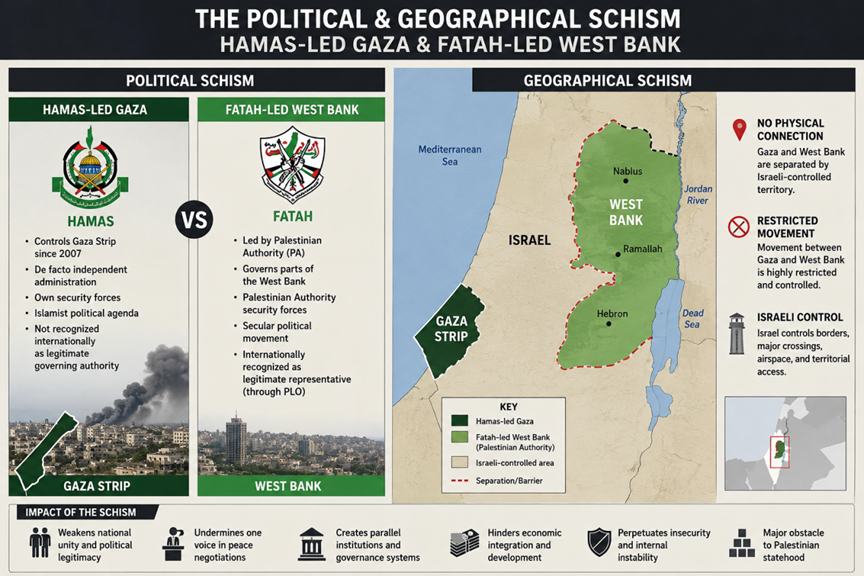
The political divide between Hamas and Fatah is the most fundamental barrier to Palestinian statehood because it has created two rival systems of governance operating independently. This division deepened after Hamas’s 2006 electoral victory, which triggered intense political confrontation and institutional breakdown between the two factions. The crisis escalated into armed conflict, which fundamentally altered the political structure of Palestinian territories. This fragmentation became irreversible when Hamas took control of the Gaza Strip in June 2007 after violent clashes with Fatah forces, leading to the establishment of two separate administrations. Since then, both groups have governed independently, weakening national unity and eliminating the possibility of a single political authority. This continued division undermines coherent decision-making and prevents the emergence of a unified state structure.
- Geographical separation of Gaza and West Bank
The geographical separation between Gaza and the West Bank is a structural barrier that makes the creation of a unified Palestinian state extremely difficult. The two territories are not physically connected, which disrupts political, economic, and administrative integration. Movement between the regions is highly restricted, limiting coordination between institutions and citizens. This lack of territorial continuity prevents the development of unified infrastructure and national systems. The West Bank and Gaza are physically separated by Israeli-controlled territory, which makes direct land-based connectivity between the two Palestinian regions impossible, further complicating state-building efforts. As a result, even if political reconciliation is achieved, geographical fragmentation continues to obstruct the formation of a viable sovereign state.
- Absence of a unified national leadership
A key requirement for statehood is the presence of a single legitimate leadership, which is currently absent in the Palestinian case due to internal division. The Palestinian Authority under Fatah governs parts of the West Bank, while Hamas maintains control over Gaza independently, creating parallel leadership structures. This situation emerged after the collapse of the unity government and has persisted despite repeated reconciliation efforts. The absence of centralized authority has weakened governance, coordination, and national decision-making. In June 2007, President Mahmoud Abbas responded to the Gaza takeover by dismissing the Hamas-led unity government and forming a separate emergency administration in the West Bank, which institutionalized the leadership split. Consequently, Palestinians lack a unified national leadership capable of representing the entire population effectively.
- Difficulties in peace negotiations
The internal division between Hamas and Fatah has severely weakened Palestinian participation in international peace negotiations. External actors face difficulty engaging with a single representative authority due to competing political claims. This has resulted in inconsistent positions on core issues such as recognition of Israel, borders, and security arrangements. The absence of consensus reduces credibility and weakens bargaining power in negotiations. Following Hamas’s victory in the 2006 elections, many Western states, including the United States and the European Union, refused to recognize its government, leading to its exclusion from formal diplomatic processes. As a result, peace negotiations remain fragmented and ineffective, with no unified Palestinian voice at the international level.
- Administrative and governance challenges
The Palestinian territories suffer from severe administrative fragmentation due to the existence of two separate governance systems. The West Bank is administered by the Palestinian Authority with international support, while Gaza is governed independently by Hamas under a different institutional framework. This division has created duplication of ministries, inconsistent policies, and weak coordination between institutions. Public service delivery has also been significantly affected due to a lack of unified planning and execution. Since the 2007 split, both Gaza and the West Bank have developed separate administrative, legal, and bureaucratic systems, making institutional integration increasingly difficult. This administrative divergence weakens overall state capacity and obstructs long-term governance efficiency.
- Security fragmentation and armed rivalry
Security fragmentation is another major obstacle to Palestinian statehood, as both regions are controlled by separate armed forces loyal to different authorities. Hamas maintains its own military and internal security apparatus in Gaza, while the Palestinian Authority controls security forces in the West Bank. This division emerged after the 2007 conflict and has remained unresolved despite multiple reconciliation attempts. The lack of a unified security structure prevents the establishment of a monopoly over the use of force, which is essential for sovereignty. After the 2007 Gaza takeover, Hamas consolidated its control by expelling Fatah-affiliated security forces and establishing independent armed institutions in the territory, further deepening institutional separation. This continued rivalry undermines stability and makes unified statehood unachievable.
Institutional and Political Reconciliation Mechanisms for Reunifying Palestinian Governance
- National reconciliation between Hamas and Fatah
A durable political settlement between Hamas and Fatah is the foundational requirement for reunifying Palestinian governance, as all other reforms depend on ending internal rivalry. The deep mistrust between the two factions has persisted since the 2007 Gaza split, making reconciliation politically sensitive and institutionally fragile. A structured dialogue process under neutral mediation is essential to rebuild trust and define shared political priorities. Previous efforts such as the Cairo and Mecca agreements failed primarily due to lack of implementation and continued rivalry between the two factions, showing that symbolic agreements alone are insufficient. Therefore, sustained political engagement and enforceable commitments are necessary to prevent relapse into conflict and to restore national unity.
- Formation of a unified national government
The establishment of a single national unity government is crucial for eliminating parallel administrations in Gaza and the West Bank. Such a government would consolidate executive authority and ensure that policies are implemented uniformly across Palestinian territories. The absence of a unified cabinet has historically weakened governance and created competing decision-making structures. After the 2007 split, Hamas governed Gaza independently while President Mahmoud Abbas formed a separate emergency government in the West Bank, resulting in institutional dualism. A unified government would help restore centralized authority, improve governance efficiency, and strengthen Palestinian representation at both domestic and international levels.
- Conducting free and fair elections
Holding inclusive, transparent, and internationally monitored elections is essential for restoring political legitimacy and rebuilding public trust in governance. Elections would provide Palestinians with a democratic mechanism to choose a unified leadership capable of representing both Gaza and the West Bank. The lack of elections since 2006 has contributed to political stagnation and leadership fragmentation. The 2006 legislative elections, which resulted in a Hamas victory, were followed by political conflict and institutional breakdown between Hamas and Fatah, demonstrating the need for a more stable and widely accepted electoral framework. Future elections must therefore be conducted under mutually agreed rules to ensure legitimacy and acceptance of outcomes.
- Integration of security institutions under a single command
Unifying security forces is essential for establishing state sovereignty, as a state must maintain a monopoly over the use of force. Currently, Hamas maintains its own armed wing in Gaza, while the Palestinian Authority controls separate security forces in the West Bank, creating parallel military structures. This fragmentation undermines law enforcement, stability, and national cohesion. Following the 2007 Hamas takeover of Gaza, Fatah-affiliated security forces were expelled and replaced by Hamas-controlled security structures, solidifying the split. Integration under a single national command, possibly supported by international supervision, is necessary to prevent internal conflict and ensure unified security governance.
- Strengthening common state institutions (parliament, judiciary, civil service)
Rebuilding and unifying core state institutions is critical for functional governance and long-term state-building. At present, both Gaza and the West Bank operate separate administrative systems, leading to duplication and inefficiency. A unified parliament, judiciary, and civil service would ensure consistent policymaking and legal coherence across Palestinian territories. Since the 2007 division, institutional structures in Gaza and the West Bank have evolved separately under Hamas and the Palestinian Authority, respectively, weakening national institutional capacity. Strengthening shared institutions would improve governance efficiency, legal uniformity, and administrative coordination, all of which are essential for viable statehood.
- Developing a shared political vision with regional and international support
A unified political vision is necessary to reconcile ideological differences between Hamas and Fatah and to establish common national objectives. Hamas and Fatah differ significantly in their approaches to resistance, diplomacy, and recognition of Israel, making a shared framework essential for long-term stability. Regional actors such as Egypt and Qatar, along with international stakeholders, can play a mediating role in facilitating dialogue and ensuring implementation of agreements. Repeated reconciliation efforts in Cairo and Doha have shown that external mediation is essential but insufficient without internal political commitment, highlighting the need for both domestic consensus and international guarantees. A shared vision would help align internal governance with external diplomatic expectations, strengthening the case for Palestinian statehood.
Critical Analysis
The political and geographical division between Gaza and the West Bank has become a major structural obstacle to Palestinian statehood. The continued rivalry between Hamas and Fatah has produced parallel systems of governance, weakening institutional coherence and national unity. This fragmentation has reduced the effectiveness of Palestinian political leadership and created competing centers of authority. It has also undermined democratic legitimacy due to the absence of sustained electoral processes. Furthermore, the split has weakened Palestine’s diplomatic position in international negotiations, as unified representation is lacking. External mediation efforts have repeatedly failed due to internal mistrust and conflicting political agendas. As a result, the Palestinian political system remains deeply divided and institutionally fragile.
Conclusion
In conclusion, the absence of political unity between Gaza and the West Bank remains the central barrier to viable Palestinian statehood. Without reconciliation between Hamas and Fatah, no sustainable governance structure can emerge. Institutional fragmentation continues to weaken state-building efforts and international credibility. Therefore, reunification through political compromise, institutional integration, and democratic renewal is essential. Only a unified leadership can transform fragmented governance into a functioning state. Until then, the prospect of an independent and effective Palestinian state will remain limited. enable SMEs to become even more effective contributors to the country’s economic development.

CSS Solved Past Papers’ Essays
Looking for the last ten years of CSS and PMS Solved Essays and want to know how Sir Kazim’s students write and score the highest marks in the essays’ papers? Then, click on the CSS Solved Essays to start reading them.
CSS Solved Essays
CSS Solved Islamiyat Past Papers
Want to read the last ten years’ Islamiyat Solved Past Papers to learn how to attempt them and to score high? Let’s click on the link below to read them all freely. All past papers have been solved by Pakistan’s top CSS Islamiyat coaches having the highest score of their students.
CSS Solved Islamiyat
CSS Solved General Science & Ability Past Papers
Want to read the last ten years’ General Science & Ability Solved Past Papers to learn how to attempt them and to score high? Let’s click on the link below to read them all freely. All past papers have been solved by Pakistan’s top CSS GSA coachez having the highest score of their students.
CSS Solved General Science & Ability
CSS Solved Pakistan Affairs Past Papers
Want to read the last fifteen years’ Pakistan Affairs Solved Past Papers to learn how to attempt them and to score high? Let’s click on the link below to read them all freely. All past papers have been solved by Pakistan’s top CSS Pakistan Affairs coaches having the highest score of their students.
CSS Solved Pakistan Affairs
CSS Solved Current Affairs Past Papers
Want to read the last fifteen years’ Current Affairs Solved Past Papers to learn how to attempt them and to score high? Let’s click on the link below to read them all freely. All past papers have been solved by Pakistan’s top CSS Current Affairs coaches having the highest score of their students.
CSS Solved Current Affairs