CSS Islamiat | Two Nation Theory Reflects the Relationship Between Islamic Culture and Civilization
The following question of CSS Islamiat is solved by Ronra Kasi under the supervision of Howfiv’s Islamiat coach, Miss Ayesha Irfan. She learnt how to attempt 20 marks question and essay writing from Sir Syed Kazim Ali, Pakistan’s best CSS and PMS English essay and precis teacher with the highest success rate of his students. This solved question is attempted on the pattern taught by Sir to his students, scoring the highest marks in compulsory and optional subjects for years.

Outline
1-Introduction
2-A Panoramic Overview
- Two Nation Theory: Origin, Evolution, and Its Role in Creation of Pakistan
- Islamic Culture and Civilization: Its Foundations, Features, and Contribution to Human Progress
3-Two Nation Theory reflecting the relationship between Islamic culture and civilization
- 3.1-Islam Gave Muslims a Distinct Civilizational Identity Separate from Hindu Society, from the Charter of Medina to the Urdu-Hindi Controversy (1867)
- 3.2-Iqbal’s Allahabad Address (1930) Presented Islam as a Complete Code of Life That Shaped Muslims into a Self-Conscious Nation
- 3.3-Congress Rule (1937-39) Proved the Need to Protect Muslim Culture Politically
- 3.4-The Lahore Address (1940) and Jinnah’s Eid Message (1945) Showed That Separate Social Systems, Law, Customs, and Heroes Made Cultural Merger Impossible
4-Two Nation Theory reflecting the principles of Islamic governance in shaping the ideology and creation of Pakistan
- 4.1-A Separate Homeland Was Essential to Practise Islamic Governance, as Reflected in the Allahabad Address (1930), the Lahore Resolution (1940), and Independence (1947)
- 4.2-Islamic Principles of Justice, Equality, and Minority Rights Formed the Moral Basis of the Demand for a State
- 4.3-Shura (Consultation) and the Rule of Law Offered an Islamic Alternative to Majoritarian Hindu-Dominated Rule
- 4.4-Sovereignty Belongs to Allah, Exercised by the People as a Sacred Trust, as Declared in the Objectives Resolution (1949)
5-Conclusion

Answer to the Question
Introduction
Pakistan did not appear suddenly in 1947; it grew out of a long Muslim search for identity and a state that could protect it. The Hindi-Urdu controversy of 1867 widened the cultural divide. In 1930, Iqbal’s Allahabad Address pointed towards a Muslim state in the North-West, and in 1940 Jinnah’s Lahore address described Hindus and Muslims as two civilizations. Pakistan followed on 14 August 1947, and the Objectives Resolution of 1949 tied it to Islamic principles. Thus, the Two Nation Theory reflects both Islamic culture and Islamic governance.
A Panoramic Overview
- Two Nation Theory: Origin, Evolution, and Its Role in Creation of Pakistan
To begin with, the Two Nation Theory is the idea that Muslims and Hindus of the subcontinent are two separate nations. To trace the origin, its roots go back to the Hindi-Urdu controversy of 1867, which widened the gap between the two communities. For instance, Iqbal’s Allahabad Address of 1930 proposed a Muslim state in the North-West, and the Lahore Resolution, moved by A. K. Fazlul Huq on 23 March 1940, gave the idea political form. Pakistan was created on 14 August 1947 as its result. In a word, the theory moved from a cultural feeling to a national demand.
- Islamic Culture and Civilization: Its Foundations, Features, and Contribution to Human Progress
Adding to the above, Islamic culture and civilization is rooted in the Quran, and its first political form appeared when the Prophet created a community in Medina in 622 CE under its own charter. In Baghdad’s House of Wisdom, Al-Khwarizmi developed algebra and Ibn Sina wrote the Canon of Medicine, used in Europe for centuries. In modern times, Jinnah’s Eid message of September 1945 called the Quran the general code of Muslim life, and the Objectives Resolution of 1949 tied Pakistan to Islamic principles of justice, equality, and tolerance. Therefore, Pakistan can honour this civilization by combining faith with knowledge and service to humanity.
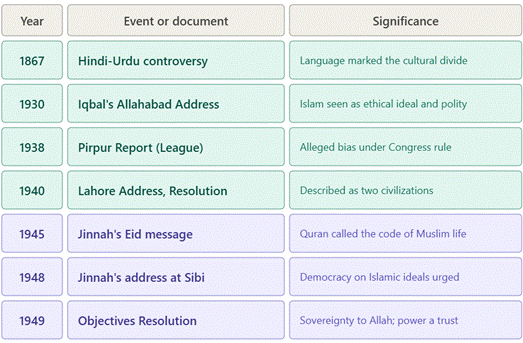
The table above summarises the key milestones that reflect the link between the Two Nation Theory, Islamic culture, and Islamic governance
Two Nation Theory Reflecting the Relationship Between Islamic Culture and Civilization
The relationship between the Two Nation Theory and Islamic culture and civilization can be understood through the following arguments
- Islam Gave Muslims a Distinct Civilizational Identity Separate from Hindu Society, from the Charter of Medina to the Urdu-Hindi Controversy (1867)
In the first instance, Islam gave the Muslims a separate civilizational identity that set them apart from Hindu society. As an illustration, the Charter of Medina, drawn up after the Prophet’s arrival in 622 CE, described the believers as one community distinct from other people. This shows that Islam built a collective identity for its followers from the very beginning. The same identity surfaced in India in 1867, when the Hindi-Urdu controversy began. According to a Dawn column, Babu Shiv Prasad asked the Hindu members of Sir Syed’s Scientific Society to use Hindi, after which Sir Syed concluded that the two communities could no longer go together. To put it succinctly, the Two Nation Theory grew naturally from Islam’s own civilizational roots.
- Iqbal’s Allahabad Address (1930) Presented Islam as a Complete Code of Life That Shaped Muslims into a Self-Conscious Nation
Furthermore, Islam is a complete code of life that guides every part of a Muslim’s existence, which shaped Muslims into a self-conscious nation. To illustrate, in his presidential address to the Muslim League at Allahabad on 29 December 1930, Iqbal described Islam as an ethical ideal and a polity, the chief formative influence on Muslim society in India. This means Muslims could not separate religion from politics or society. The Quran itself says, “enter into Islam completely” (2:208). This tells believers to follow Islam fully, not partly. Therefore, this complete way of life made Muslims a distinct nation that needed its own homeland.
- Congress Rule (1937-39) Proved the Need to Protect Muslim Culture Politically
Similarly, historical experience, especially Congress rule between 1937 and 1939, convinced Muslims that their culture needed political protection. For instance, the Muslim League’s Pirpur Committee, appointed in March 1938, issued a report in November 1938 alleging systematic cultural discrimination against Muslims in Congress provinces. The League also objected to compulsory Vande Mataram and to the Wardha and Vidya Mandir education schemes, and in December 1939 Jinnah called on Muslims to observe 22 December as a Day of Deliverance. These actions reflected Muslim fear of losing their identity under majority rule. The Quran teaches unity, saying “hold firmly to the rope of Allah all together” (3:103). This reminds Muslims to stay united when their faith is under pressure. Therefore, the Lahore Resolution of March 1940 was a natural political response to these experiences.
- The Lahore Address (1940) and Jinnah’s Eid Message (1945) Showed That Separate Social Systems, Law, Customs, and Heroes Made Cultural Merger Impossible
In the same vein, differences in customs, literature and heroes made a cultural merger between Hindus and Muslims impossible. To illustrate, in his presidential address at the Lahore session of the Muslim League (22 March 1940), Jinnah said the two communities neither intermarry nor interdine, and have different epics, heroes and historical inspirations. Often the hero of one is the enemy of the other. Five years later, in his Eid message of September 1945, Jinnah called the Quran the general code of the Muslims, regulating every department of life, collectively and individually. This shows that even their law and social conduct came from a different source. Therefore, these deep cultural differences strongly support the Two Nation Theory.
Two Nation Theory Reflecting the Principles of Islamic Governance in Shaping the Ideology and Creation of Pakistan
The role of Islamic governance in shaping the ideology and creation of Pakistan can be understood through the following arguments.
- A Separate Homeland Was Essential to Practise Islamic Governance, as Reflected in the Allahabad Address (1930), the Lahore Resolution (1940), and Independence (1947)
Moving down the ladder, a separate homeland was essential for Muslims to practise Islamic governance freely. To illustrate, in his Allahabad Address of 1930, Iqbal called a consolidated North-West Indian Muslim State the final destiny of at least North-West India’s Muslims. On 23 March 1940, A. K. Fazlul Huq moved the Lahore Resolution at the Muslim League’s Lahore session, and Chaudhry Khaliquzzaman seconded it. This shows the demand moved from an idea to a political programme, which ended in the creation of Pakistan on 14 August 1947. The Prophet’s community at Medina in 622 CE, under its own charter, gives an Islamic precedent for Muslims organising themselves to live by Islam. Therefore, Pakistan became the natural outcome of this ideology.
- Islamic Principles of Justice, Equality, and Minority Rights Formed the Moral Basis of the Demand for a State
Along with that, justice, equality and minority rights formed the moral basis of the demand for a separate state. To be sure, in a message of February 1945, Jinnah said that Islam came to establish democracy, peace and justice and to safeguard the rights of the oppressed. This shows Pakistan was imagined as a fair state for everyone. Similarly, Article 25 of the Medina Charter said the Jews of Banu Awf had their religion and the Muslims had theirs. This shows Islam respects religious freedom for non-Muslims. To sum up, justice and tolerance were core values of the Muslim demand for Pakistan.
- Shura (Consultation) and the Rule of Law Offered an Islamic Alternative to Majoritarian Hindu-Dominated Rule
More importantly, consultation and the rule of law gave Muslims an Islamic alternative to majority rule dominated by Hindus. In his Lahore address of 1940, Jinnah warned that a democratic system forced on minorities under a Hindu majority could only mean “Hindu Raj”. Eight years later, at Sibi on 14 February 1948, he urged that Pakistan’s democracy be founded on truly Islamic ideals and principles. This shows that the leadership wanted government guided by Islamic values, not simple majority power. The Quran praises believers whose affairs are decided by consultation among themselves: “whose affair is determined by consultation” (42:38). This makes shura a religious duty, not just a political choice. In a word, consultation gave Pakistan a fair Islamic model of government against majoritarian rule.
- Sovereignty Belongs to Allah, Exercised by the People as a Sacred Trust, as Declared in the Objectives Resolution (1949)
Last but not least, Pakistan’s ideology rests on the Islamic principle that sovereignty belongs to Allah alone. To illustrate, the Objectives Resolution, moved by Prime Minister Liaquat Ali Khan on 7 March 1949 and passed unamended on 12 March 1949, declared that sovereignty over the universe belongs to God, and that authority is delegated to the state through its people as a sacred trust. Liaquat Ali Khan explained that the state would use its powers through the chosen representatives of the people, which removes any danger of theocracy. The Quran says, “render trusts to whom they are due” (4:58). This links power with responsibility. Thus, Islamic governance shaped the ideological base on which Pakistan was built.
Conclusion
The inescapable conclusion is that the Two Nation Theory was more than a demand for territory; it expressed the Islamic belief that faith shapes culture, law, and political life. From the Hindi-Urdu controversy of 1867 and Iqbal’s address of 1930 to the Lahore Resolution of 1940 and the Objectives Resolution of 1949, each stage drew on a distinct Muslim civilization and on principles of justice, equality, and consultation. Thus, the theory remains a lasting reflection of Islamic civilization and governance in the creation and ideology of Pakistan.
Searching for CSS or PMS Solved Islamiat Past Papers?
Are you preparing for the CSS or PMS and searching for solved Islamiat past papers, notes, books, PDFs, and MCQs? Explore them for free on Howtests and Cssprepforum. All content is fully solved and written by Miss Ayesha Irfan. For your convenience, the links are provided below. Simply click on any to start reading and preparing.