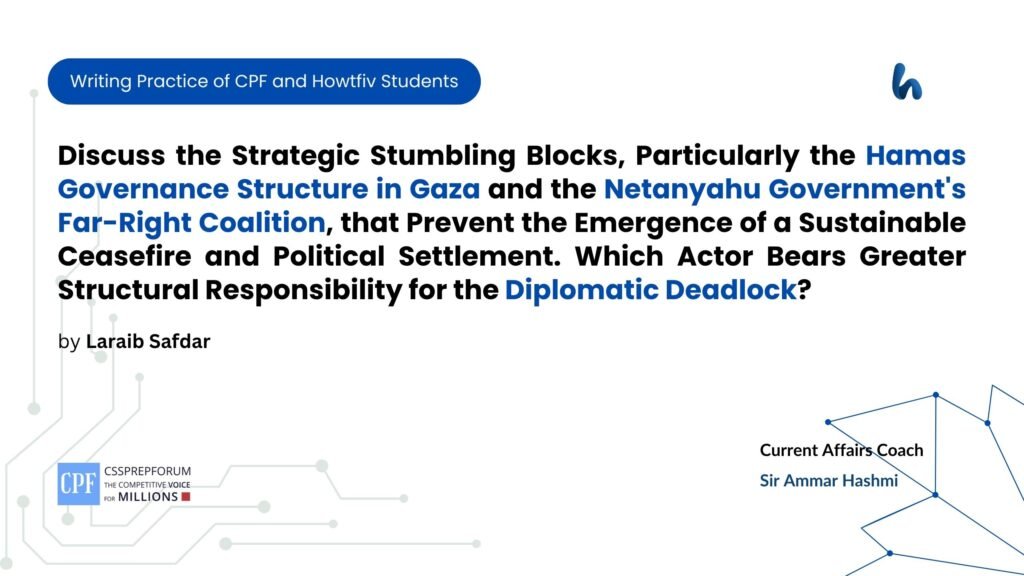
CSS Current Affairs | Strategic Stumbling Blocks in the Emergence of a Sustainable Ceasefire and Political Settlement
The following assignment question for CSS Current Affairs is solved by Laraib Safdar under the supervision of Howfiv’s Pakistan Affairs and Current Affairs Coaches: Miss Iqra Ali and Sir Ammar Hashmi. She learnt how to attempt 20 marks question and essay writing from Sir Syed Kazim Ali, Pakistan’s best CSS and PMS English essay and precis teacher with the highest success rate of his students. This solved question is attempted on the pattern taught by Sir to his students, scoring the highest marks in compulsory and optional subjects for years.

Outline
1-Introduction
2-Overview of the Israel-Hamas Peace Process and Ceasefire Challenges
3-Strategic Stumbling Blocks to a Sustainable Ceasefire and Political Settlement
- Hamas’s Governance Structure and Dual Political–Military Role
- Ideological Constraints within Hamas
- Netanyahu’s Far-Right Coalition Politics
- Settlement Expansion and the Erosion of Trust
- Domestic Political Incentives on Both Sides
- Absence of a Credible Political Horizon
4-Which Actor Bears Greater Structural Responsibility?
5-Critical Analysis
6-Conclusion
Answer to the question
Introduction
The conflict between Hamas and Israel represents one of the most enduring and complex disputes in contemporary international politics. Despite repeated attempts by regional and international actors to broker ceasefires and advance political negotiations, a sustainable settlement remains elusive. Consequently, the persistence of violence cannot be explained solely by immediate military considerations but must also be understood through the political structures and ideological commitments of the principal actors involved. Hamas’s governance model in Gaza and the far-right coalition led by Benjamin Netanyahu have emerged as significant obstacles to a durable ceasefire and long-term political resolution.
Overview of the Israel-Hamas Peace Process and Ceasefire Challenges
Firstly, the Israel-Palestine conflict has witnessed numerous ceasefire agreements and peace initiatives over the past several decades, including mediation efforts by Egypt, Qatar, the United States, and the United Nations. However, most ceasefires have proved temporary because they addressed immediate military escalation rather than the deeper political disputes surrounding governance in Gaza, Israeli security concerns, Palestinian statehood, settlements, and mutual recognition. Consequently, the absence of a comprehensive political framework has repeatedly caused negotiations to collapse, making sustainable peace increasingly difficult to achieve.
Strategic Stumbling Blocks to a Sustainable Ceasefire and Political Settlement
- Hamas’s Governance Structure and Dual Political-Military Role
Firstly, Hamas’s dual role as both a governing authority and an armed resistance movement creates significant challenges for peace efforts. Since assuming control of Gaza in 2007, Hamas has maintained an ideological commitment to armed resistance against Israel while simultaneously exercising governmental responsibilities over a densely populated territory. Consequently, any permanent ceasefire risks creating tensions within Hamas between pragmatic governance considerations and its resistance-oriented identity. Moreover, the organization’s military wing operates alongside its political leadership, making it difficult to separate security issues from political negotiations. As a result, Israel and several Western states often question whether Hamas can reliably commit to and enforce a lasting peace agreement.
- Ideological Constraints within Hamas
Furthermore, Hamas’s political legitimacy has historically been linked to its image as a resistance movement rather than solely as a governing institution. Consequently, significant concessions toward Israel may be perceived by parts of its support base as a departure from its founding principles. While Hamas has at times demonstrated tactical flexibility through temporary truces and negotiations, it has generally refrained from formally recognizing Israel or permanently abandoning armed struggle. Therefore, ideological constraints limit the organization’s ability to fully embrace a comprehensive political settlement, thereby complicating diplomatic initiatives.
- Netanyahu’s Far-Right Coalition Politics
Moreover, the coalition governments led by Benjamin Netanyahu have increasingly relied on support from nationalist and far-right political parties. Consequently, Israeli policymaking has often been influenced by coalition partners who oppose significant territorial concessions, advocate the expansion of settlements, and reject the establishment of a fully sovereign Palestinian state. This political reality narrows the government’s flexibility during negotiations and makes it difficult to advance confidence-building measures necessary for a lasting peace process. Therefore, coalition politics within Israel have become a major structural obstacle to diplomatic progress.
- Settlement Expansion and Erosion of Trust
Additionally, continued settlement expansion in the occupied Palestinian territories has undermined confidence in the feasibility of a negotiated two-state solution. From the Palestinian perspective, ongoing settlement construction alters realities on the ground and reduces the territorial basis for an independent state. Consequently, many Palestinians view diplomatic negotiations as ineffective, while Israeli hardliners often see settlements as strengthening national security and historical claims. As a result, the expansion of settlements has contributed significantly to mutual distrust and has complicated efforts to establish a viable political framework for peace.
- Domestic Political Incentives on Both Sides
Similarly, both Hamas and the Netanyahu-led coalition operate within domestic political environments that often reward hardline positions. For Hamas, resistance against Israel remains an important source of legitimacy. For Netanyahu’s coalition, strong security rhetoric and opposition to major concessions appeal to key political constituencies. Consequently, both sides face domestic pressures that discourage compromise and encourage policies aimed at preserving political support. Thus, internal political calculations frequently take precedence over long-term diplomatic objectives.
- The Absence of a Credible Political Horizon
Furthermore, a sustainable ceasefire generally requires a broader political process capable of addressing underlying grievances. However, neither side has consistently presented a mutually acceptable political roadmap for resolving the conflict. Hamas seeks substantial changes to the political status quo, while significant elements within Israel’s governing coalition reject key Palestinian demands regarding statehood and sovereignty. Consequently, ceasefires often function as temporary pauses in hostilities rather than steps toward a comprehensive settlement. Therefore, the absence of a credible political horizon perpetuates the cycle of conflict and diplomatic stagnation.
Which Actor Bears Greater Structural Responsibility?
However, determining which actor bears greater structural responsibility requires distinguishing between immediate acts of violence and the broader conditions that sustain the conflict. Hamas’s commitment to armed resistance and its refusal to fully integrate into a negotiated political framework undeniably complicate peace efforts. Nevertheless, as the internationally recognized state actor possessing greater military, economic, and diplomatic leverage, Israel occupies a more influential position in shaping the long-term political environment. Moreover, policies associated with settlement expansion, restrictions on Palestinian political aspirations, and the positions of far-right coalition partners have significantly constrained opportunities for a negotiated settlement. Consequently, while both actors contribute to the deadlock, many analysts argue that the side possessing greater structural power bears a correspondingly greater responsibility for creating conditions conducive to a sustainable political solution. From the perspective of conflict resolution theory, parties possessing greater structural power also carry greater responsibility for creating conditions conducive to sustainable peace. At the same time, Hamas’s continued reliance on armed confrontation strengthens Israeli security narratives and weakens moderate Palestinian political alternatives. Therefore, while both actors contribute substantially to the diplomatic deadlock, the greater structural responsibility arguably rests with the actor possessing greater capacity to influence the long-term political and security environment.
Critical Analysis
Ultimately, the diplomatic deadlock is sustained not by a single actor but by the interaction of mutually reinforcing political and ideological constraints. Hamas’s governance structure incentivizes continued resistance and limits the scope for permanent compromise, while Netanyahu’s far-right coalition benefits politically from maintaining hardline security policies and resisting substantial concessions. However, structural responsibility is not necessarily equal. Because Israel possesses superior control over territory, resources, security arrangements, and the broader political framework within which negotiations occur, its policy choices have a greater capacity to either facilitate or obstruct progress toward a settlement. At the same time, Hamas’s continued reliance on armed confrontation justifies Israeli security policies and weakens moderate political alternatives. Therefore, the deadlock is best understood as a product of reciprocal obstruction, albeit within an asymmetrical power relationship.
Conclusion
In conclusion, the emergence of a sustainable ceasefire and political settlement is hindered by significant structural obstacles embedded within both Hamas’s governance model and Netanyahu’s far-right coalition government. Hamas’s commitment to armed resistance, ideological constraints, and dual political-military structure complicate efforts toward long-term peace. Conversely, the Israeli government’s coalition dynamics, settlement policies, and resistance to key elements of Palestinian statehood have narrowed the prospects for meaningful negotiations. While both actors contribute substantially to the diplomatic impasse, the greater structural responsibility arguably rests with the actor possessing greater political and military power to shape the conditions of conflict and peace. Hence, a durable resolution will require transformative political changes on both sides, coupled with sustained international engagement and a credible framework for addressing the fundamental aspirations and security concerns of Israelis and Palestinians alike.

CSS Solved Past Papers’ Essays
Looking for the last ten years of CSS and PMS Solved Essays and want to know how Sir Kazim’s students write and score the highest marks in the essays’ papers? Then, click on the CSS Solved Essays to start reading them.
CSS Solved Essays
CSS Solved Islamiyat Past Papers
Want to read the last ten years’ Islamiyat Solved Past Papers to learn how to attempt them and to score high? Let’s click on the link below to read them all freely. All past papers have been solved by Pakistan’s top CSS Islamiyat coaches having the highest score of their students.
CSS Solved Islamiyat
CSS Solved General Science & Ability Past Papers
Want to read the last ten years’ General Science & Ability Solved Past Papers to learn how to attempt them and to score high? Let’s click on the link below to read them all freely. All past papers have been solved by Pakistan’s top CSS GSA coachez having the highest score of their students.
CSS Solved General Science & Ability
CSS Solved Pakistan Affairs Past Papers
Want to read the last fifteen years’ Pakistan Affairs Solved Past Papers to learn how to attempt them and to score high? Let’s click on the link below to read them all freely. All past papers have been solved by Pakistan’s top CSS Pakistan Affairs coaches having the highest score of their students.
CSS Solved Pakistan Affairs
CSS Solved Current Affairs Past Papers
Want to read the last fifteen years’ Current Affairs Solved Past Papers to learn how to attempt them and to score high? Let’s click on the link below to read them all freely. All past papers have been solved by Pakistan’s top CSS Current Affairs coaches having the highest score of their students.
CSS Solved Current Affairs