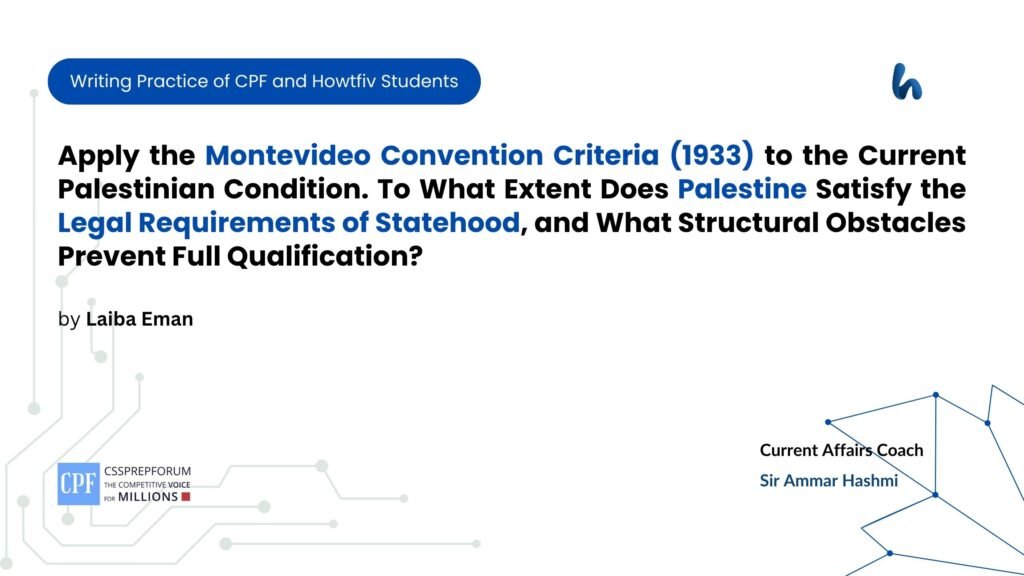
CSS Current Affairs | Montevideo Convention Criteria (1933) and the Current Palestinian Condition
The following assignment question for CSS Current Affairs is solved by Laiba Eman under the supervision of Howfiv’s Pakistan Affairs and Current Affairs Coaches: Miss Iqra Ali and Sir Ammar Hashmi. She learnt how to attempt 20 marks question and essay writing from Sir Syed Kazim Ali, Pakistan’s best CSS and PMS English essay and precis teacher with the highest success rate of his students. This solved question is attempted on the pattern taught by Sir to his students, scoring the highest marks in compulsory and optional subjects for years.

Outline
1-Introduction
2-Montevideo Convention and Statehood
3-To What Extent Does Palestine Satisfy the Montevideo Criteria?
- Having a Permanent Population
- Having Territory but not Properly Defined
- Lacking Effective Government
- Having Limited Capacity to Enter Relations with Other States
4-Structural Obstacles to Full Statehood
- Israeli Occupation and Settlement Expansion
- Political Division
- The Jerusalem Dispute
- Limited Sovereign Control
- Incomplete International Acceptance
5-Conclusion
Answer to the question
Introduction
Introduction
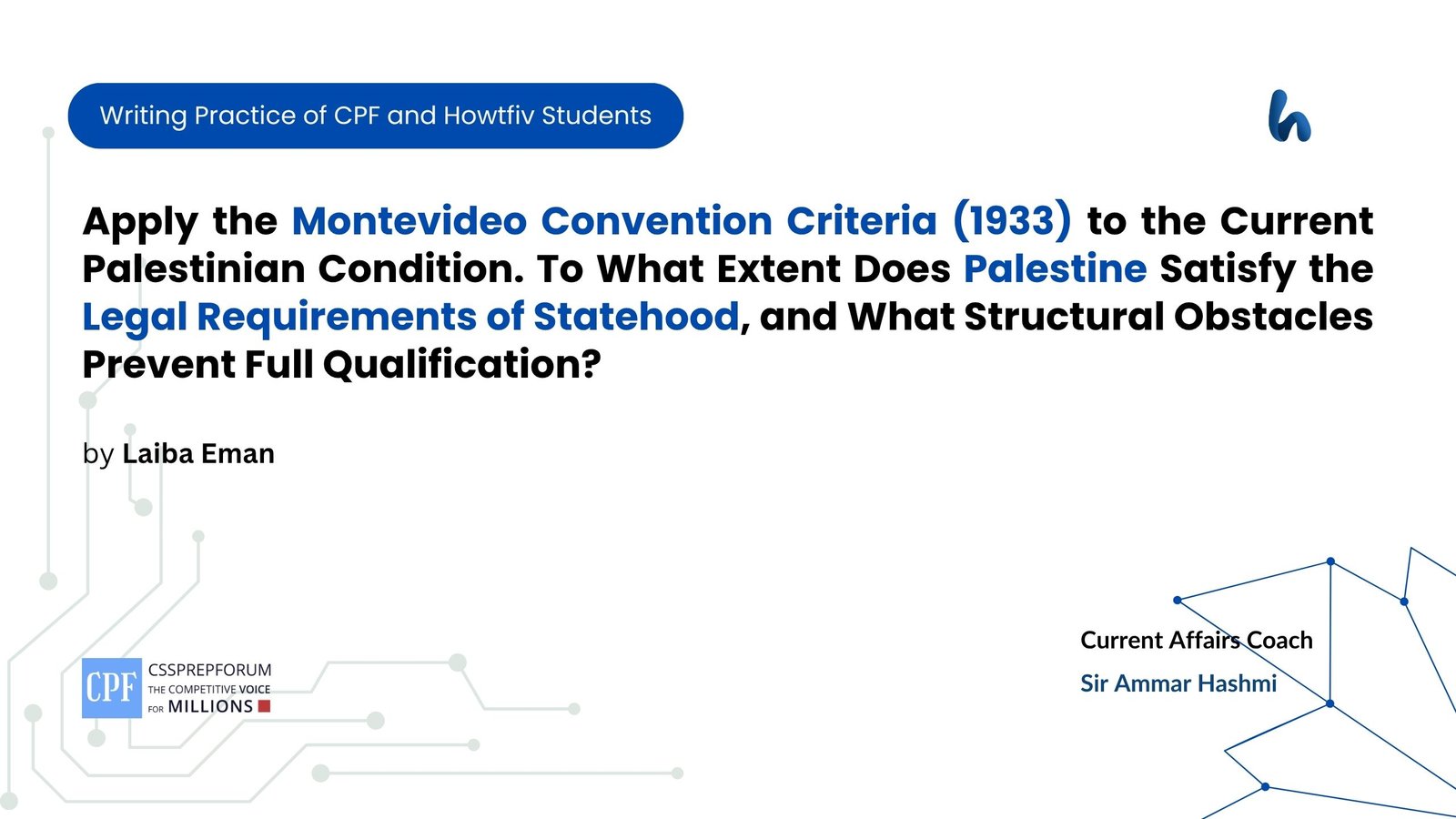
The question of Palestinian statehood remains one of the most debated issues in contemporary international law and international relations. The Montevideo Convention (1933) provides the widely accepted legal framework for determining statehood by establishing four criteria: a permanent population, a defined territory, an effective government, and the capacity to enter into relations with other states. While Palestine satisfies several of these requirements to a significant extent and enjoys broad international recognition, persistent political fragmentation, territorial disputes, and external constraints continue to impede its emergence as a fully sovereign and universally accepted state.
Montevideo Convention and Statehood
Article 1 of the Montevideo Convention defines a state as an entity possessing: (1) a permanent population, (2) a defined territory, (3) an effective government, and (4) the capacity to enter into relations with other states. Importantly, the Convention does not make international recognition a prerequisite for statehood, reflecting the declaratory theory of statehood.
To What Extent Does Palestine Satisfy the Montevideo Criteria?
- Having Permanent Population
Palestine largely satisfies the requirement of a permanent population. Millions of Palestinians reside in the West Bank, East Jerusalem, and the Gaza Strip and possess a distinct national identity. Despite displacement and refugee crises, a stable and continuous population remains attached to the territory.
- Having Territory but not Properly Defined
Palestine partially fulfills the criterion of a defined territory. The West Bank, East Jerusalem, and Gaza Strip constitute the territory claimed by the State of Palestine. Although borders remain disputed and Israeli settlements have fragmented parts of the territory, international law does not require perfectly demarcated boundaries for statehood. Therefore, Palestine possesses an identifiable territorial base despite ongoing disputes.
- Lacking Effective Government
This criterion represents Palestine’s greatest challenge. Governance is divided between the Palestinian Authority in the West Bank and Hamas in Gaza. Furthermore, Israeli control over borders, airspace, movement, and security significantly restricts the authority of Palestinian institutions. Consequently, Palestine possesses governmental structures but lacks complete and effective control over its claimed territory.
- Having Limited Capacity to Enter Relations with Other States
Palestine partially fulfills the fourth requirement. As More than 145 states recognize Palestine, it maintains diplomatic relations with numerous countries. It holds non-member observer state status at the United Nations and participates in various international organizations and treaties. These developments demonstrate a considerable capacity to conduct foreign relations; however, such capacity remains constrained by limited sovereignty.
Structural Obstacles to Full Statehood
International law experts highlight multiple structural challenges that prevent Palestine from being a sovereign state on practical grounds.
- Israeli Occupation and Settlement Expansion
The first challenge to Palestinian statehood is Israel’s illegal settlements in Palestinian land. Thousands of Israelis have been settled in the West Bank and East Jerusalem. Although these settlements are declared illegal by the United Nations, the International Court of Justice (ICJ), and several other sovereign countries, no one could stop Israel from settling its population in Palestinian territory. Moreover, the Oslo Accords’ administrative division of the West Bank has facilitated Israel’s military control. Therefore, Israeli military control and the expansion of settlements in the West Bank continue to undermine Palestinian territorial integrity and sovereignty, and the fragmentation of Palestinian land weakens prospects for a viable state.
- Political Division
One of the biggest challenges to Palestinian statehood is the presence of two governments with opposing ideas and agendas in Palestinian land. The Palestinian Authority in the West Bank has international recognition but is the least popular among Palestinians. On the other hand, Hamas governs Gaza with popular support. However, internationally, it is declared a terrorist organization. Moreover, the rivalry between the Palestinian Authority and Hamas has created dual centers of power. This internal fragmentation weakens governance and prevents the emergence of a unified national authority.
- The Jerusalem Dispute
Moreover, Jerusalem has remained the major cause of the dispute. Both Israelis and Palestinians claim Jerusalem as their capital, as it is a holy city for both Muslims and Jews. Hence, the unresolved status of the city remains one of the most contentious obstacles to a comprehensive political settlement and stable statehood.
- Limited Sovereign Control
Another challenge is Israel’s military control over Palestinian territories. The destruction, genocide, and blockade in Gaza have weakened Palestine as a state. Palestine has run out of resources, lost millions of precious lives, and is left with a war-torn nation. Consequently, Palestine lacks full control over its borders, airspace, security affairs, and natural resources. Such limitations restrict its ability to exercise the powers normally associated with sovereign states.
- Incomplete International Acceptance
Although Palestine enjoys broad recognition, it is not universally recognized and remains outside full UN membership. Moreover, several countries have only awarded diplomatic recognition to the State of Palestine. Some countries, like Canada and the UK, even added conditions to their recognition. Practically, these countries are not intended to establish foreign relations with Palestine until the establishment of peace. Therefore, right now Palestine cannot engage in trade and other foreign treaties on practical grounds, which poses a grave threat to Palestinian statehood.
Conclusion
Applying the Montevideo Convention reveals that Palestine clearly satisfies the requirements of a permanent population and possesses a substantial capacity to engage in international relations. It also has identifiable territory despite unresolved border disputes. However, the criterion of effective government remains only partially fulfilled due to political fragmentation and extensive external constraints. Consequently, Palestine exhibits many legal characteristics of statehood but continues to face structural obstacles that prevent the realization of full and uncontested sovereignty. Its statehood, therefore, remains legally significant yet practically constrained by political realities on the ground.
CSS Solved Past Papers’ Essays
Looking for the last ten years of CSS and PMS Solved Essays and want to know how Sir Kazim’s students write and score the highest marks in the essays’ papers? Then, click on the CSS Solved Essays to start reading them.
CSS Solved Essays
CSS Solved Islamiyat Past Papers
Want to read the last ten years’ Islamiyat Solved Past Papers to learn how to attempt them and to score high? Let’s click on the link below to read them all freely. All past papers have been solved by Pakistan’s top CSS Islamiyat coaches having the highest score of their students.
CSS Solved Islamiyat
CSS Solved General Science & Ability Past Papers
Want to read the last ten years’ General Science & Ability Solved Past Papers to learn how to attempt them and to score high? Let’s click on the link below to read them all freely. All past papers have been solved by Pakistan’s top CSS GSA coachez having the highest score of their students.
CSS Solved General Science & Ability
CSS Solved Pakistan Affairs Past Papers
Want to read the last fifteen years’ Pakistan Affairs Solved Past Papers to learn how to attempt them and to score high? Let’s click on the link below to read them all freely. All past papers have been solved by Pakistan’s top CSS Pakistan Affairs coaches having the highest score of their students.
CSS Solved Pakistan Affairs
CSS Solved Current Affairs Past Papers
Want to read the last fifteen years’ Current Affairs Solved Past Papers to learn how to attempt them and to score high? Let’s click on the link below to read them all freely. All past papers have been solved by Pakistan’s top CSS Current Affairs coaches having the highest score of their students.
CSS Solved Current Affairs