CSS Pakistan Affairs | Distribution of Powers b/w the Federation and Provinces Under the 1973 Constitution
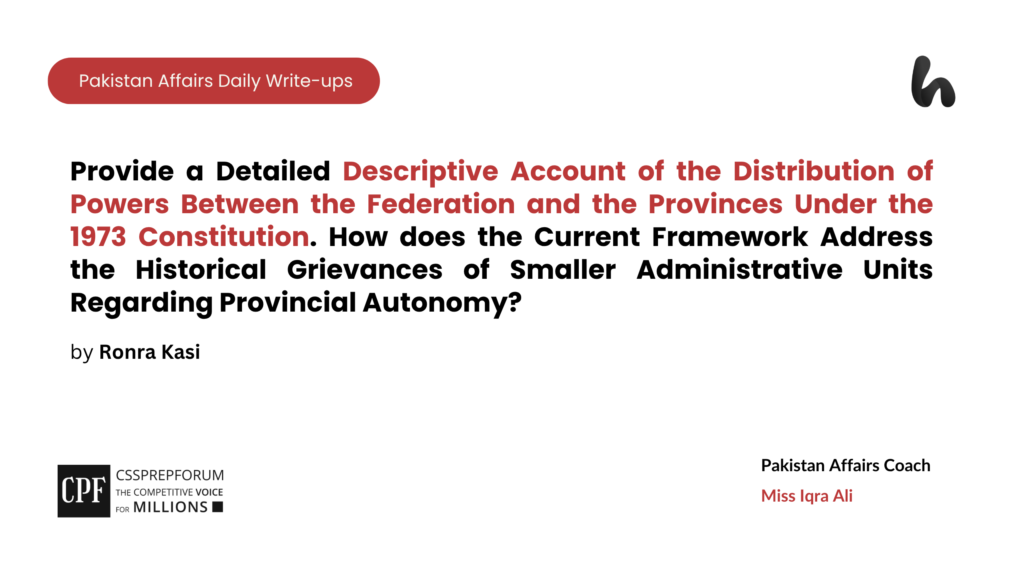
The following assignment question for CSS Pakistan Affairs is solved by Ronra Kasi under the supervision of Howfiv’s Pakistan Affairs and Current Affairs Coaches: Miss Iqra Ali and Sir Ammar Hashmi. She learnt how to attempt 20 marks question and essay writing from Sir Syed Kazim Ali, Pakistan’s best CSS and PMS English essay and precis teacher with the highest success rate of his students. This solved question is attempted on the pattern taught by Sir to his students, scoring the highest marks in compulsory and optional subjects for years.

Outline
1-Introduction
2-A Panoramic Overview of the 1973 Constitution
3-Dissecting the Distribution of Powers Between the Federation and the Provinces Under the 1973 Constitution
- Legislative Powers: Who Makes Laws on What
- Evidence: Article 142 splits legislative competence between Parliament and Provincial Assemblies; Article 143 gives federal law primacy on Federal List matters; residuary powers rest with provinces under Article 142(c).
- Executive Powers: Who Implements the Laws
- Evidence: Article 97 extends provincial executive authority to matters the Provincial Assembly can legislate on; Article 137 grants matching federal executive authority; Article 149 allows limited federal directions to provinces.
- Financial Powers: Who Gets What Share of Revenue
- Evidence: Article 160 establishes the National Finance Commission to determine vertical and horizontal distribution of the divisible tax pool between the Federation and Provinces, revised periodically through NFC Awards.
- Resource Ownership: Who Controls Natural Resources
- Evidence: Article 172(3) vests ownership of minerals and oil within a province’s territorial limits, including territorial waters, in that province rather than the Federation, reversing earlier centralized resource control.
- Institutional Balance: How Provinces Get a Voice at the Center
- Evidence: Article 153 establishes the Council of Common Interests; Article 154 mandates quarterly CCI meetings on Part II Federal List subjects; Article 59 gives every province equal Senate representation.
4-Analysing how the Current Framework Addresses the Historical Grievances of Smaller Administrative Units Regarding Provincial Autonomy
- From One Unit to Restored Provincial Identity
- Evidence: The 1973 Constitution reversed the 1955 One Unit Scheme, restoring Punjab, Sindh, KP, and Balochistan as constitutionally recognized federating units under Article 1, ending forced administrative merger.
- Fixing the Population-Only NFC Formula
- Evidence: Article 160 governs NFC Awards; the 7th NFC Award (2009) added poverty/backwardness, revenue collection, and inverse population density to population, raising Balochistan and KP’s fiscal share.
- Ending Federal Encroachment via the Concurrent List
- Evidence: The 18th Amendment (2010) deleted the Concurrent Legislative List from the Fourth Schedule, devolving 47 subjects, including education and health, exclusively to provinces under Article 142.
- Resource Ownership Returned to the Provinces
- Evidence: Article 172(3), inserted by the 18th Amendment, vests mineral and hydrocarbon ownership within a province’s territorial limits and territorial waters in the province, not the Federation.
- Strengthening the CCI as a Provincial Voice
- Evidence: The 18th Amendment reconstituted the CCI under Article 153–154, mandating quarterly meetings and giving provinces near-equal representation with the Federation over Part II Federal List subjects.
5-Bridging the Implementation Gap: Way Forward for Provincial Autonomy
- To Revive the Stalled NFC Award
- To Build Provincial Capacity for Devolved Subjects
- To Ensure Regular and Effective CCI Meetings
6-Critical Analysis
7-Conclusion

Answer to the question
Introduction
The relationship between the federation and the provinces has remained one of the most contested questions in Pakistan’s constitutional history. Similarly, this tension has shaped not just policy debates but the very survival of the federation itself. Since independence, provinces have struggled for a fair share of legislative, financial, and administrative authority, and this struggle shaped much of the political turbulence between 1947 and 1973. As an illustration, this clash is best understood through the theory of Ethnic Federalism, which posits that central governments in multi-ethnic states must devolve structural power to regional groups to prevent fragmentation. In the same vein, the 1973 Constitution attempted to settle this question by laying down a federal structure, later strengthened through the 18th Amendment of 2010 to accommodate ethno-regional aspirations. Yet, the debate over provincial autonomy has never fully disappeared, resurfacing with every NFC Award and every Council of Common Interests meeting.
A Panoramic Overview of the 1973 Constitution
The 1973 Constitution, adopted unanimously by an elected Parliament, remains Pakistan’s only constitution to survive as the country’s supreme law for over five decades. Its endurance alone sets it apart from the 1956 and 1962 Constitutions, both of which were abrogated within a decade. It established a federal parliamentary system with a bicameral legislature, dividing powers among the federation, the provinces, and shared institutions such as the Council of Common Interests, while reserving certain subjects exclusively for the centre under the Federal Legislative List. Apart from this, over time, amendments, most significantly the 18th Amendment, reshaped this balance, shifting greater legislative and financial weight toward the provinces. Consequently, this means the document in use today is considerably more provincial-friendly than the one originally passed in 1973.
Dissecting the Distribution of Powers Between the Federation and the Provinces Under the 1973 Constitution
- Legislative Powers: Who Makes Laws on What
In the first instance, legislative authority under the 1973 Constitution is divided between the federal Parliament and the provincial assemblies. To be sure, this division was meant to prevent the kind of over-centralization that had weakened provincial trust in the past. To illustrate, Article 142 lays down this division of legislative competence, while Article 143 gives federal law primacy whenever a conflict arises with provincial law on a Federal List subject. Importantly, Article 142(c) assigns all residuary subjects, matters not mentioned in the Federal List, to the provinces, which marks a significant departure from earlier constitutions that favoured central control. In effect, anything the Constitution does not explicitly claim for the centre automatically falls within provincial reach. To sum up, this residuary clause remains one of the strongest legal guarantees of provincial legislative space in Pakistan.
- Executive Powers: Who Implements the Laws
Adding to the above, executive authority mirrors the legislative division, giving provinces the power to implement laws within their own domain. Similarly, this ensures that provinces are not merely lawmakers on paper but also the actual implementers of those laws on the ground. In particular, Article 97 extends provincial executive authority to every matter the Provincial Assembly can legislate on, while Article 137 grants the federal government matching executive authority over Federal List subjects. Nonetheless, Article 149 allows the federation to issue directions to provinces in limited circumstances, such as ensuring compliance with federal laws, which keeps a degree of central oversight intact. Additionally, this shows that executive autonomy under the Constitution is real but not absolute. Thus, this arrangement tries to balance provincial self-rule with the practical need for federal coordination.
- Financial Powers: Who Gets What Share of Revenue
Moving ahead, financial powers determine how much fiscal space provinces actually enjoy, regardless of what the legislative and executive lists say on paper. Likewise, without adequate funds, even the widest legislative and executive powers would remain difficult to exercise in practice. Just to address this, Article 160 establishes the National Finance Commission, the body responsible for deciding how the divisible tax pool is shared vertically between the federation and provinces, and horizontally among the provinces themselves. Since this distribution is revised periodically through NFC Awards, it has become one of the most contested financial mechanisms in Pakistan’s federal system. Consequently, every revision of the award directly reshapes how much each province can spend on its own development priorities. Therefore, the NFC functions as the fiscal backbone of provincial autonomy.
- Resource Ownership: Who Controls Natural Resources
Hand in hand with this, ownership of natural resources has historically been one of the most sensitive federal-provincial issues, particularly for resource-rich but underdeveloped provinces. Additionally, control over resources found within a province’s own territory was long seen as a basic test of genuine autonomy. For instance, Article 172(3) vests ownership of minerals and oil within a province’s territorial limits, including its territorial waters, in that province rather than the federation. As a result, this provision reversed decades of centralized resource control, under which provinces like Balochistan received little benefit from resources extracted from their own soil. Accordingly, the change directly linked resource wealth to the province where it originates, rather than to the centre alone. In other words, resource ownership under Article 172(3) is therefore both a legal and a political correction to earlier imbalance.
- Institutional Balance: How Provinces Get a Voice at the Center
Beyond legislative, executive, and financial powers, provinces also need institutional platforms where their voice can shape national policy. More importantly, without such platforms, provinces would have authority within their own borders but little influence over decisions taken at the centre. For this very reason, Article 153 establishes the Council of Common Interests, Article 154 mandates that it meet once every ninety days to decide matters on the Part II Federal List, and Article 59 gives every province, regardless of population, equal representation in the Senate. On account of this, these institutions were designed to give smaller provinces a voice that population-based representation in the National Assembly could never provide. In particular, equal Senate representation ensures that a smaller province is never simply outvoted by a larger one. Together, they form the structural safeguard for provincial participation at the centre.
Analysing How the Current Framework Addresses the Historical Grievances of Smaller Administrative Units Regarding Provincial Autonomy
- From One Unit to Restored Provincial Identity
Perhaps the deepest historical grievance of the smaller provinces was the erasure of their identity under the One Unit Scheme. Undeniably, merging four distinct provinces into a single administrative unit had stripped them of their separate legislatures, budgets, and political representation. Nevertheless, the 1973 Constitution reversed the 1955 One Unit Scheme, restoring Punjab, Sindh, Khyber Pakhtunkhwa, and Balochistan as constitutionally recognized federating units under Article 1. In no uncertain terms, this restoration ended nearly two decades of forced administrative merger, during which the smaller provinces had lost their separate political and administrative identity altogether. However, without this restoration, none of the later autonomy-related reforms would have had a distinct province to apply to. To conclude, recognizing the four provinces as distinct units was the first and most symbolic step toward addressing their grievances.
- Fixing the Population-Only NFC Formula
For decades, the NFC distribution formula relied almost entirely on population, which disadvantaged provinces with smaller populations but larger needs. To that extent, Balochistan, despite covering nearly half of Pakistan’s landmass and facing severe underdevelopment, received a correspondingly small share simply because its population was low. In particular, Article 160 governs how NFC Awards are formulated, and the 7th NFC Award of 2009 finally added poverty and backwardness, revenue collection, and inverse population density as additional criteria alongside population. Above all, this change raised the fiscal share of Balochistan and Khyber Pakhtunkhwa, provinces that had long argued that a population-only formula ignored their underdevelopment and low revenue base. Consequently, it showed that the formula could be redesigned to reward need rather than headcount alone. Therefore, the 7th NFC Award thus marked a genuine attempt to make fiscal federalism more equitable.
- Ending Federal Encroachment via the Concurrent List
One must not overlook the fact that the Concurrent Legislative List had long allowed the federation to legislate on subjects that provinces considered their own domain. Moreover, this overlap meant that even after passing provincial laws, provinces often found federal legislation overriding their own on the same subjects. To address this, the 18th Amendment of 2010 deleted the Concurrent Legislative List from the Fourth Schedule altogether, devolving forty-seven subjects, including education and health, exclusively to the provinces under Article 142. provided that, this devolution was one of the most far-reaching reforms in Pakistan’s constitutional history, directly addressing complaints that the federation had encroached on provincial legislative territory for decades. For the first time, provinces gained exclusive and uncontested control over subjects central to everyday governance. Hence, it remains the clearest legal expression of provincial autonomy in the post-1973 era.
- Resource Ownership Returned to the Provinces
Beyond this, resource ownership was another area where the 18th Amendment directly responded to provincial grievances. Before this reform, resource-rich provinces often watched their minerals and hydrocarbons extracted with little local control or return. As an illustration, Article 172(3), inserted through the 18th Amendment, vests ownership of minerals and hydrocarbons within a province’s territorial limits and territorial waters in that province rather than the federation. For Balochistan in particular, where resource extraction without local benefit had fuelled decades of resentment, this constitutional guarantee carried both material and symbolic weight. As a result, it gave provinces a direct legal claim over wealth generated from their own land and waters. Thus, it converted a longstanding grievance into a codified constitutional right.
- Strengthening the CCI as a Provincial Voice
In addition to the above, a stronger Council of Common Interests was central to making provincial participation meaningful rather than merely symbolic. Before the 18th Amendment, the CCI met rarely and carried little real weight in federal decision-making. However, the 18th Amendment reconstituted the CCI under Articles 153 and 154, making quarterly meetings mandatory and giving provinces near-equal representation with the federation over Part II Federal List subjects. Regular, institutionalized consultation replaced what had previously been an infrequent and often bypassed forum, giving provinces a genuine seat at the table on shared subjects. This shift turned consultation from an occasional courtesy into a constitutional obligation. This reform strengthened the CCI from a nominal body into a functioning instrument of federal-provincial coordination.
Bridging the Implementation Gap: Way Forward for Provincial Autonomy
Despite these constitutional gains, gaps in implementation continue to limit real provincial autonomy.
- Reviving the Stalled NFC Award
The most urgent structural fix is reviving the next NFC Award, which has remained stalled since 2010. In particular, Wallace Oates’ theory of fiscal federalism holds that a federation functions efficiently only when fiscal transfers are revised periodically to match each unit’s changing revenue capacity and development needs, and Pakistan’s NFC mechanism under Article 160 was designed on exactly this logic. It bears emphasis that using an outdated formula from 2010 means provincial allocations no longer reflect present-day population shifts, poverty levels, or revenue collection, weakening the very fairness the 7th Award had achieved. Therefore, a fresh NFC Award is not a political favour to the provinces but a technical necessity for the fiscal federal system to keep working as intended.
- Building Provincial Capacity for Devolved Subjects
Second, devolution on paper means little if provinces cannot administer what they have received. For instance, Dennis Rondinelli’s decentralization model distinguishes devolution, the actual transfer of authority to a subnational unit, from deconcentration, where authority is transferred but the receiving unit still depends on the centre for capacity and resources, and much of Pakistan’s post-18th Amendment experience has drifted toward the latter. Moreover, many provinces still lack the trained staff, data systems, and planning capacity to run devolved subjects like education and health independently of federal support. Stemming from this reality, strengthening provincial bureaucracies and technical departments would move Pakistan’s devolution closer to Rondinelli’s true devolution model rather than a nominal transfer of names without power.
- Ensuring Regular and Effective CCI Meetings
Third, a federation only functions smoothly when its coordinating institutions are used consistently, not occasionally. As an illustration, Daniel Elazar’s cooperative federalism model argues that federating units and the centre must engage in continuous, structured consultation on shared subjects rather than treating coordination as optional, which is precisely the role Article 154 assigns to the Council of Common Interests through its mandatory quarterly meetings. Yet, in practical terms, CCI meetings have often been delayed or skipped, leaving provinces without a functioning forum to raise concerns on hydroelectric power, natural gas, or other shared subjects. For this very reason, enforcing the quarterly requirement in letter and spirit would turn the CCI from a dormant constitutional clause into a cooperative federalism model that actually works.
Critical Analysis
On balance, the 1973 Constitution, particularly after the 18th Amendment, has made real and measurable progress toward provincial autonomy. Similarly, few federations have devolved as many subjects in a single amendment as Pakistan did in 2010. Likewise, the devolution of forty-seven subjects, the constitutional recognition of resource ownership, and a more representative NFC formula are substantive achievements that earlier constitutions never delivered. Notwithstanding this, autonomy on paper has not always translated into autonomy in practice, since fiscal dependence on federal transfers, limited provincial capacity, and irregular CCI meetings continue to constrain the provinces. Compounding this further, this gap between constitutional design and administrative follow-through is where most of the remaining criticism is concentrated. What emerges from this analysis is that the framework is best described as structurally strong but administratively incomplete, requiring consistent political will to fully realize the autonomy it promises.
Conclusion
The inescapable conclusion is that the 1973 Constitution, especially as amended in 2010, represents Pakistan’s most serious constitutional effort to balance federal authority with provincial autonomy. Moreover, it succeeded where earlier constitutions had failed, without a shadow of doubt, by giving this balance lasting legal and institutional form. Additionally, through legislative devolution, a fairer NFC formula, resource ownership rights, and a strengthened CCI, it has addressed many of the historical grievances that once threatened national unity. Still, unresolved issues such as the stalled NFC Award and weak provincial capacity show that autonomy remains a work in progress rather than a finished project. What remains is not a question of drafting new provisions but of applying the ones already in place. In a word, sustained implementation, not further constitutional amendment, is now the real test of whether provincial autonomy under the 1973 Constitution can move from promise to practice.

CSS Solved Past Papers’ Essays
Looking for the last ten years of CSS and PMS Solved Essays and want to know how Sir Kazim’s students write and score the highest marks in the essays’ papers? Then, click on the CSS Solved Essays to start reading them.
CSS Solved Essays
CSS Solved Islamiyat Past Papers
Want to read the last ten years’ Islamiyat Solved Past Papers to learn how to attempt them and to score high? Let’s click on the link below to read them all freely. All past papers have been solved by Pakistan’s top CSS Islamiyat coaches having the highest score of their students.
CSS Solved Islamiyat
CSS Solved General Science & Ability Past Papers
Want to read the last ten years’ General Science & Ability Solved Past Papers to learn how to attempt them and to score high? Let’s click on the link below to read them all freely. All past papers have been solved by Pakistan’s top CSS GSA coachez having the highest score of their students.
CSS Solved General Science & Ability
CSS Solved Pakistan Affairs Past Papers
Want to read the last fifteen years’ Pakistan Affairs Solved Past Papers to learn how to attempt them and to score high? Let’s click on the link below to read them all freely. All past papers have been solved by Pakistan’s top CSS Pakistan Affairs coaches having the highest score of their students.
CSS Solved Pakistan Affairs
CSS Solved Current Affairs Past Papers
Want to read the last fifteen years’ Current Affairs Solved Past Papers to learn how to attempt them and to score high? Let’s click on the link below to read them all freely. All past papers have been solved by Pakistan’s top CSS Current Affairs coaches having the highest score of their students.
CSS Solved Current Affairs