CSS Pakistan Affairs | Dismemberment of Pakistan and ‘Two-Nation Theory’
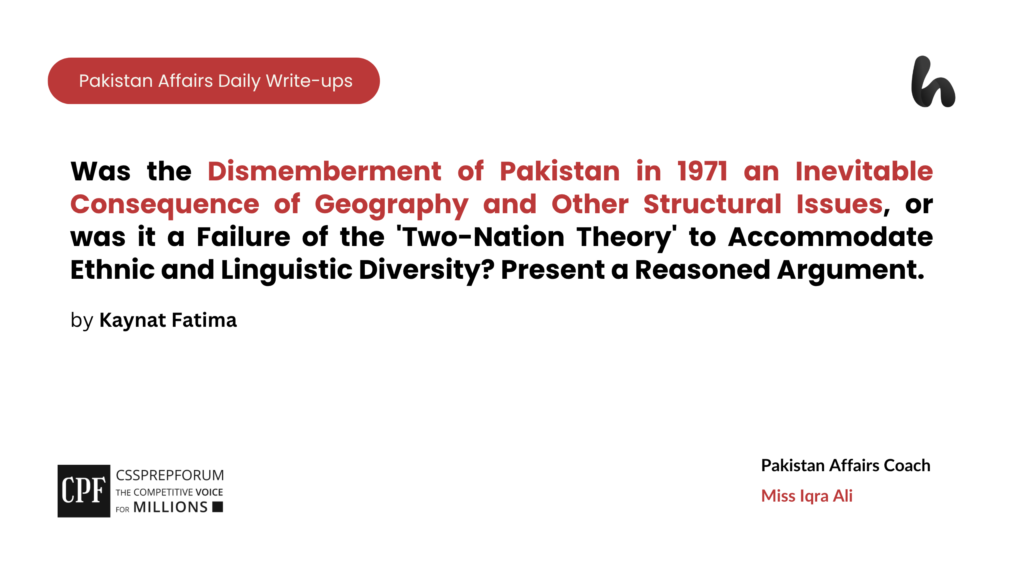
The following assignment question for CSS Pakistan Affairs is solved by Kaynat Fatima under the supervision of Howfiv’s Pakistan Affairs and Current Affairs Coaches: Miss Iqra Ali and Sir Ammar Hashmi. She learnt how to attempt 20 marks question and essay writing from Sir Syed Kazim Ali, Pakistan’s best CSS and PMS English essay and precis teacher with the highest success rate of his students. This solved question is attempted on the pattern taught by Sir to his students, scoring the highest marks in compulsory and optional subjects for years.

Outline
1-Introduction
2-Understanding the Two-Nation Theory
- ✓Definition of the Theory
- ✓Ideological Foundations
- ✓Objectives Behind Pakistan
3-The Dismemberment of Pakistan in 1971: The Collapse of the Two-Nation Theory Under the Weight of Ethnic and Linguistic Nationalism
- ✓The Primacy of Language: The First Crack in the Monolith
- Case in Point: The 1952 Language Movement (Bhasha Andolon).
- ✓Economic Disparity: The “Internal Colony” Narrative
- Case in Point: The Revenue Gap Statistics from the 1960s showed that although East Pakistan accounted for 55% of the population, it received less than 30% of total development expenditure.
- ✓Political Marginalization and the “West Pakistan Elite.”
- Case in Point: The Delay of the Constitution
- ✓The Failure of Federalism: The One-Unit Scheme
- Case in Point: The 1955 One-Unit Scheme
- ✓The 1970 Elections: The Breaking Point of Democratic Two-Nation Theory
- Case in Point: The Postponement of the National Assembly
- ✓Military Intervention: Operation Searchlight
- Case in Point: Operation Searchlight (March 25, 1971): The brutality of this operation shattered any remaining ideological bond
- ✓The “Two-Nation Theory” vs. the “Three-Nation Reality.”
- Case in Point: Indira Gandhi famously claimed that 1971 “drowned the Two-Nation Theory in the Bay of Bengal.”
4- Opponents of this View Argue that the Dismemberment of Pakistan in 1971 was not a Failure of the Two-Nation Theory; Rather, it was the Inevitable Consequence of Geographical Separation, Structural Inequalities, Political Mismanagement, and Economic Disparity.
- ✓Counter-Argument 1: The 1000-Mile Geographical Distance Made Pakistan’s Unity Impossible. Opponents argue that East and West Pakistan were separated by nearly 1000 miles of Indian territory, making political integration, military coordination, and administrative unity inherently unsustainable.
- Refutation: Geographical separation alone cannot explain state disintegration because many countries have survived despite territorial discontinuity and regional diversity. The real issue was the failure of political leadership to build inclusive institutions and equitable governance between the two wings.
- Case in Point: Before 1971, countries such as Indonesia and even the United States managed geographically distant territories through political accommodation and federal mechanisms.
- Refutation: Geographical separation alone cannot explain state disintegration because many countries have survived despite territorial discontinuity and regional diversity. The real issue was the failure of political leadership to build inclusive institutions and equitable governance between the two wings.
- ✓Counter-Argument 2: Another argument suggests that Pakistan did not collapse internally; rather, India exploited the crisis militarily and diplomatically to weaken Pakistan. Hence, the breakup should be attributed to external aggression rather than internal ideological failure.
- Refutation: Indian intervention accelerated the separation, but it did not create the underlying crisis. External powers can only exploit vulnerabilities that already exist within a state. The roots of Bengali alienation had developed over decades through political exclusion, linguistic suppression, and the denial of democratic rights.
- Case in Point: The Bengali nationalist movement had already gained massive support after the 1970 elections and Operation Searchlight, even before India formally intervened in December 1971.
- Refutation: Indian intervention accelerated the separation, but it did not create the underlying crisis. External powers can only exploit vulnerabilities that already exist within a state. The roots of Bengali alienation had developed over decades through political exclusion, linguistic suppression, and the denial of democratic rights.
- ✓Counter-Argument 3: Geography granted India a “permanent strategic advantage.” By controlling the land, sea, and air routes between the two wings, India could and did exploit the structural fragility of the Pakistani state.
- Refutation: A hostile neighbor can only exploit internal divisions if they already exist. For 24 years, the 1,000-mile distance was bridged by a shared sense of purpose. India did not burn that bridge; it was burned by the West Pakistani elite’s refusal to recognize the Bengali language and ethnic rights.
- Case in Point: India did not create the Awami League, nor did it invent the “Six Points.” These were indigenous responses to the TNT’s failure to provide a “Muslim identity” that included “Bengali culture.”
- Refutation: A hostile neighbor can only exploit internal divisions if they already exist. For 24 years, the 1,000-mile distance was bridged by a shared sense of purpose. India did not burn that bridge; it was burned by the West Pakistani elite’s refusal to recognize the Bengali language and ethnic rights.
5-Critical Analysis
6-Conclusion

Answer to the question
Introduction
The dismemberment of Pakistan in 1971 remains one of the most debated events in South Asian history. The separation of East Pakistan and the emergence of Bangladesh raised profound questions regarding the ideological foundations of Pakistan. Although the thousand-mile separation of the two wings made the breakup an inevitable consequence of geography and economics, the conflict’s true significance lay in its exposure of the Two-Nation Theory’s failure to address linguistic and ethnic identities. In reality, although geography and structural issues intensified the crisis, the principal cause of the dismemberment was the inability of the Pakistani state to create an inclusive national identity that respected Bengali linguistic, cultural, and political aspirations.
Understanding the Two-Nation Theory
- Definition of the Two-Nation Theory
The Two-Nation Theory was the political and ideological belief that Muslims and Hindus of the Indian subcontinent constituted two distinct nations because they possessed different religions, cultures, social traditions, historical experiences, and political interests. Although both communities had lived together for centuries, Muslim political thinkers increasingly argued that religious identity was closely connected with their collective political and social interests. Consequently, Muslims needed constitutional safeguards and, eventually, a separate political arrangement where they could preserve and develop their distinct identity.
- Ideological Foundations
The intellectual foundations of the Two-Nation Theory developed gradually rather than emerging from a single individual or event. Sir Syed Ahmad Khan was among the earliest prominent Muslim thinkers to emphasize the distinct political interests of Muslims and Hindus, particularly after the political changes following the War of Independence of 1857. He encouraged Muslims to acquire modern education and develop political awareness so that they could protect their interests in a changing India. Later, Allama Muhammad Iqbal gave the idea a broader political dimension. In his Allahabad Address of 1930, he envisioned a consolidated Muslim-majority political unit in north-western India, arguing that Muslim identity required meaningful political expression. Building upon these intellectual developments, Quaid-e-Azam Muhammad Ali Jinnah transformed Muslim political aspirations into a powerful constitutional and political struggle through the Muslim League. Thus, the theory evolved from intellectual reflection into an organized political demand.
- Objectives Behind the Creation of Pakistan
The Two-Nation Theory ultimately provided an ideological basis for the demand for Pakistan. First, Muslims sought the protection of their religious and cultural identity in a politically changing subcontinent. Second, they demanded political autonomy so that they could govern themselves and safeguard their collective political interests rather than remain permanently dependent on a Hindu-majority political structure. Moreover, the movement aimed to create an environment in which Muslims could preserve and develop their Islamic culture, traditions, and values. Therefore, the demand for Pakistan was presented not merely as a territorial claim but as a struggle for political security, cultural preservation, and the collective expression of Muslim identity.
The Dismemberment of Pakistan in 1971: The Collapse of the Two-Nation Theory Under the Weight of Ethnic and Linguistic Nationalism
- The Primacy of Language: The First Crack in the Monolith
Furthermore, the first major challenge to the ideological unity of Pakistan emerged through the language issue. Although Bengalis constituted the majority population of Pakistan, Urdu was declared the sole national language. Consequently, Bengalis perceived this decision as cultural domination by West Pakistan. The Bengali Language Movement reached its peak on February 21, 1952, when students protesting for the recognition of Bengali were killed by police in Dhaka. As a result, linguistic identity became a powerful political force in East Pakistan. Thus, the state’s refusal to recognize Bengali culture weakened the emotional bond created by religion alone.
- Economic Disparity: The “Internal Colony” Narrative
Another major source of Bengali resentment was economic inequality between the two wings. Despite East Pakistan generating substantial export revenue through jute, most state investment and industrial development remained concentrated in West Pakistan. Statistics from the 1960s demonstrated that East Pakistan, despite comprising nearly 55 percent of the population, received less than 30 percent of total development expenditure. Consequently, many Bengalis believed that East Pakistan had become an “internal colony” exploited by the ruling elite of West Pakistan. Therefore, economic deprivation transformed regional dissatisfaction into nationalist consciousness.
- Political Marginalization and the “West Pakistani Elite”
In addition to economic inequality, Bengalis faced political exclusion. The civil bureaucracy and military leadership remained dominated by West Pakistani elites, particularly Punjabis and Muhajirs. The prolonged delay in framing Pakistan’s constitution intensified Bengali frustrations. Although East Pakistan had a numerical majority, constitutional arrangements repeatedly denied Bengalis proportional political authority. Consequently, democratic principles were sacrificed to preserve elite dominance. Hence, political marginalization deepened the perception that Bengali interests were systematically ignored.
- The Failure of Federalism: The One-Unit Scheme
Furthermore, Pakistan’s federal structure failed to accommodate regional diversity. Instead of promoting provincial autonomy, the central government pursued excessive centralization. Under the One-Unit Scheme, all provinces of West Pakistan were merged into a single administrative unit to create parity with East Pakistan. However, Bengalis interpreted this policy as an attempt to neutralize their demographic majority. Therefore, rather than fostering unity, the scheme increased mistrust between the two wings. Thus, the state failed to establish a genuinely federal system capable of respecting ethnic diversity.
- The 1970 Elections: The Breaking Point of Democratic Two-Nation Theory
Similarly, the crisis reached its climax after the general elections of 1970. The Awami League, led by Sheikh Mujibur Rahman, won an overwhelming majority based on its Six-Point Programme demanding provincial autonomy. Instead of transferring power to the elected representatives, the military regime postponed the National Assembly session. Consequently, Bengalis viewed this act as a denial of their democratic rights. At this critical moment, the ideological unity of Pakistan collapsed under political mistrust. Therefore, the refusal to respect democratic principles accelerated separatist sentiment.
- Military Intervention: Operation Searchlight
Moreover, when political negotiations between East and West Pakistan failed, the state resorted to military force instead of democratic reconciliation. Consequently, the Pakistani military launched Operation Searchlight on March 25, 1971, to crush Bengali nationalism and restore central authority in East Pakistan. However, the operation targeted students, intellectuals, political activists, and civilians, treating the Bengali population as enemies rather than equal citizens of the state. As a result, widespread killings, destruction, and human rights violations deepened Bengali resentment against West Pakistan. The brutality of Operation Searchlight shattered whatever ideological bond still existed between the two wings because it demonstrated that the principle of “Muslim brotherhood” could not survive when the state used violence against its own majority population. Therefore, the operation proved to be a decisive turning point that transformed the Bengali autonomy movement into a full-scale struggle for independence and further exposed the inability of the Two-Nation Theory to sustain unity in the absence of justice, equality, and political inclusion.
- The “Two-Nation Theory” versus the “Three-Nation Reality”
Last but not least, the dismemberment of Pakistan in 1971 gave rise to the argument that the Two-Nation Theory had failed to maintain unity among the Muslims of Pakistan. Critics, most notably Indian Prime Minister Indira Gandhi, famously declared that the events of 1971 had “drowned the Two-Nation Theory in the Bay of Bengal.” According to this perspective, the creation of Bangladesh demonstrated that ethnic, linguistic, and cultural identities were more powerful than religious identity in the modern political world. Although the Muslims of East and West Pakistan shared a common religion, big differences in language, culture, economic interests, and political aspirations ultimately divided them. Consequently, Bengali nationalism emerged as a stronger force than pan-Islamic nationalism. This development led many scholars to argue that the subcontinent’s reality was not based on merely two nations, Muslims and Hindus, but rather on multiple national identities, including the Bengali nation. Therefore, the emergence of Bangladesh exposed the limitations of the Two-Nation Theory in accommodating ethnic and linguistic diversity within a single state.
Opponents of this View Argue that the Dismemberment of Pakistan in 1971 was not a Failure of the Two-Nation Theory; Rather, it was the Inevitable Consequence of Geographical Separation, Structural Inequalities, Political Mismanagement, and Economic Disparity.
Despite the above arguments, many scholars reject the notion that 1971 represented the failure of the Two-Nation Theory. Instead, they argue that geography, structural weaknesses, and external intervention made Pakistan’s unity unsustainable.
Nonetheless, East and West Pakistan were separated by approximately one thousand miles of Indian territory. Therefore, political integration, military coordination, and administrative efficiency were inherently difficult. However, geographical separation alone cannot explain state disintegration. Many geographically fragmented states have survived through inclusive governance and effective federalism. The true failure lay in the inability of the Pakistani leadership to create equitable political institutions and national integration mechanisms. Countries such as Indonesia and even the United States managed geographically distant territories through political accommodation and constitutional flexibility. Therefore, geography became dangerous only because political trust had already collapsed.
Nevertheless, India exploited Pakistan’s internal crisis and militarily intervened to weaken its rival. Hence, the breakup should be attributed to external aggression rather than ideological failure. Although Indian intervention accelerated the separation, it did not create the crisis. External actors can only exploit divisions that already exist internally. Bengali alienation had emerged decades before Indian military involvement. The Awami League had already won overwhelming support in the 1970 elections before India formally intervened. Similarly, Sheikh Mujibur Rahman’s Six-Point Programme reflected indigenous demands for autonomy rather than foreign-sponsored separatism. Therefore, India exploited the crisis, but Pakistan’s internal failures produced it.
Nonetheless, India possessed permanent strategic superiority because it controlled the land, sea, and air routes connecting the two wings of Pakistan. However, strategic vulnerabilities alone do not destroy states. For nearly twenty-four years, Pakistan survived despite geographical separation because a shared ideological purpose initially existed. The real issue emerged when Bengali linguistic and ethnic identity was denied recognition. India neither created the Awami League nor invented the Six Points. These movements emerged organically from Bengali grievances regarding cultural suppression and political exclusion. Hence, the crisis originated internally rather than externally.
Critical Analysis
A critical examination reveals that the dismemberment of Pakistan cannot be explained through a single factor. Geography, economic disparity, weak institutions, military dominance, and Indian intervention all contributed significantly to the crisis. Nevertheless, these structural problems became destructive because the Pakistani state failed to develop an inclusive interpretation of the Two-Nation Theory. The original theory successfully mobilized Muslims against Hindu majoritarianism before partition. However, after independence, the state leadership failed to redefine nationhood in a manner that accommodated Pakistan’s ethnic and linguistic pluralism. Instead of embracing diversity within an Islamic framework, successive governments promoted centralized nationalism dominated by West Pakistani elites. Moreover, democracy was repeatedly undermined through military intervention and bureaucratic authoritarianism. Consequently, Bengali demands for autonomy gradually evolved into demands for independence. Therefore, the tragedy of 1971 was not merely the failure of geography or economics; rather, it was fundamentally the failure of political leadership to translate ideology into inclusive statecraft.
Conclusion
In conclusion, the dismemberment of Pakistan in 1971 was not simply an inevitable consequence of geographical separation or structural weaknesses. Although the thousand-mile distance, economic disparities, political instability, and Indian intervention intensified the crisis, the deeper issue was the inability of the Pakistani state to accommodate ethnic and linguistic diversity within the framework of the Two-Nation Theory. The refusal to recognize Bengali language, culture, political rights, and democratic mandate weakened the ideological unity that had once inspired the creation of Pakistan. Therefore, the tragedy of 1971 ultimately demonstrated that religion alone cannot sustain a nation unless it is accompanied by justice, federalism, democracy, and inclusive governance.

CSS Solved Past Papers’ Essays
Looking for the last ten years of CSS and PMS Solved Essays and want to know how Sir Kazim’s students write and score the highest marks in the essays’ papers? Then, click on the CSS Solved Essays to start reading them.
CSS Solved Essays
CSS Solved Islamiyat Past Papers
Want to read the last ten years’ Islamiyat Solved Past Papers to learn how to attempt them and to score high? Let’s click on the link below to read them all freely. All past papers have been solved by Pakistan’s top CSS Islamiyat coaches having the highest score of their students.
CSS Solved Islamiyat
CSS Solved General Science & Ability Past Papers
Want to read the last ten years’ General Science & Ability Solved Past Papers to learn how to attempt them and to score high? Let’s click on the link below to read them all freely. All past papers have been solved by Pakistan’s top CSS GSA coachez having the highest score of their students.
CSS Solved General Science & Ability
CSS Solved Pakistan Affairs Past Papers
Want to read the last fifteen years’ Pakistan Affairs Solved Past Papers to learn how to attempt them and to score high? Let’s click on the link below to read them all freely. All past papers have been solved by Pakistan’s top CSS Pakistan Affairs coaches having the highest score of their students.
CSS Solved Pakistan Affairs
CSS Solved Current Affairs Past Papers
Want to read the last fifteen years’ Current Affairs Solved Past Papers to learn how to attempt them and to score high? Let’s click on the link below to read them all freely. All past papers have been solved by Pakistan’s top CSS Current Affairs coaches having the highest score of their students.
CSS Solved Current Affairs