CSS/PMS Islamiat | Compare and Contrast the Islamic Concept of ‘Nafs’ with Modern Psychological Theories Of the Human Ego
The Islamic concept of Nafs structuralizes the human psyche through spiritual ascension across Ammarah, Lawwamah, and Mutma’innah, whereas Freudian psychoanalysis restricts behavior to secular tensions among the Id, Ego, and Superego; therefore, remains an important topic in CSS Islamiat.

Outline
1-Introduction
2-A Bird’s-Eye View: Islamic Concept of Nafs and Freud’s Theory of Modern Psychology
3-Comparison Between the Islamic Concept of Nafs and Modern Psychological Theories
3.1- Acknowledge Internal Conflict Within the Human Self
3.2-Creates Awareness of Right and Wrong and Produces Guilt
3.3- Inner Peace as the Ultimate Goal of the Self
4-Contrast Between the Islamic Concept of Nafs vs Modern Psychological Theories
4.1-The Source of Moral Authority: Divine Revelation vs. Social Conditioning
4.2- The Spiritual Dimension: Nafs as a Journey Toward Allah vs. Freud’s Secular Framework
4.3- The Nature of the Lowest Stage: Reformable vs. Permanent Instinct
5-How the Islamic Framework Offers a More Holistic Approach to Mental Health and Inner Peace?
5.1-Islam Addresses the Root Cause: The State of the Heart and Soul
5.2-The Three Stages of Nafs: A Clear and Progressive Path to Inner Peace
5.3-Islam’s Framework Is Not Limited to the Individual: It Builds a Just and Peaceful Society
5.4-The Concept of Divine Accountability: A Permanent Moral Anchor
6-Conclusion
Answer to the Question
Introduction
The human soul has always been a subject of deep thinking, both in religion and in science. Islam describes the inner self through the concept of Nafs, dividing it into three spiritual states: Nafs al-Ammarah (the commanding soul), Nafs al-Lawwamah (the self-reproaching soul), and Nafs al Mutma’innah (the peaceful soul). On the other hand, Sigmund Freud, the Austrian neurologist,proposed a different model of the inner mind built on three psychological components: the Id, the Ego, and the Superego. While the two frameworks come from entirely different traditions and time periods, they both try to explain why human beings struggle within themselves and what it means to live a balanced inner life. Yet, in practical terms, they differ profoundly in their view of whether the lowest state of the self can be truly transformed.
Bird’s-Eye View: Islamic concept of Nafs and Freud’s Theory of Modern Psychology
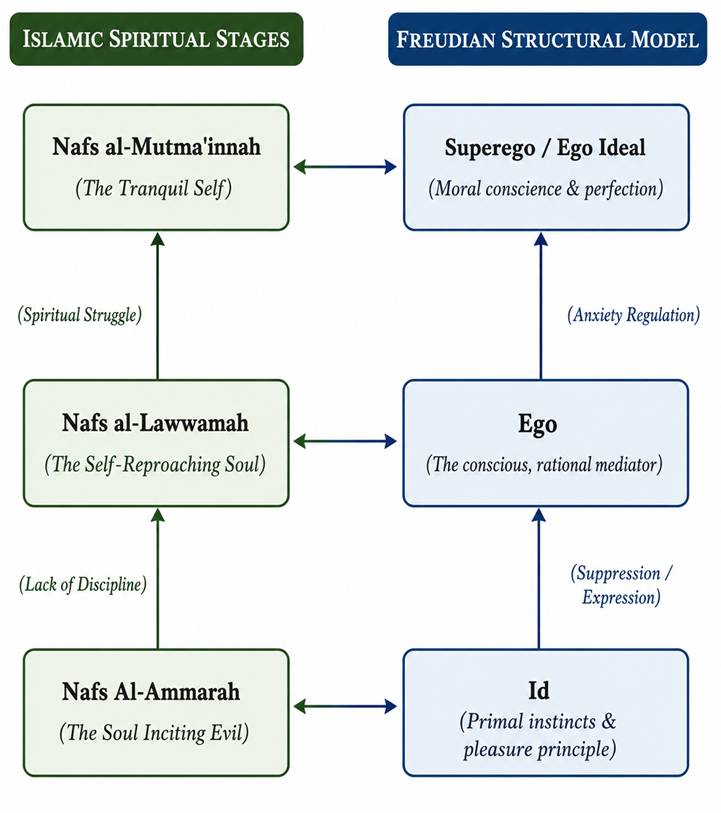
Islam describes the human soul, known as nafs, not as a single fixed state but as a living, changing reality that moves through distinct spiritual stages. According to the Islamic framework, every human being begins at the lowest level, nafs al-ammarah, the soul that commands toward evil and follows desire without control. In particular, the Quran states, “Indeed, the soul is prone to command evil” (Surah Yusuf ). Adding on, with moral awareness and sincere effort, a person can rise to the stage of nafs al-lawwamah, the self-reproaching soul that feels guilt after wrongdoing and begins to distinguish between right and wrong. Further to this, the highest state is nafs al-mutma’innah: the peaceful soul that has found complete rest through obedience to Allah. To illustrate, Allah addressed in the Quran with honor, “O tranquil soul, return to your lord, pleased and pleasing” (surah al-fajr ). Taken together, these factors suggest that this journey from the lowest to the highest state is not automatic; it requires tazkiyah (self-purification) through prayer, fasting, remembrance of Allah, and following the Quran and Sunnah. Notwithstanding this, Sigmund Freud’s structural model divides the human psyche into three interacting parts. The id operates unconsciously, driven by biological impulses and immediate pleasure. The ego acts as the conscious mediator, balancing these primal desires with reality. Finally, the superego enforces morality and societal rules, shaping our conscience and behavior.
Comparison Between the Islamic Concept of Nafs vs Modern Psychological Theories
Despite their different origins, the Islamic concept of Nafs and Freud’s psychoanalytic model share certain observations about the inner self that cannot be overlooked.
- Acknowledge Internal Conflict Within the Human Self
To begin with, one of the most striking similarities between the Islamic concept of Nafs and Freud’s structural theory is that both agree on one basic truth: the human being is not at peace with himself by default. There is always a struggle happening inside. In particular, Islam teaches this clearly through the stage of Nafs al-Ammarah, which is described in the Quran as the soul that “Commands toward evil” Surah Yusuff 12:53). This soul pulls a person toward desire, sin, and immediate pleasure without thinking about consequences. Similarly, Freud’s id operates on what he called the “Pleasure Principle “, it seeks immediate gratification of instincts and desires without caring about reality, morality, or the needs of others. In both frameworks, the lowest level of the self is driven by impulse and craving. Islam frames this as the beginning of a spiritual journey, while Freud frames it as the most primitive layer of the human personality. To sum up, the point of agreement is clear: Both traditions recognize that a raw, uncontrolled inner force exists in every human being, and that this force pulls toward excess and immediate satisfaction.
- Creates Awareness of Right and Wrong and Produces Guilt
In addition to the above, another important similarity is that both Islam and Freud’s theory include a middle stage or component that makes a person aware of their moral failures and produces a feeling of guilt or regret. In Islamic thought, this is Nafs al-Lawwamah, the self-reproaching soul. Allah asserts by it in the Quran, saying, “And those who, when they commit an immorality or wrong themselves [by sinning], remember Allah and seek forgiveness for their sins…”Surah Ali ‘Imran (3:135) This is the soul that knows the difference between right and wrong and blames itself after falling into sin. It represents moral consciousness, the moment when a person wakes up and feels the weight of what they have done. In Freud’s theory, this role belongs to the superego. According to Freud, the superego is the moral conscience of a person. It acts as the “Inner voice” That tells a person when they have done something wrong and punishes them internally with feelings of guilt, shame, and anxiety when they fall short of moral standards. Therefore, both concepts describe a moral awareness system within the self that monitors behavior and responds when something goes wrong.
- Inner Peace as the Ultimate Goal of the Self
The most meaningful similarity between the two frameworks is that both identify inner peace and balance as the highest state a human being can reach. In Islam, this is represented by Nafs Al-Mutma’innah, the peaceful soul. To illustrate, the Quran addresses this soul directly, “O tranquil soul, return to your lord, pleased and pleasing [to him]. (Surah al-Fajr). This is the state where a person has overcome their desires, strengthened their faith, and found deep contentment through closeness to Allah. In Freud’s theory, psychological health is also understood as a state of balance. When the id, ego, and superego work together in harmony, without one dominating the others, the person is mentally stable, able to make good decisions, and not overwhelmed by either extreme impulse or excessive guilt. A dominant superego leads to anxiety and perfectionism, while a dominant id leads to impulsive and destructive behavior. Balance is the goal for Freud too, even though he describes it in purely psychological terms. Both traditions, therefore, agree that the goal of inner development is to reach a state where the self is no longer at war with itself.

Contrast Between the Islamic Concept of Nafs vs Modern Psychological Theories
Despite sharing a common subject, Islam and modern psychology differ sharply in how they understand the human soul, and these differences are both fundamental and far-reaching.
- The Source of Moral Authority: Divine Revelation vs. Social Conditioning
Despite the aforementioned similarities, the difference between the two frameworks lies in where they locate the source of morality. In Islam, the moral standard comes directly from Allah; it is absolute, eternal, and unchanging. The Nafs model is rooted in the Quran and Sunnah, and the path from Nafs al-Ammarah to Nafs al-Mutma’innah is guided by divine revelation. A Muslim knows what is right and wrong not because society tells them, but because Allah has revealed it. The Quran states, “Indeed, Allah commands justice and Ihsan.”(Surah An-Nahl). This makes Islamic moral values universal; they do not change based on culture or generation. Freud’s model, on the other hand, locates morality entirely within human experience. According to Freud, the Superego forms through the internalization of parental and societal values during early childhood. This means morality, in Freud’s view, is not absolute; it is whatever your parents and society taught you to believe. Freud saw no divine element in human conscience; it was, for him, purely a product of psychology and social learning. This is a big and unbridgeable difference: Islam grounds moral authority in God, while Freud grounds it entirely in human society.
- The Spiritual Dimension: Nafs as a Journey Toward Allah vs. Freud’s Secular Framework
Second, a major contrast between the two frameworks is that Islam places the concept of Nafs within a spiritual journey that has a divine purpose and a divine destination. The three stages of Nafs are not just psychological descriptions; they are a map of the soul’s progress toward Allah. The Prophet Muhammad (PBUH) said, “Indeed, in the body there is a piece of flesh; if it is sound, the whole body is sound, and if it is corrupt, the whole body is corrupt. Indeed, it is the heart.” (Sahih Bukhari and Sahih Muslim). This teaches that inner purification (Tazkiyah) is an act of worship and a means of drawing closer to Allah. The goal of Nafs al-Mutma’innah is not just personal happiness; it is the pleasure of Allah and entry into His mercy. Freud’s framework, by contrast, is completely secular. It has no concept of God, the soul in a divine sense, the afterlife, or worship. For Freud, the human mind is a biological and psychological mechanism, and the goal of therapy is simply to achieve a better balance among the Id, Ego, and Superego so that a person can function in society without suffering too much. Therefore, there is no spiritual elevation, no divine connection, and no concept of accountability before God. This makes the two frameworks very different in their ultimate purpose and vision of human well-being.
- The Nature of the Lowest Stage: Reformable vs. Permanent Instinct
Third, the most clear difference is how the two frameworks view the lowest, most primitive level of the self. In Islam, Nafs al-Ammarah is not permanent. It is the starting point of a spiritual journey that can be overcome through sincere effort, worship, remembrance of Allah, and adherence to the Quran and Sunnah. Allah Himself provides an exception in the Quran, “Indeed, the soul commands toward evil, except for those upon whom my Lord has mercy.” (Surah Yusuf 12:53). This shows that with Allah’s mercy and human effort, a person can rise above the commanding soul and eventually reach the state of peace. The Nafs can be educated, trained, and transformed. Freud’s Id, however, is described as a permanent, unchangeable biological force. It is present from birth, entirely unconscious, and always pushing for immediate pleasure. It cannot be educated or reformed; it can only be managed by the Ego and restrained by the Superego. Freud saw the Id as the “oldest and most primitive psychic agency” that does not grow or change with time. This is a significant difference: Islam believes the lowest state of the soul can be transformed through faith and effort, while Freud believed the Id is a fixed biological reality that must simply be kept under control.
How the Islamic Framework Offers a More Holistic Approach to Mental Health and Inner Peace?
- Islam Addresses the Root Cause: The State of the Heart and Soul
Compounding this further, one of the strongest reasons why the Islamic framework offers a more holistic approach to mental health is that it addresses the root cause of inner struggle: the state of the heart and the soul. Islam does not only look at symptoms or behavior, but it also goes to the very core of who a person is and asks: what is the condition of your soul. The Holy Prophet said this in a hadith, “Indeed, in the body there is a piece of flesh; if it is sound, the whole body is sound, and if it is corrupt, the whole body is corrupt.” This teaches that real mental and spiritual health begins with the purification of the heart through Tazkiyah, a process that includes prayer (Salah), fasting (Sawm), remembrance of Allah (Dhikr), and charity (Zakat). Freud’s model only works at the level of the conscious and unconscious mind, with no concept of spiritual healing. It provides talk therapy and psychological analysis, but it cannot offer the deep peace that comes from a relationship with God. Islam provides this relationship as the foundation of all healing, making its approach far more complete and total than Freud’s purely psychological model.
- The Three Stages of Nafs: A Clear and Progressive Path to Inner Peace
Further to this, the Islamic framework offers something very practical that Freud’s model does not: a clear, progressive road-map for inner development. The journey from Nafs al-Ammarah to Nafs al-Lawwamah, to Nafs al-Mutma’innah is not just a description of three psychological states; instead, it is a spiritual ladder that a person can consciously climb. A person who is aware that their Nafs is in the Ammarah state can take specific steps, increasing their Salah, seeking forgiveness, and avoiding sin, to move toward the Lawwamah stage, where moral awareness grows. From there, continued spiritual effort leads to the Mutma’innah state, where Allah Himself addresses the soul with peace and acceptance. This gives a Muslim both self-awareness and direction. Freud’s model, by contrast, describes how the Id, Ego, and Superego work and conflict, but it does not offer the person a clear spiritual path forward. Freudian therapy often takes years and involves re-analyzing childhood trauma, with no guaranteed outcome of inner peace. The Islamic model offers a far more direct and accessible path: submission to Allah, moral effort, and sincere worship are all within reach of every person, regardless of their background or resources.
- Islam’s Framework Is Not Limited to the Individual: It Builds a Just and Peaceful Society
Another reason why the Islamic framework is more holistic is that the purification of the Nafs in Islam is not only a personal matter; it has direct consequences for society. When individuals purify their souls, society becomes more just, more compassionate, and more stable. The Quran states, “Indeed, Allah will not change the condition of a people until they change what is within themselves.” (Surah Ar-Ra’d 13:11). This verse directly links inner personal reform with collective social progress. The concept of Amr bil Ma’ruf wa Nahi anil Munkar (enjoining good and forbidding evil) extends this personal responsibility outward. Muslims are expected to contribute to the moral health of their entire community. On the other hand, Freud’s theory is entirely individual. It focuses on the inner conflicts of a single person’s mind and aims to help that one individual function better. It has no societal dimension, no concept of collective moral responsibility, and no divine framework for building a just community. Islam treats the individual and society as connected; healing the Nafs of one person contributes to the healing of the whole community. Thus, this makes the Islamic approach more complete and more far-reaching than Freud’s purely individualistic model.
- The Concept of Divine Accountability: A Permanent Moral Anchor
Last but not least, the most powerful argument for the holistic superiority of the Islamic framework is the concept of accountability before Allah (Muhasaba). In Islam, a person always knows that their actions are being recorded and that they will stand before Allah on the Day of Judgment. This is not a source of fear alone; it is a source of extraordinary inner stability. To illustrate, the Quran states, “To Allah belongs all that is in the heavens and on the earth: whether you reveal what is in your hearts or conceal it, Allah will call you to account for it.” (Surah Al-Baqarah 2:284). When a person truly internalizes this, they have a moral anchor that never moves. Whether society approves or disapproves, whether they are praised or criticized, their standard of behavior is fixed: it comes from Allah. This prevents the kind of moral relativism that Freud’s model cannot address. In Freud’s framework, the Superego is only as strong or as reliable as the values a person learned from their parents and society. If those values were corrupted or weak, the Superego will be corrupted or weak too. There is no ultimate moral reference point. Therefore, the Islamic concept of Taqwa (God-consciousness) permanently fills this gap and provides a consistent, divine moral compass that protects the soul from confusion and collapse, no matter what the external world looks like.
Conclusion
To put it succinctly, the Islamic concept of Nafs and Freud’s theory of the Id, Ego, and Superego share certain similarities, both acknowledge internal conflict, both include a guilt-producing moral component, and both see inner balance as the highest human goal. However, they differ profoundly in their source of moral authority, their inclusion of the spiritual dimension, and their view of whether the lowest state of the self can be truly transformed. Most importantly, the Islamic framework goes further than Freud’s model by offering a divine path for inner purification, a progressive spiritual road-map toward peace, a social dimension that connects personal reform to communal justice, and an eternal moral anchor in the form of accountability before Allah. The Islamic framework is not just a theory of The mind, it is a complete guide for the soul, the individual, and the society. True holistic well-being, in the Islamic view, is not something a therapist can give; it is something Allah grants to those who sincerely strive for it.
Important Note for CSS and PMS Aspirants
For aspirants preparing for competitive examinations, exploring solved past papers is essential to understand examiner expectations, analytical answer writing, and paper trends. Therefore, candidates are strongly encouraged to read the following comprehensive solved papers available on CSSPREPFORUM.
- CSS Solved Pakistan Affairs Past Papers
- CSS Solved Current Affairs Past Papers
- CSS Solved Islamiat Past Papers
- CSS Solved General Science and Ability Past Papers
Moreover, aspirants searching for the most credible and result-oriented teachers for CSS and PMS preparation can benefit from the following detailed guidance articles
- Who is the Best CSS PMS Islamiat Teacher in Pakistan?
- Who is the Best CSS PMS Pakistan Affairs Teacher in Pakistan?
- Who is the Best CSS Current Affairs Teacher in Pakistan?
- Who is the Best CSS GSA Teacher in Pakistan?
- Who is the Best CSS PMS English Essay and Precis Teacher in Pakistan?
- Who is the Best English Grammar Teacher in Pakistan?