Imagine turning a 200-page SBP Annual Report into a clean summary with precise statistics while sipping your evening tea. Artificial Intelligence has fundamentally shifted the mechanics of competitive exam preparation. The real question is no longer if you should use AI, but whether you are using it as an analytical co-pilot or a dangerous crutch.
The Central Superior Services (CSS) and Provincial Management Services (PMS) exams in Pakistan are notorious for their demanding syllabi, multi-dimensional essay prompts, and rigorous analytical benchmarks. Every year, thousands of candidates pour hours into memorizing books, highlighting op-eds, and creating manual notes. However, competitive exams do not reward passive labor; they reward structured synthesis, multi-angle reasoning, precise evidence, and sharp presentation. When integrated deliberately into your daily workflow, AI tools act as personal research assistants, study planners, and conceptual tutors. Whether you are breaking down dense economic theories or mapping complex geopolitical conflicts, AI can compress weeks of administrative overhead into focused, high-yield study sessions. This guide walks through exactly how that aspirants-AI partnership should work: where AI genuinely helps, which tools are suited to which task, and where its usefulness stops.
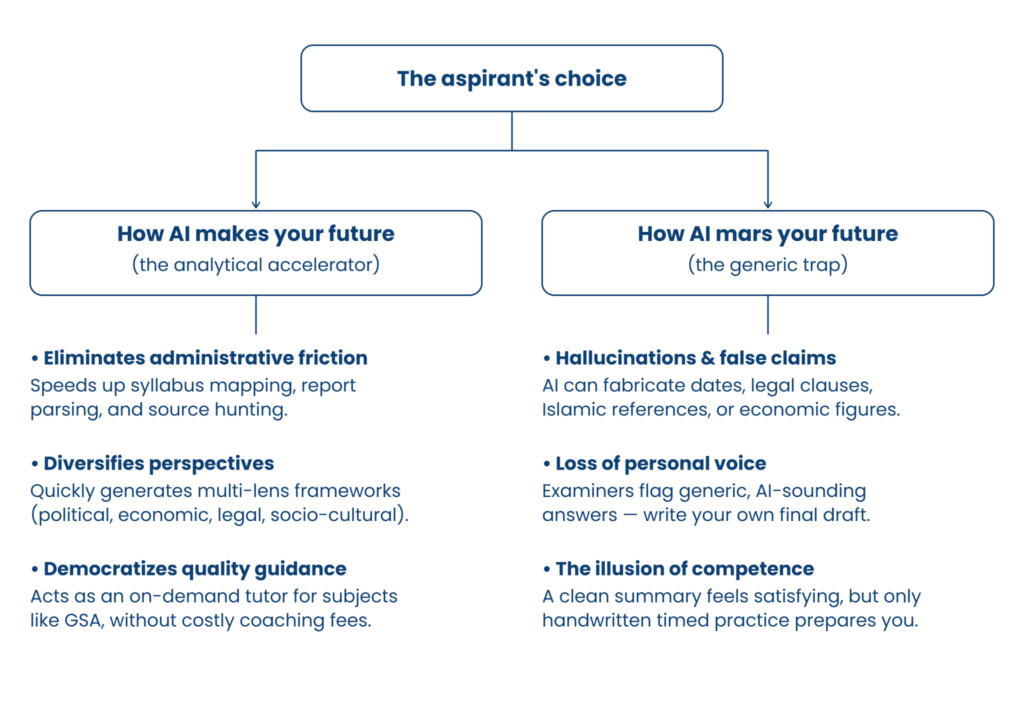
How AI Can Make or Mar an Aspirant’s Future
Before touching a single prompt, every candidate must understand the dual-edged nature of Large Language Models (LLMs).
How to Use AI for CSS & PMS Preparation
Here is a practical, step-by-step breakdown of how to deploy specialized AI tools across your core preparation tasks.
1- Syllabus Breakdown & Module Creation
The official FPSC and PPSC syllabi are written in short, compressed headings that give little sense of how much material actually sits underneath them. ChatGPT or Claude is well suited to expanding these headings into a full, checkable list of sub-topics, because it can reason through how a syllabus line is typically taught and examined. For instance, in Islamiat, a heading like “Sources of Islamic Law” can be broken into every individual source with its scope and relevant examples. For Pakistan Affairs, “Ideology of Pakistan” can be expanded into its historical, political, and constitutional dimensions separately. For General Science & Ability, a line such as “Basic Concepts in Biology” can be split into the specific systems and processes typically drawn from it. What was one vague line becomes a concrete checklist, which is the only way a self-study candidate can measure real progress instead of a false sense of having “covered” a subject.
- Top Tools: ChatGPT or Claude.
- How It Works: Input an official syllabus heading and request a structured learning roadmap complete with required sub-themes, core theoretical frameworks, and target arguments.
- Prompt Example:
“Act as a CSS mentor. Take the official FPSC syllabus topic [ eg. ‘Constitutional and Political Developments in Pakistan since 1947’]. Break it down into 4 sequential study modules. For each module, list 3 core analytical questions examiners like to ask, key constitutional articles involved, and a list of essential historical events I must review.”
2- Understanding Basic Concepts & Technical Topics
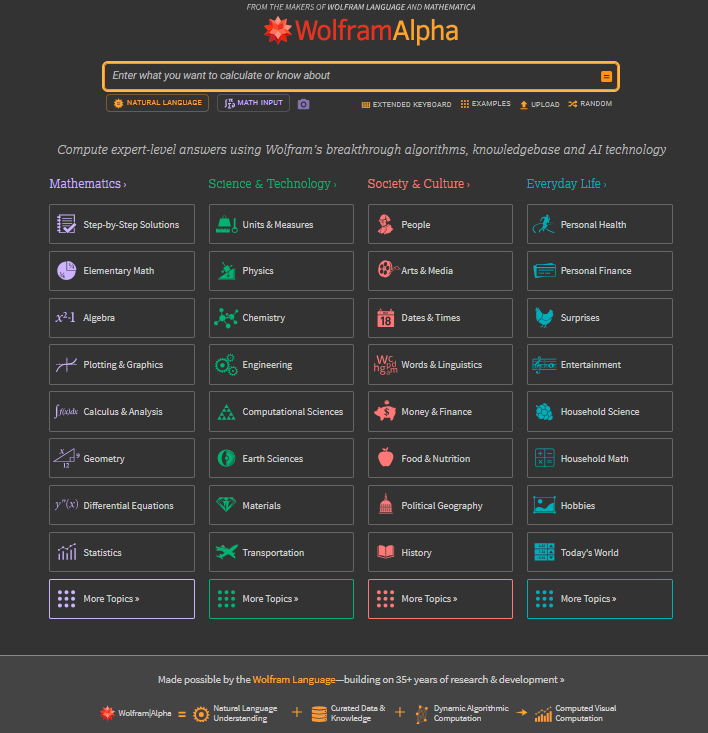
For a first-pass explanation of something unfamiliar, a conversational tool like Gemini works well, since it can adjust the depth of an answer depending on how it’s asked. For instance, in Islamiat, this means asking for a simple explanation of a jurisprudential concept before asking for the more advanced version an actual answer would need. However, Usul AI is a tool to understand Islamic concept with authentic sources from the Quran, Hadith, and Fiqh. Likewise, Wolfram Alpha is one of the exceptional AI tools that walks through the concepts of any topic of any subject step by step, rather than only giving the final answer, so the underlying method is genuinely understood rather than memorized.
This layered approach. Simple first, advanced second, mimics how a good teacher actually builds a concept, which is otherwise very hard to replicate through self-study alone.
- Top Tools: Google Gemini, Usul AI, or Wolfram Alpha
- How It Works: Gemini breaks down complex processes into simple analogies, key definitions, and textual descriptions of diagrams you can draw in the exam. Wolfram Alpha provides step-by-step logic with easy to use subtools. Following is the visualization of snipped homescreen of Wolfram Alpha
- Example Prompt:
“Explain the process of ‘Plate Tectonics and Earthquake Formation’ for a 5-mark GSA question. Provide: (1) A simple 3-sentence summary, (2) Key scientific terminology, (3) A real-world example, and (4) A textual description of a clean, labeled diagram I can manually sketch on my answer sheet.”
3- Analyzing Past Papers & Identifying Trends
Instead of manually sifting through a decade of past paper booklets, live-search AI tools can aggregate past questions, spot repeating themes, and show how FPSC phrasing has evolved. Past paper trends shift year to year, so this task is better suited to a tool with live, current retrieval rather than a static one. Google AI or Perplexity both fit this well, since they search current, indexed sources rather than relying purely on fixed training data.
- Top Tools: Perplexity AI or Google Gemini.
- How It Works: These models search real-time google databases and past paper archives, grouping questions by thematic similarity and flagging high-yield topics.
- Prompt Example:
“Analyze CSS [Pakistan Affairs past paper questions] from the last 10 years regarding [‘Pakistan-US Relations’]. Group the questions by recurring sub-themes, highlight how the examiner’s angle has shifted over time, and list the core arguments expected in a top-tier answer.”
4- Creating Adaptive Study Schedules
Paper timetables are rigid; when real life disrupts your afternoon, a manual schedule breaks. AI-driven scheduling platforms automatically adjust study blocks around your actual pace and priority tasks. A workable schedule is best built in two stages.
First, ChatGPT can take your subject combination, months remaining, and daily available hours, and distribute study time proportionally across compulsory and optional papers, leaving room for revision and past paper practice near the end.
Second, a dedicated AI scheduling tool such as Motion takes that plan and actually holds it on your real calendar, rearranging tasks automatically as days slip or subjects take longer than expected, rather than leaving you with a static timetable that has to be manually redone every time something changes. This combination solves the actual problem most self-study candidates have: not the absence of a plan, but a plan that collapses within two weeks because nothing is enforcing it.
- Top Tools: ChatGPT or Motion.
- How It Works: Set task priorities (e.g., “GSA Ability Math Practice – High Priority”) alongside your total weekly hours. The scheduling engine dynamically arranges your calendar and shifts lower-priority tasks when you run late. You can also download a detailed excel sheet directly to get a printout.
- Prompt Example
“Create a balanced [12-week] CSS study routine for a candidate with [6 hours] of daily availability. Allocate time dynamically across compulsory and optional subjects. Build in dedicated daily slots for reading, analysis, timed math problem-solving, and weekly manual writing.”
5- Hunting Quality Academic Sources & PDFs
Generic web searches often lead to low-quality blogs. Academic AI search engines directly query peer-reviewed research papers, university databases, and policy institute reports. Consensus is built specifically for academic and scholarly search, drawing from indexed research rather than the general web, which makes it well suited to locating credible, citable material. For Example, for Current Affairs, it means locating policy papers or think-tank analysis on a live international or national issue. An answer supported by this kind of evidence reads very differently from one built on memorized textbook lines, and this tool gets a candidate to that material quickly, without needing paid access to a university research database.
- Top Tools: Consensus
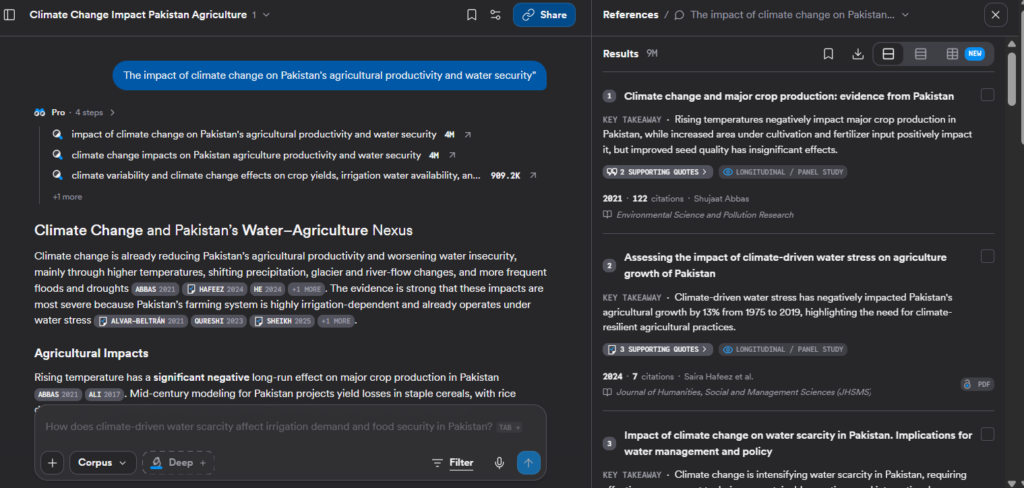
- How It Works: Enter a research query or policy question, and the platform retrieves direct findings, author conclusions, and exact papers. Just write the exact title and the consensus will give relevant papers list.
- Example Prompt
“The impact of climate change on Pakistan’s agricultural productivity and water security”
6- Extracting Data from Huge Reports
Comprehensive publications, such as the Pakistan Economic Survey, UN Development Reports, or State Bank Annual Reports, contain vital statistics, but reading hundreds of pages is impractical. Document-based AI extracts facts directly from your uploaded files. NotebookLM can not only extract papers from google source but also allow a candidate to upload a specific document and converse directly with that document, keeping every answer traceable back to the actual source rather than to general AI knowledge. This turns hours of reading into a focused, source-grounded summary in a fraction of the time.
- Top Tools: NotebookLM
- How It Works: Upload primary PDF documents directly into NotebookLM. Because the model operates strictly within your uploaded files, it avoids hallucinations and gives you exact page references for every extracted stat or quote.
- Prompt Example:
“Based strictly on the uploaded IMF Staff Report / SBP Economic Survey PDF, extract the top 5 structural reasons for Pakistan’s inflation and fiscal deficit. Present the output in a clean table with statistical figures, policy recommendations, and exact page numbers from the text.”
7- Leveraging Basic-Level Answer Evaluations
While AI cannot evaluate the nuanced emotional resonance of an English Essay or complex argumentative or analytical question statements of other subjects, it can assess whether your descriptive answers meet basic structural criteria: argument density, flow, heading organization, and grammar.
- Top Tools: Claude or ChatGPT.
- How It Works: Type or scan (via OCR) your handwritten practice answer and ask the model to evaluate it against a strict marking rubric.
- Prompt Example:
“I am pasting my practice answer for a 20-mark question on ‘The Concept of Public Administration and Governance’. Critically evaluate it based on: (1) Logical flow and heading structure, (2) Integration of references, (3) Contemporary relevance to modern governance, and (4) Identification of weak or repetitive arguments. Point out specific gaps.”
8- Updating Contemporary Data & News Extraction
Since no AI model is accurately updated to the given date, this task works best in reverse. Gather the raw material yourself from a newspaper or official source (Opinion or news) and only then paste it into an AI tool and ask it to organize what you’ve given it, rather than asking the AI to recall recent events from memory. For example, in Current Affairs, this means pasting a news article on a major policy development and asking for it to be organized under background, key developments, stakeholders, and implications. Reversing the process this way removes the single biggest risk in using AI for current data: outdated or simply incorrect recall of very recent events, while still saving significant organizing time.
- Top Tools: Claude, Gemini or ChatGPT.
- How It Works: Paste the full text of a long article into the workspace. Ask the AI to extract arguments, statistical figures, and quotes, re-organizing them into revision-ready notes.
- Prompt Example:
“I am pasting an op-ed regarding the Middle East security matrix. Reorganize this text under four headings: (1) Main Thesis, (2) Key Historical/Geopolitical Context, (3) Crucial Data/Quotes, and (4) Potential Strategic Outcomes for South Asia. Do not skip any important information or fact.”
9- Creating Digestible & Visual Study Assets
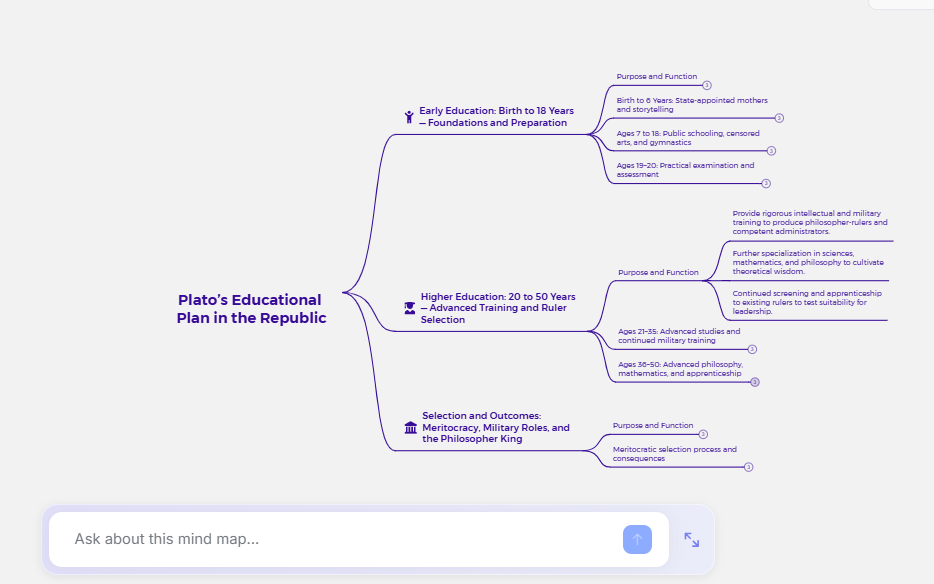
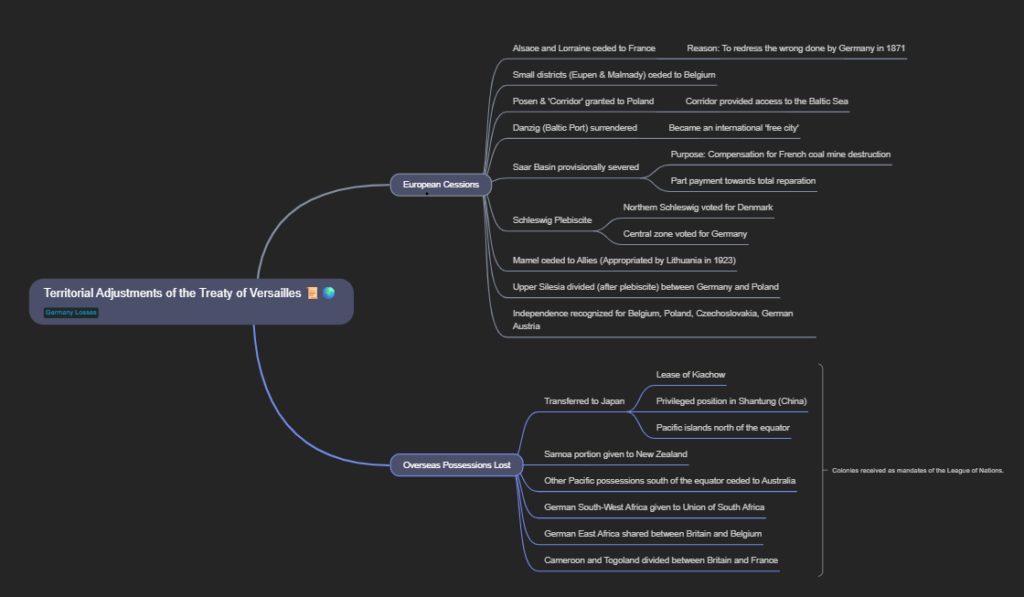
Long reports and dense chapters are far easier to retain in visual form than as continuous prose, particularly during revision. Mindmap AI or Mapify can convert a block of text into a mind map or flowchart, which works well for Pakistan Affairs timelines or Islamiat classifications of law or Political Science concepts where sequence and hierarchy matter. It does not replace close reading, but makes a second or third pass over already-studied material considerably faster. Therefore, rather than giving a simple prompt, pasting your already-made notes can do wonders.
- Top Tools: Mindmap AI or Mapify AI
- How It Works: Paste an outlined summary into these visual engines to generate clean flowcharts, timelines, or conceptual maps automatically. You can also chat with maps to edit them per requirements. Following is one visualization from Mapify AI
Following is an example from Mindmap AI
Prompt Example
“Convert my notes on the ‘Constitutional History of Pakistan (1947–1973)’ into a hierarchical outline format suitable for generating a flowchart. Group events sequentially by: Political Trigger ➔ Key Committees/Drafts ➔ Main Bottlenecks ➔ Final Outcome.”
Limitations of Using AI Tools in Preparation
No AI tool, regardless of sophistication, should be treated as an authoritative source on its own. A candidate should keep the following firmly in mind:
- Currency of information:
Static AI models can lag behind real developments; any claim should be cross-checked against a live source before it is memorized as fact. - Fabricated citations or facts:
AI tools can occasionally produce plausible-sounding but inaccurate references, dates, or figures. Every factual claim intended for an actual exam answer must be independently verified. This is especially critical for Islamiat, where an incorrect reference is a serious error, not a minor one. - Absence of examiner judgment:
These tools can flag structural weaknesses in an answer, but they cannot replicate the judgment of a human examiner familiar with FPSC or PPSC’s specific expectations and evolving marking conventions. - Risk of over-reliance:
A candidate who outsources understanding rather than using these tools to sharpen it will find that convenience in preparation does not translate into competence on exam day. The tool should accelerate your thinking, not replace it.
Solution: Learning These Tools the Right Way
Reading about nine different uses of AI is one thing; actually building them into a daily study routine, correctly, is another matter entirely, and this is where most self-study candidates struggle, not because the tools are complicated, but because there’s no one to show them how it’s actually done on real CSS/PMS material. This is precisely the gap the CSS Compulsory Subjects Course by CSS Prep Forum is built to close: a guided, mentor-led session where these AI tools are taught by the most learned coaches: Miss Iqra Ali, Sir Ammar Hashmi, and Miss Ayesha Irfan, along the detailed lectures on all topics from the actual syllabus, with hands-on practice on real past papers and real written answers, rather than a list of tool names a candidate is left to figure out alone.
Click to Explore What Previous Students Have to Say About the Session:
Bottomline
AI is not a shortcut to clearing CSS or PMS, and it was never going to be one. It is an engine. If you let the engine drive the car while you sleep in the backseat, blindly copying generic answers and neglecting primary reading, you will likely crash when faced with FPSC’s analytical papers. But if you sit firmly in the driver’s seat, using AI to clear administrative clutter, pull precise data, construct multi-dimensional frameworks, and simplify technical concepts, you will prepare faster, deeper, and far more effectively than traditional methods allow.
Important Note for CSS and PMS Aspirants
For aspirants preparing for competitive examinations, exploring solved past papers is essential to understand examiner expectations, analytical answer writing, and paper trends. Therefore, candidates are strongly encouraged to read the following comprehensive solved papers available on CSSPREPFORUM.
- CSS Solved Pakistan Affairs Past Papers
- CSS Solved Current Affairs Past Papers
- CSS Solved Islamiat Past Papers
- CSS Solved General Science and Ability Past Papers
Moreover, aspirants searching for the most credible and result-oriented teachers for CSS and PMS preparation can benefit from the following detailed guidance articles
- Who is the Best CSS PMS Islamiat Teacher in Pakistan?
- Who is the Best CSS PMS Pakistan Affairs Teacher in Pakistan?
- Who is the Best CSS Current Affairs Teacher in Pakistan?
- Who is the Best CSS GSA Teacher in Pakistan?
- Who is the Best CSS PMS English Essay and Precis Teacher in Pakistan?
- Who is the Best English Grammar Teacher in Pakistan?