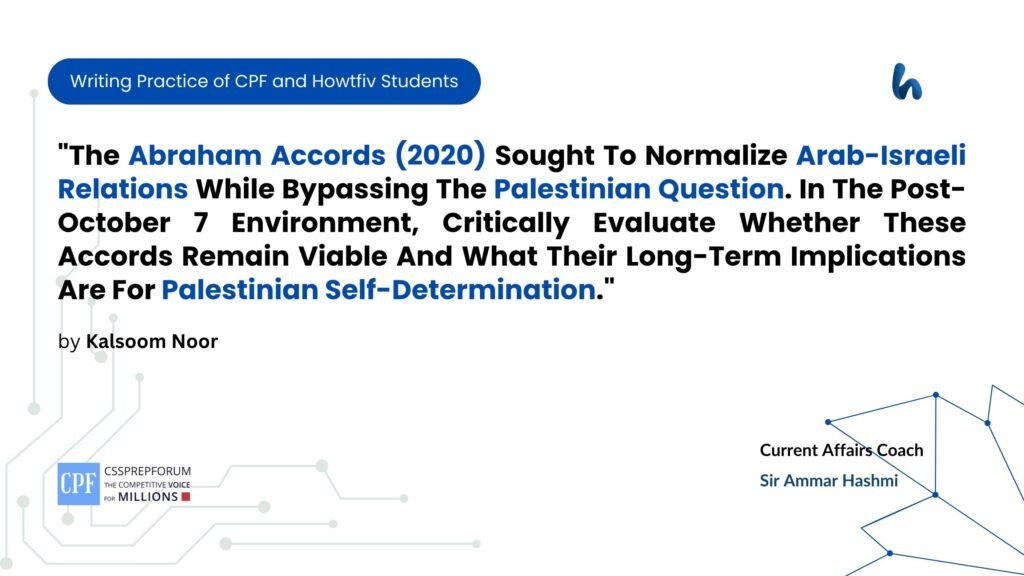
CSS Current Affairs | Abraham Accords: Normalizing Arab-Israeli Relations While Bypassing the Palestinian Question
The following assignment question for CSS Current Affairs is solved by Kalsoom Noor under the supervision of Howfiv’s Pakistan Affairs and Current Affairs Coaches: Miss Iqra Ali and Sir Ammar Hashmi. She learnt how to attempt 20 marks question and essay writing from Sir Syed Kazim Ali, Pakistan’s best CSS and PMS English essay and precis teacher with the highest success rate of his students. This solved question is attempted on the pattern taught by Sir to his students, scoring the highest marks in compulsory and optional subjects for years.

Outline
1-Introduction
2-An Overview of the Abraham Accords (2020)
3-Critically Evaluating the Viability of the Abraham Accords in the Post-October 7 Environment
- 3.1 Common Perceptions of Iran as a Regional Threat Preserving Arab-Israeli Alignment
- 3.2 Expanding Economic Stakes Making Reversal of Normalization Costly
- 3.3 Institutionalized Diplomatic and Security Cooperation Ensuring Continuity
- 3.4 Strategic State Interests Outweighing Domestic Opposition to Normalization
4-Long-Term Implications for Palestinian Self-Determination
- 4.1 Arab-Israeli Normalization Weakening the Palestinian Cause
- 4.2 Erosion of Collective Arab Pressure Limiting Palestinian Leverage
- 4.3 Decoupling Normalization from Statehood Undermining the Two-State Solution
- 4.4 Renewed Global Focus Revitalizing the Palestinian Narrative
5-Critical Analysis6-Conclusion
Answer to the question
Introduction
The Abraham Accords, signed in 2020 between Israel and some Arab countries, were considered a major diplomatic development in the Middle East. Their main objective was to normalize relations between Arab states and Israel through economic, political, and security cooperation, while largely setting aside the Palestinian issue. However, the events of October 7, 2023, and the subsequent war in Gaza brought the Palestinian question back to the center of regional and international politics. Despite these developments, the Abraham Accords remain viable because of the strong strategic and economic interests of the participating states. At the same time, they have significant long-term implications for Palestinian self-determination by weakening Palestine’s diplomatic position while also drawing renewed global attention to its struggle for statehood.
An Overview of the Abraham Accords (2020)
The Abraham Accords were signed in 2020 between Israel and several Arab countries, including the United Arab Emirates and Bahrain, with the support of the United States. The agreements aimed to establish diplomatic relations and promote cooperation in areas such as trade, investment, technology, tourism, and security. They were seen as a breakthrough in Arab-Israeli relations because, unlike previous Arab policies, normalization was pursued without first resolving the Palestinian conflict. While supporters viewed the Accords as a step towards regional stability and economic progress, critics argued that they sidelined Palestinian aspirations for an independent state and ignored one of the core disputes in the Middle East.
Critically Evaluating the Viability of the Abraham Accords in the Post-October 7 Environment
The events of October 7, 2023, and the subsequent Gaza conflict led many observers to question the future of the Abraham Accords. The resurgence of the Palestinian issue and growing public anger in the Arab world created new challenges for the normalization process. However, despite these pressures, several factors suggest that the Accords continue to remain viable in the changing regional environment.
- 3.1 Common Perceptions of Iran as a Regional Threat Preserving Arab-Israeli Alignment
One of the main reasons the Abraham Accords remain viable after October 7 is the shared perception of Iran as a major regional threat. Countries such as the UAE and Bahrain view Iran’s regional influence, missile program, and support for proxy groups as security challenges, while Israel considers Iran its foremost strategic adversary. As a result, common security concerns continue to encourage cooperation between Israel and Arab states despite tensions arising from the Gaza conflict. Therefore, the convergence of security interests against Iran remains a key factor sustaining the Abraham Accords in the post-October 7 environment.
- 3.2 Expanding Economic Stakes Making Reversal of Normalization Costly
Another factor contributing to the viability of the Abraham Accords is the growing economic cooperation between Israel and the signatory Arab states. Since 2020, trade, investment, tourism, and technology partnerships between Israel and Arab countries have increased significantly. As a result, reversing normalization would carry substantial economic costs, making the Accords more sustainable in the post-October 7 environment.
- 3.3 Institutionalized Diplomatic and Security Cooperation Ensuring Continuity
The continuity of the Abraham Accords is further strengthened by the formal mechanisms created under the normalization process. Regular high-level engagements, intelligence sharing, and joint initiatives have developed strong links between the participating countries. Consequently, these established channels of cooperation help maintain relations even during periods of regional instability.
- 3.4 Strategic State Interests Outweighing Domestic Opposition to Normalization
The Abraham Accords also remain viable because governments often prioritize national interests over public opinion in foreign policy decisions. Despite widespread public sympathy for Palestinians following the Gaza conflict, the signatory states have largely maintained their relations with Israel. Hence, the pursuit of strategic, economic, and security interests continues to outweigh domestic opposition to normalization.
Long-Term Implications for Palestinian Self-Determination
The Abraham Accords have important long-term implications for the Palestinian struggle for self-determination. By shifting Arab-Israeli relations towards normalization, they have reduced the traditional centrality of the Palestinian question in regional diplomacy. At the same time, the post-October 7 environment has brought renewed international attention to Palestinian rights, making the overall impact complex and multi-dimensional.
- 4.1 Arab-Israeli Normalization Weakening the Palestinian Cause
Arab-Israeli normalization under the Abraham Accords has weakened the traditional diplomatic position of the Palestinian cause in the region. Several Arab states have established formal relations with Israel without linking it to the creation of a Palestinian state, reducing Palestine’s leverage in Arab diplomacy. As a result, the Palestinian issue has become less central in regional negotiations, limiting its influence in shaping Middle Eastern political agendas.
- 4.2 Erosion of Collective Arab Pressure Limiting Palestinian Leverage
The Abraham Accords have also weakened the collective Arab pressure that traditionally supported the Palestinian cause. With several Arab states now pursuing independent bilateral relations with Israel, the unified regional stance on Palestine has become fragmented. As a result, Palestine has lost significant diplomatic leverage that was previously derived from Arab solidarity.
- 4.3 Decoupling Normalization from Statehood Undermining the Two-State Solution
The Abraham Accords have further weakened the prospects of the two-state solution by separating normalization from the condition of Palestinian statehood. Since Arab states are establishing relations with Israel without linking them to progress on Palestine, the traditional diplomatic pressure for a negotiated settlement has declined. This decoupling has therefore made the realization of an independent Palestinian state more difficult.
- 4.4 Renewed Global Focus Revitalizing the Palestinian Narrative
Despite the trend of normalization, the post-October 7 situation has brought renewed international attention to the Palestinian issue. The Gaza conflict has increased global awareness and debate over Palestinian rights and humanitarian conditions. As a result, the Palestinian narrative has regained visibility on the international stage, even within a changing regional order.
Critical Analysis
The Abraham Accords remain largely viable in the post-October 7 environment as they are anchored in strong strategic, economic, and security interests that continue to bind the participating states. The persistence of these agreements, despite renewed regional tensions and heightened public sensitivity over the Palestinian issue, reflects their deep institutional and state-centric foundations. However, their fundamental weakness lies in the deliberate exclusion of the Palestinian question, which continues to be the central source of instability in the region and undermines the legitimacy of any lasting peace framework. Thus, while the Accords are effective in maintaining pragmatic interstate cooperation, they remain structurally incomplete and incapable of delivering a comprehensive and sustainable resolution to the Middle Eastern conflict.
Conclusion
In conclusion, the Abraham Accords have significantly reshaped Arab-Israeli relations by prioritizing strategic cooperation and normalization over the traditional requirement of linking peace with the Palestinian question. In the post-October 7 environment, these agreements have largely remained intact due to strong political, economic, and security interests among the participating states, which continue to support their continuation despite regional tensions. However, the renewed visibility of the Palestinian issue highlights that the underlying conflict has not been resolved and continues to challenge the legitimacy of any peace process that excludes it. Therefore, although the Abraham Accords are likely to persist in the foreseeable future, a durable and just regional order will ultimately depend on meaningful progress toward Palestinian self-determination and a comprehensive settlement of the conflict.

CSS Solved Past Papers’ Essays
Looking for the last ten years of CSS and PMS Solved Essays and want to know how Sir Kazim’s students write and score the highest marks in the essays’ papers? Then, click on the CSS Solved Essays to start reading them.
CSS Solved Essays
CSS Solved Islamiyat Past Papers
Want to read the last ten years’ Islamiyat Solved Past Papers to learn how to attempt them and to score high? Let’s click on the link below to read them all freely. All past papers have been solved by Pakistan’s top CSS Islamiyat coaches having the highest score of their students.
CSS Solved Islamiyat
CSS Solved General Science & Ability Past Papers
Want to read the last ten years’ General Science & Ability Solved Past Papers to learn how to attempt them and to score high? Let’s click on the link below to read them all freely. All past papers have been solved by Pakistan’s top CSS GSA coachez having the highest score of their students.
CSS Solved General Science & Ability
CSS Solved Pakistan Affairs Past Papers
Want to read the last fifteen years’ Pakistan Affairs Solved Past Papers to learn how to attempt them and to score high? Let’s click on the link below to read them all freely. All past papers have been solved by Pakistan’s top CSS Pakistan Affairs coaches having the highest score of their students.
CSS Solved Pakistan Affairs
CSS Solved Current Affairs Past Papers
Want to read the last fifteen years’ Current Affairs Solved Past Papers to learn how to attempt them and to score high? Let’s click on the link below to read them all freely. All past papers have been solved by Pakistan’s top CSS Current Affairs coaches having the highest score of their students.
CSS Solved Current Affairs