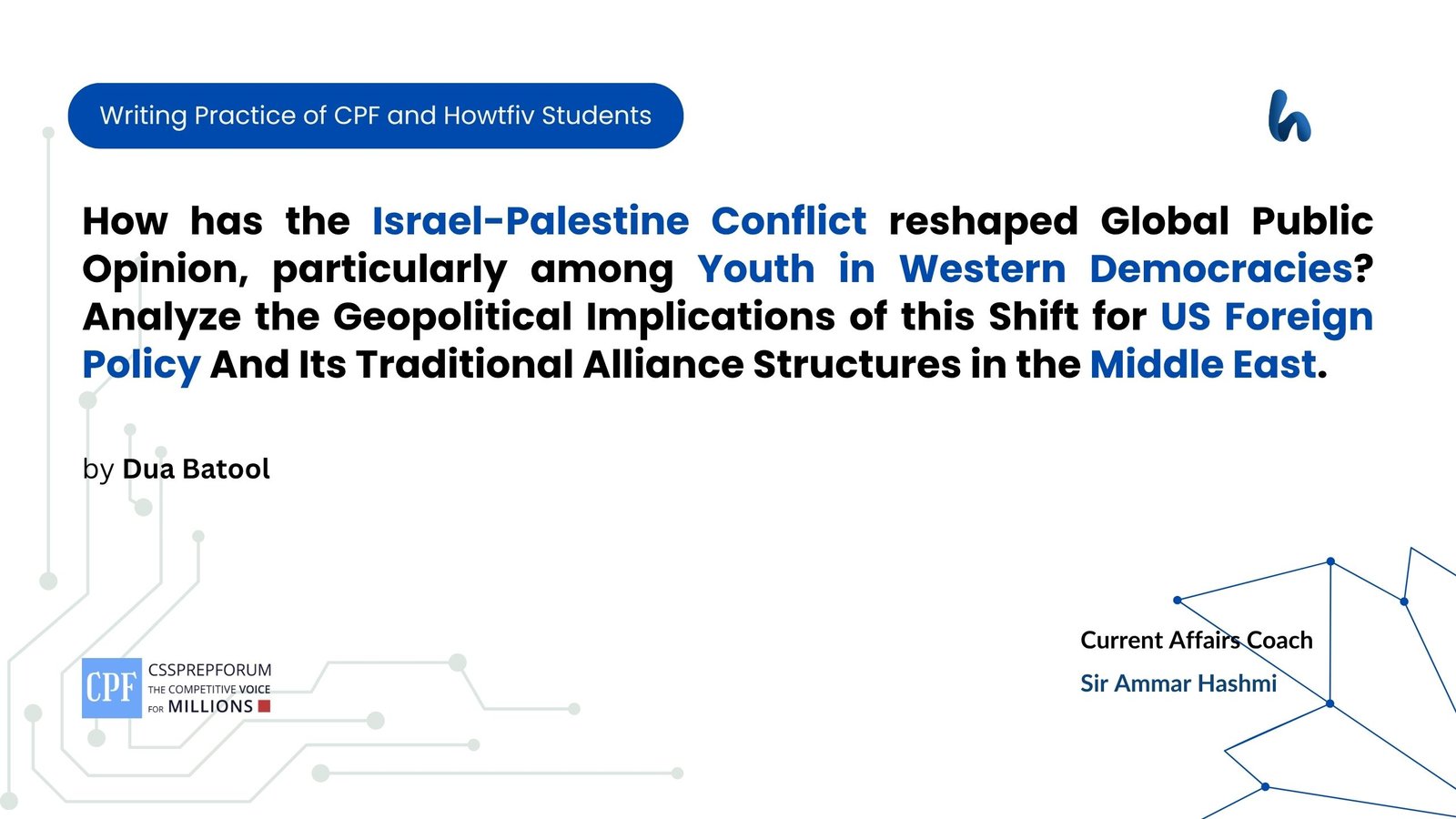
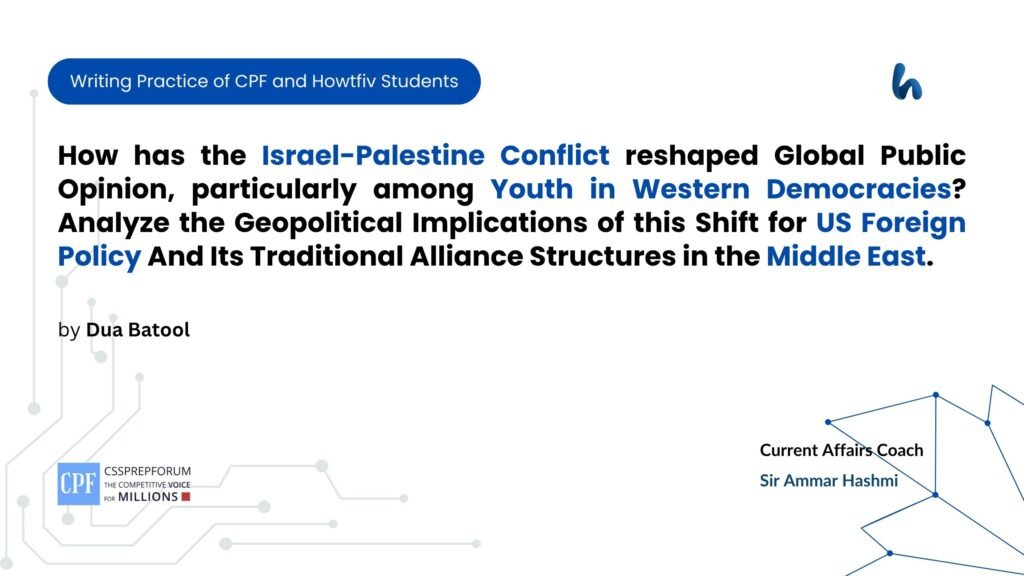
CSS Current Affairs | Israel-Palestine Conflict reshaped Public Opinion in Western Democracies
The following assignment question for CSS Current Affairs is solved by Dua Batool under the supervision of Howfiv’s Pakistan Affairs and Current Affairs Coaches: Miss Iqra Ali and Sir Ammar Hashmi. She learnt how to attempt 20 marks question and essay writing from Sir Syed Kazim Ali, Pakistan’s best CSS and PMS English essay and precis teacher with the highest success rate of his students. This solved question is attempted on the pattern taught by Sir to his students, scoring the highest marks in compulsory and optional subjects for years.

Outline
1-Introduction
2-Historical Evolution of the Israel-Palestine Conflict and its Traditional Western Interpretation
3-Reshaping Global Public Opinion through the Israel-Palestine Conflict among Youth in Western Democracies
- Humanizing Palestinian suffering through real-time digital exposure
- Reframing the conflict from a security issue to a human rights issue
- Weakening the traditional Western media narrative
- Expanding solidarity across social justice movements
4-Geopolitical Implications of this Shift for US Foreign Policy
- Increasing domestic pressure on the US to revise its pro-Israel stance
- Damaging the US credibility on human rights and international law
- Encouraging greater debate within US institutions
5-Implications for the USA’s Traditional Alliance Structures in the Middle East
- Straining US relations with Arab partners
- Creating openings for rival powers and anti-US narratives
- Weakening the momentum of Arab-Israel normalization
6-Critical Analysis
7-Conclusion
Answer to the question
Introduction
The Israel-Palestine conflict has moved far beyond its regional boundaries to become one of the most influential drivers of global public opinion in the contemporary era, particularly among youth in Western democracies. It has reshaped their perceptions through direct exposure to humanitarian suffering, reframing of the issue as one of rights and justice, declining trust in mainstream media, and growing transnational solidarity movements.
These shifts carry clear geopolitical implications. For U.S. foreign policy, they are reflected in rising domestic pressure to reassess its pro-Israel stance, weakening credibility on human rights, and expanding institutional debate. For America’s traditional alliance structures in the Middle East, they are visible in strained Arab partnerships, increased space for rival powers and alternative narratives, and slowing momentum in Arab-Israel normalization. Hence, the conflict has significantly reshaped global public opinion among Western youth, tightening constraints on US foreign policy while weakening the effectiveness of its traditional alliance system in the Middle East.
Historical Evolution of the Israel-Palestine Conflict and its Traditional Western Interpretation
The Israel-Palestine conflict has developed through a long historical process shaped by competing national aspirations, colonial legacies, and repeated wars. It began in the late 19th century with the rise of Zionism and growing Arab nationalism in Palestine. Under the British Mandate, tensions increased as both communities claimed the same land. The 1948 creation of Israel and the first Arab-Israeli war led to large-scale Palestinian displacement, which became central to the Palestinian narrative. Further wars in 1967 and 1973 resulted in Israeli occupation of the West Bank and Gaza, turning the conflict into a lasting regional issue. Western policy discourse has traditionally viewed the conflict mainly through a strategic and security lens. Israel has been seen as a key ally in a volatile region, while the Palestinian issue has been managed through diplomacy, peace talks, and counterterrorism frameworks. Processes like the Oslo Accords focused on gradual negotiation, often sidelining core political issues like statehood and refugees. Overall, this historical and policy framing reflects how the Israel-Palestine conflict has been managed within Western discourse primarily as a security and strategic issue rather than a political or human rights problem.
Reshaping Global Public Opinion through the Israel-Palestine Conflict among Youth in Western Democracies
- Humanizing Palestinian suffering through real-time digital exposure
The Israel-Palestine conflict has reshaped youth opinion in Western democracies by making Palestinian suffering visible, immediate, and emotionally undeniable through digital media. Unlike earlier phases of the conflict, the Gaza war unfolded before young audiences in real time through videos of bombed neighbourhoods, injured children, starving families, and displaced civilians circulating on social media platforms. This constant visual exposure weakened the distance that once separated Western publics from Palestinian pain and transformed the conflict from an abstract geopolitical issue into a human tragedy. The political effect of this exposure is reflected in polling in Gallup’s July 2025 survey showing that only 9% of Americans approved of Israel’s military action in Gaza, while overall US approval had fallen to 32% and disapproval had risen to 60%. Thus, digital exposure did not simply inform Western youth; it humanized Palestinians in their moral imagination and pushed public opinion away from indifference.
- Reframing the conflict from a security issue to a human rights issue
In addition, a major transformation in Western youth opinion has been the reframing of the Israel-Palestine conflict from a narrow security problem into a wider human rights and humanitarian justice issue. For decades, the dominant Western narrative treated the conflict primarily through Israel’s right to self-defence, terrorism, and regional security. However, the scale of destruction in Gaza, the mass displacement of civilians, and the visible collapse of humanitarian conditions have led many young people to interpret the conflict through the language of civilian protection, international law, and collective punishment. This shift is reflected in the 2024 Harvard Youth Poll, which shows strong youth support for a permanent ceasefire, with young Americans backing it by a large margin. This suggests that the conflict is no longer confined to Israel’s security needs; it increasingly centres on whether Palestinian lives, rights, and dignity are being systematically violated. In this way, the conflict has been morally recast in the eyes of Western youth.
- Weakening the traditional Western media narrative
Another significant shift has been the weakening of the traditional Western media narrative that long shaped public understanding of Israel-Palestine. Earlier, mainstream coverage often foregrounded Israeli security concerns while presenting Palestinian suffering as secondary, numerical, or contextless. The current conflict, however, unfolded in a media environment where citizen footage, independent journalists, livestreams from Gaza, and social media testimony competed directly with legacy news institutions. This disrupted the monopoly of conventional framing and enabled young audiences to compare official narratives with on-the-ground visuals. As a result, many began to question the selectivity, language, and silences of mainstream reporting. Academic research on Western media coverage of the war also points in this direction, showing that Israeli victims were more often individualized while Palestinian victims were frequently portrayed as anonymous collectives, creating a distorted moral balance. At the same time, the spread of alternative digital sources allowed Palestinian voices to bypass editorial filters and speak directly to global audiences. As a result, Western youth are no longer passive consumers of elite media framing, actively changing their opinions on the Israel-Palestine conflict.
- Expanding solidarity across social justice movements
Besides that, the Israel-Palestine conflict has reshaped global opinion by linking the Palestinian cause with wider social justice movements that resonate strongly with Western youth. For many young activists, Palestine is no longer seen as an isolated territorial dispute in the Middle East; it has been integrated into broader struggles against racism, settler colonialism, militarism, state violence, and structural inequality. This is why pro-Palestine demonstrations on Western campuses often borrow the language, symbols, and methods of climate activism, Black Lives Matter, decolonial campaigns, and anti-war mobilization. The campus encampments of 2024 illustrated this fusion clearly, in which students were not merely demanding a ceasefire, but also calling for divestment, institutional accountability, and ethical consistency. This broader solidarity matters because it has enlarged the Palestinian issue beyond ethnic or religious identification and relocated it within a universal discourse of justice. Hence, the conflict has not only changed opinions about one war but has embedded Palestine within the wider conscience of youth-led transnational activism.
Geopolitical implications of this Shift for US foreign policy
- Increasing domestic pressure on the US to revise its pro-Israel stance
The most immediate geopolitical implication of shifting youth opinion in Western democracies is the intensification of domestic pressure within the United States to recalibrate its traditionally pro-Israel foreign policy. As public discourse increasingly reflects sympathy for Palestinian civilians, particularly after the 2023 Gaza war, elected representatives face growing electoral and institutional pushback, especially from younger voters, progressive Democrats, and university-educated constituencies. This is evident in the 2023–2024 congressional election cycle, where multiple U.S. House districts witnessed primary challenges against incumbents over unconditional military aid to Israel, most notably in progressive-leaning constituencies, where Gaza-related voting records became a central campaign issue. Consequently, U.S. foreign policy is increasingly constrained by internal pluralism, forcing Washington to balance strategic alliance management with domestic legitimacy. This creates a structural shift where Middle East policy is no longer insulated from electoral accountability, narrowing policy autonomy and making long-term unconditional alignment with Israel politically harder to sustain.
- Damaging the US credibility on human rights and international law
Another deeper geopolitical implication lies in the erosion of the U.S. normative authority in global governance, particularly its long-claimed leadership on human rights and international law. The visible divergence between US commitment to civilian protection and its continued military and diplomatic support for Israel during the Gaza conflict has intensified global perceptions of double standards. This is underscored by the International Court of Justice’s January 2024 provisional measures, which found it plausible that Israel’s actions in Gaza could fall under the Genocide Convention, while the United States simultaneously continued providing military and diplomatic backing to Israel at the UN Security Council, including repeated vetoes of ceasefire resolutions. The UN General Assembly’s overwhelming support for ceasefire demands, consistently backed by over 150 member states, further highlighted Washington’s isolation from global opinion. Hence, among the Western youth and civil society groups, this contradiction has weakened the moral legitimacy of U.S. foreign policy narratives, often framing them as selectively applied depending on strategic interests.
- Encouraging greater debate within the US institutions
Further, the shift in public opinion has also institutionalized a more contested and ideologically plural debate within American foreign policy establishments. Traditionally, Middle East policy was shaped by a relatively stable bipartisan consensus in favor of Israel; however, that consensus is now increasingly fractured. During the 2023–2024 war period, internal dissent mechanisms within the State Department reportedly received an increased volume of formal objections from diplomats regarding civilian casualty levels and arms transfer policies, reflecting rare bureaucratic pushback against executive decisions. Public resignations of officials from agencies such as the State Department and Department of Education, citing disagreement with Gaza-related policy positions, further demonstrate institutional fracture due to change in public opinion after Israel Palestine conflict.Thus, this reflects how evolving public opinion is filtering into institutional spaces, making foreign policy formulation more contested and less insulated from societal sentiment in the US.
Implications for the USA’s traditional alliance structures in the Middle East
- Straining US relations with Arab partners
Shifts in Western youth opinion in Israel- Palestine conflict have directly complicated Washington’s long-standing alliance management with key Arab partners, particularly as public pressure increasingly constrains the United States diplomatic flexibility on Israel. This strain became visible during the 2023 Gaza war, when despite sustained U.S. backing for Israel, Arab states such as Jordan, Egypt, and Saudi Arabia faced intense domestic protests demanding stronger condemnation of Israeli military actions and a break from perceived alignment with Washington. For instance, Saudi Arabia’s temporary suspension of normalization talks with Israel in late 2023, publicly justified on the grounds of Palestinian statehood concerns, reflected the growing sensitivity of Arab regimes to public sentiment shaped by global media and youth activism. Consequently, Washington’s alliance architecture is under pressure, as its partners must balance strategic dependence on the U.S. with rising domestic legitimacy costs linked to U.S. policy positions.
- Creating openings for rival powers and anti-US narratives
Further, the shift in global public opinion has created strategic space for rival powers to challenge American influence and amplify anti-US narratives. Russia and China have actively leveraged the Gaza war in multilateral forums, with both states repeatedly framing the US vetoes at the UN Security Council as evidence of selective adherence to international law. China’s Foreign Ministry statements during 2023–2024 consistently contrasted the US military support for Israel with its human rights rhetoric, reinforcing narratives of Western double standards across Global South media ecosystems. This narrative competition has been amplified by digital platforms, where pro-Palestinian content often intersects with broader critiques of the US hegemony, particularly among younger global audiences. Thus, the strategic implication is a gradual erosion of America’s dominance, as rivals convert perception gaps into geopolitical influence opportunities.
- Weakening the momentum of Arab-Israel normalization
In addition to this, rising public pressure by the Western youth has significantly slowed the trajectory of Arab-Israel normalization, particularly under frameworks like the Abraham Accords, by reintroducing the Palestinian issue as a central legitimacy constraint. The most direct indicator came in October 2023, when Saudi Arabia formally paused the US-brokered normalization discussions with Israel, explicitly linking any future progress to a credible pathway toward Palestinian statehood. This marked a reversal of momentum built since the 2020 Abraham Accords, as the Gaza conflict and its global visibility, especially through youth-led digital mobilization in Western societies, re-politicized the Palestinian question, making normalization diplomatically costly for Arab regimes facing domestic and transnational public scrutiny. As a result, the USA’s strategy of gradually integrating Israel into a regional alliance framework is now encountering structural resistance, where public opinion pressures constrain elite-driven diplomacy and slow the consolidation of the US-led regional order with its alliance in the Middle East.
Critical Analysis
The Israel-Palestine conflict has significantly reshaped global public opinion, particularly among youth in Western democracies, by shifting the dominant lens from a security narrative to a human rights perspective. This shift has made Western public opinion more critical, emotionally engaged, and less aligned with traditional state narratives. However, when this changing perception is linked to U.S. foreign policy, the impact is more indirect than transformative. American policy continues to be guided primarily by strategic interests such as alliance with Israel, regional stability, and military-diplomatic cooperation. These foundations remain stable regardless of public opinion shifts. What has changed is not the direction of policy itself, but the context in which it operates, as US actions are now more publicly scrutinized, more frequently contested in domestic politics, and more exposed to legitimacy debates, especially among younger voters and institutions. Thus, changing public opinion is not overriding US strategic calculations, but it is steadily increasing the political cost, moral questioning, and domestic sensitivity attached to them. In this way, it is shaping the discourse and constraints around US foreign policy.
Conclusion
In conclusion, the Israel-Palestine conflict has reshaped global public opinion, particularly among Western youth, by shifting it from a traditional security framing to a human rights perspective. This has been driven by humanizing Palestinian suffering via real-time digital exposure, exposing Western double standards, weakening traditional media narratives, deepening generational divides, and expanding solidarity across global social movements. These changes have also produced clear geopolitical implications for U.S. foreign policy and have affected America’s traditional alliance structures in the Middle East. Thus, the conflict has not only reshaped global perceptions but has also redefined the political and strategic environment in which U.S. foreign policy and its regional alliances operate.

CSS Solved Past Papers’ Essays
Looking for the last ten years of CSS and PMS Solved Essays and want to know how Sir Kazim’s students write and score the highest marks in the essays’ papers? Then, click on the CSS Solved Essays to start reading them.
CSS Solved Essays
CSS Solved Islamiyat Past Papers
Want to read the last ten years’ Islamiyat Solved Past Papers to learn how to attempt them and to score high? Let’s click on the link below to read them all freely. All past papers have been solved by Pakistan’s top CSS Islamiyat coaches having the highest score of their students.
CSS Solved Islamiyat
CSS Solved General Science & Ability Past Papers
Want to read the last ten years’ General Science & Ability Solved Past Papers to learn how to attempt them and to score high? Let’s click on the link below to read them all freely. All past papers have been solved by Pakistan’s top CSS GSA coachez having the highest score of their students.
CSS Solved General Science & Ability
CSS Solved Pakistan Affairs Past Papers
Want to read the last fifteen years’ Pakistan Affairs Solved Past Papers to learn how to attempt them and to score high? Let’s click on the link below to read them all freely. All past papers have been solved by Pakistan’s top CSS Pakistan Affairs coaches having the highest score of their students.
CSS Solved Pakistan Affairs
CSS Solved Current Affairs Past Papers
Want to read the last fifteen years’ Current Affairs Solved Past Papers to learn how to attempt them and to score high? Let’s click on the link below to read them all freely. All past papers have been solved by Pakistan’s top CSS Current Affairs coaches having the highest score of their students.
CSS Solved Current Affairs