CSS Current Affairs | Russia-Ukraine War: Frozen Conflict not a Decisive Victory
The following assignment question for CSS Current Affairs is solved by Ronra Kasi under the supervision of Howfiv’s Pakistan Affairs and Current Affairs Coaches: Miss Iqra Ali and Sir Ammar Hashmi. She learnt how to attempt 20 marks question and essay writing from Sir Syed Kazim Ali, Pakistan’s best CSS and PMS English essay and precis teacher with the highest success rate of his students. This solved question is attempted on the pattern taught by Sir to his students, scoring the highest marks in compulsory and optional subjects for years.

Outline
1-Introduction
2-Elucidating the Current Dynamics of the Russia-Ukraine War
3-Why is the Russia-Ukraine War a Frozen Conflict Rather than a Decisive Victory for Either Side
- ✓Mutual Military Attrition Without Breakthrough Capacity
- Evidence: According to Russia Matters (2026), Russian forces gained only about 15 square miles of Ukrainian territory in four weeks (June-July 2026), a marginal shift after over four years of fighting, indicating that neither side can achieve a breakthrough.
- ✓NATO’s Deterrent Shadow Without NATO’s Direct Involvement
- Evidence: According to the CFR Conflict Tracker, NATO has armed Ukraine extensively but avoided direct troop deployment or a no-fly zone, fearing direct NATO-Russia confrontation; this self-imposed ceiling prevents Ukraine from achieving decisive military superiority.
- ✓Sanctions That Weaken but Don’t Cripple
- Evidence: According to the Kremlin, Putin has repeatedly invoked Russia’s nuclear doctrine during the war, including warnings after Western debates over supplying long-range missiles, reinforcing perceptions that direct NATO confrontation risks nuclear escalation.
- ✓Diplomacy Without Enforcement Power
- Evidence: According to Carnegie, despite roughly 24,000 sanctions making Russia the world’s most-sanctioned country, its economy grew nearly 4% in 2024 by pivoting exports to China and India, avoiding the collapse that sanctions were meant to induce.
- ✓Divergent and Incompatible Endgames
- Evidence: According to Reuters, Trump-mediated calls, the Alaska summit, and Istanbul talks produced no binding ceasefire; repeated “constructive” conversations since 2025 show diplomacy occurring without any mechanism compelling either side to actually stop fighting.
- ✓Domestic Political Incentives to Continue Rather Than Concede
- Evidence: According to Zelensky, Russia demands Ukraine cede four regions, demilitarise, and abandon NATO ambitions, while Ukraine rejects these as a “complete sham,” leaving no overlapping settlement terms either side will accept.
- ✓Domestic Political Pressures Blocking Compromise
- Evidence: According to the AP, 2026 Reports, Ukraine faces protests after its defence minister’s ousting, while Putin’s legitimacy is partly built on wartime narratives of restoring Russian strength, making concessions politically costly for both leaderships.
- ✓Great-Power Rivalry Sustaining the Deadlock
- Evidence: According to the ISW analysis, the war has become a proxy arena for broader US-Russia-China multipolar competition, with each external power’s interest in outcomes discouraging a swift resolution that fully favours the other side.
4-Conclusion
Answer to the Question
Introduction
International conflicts rarely end through military exhaustion alone; they end when both sides perceive further fighting as more costly than negotiation. To trace the origin, William Zartman’s theory of “Mutually Hurting Stalemate” explains why the Russia-Ukraine war remains frozen rather than decisively won: neither Russia’s territorial gains nor Ukraine’s Western-backed resistance has produced a breaking point painful enough to force capitulation. Of critical importance here is that four years of sanctions, sacrifice, and stagnant frontlines have hurt both sides without exhausting either. In other words, this fact signifies that the conflict persists not from military necessity but from an unresolved balance of pain.
Elucidating the Current Dynamics of the Russia-Ukraine War
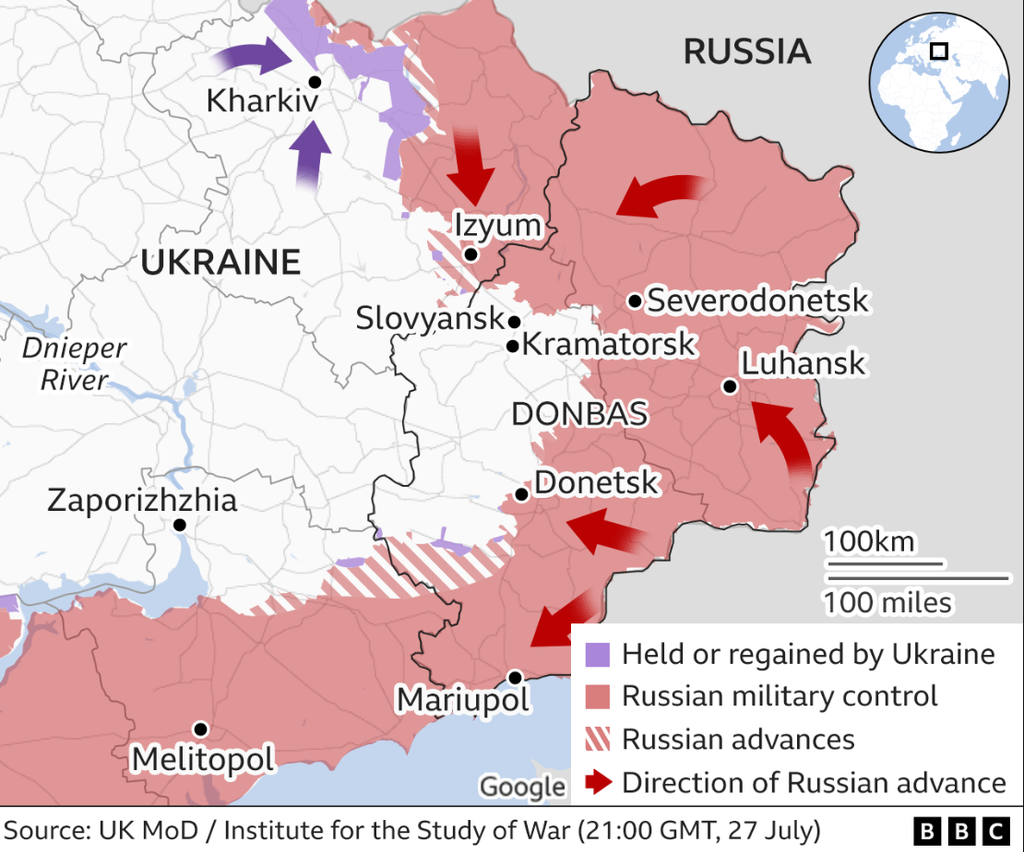
The Russia-Ukraine war has settled into a grinding stalemate marked by simultaneous fighting and diplomacy. This is evident from the pattern of events unfolding in mid-June. For instance, Russia gained just 15 square miles in four weeks (June-July 2026) while Trump held separate calls with Zelensky and Putin, followed by an Ankara meeting, yet no ceasefire emerged. Moreover, Ukraine’s deep strikes have cut Russian oil-refining capacity by a quarter, while Russia continues battering Ukraine’s energy grid. Namely, this fact signifies that battlefield attrition and inconclusive diplomacy are now mutually reinforcing rather than resolving the conflict. To summarise, neither military pressure nor talks has yet produced a decisive change.
Why is the Russia-Ukraine War a Frozen Conflict Rather than a Decisive Victory for Either Side
- Mutual Military Attrition Without Breakthrough Capacity
First and foremost, despite more than four years of continuous fighting, neither Russia nor Ukraine has achieved the kind of breakthrough needed to force the other into surrender. This stalemate persists because both militaries have adapted to each other’s tactics, turning the front into a grinding war of attrition rather than maneuver. In particular, according to Russia Matters (2026), Russian forces gained only about 15 square miles of Ukrainian territory in four weeks (June-July 2026), a marginal shift after over four years of fighting, indicating that neither side can achieve a breakthrough. This fact signifies that raw battlefield effort no longer translates into decisive territorial change. To sum up, the war has settled into exhaustion, not resolution.
- NATO’s Deterrent Shadow Without NATO’s Direct Involvement
Compounding this further, NATO’s support for Ukraine has been extensive but deliberately bounded, ensuring the alliance never crosses into confrontation with Russia. Along with that, this self-imposed restraint stems from the fear that any NATO-Russia clash could spiral into a wider European war. As an illustration, according to the CFR Conflict Tracker, NATO has armed Ukraine extensively but avoided direct troop deployment or a no-fly zone, fearing direct NATO-Russia confrontation; this self-imposed ceiling prevents Ukraine from achieving decisive military superiority. Certainly, this fact signifies that Western support was calibrated to sustain Ukraine’s defence, not to secure its outright victory. In other words, the ceiling itself guarantees the war cannot end decisively.
- Sanctions That Weaken but Don’t Cripple
Building upon the above, Russia’s nuclear arsenal functions as an invisible boundary that neither Ukraine nor its Western backers have been willing to test. Accordingly, this deterrent effect discourages the kind of aggressive military assistance that might otherwise tip the balance firmly toward Kyiv. To illustrate, according to the Kremlin, Putin has repeatedly invoked Russia’s nuclear doctrine during the war, including warnings after Western debates over supplying long-range missiles, reinforcing perceptions that direct NATO confrontation risks nuclear escalation. This fact signifies that fear of nuclear confrontation, more than battlefield logic, is capping how far the war can be pushed. Therefore, the deadlock is partly a product of restraint, not capability.
- Diplomacy Without Enforcement Power
Along the same lines, Western strategy assumed that economic isolation would cripple Russia’s ability to sustain the war, but this assumption has not held. At the same time, sanctions altered Russia’s trade patterns without breaking its capacity to fight. For instance, according to Carnegie, despite roughly 24,000 sanctions making Russia the world’s most-sanctioned country, its economy grew nearly 4% in 2024 by pivoting exports to China and India, avoiding the collapse that sanctions were meant to induce. Consequently, this fact signifies that economic coercion alone cannot compel a determined state to capitulate when alternative markets exist. To summarise, sanctions reshaped the war’s economics without ending it.
- Divergent and Incompatible Endgames
Moving ahead, at the heart of the deadlock lies a basic incompatibility: what Russia demands as victory, Ukraine treats as annihilation of its sovereignty. Strikingly, this gap leaves no shared middle ground for negotiators to build on. To illustrate, according to Zelensky, Russia demands Ukraine cede four regions, demilitarise, and abandon NATO ambitions, while Ukraine rejects these as a “complete sham,” leaving no overlapping settlement terms either side will accept. To be sure, this fact signifies that the war cannot end through compromise while both sides define victory in mutually exclusive terms. Thus, the stalemate reflects a clash of absolutes, not miscommunication.
- Domestic Political Pressures Blocking Compromise
Above all, both leaderships face internal political costs that make concessions appear more dangerous than continued war. It’s worth noting that, paradoxically, peace could destabilise the very governments meant to negotiate it. For instance, according to the AP, 2026 Reports, Ukraine faces protests after its defence minister’s ousting, while Putin’s legitimacy is partly built on wartime narratives of restoring Russian strength, making concessions politically costly for both leaderships. Accordingly, this fact signifies that ending the war carries real political risk for both Zelensky and Putin, not just Ukraine. To sum up, domestic survival, not just national interest, now shapes battlefield decisions.
- Great-Power Rivalry Sustaining the Deadlock
Last but not least, the Russia-Ukraine conflict has become entangled in a larger contest between major powers, each with a stake in how it ends. This broader rivalry discourages any swift resolution that clearly favours one side. In particular, according to the ISW analysis, the war has become a proxy arena for broader US-Russia-China multipolar competition, with each external power’s interest in outcomes discouraging a swift resolution that fully favours the other side. Consequently, this fact signifies that the conflict’s duration is driven partly by global power politics, not solely by Kyiv and Moscow’s own calculations. The inescapable conclusion is that external interests keep the deadlock alive.
| # | Dimension | Why It Prevents Decisive Victory | Key Evidence |
| 1 | Military | Neither side can break the frontline | Russia gained only ~15 sq. miles in 4 weeks (2026) |
| 2 | NATO’s Role | Support is capped below confrontation | Arms supplied, but no troops/no-fly zone |
| 3 | Nuclear Factor | Escalation deterred by nuclear signalling | Putin invoked the doctrine over missile transfers |
| 4 | Economic | Sanctions failed to cripple Russia | 24,000 sanctions; still ~4% GDP growth (2024) |
| 5 | Diplomacy | Talks lack enforcement mechanisms | Alaska Summit, Istanbul talks, no ceasefire |
| 6 | Core Demands | Victory conditions are mutually exclusive | Russia’s terms were rejected as a “complete sham” |
| 7 | Domestic Politics | Concession is politically costly for both | Ukraine protests; Putin’s wartime legitimacy |
| 8 | Great-Power Rivalry | External powers discourage a quick resolution | War as a US-Russia-China proxy arena |
Conclusion
All things considered, the above analysis suggests that the Russia-Ukraine war illustrates how modern conflicts can persist without resolution when neither military force nor diplomacy alone can break a deadlock. Along with that, four years of territorial stalemate, ineffective sanctions, nuclear deterrence, and irreconcilable demands have created a mutually hurting stalemate, yet neither side has reached the pain threshold required for genuine compromise. To be sure, this fact signifies that frozen conflicts are sustained less by battlefield capability than by political will, deterrence limits, and competing great-power interests. To cut it short, until this balance of pain shifts decisively, Ukraine will likely remain a contested frontier rather than a resolved sovereign settlement.

CSS Solved Past Papers’ Essays
Looking for the last ten years of CSS and PMS Solved Essays and want to know how Sir Kazim’s students write and score the highest marks in the essays’ papers? Then, click on the CSS Solved Essays to start reading them.
CSS Solved Essays
CSS Solved Islamiyat Past Papers
Want to read the last ten years’ Islamiyat Solved Past Papers to learn how to attempt them and to score high? Let’s click on the link below to read them all freely. All past papers have been solved by Pakistan’s top CSS Islamiyat coaches having the highest score of their students.
CSS Solved Islamiyat
CSS Solved General Science & Ability Past Papers
Want to read the last ten years’ General Science & Ability Solved Past Papers to learn how to attempt them and to score high? Let’s click on the link below to read them all freely. All past papers have been solved by Pakistan’s top CSS GSA coachez having the highest score of their students.
CSS Solved General Science & Ability
CSS Solved Pakistan Affairs Past Papers
Want to read the last fifteen years’ Pakistan Affairs Solved Past Papers to learn how to attempt them and to score high? Let’s click on the link below to read them all freely. All past papers have been solved by Pakistan’s top CSS Pakistan Affairs coaches having the highest score of their students.
CSS Solved Pakistan Affairs
CSS Solved Current Affairs Past Papers
Want to read the last fifteen years’ Current Affairs Solved Past Papers to learn how to attempt them and to score high? Let’s click on the link below to read them all freely. All past papers have been solved by Pakistan’s top CSS Current Affairs coaches having the highest score of their students.
CSS Solved Current Affairs