CSS Current Affairs | Russia’s Geography and its Foreign Policy
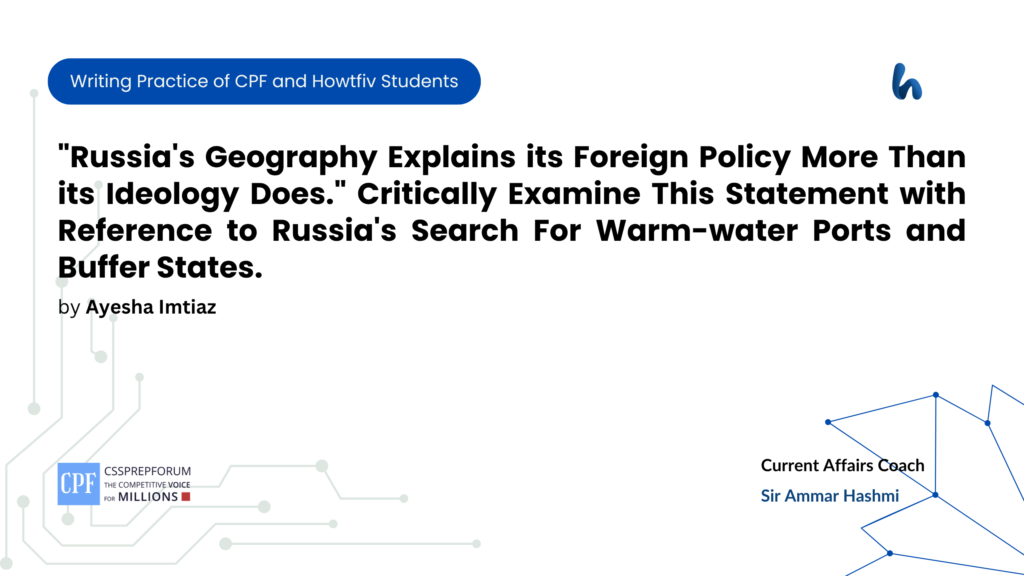
The following assignment question for CSS Current Affairs is solved by Ayesha Imtiaz under the supervision of Howfiv’s Pakistan Affairs and Current Affairs Coaches: Miss Iqra Ali and Sir Ammar Hashmi. She learnt how to attempt 20 marks question and essay writing from Sir Syed Kazim Ali, Pakistan’s best CSS and PMS English essay and precis teacher with the highest success rate of his students. This solved question is attempted on the pattern taught by Sir to his students, scoring the highest marks in compulsory and optional subjects for years.

Outline
1-Introduction
2-Russia’s Geography and Ideology: Competing Explanations of Foreign Policy
3-The Geographic Determinant: Structural Insecurities
A. The Imperative for Buffer States
- The Absence of Natural Defensive Barriers and Structural Vulnerability
- The Establishment of Strategic Depth Through Borderland Buffer States
- Strategic Continuity Across Tsarist, Soviet, and Modern Regimes
B. The Quest for Warm-Water Ports
- Maritime Isolation and the Strategic Pursuit of Warm-Water Ports
- Strategic Chokepoints and Maritime Vulnerability
- The Security of Ice-Free Ports for Naval Dominance and Trade Autonomy
4-Ideology Shaping Perception of Geography:
- Russkiy Mir and the Ideological Drive for Empire
- Anti-Western Ideology and the Preservation of Regime Survival and Great-Power Status
5-Critical analysis
6-Conclusion
Introduction
A country’s foreign policy determines how it interacts with the rest of the world. Russia is a massive country stretching across Europe and Asia, and it was once the center of communist ideology. However, Russia usually puts its physical geography ahead of its political beliefs when dealing with other nations. This is best seen in Russia’s constant search for warm-water ports and defensive buffer states, showing that geography is the real foundation of its strategy. On one level, Russia needs buffer states because it lacks natural defensive barriers, needs strategic depth to stop invasions, and has followed this same pattern under Tsarist, Soviet, and modern rulers. On another level, Russia’s search for warm-water ports is driven by its frozen coastlines, foreign-controlled sea bottlenecks, and the need for reliable year-round ocean access. Although some contend that ideology, like Russian nationalism and anti-Western beliefs, drives these actions, geography remains the primary force. Simply put, geography creates Russia’s core security goals, while ideology helps its leaders justify and achieve them.
An overview of russian geography and ideology
Russia, the largest country in the world by total area, stretches across 11 time zones from Europe to the Pacific Ocean. On the one hand, its western borders lie on the flat North European Plain, with no mountain ranges or oceans for natural defense. On the other hand, its northern coastlines remain frozen for much of the year, restricting year-round sea trade. Historically, during World War II, this lack of natural defensive barriers and open terrain made the Russian heartland deeply vulnerable to Hitler’s invading Nazi forces. To overcome these physical vulnerabilities, Russian leaders throughout history have used ideology to justify expanding their control. This ideology has evolved from Tsarist autocracy and Soviet communism to modern concepts of a shared identity based on Kyivan Rus. Therefore, while geography creates Russia’s urgent need for defensive buffer states and warm-water ports, ideology provides the cultural narrative and political motivation used to secure their interests.
The Geographic Determinant: Structural Insecurities
Geography is the major factor in shaping Russian foreign policy. Russia is located on a vast, flat plain in Europe with no natural barriers like mountains or oceans to protect its western border, making it vulnerable to invasion. At the same time, most of its northern ocean coasts are frozen for much of the year, limiting its ability to trade freely by sea. Therefore, these two physical challenges, a vulnerable, wide-open land border and a lack of ice-free ports, force Russian leaders to constantly focus on securing defensive buffer zones and gaining access to warm-water seas.
The Absence of Natural Defensive Barriers and Structural Vulnerability
Russia’s heartland is deeply vulnerable to foreign military invasions owing to the absence of natural defensive barriers. Because Russia is situated on the eastern edge of the flat North European Plain, no physical obstacles exist to restrict an advancing army. For example, due to this geographic vulnerability, historically powerful forces have invaded deep into Russian territory, including Napoleon’s French army in 1812 and Nazi Germany during World War II in 1941. These historical attacks proved to Russian strategic thinkers that wide-open, flat terrain makes defending the capital nearly impossible without vast territorial depth. Therefore, these massive incursions on Russian land have driven its leaders to focus heavily on securing defensive buffer zones along its western frontier.
The Establishment of Strategic Depth Through Borderland Buffer States
To protect its vulnerable heartland, Russian foreign policy has consistently tried to establish strategic depth by controlling neighboring regions. By extending its influence over nearby territories in Eastern Europe and Central Asia, Moscow creates defensive buffer states to absorb potential foreign attacks far from its core cities. For example, after World War II, the Soviet Union set up the Warsaw Pact, turning Eastern European nations like Poland and Hungary into a massive physical shield against Western forces. This extra space ensures that if an enemy attacks, Russian forces have the time and distance needed to prepare a defense before the enemy reaches Moscow. Ultimately, controlling these surrounding areas remains a core goal of Russian foreign policy to keep any future war far away from its main cities, specifically Moscow.
Strategic Continuity Across Tsarist, Soviet, and Modern Regimes
Across different historical eras, Russian foreign policy has maintained a consistent strategic objective: to push military threats as far from its heartland as possible. Whether governed by Tsarist autocracy, Soviet communism, or modern leadership, Moscow continuously seeks to build geographic buffers to shield its open borders. For example, this continuity is evident from Tsarist expansion in the 19th century and the creation of the Soviet Warsaw Pact in 1955 to modern Russia’s fierce opposition to NATO expanding toward its western frontier. This shows that despite changing political ideologies, the geographic necessity of securing territorial buffers remains constant. Ultimately, keeping military threats at a distance is an enduring imperative for Russia, a core motivation behind its deep opposition to NATO’s expansion into Ukraine.
B. The Quest for Warm-Water Ports
Maritime Isolation and the Strategic Pursuit of Warm-Water Ports
The geographical location of Russia has made it vulnerable not only along its land borders, but also due to its maritime isolation. Despite possessing an immense coastline across 11 time zones, freezing northern waters restrict Moscow’s naval power and commercial trade for major parts of the year. For example, major northern shipping routes across the Arctic Ocean require special icebreaker ships during the winter, hampering the true trade potential of the country. This physical limitation prevents Russia from maintaining an unhindered global naval presence or building an all-weather maritime trading economy comparable to rival powers like the US, China, and India. Therefore, gaining access to a warm-water port remains one of the main goals of Russian foreign policy.
Strategic Chokepoints and Maritime Vulnerability:
In addition to frozen coastlines, Russia’s access to open oceans is heavily restricted by foreign-controlled maritime chokepoints. Because Russia’s main sea routes start in enclosed bodies of water, its ships have to travel through tight maritime corridors that foreign nations can easily monitor or block. For example, Russian ships leaving the Black Sea must go through the Bosporus Strait controlled by Turkey, and ships leaving the Baltic Sea must pass through the Danish Straits, allowing foreign powers to restrict their movement during tensions. These tight bottlenecks mean that even if Russia has ports that do not freeze, foreign nations can easily trap Russian ships and hinder Russian maritime trade during diplomatic conflicts.
The Security of Ice-Free Ports for Naval Dominance and Trade Autonomy
To maintain a global naval presence and safeguard its trade autonomy, Russian foreign policy has always focused on capturing and holding warm-water ports that do not freeze. Because its northern seas freeze and foreign countries control key waterways, Russia uses military force to gain permanent access to open-ocean ports. For example, Catherine the Great took Crimea in 1783 to build the port of Sevastopol, and modern Russia seized Crimea in 2014 while sending troops to Syria to keep its Mediterranean naval base at Tartus. This shows that operational control over warm-water naval facilities is essential for Russia to sail worldwide without seasonal interruptions. Therefore, capturing and defending ports that never freeze is a permanent goal that keeps Russia active as a major ocean power.
Ideology Shaping Perception of Geography:
Russkiy Mir and the Ideological Drive for Empire
Russia’s foreign policy isn’t just about strategy. It is also fueled by imperial and nationalist beliefs that view neighboring countries as essential parts of Russia’s own identity. Ideas like Russkiy Mir (“Russian World”) and Eurasianism view neighboring states not merely as neutral buffer zones, but as sacred lands bound to Russia’s cultural core. For example, ideological theories like Eurasianism and modern speeches by Russian leaders claim that Ukraine and Belarus are core components of the Russian cultural homeland rather than separate countries. These ideas turn political disputes into emotional fights over protecting Russian history and heritage. Therefore, the fusion of geographical strategy and nationalist ideology has transformed control over neighboring regions as a mandatory civilizational duty, framing Putin as a leader seeking to revive Russia’s historic empire.
Anti-Western Ideology and the Preservation of Regime Survival and Great-Power Status
Russia’s actions are not just about protecting physical borders; they are also driven by an anti-Western mindset that sees resisting foreign influence as vital for its national identity. Russian leaders portray Western political influence as a direct threat to Russia’s survival, using this rivalry to unite the public and demand respect as a major world power. For example, Russian leadership describes NATO expansion, democracy movements near its borders, and foreign sanctions as a deliberate Western strategy to undermine Russian sovereignty. This shows that even without a direct military invasion, the regime uses external conflicts to unite its people and consolidate domestic authority. Therefore, Russia opposes the West because its core ideology demands two things: resisting Western dominance and asserting its great-power status, like it was before the disintegration of USSR.
Critical analysis
Critically analyzing, geography is the primary element explaining Russia’s foreign policy. As a vast landmass surrounded by frozen northern waters and exposed terrestrial borders, Russia has historically directed its efforts toward securing unhindered sea access to counter regional rivals and advance its economic upliftment. For example, the severe geographical vulnerability of its northern coastline has long restricted access to warm-water ports. Consequently, the 2014 annexation of Crimea was driven by the imperative to secure the all-weather port of Sevastopol while preventing NATO from establishing a naval foothold in the Black Sea. This demonstrates that physical geography remains the principal trigger for strategic escalation in the region. Therefore, the geostrategic location of Russia represents the central, defining framework through which its national security imperatives and foreign policy decisions are shaped.
Or
Critically analyzing, the foreign policy of any nation is fundamentally driven by its national interests, and for Russia, these interests are deeply ingrained in its geography. As a vast landmass constrained by frozen northern coastlines and exposed terrestrial borders across the European Plain, Russia’s geopolitical imperatives revolve around two permanent goals: securing year-round warm-water access and maintaining strategic depth through buffer states. Historically shaped by devastating Western invasions, such as those by Napoleon and Hitler, as well as the strategic need to protect its Eurasian heartland, Moscow views neighboring territories not as mere options, but as essential security shields. Furthermore, the severe vulnerability of its northern ice-bound waters makes unhindered maritime access vital for economic upliftment and naval power, as demonstrated by the 2014 annexation of Crimea to retain the all-weather port of Sevastopol and block NATO’s expansion in the Black Sea. These twin imperatives show that physical geography remains the primary driver of strategic escalation in the region. Therefore, whether under Tsarist rule, the Soviet era, or Vladimir Putin, securing ice-free ports and preserving buffer zones represent the central, defining framework through which Russia’s national security decisions are shaped.
Conclusion
In conclusion, physical geography serves as the main driver of Russian foreign policy, creating permanent vulnerabilities that compel the search for warm-water ports and strategic buffer states across centuries and regimes. While geography forces Russia to seek these areas to survive, ideology, like Russkiy Mir and anti-Western beliefs, gives the government the story and public support it needs to take them. Thus, geography creates Russia’s core security goals, while ideology gives its leaders the motivation and excuse to achieve them.

CSS Solved Past Papers’ Essays
Looking for the last ten years of CSS and PMS Solved Essays and want to know how Sir Kazim’s students write and score the highest marks in the essays’ papers? Then, click on the CSS Solved Essays to start reading them.
CSS Solved Essays
CSS Solved Islamiyat Past Papers
Want to read the last ten years’ Islamiyat Solved Past Papers to learn how to attempt them and to score high? Let’s click on the link below to read them all freely. All past papers have been solved by Pakistan’s top CSS Islamiyat coaches having the highest score of their students.
CSS Solved Islamiyat
CSS Solved General Science & Ability Past Papers
Want to read the last ten years’ General Science & Ability Solved Past Papers to learn how to attempt them and to score high? Let’s click on the link below to read them all freely. All past papers have been solved by Pakistan’s top CSS GSA coachez having the highest score of their students.
CSS Solved General Science & Ability
CSS Solved Pakistan Affairs Past Papers
Want to read the last fifteen years’ Pakistan Affairs Solved Past Papers to learn how to attempt them and to score high? Let’s click on the link below to read them all freely. All past papers have been solved by Pakistan’s top CSS Pakistan Affairs coaches having the highest score of their students.
CSS Solved Pakistan Affairs
CSS Solved Current Affairs Past Papers
Want to read the last fifteen years’ Current Affairs Solved Past Papers to learn how to attempt them and to score high? Let’s click on the link below to read them all freely. All past papers have been solved by Pakistan’s top CSS Current Affairs coaches having the highest score of their students.
CSS Solved Current Affairs