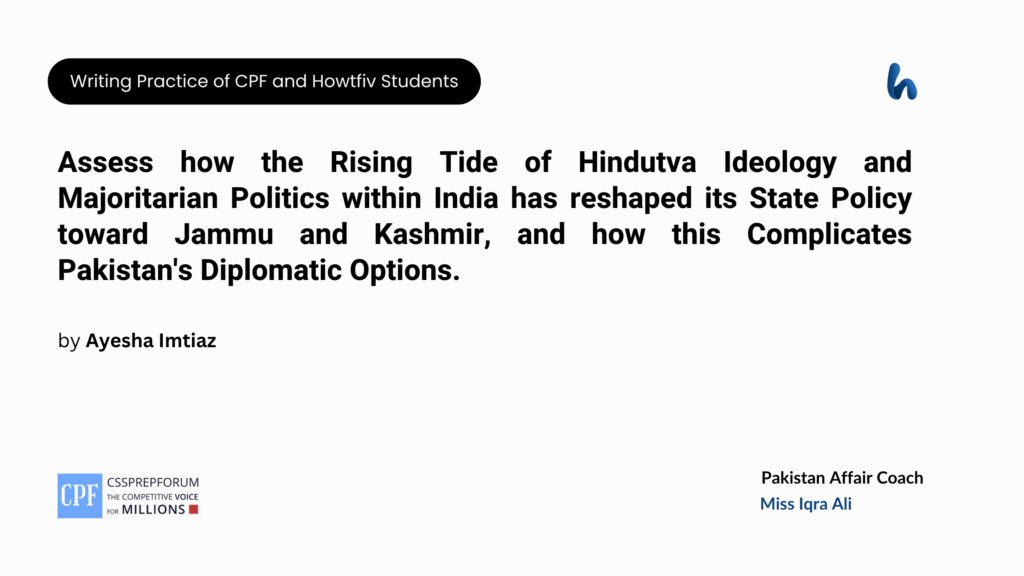
CSS Pakistan Affairs | Majoritarian Politics within India and Kashmir
The following question of CSS Pakistan Affairs is solved by Ayesha Imtiaz under the supervision of Howfiv’s Pakistan Affairs and Current Affairs Coaches: Miss Iqra Ali and Sir Ammar Hashmir. She learnt how to attempt 20 marks question and essay writing from Sir Syed Kazim Ali, Pakistan’s best CSS and PMS English essay and precis teacher with the highest success rate of his students. This solved question is attempted on the pattern taught by Sir to his students, scoring the highest marks in compulsory and optional subjects for years.

Outline
1-Introduction
2-Understanding the rising tide of Hindutva ideology and majoritarian politics in India
3-How the Rising Tide of Hindutva Ideology and Majoritarian Politics Has Reshaped State Policy Toward Jammu and Kashmir
- ✓Reshaping Kashmir’s constitutional status
- ✓Violating International Human Rights Conventions
- ✓Engineering demographic and territorial changes
- ✓Securitizing governance and public dissent
4-How Reshaped State Policy Toward Jammu and Kashmir Complicates Pakistan’s Diplomatic Options
- ✓Navigating the erosion of bilateral frameworks
- ✓Exposing international apathy and economic pragmatism
- ✓Mobilizing multilateral forums
- ✓Rebalancing strategic reliance on key allies
5-Critical analysis
6-Conclusion
Answer to the question
Introduction
Hindutva ideology is based on making Indian policies pro-Hindu, favoring the Hindu community while neglecting the rights of minorities. Following the 2019 revocation of Articles 370 and 35A, the Indian government dissolved the special status of Jammu and Kashmir. These articles had previously restricted permanent settlement, property acquisition, and state government jobs to residents. With their repeal, the central government allowed non-locals to permanently settle, purchase property, and secure government employment in the region. This reshaping of Kashmir’s constitutional status and the accompanying violations of international human rights conventions demonstrate how Hindutva ideology and majoritarian politics have transformed state policy toward Jammu and Kashmir. Furthermore, the erosion of bilateral frameworks, paired with international apathy and economic pragmatism, has severely complicated Pakistan’s diplomatic options. Consequently, Pakistan has continuously raised this issue on global platforms to seek a resolution to the Kashmir conflict.
Understanding the Rising Tide of Hindutva Ideology and Majoritarian Politics in India
Hindutva is a political movement that aims to make Hindu culture the main foundation of Indian national identity. Under the rule of the BJP, led by Prime Minister Narendra Modi, this ideology has gained prominent status. It prioritizes the beliefs and preferences of the Hindu majority, giving them a central place in law and governance. However, this shift has significantly undermined India’s standing as a secular, democratic nation. It was this same ideology that led to the demolition of the Babri Masjid and the subsequent construction of the Ram Mandir. Furthermore, it fueled the aggressive stance that resulted in the abrogation of Articles 370 and 35A. Consequently, it brought Muslim-majority Kashmir under direct control governed by majoritarian ideals, severely curbing the rights of its people, to an extent that critics warn borders on genocide.
How the Rising Tide of Hindutva Ideology and Majoritarian Politics Has Reshaped State Policy Toward Jammu and Kashmir
- Reshaping Kashmir’s Constitutional Status
The revocation of Article 370 and Article 35A in August 2019 brought a major shift in India’s legal governance of Jammu and Kashmir. By abrogating these constitutional rights, the Indian government removed the special autonomous status that had long protected the region’s unique connection with India. For example, the Jammu and Kashmir Reorganisation Act of 2019 took away the region’s statehood, split it into two central government-controlled Union Territories: Jammu & Kashmir and Ladakh, and canceled local land and job protections. This shift highlights the political idea of “one nation, one constitution,” prioritizing direct central rule over local self-governance and hampering the rights of the Kashmiris. Ultimately, this change not only permanently altered the region’s political system but also fully absorbed Jammu and Kashmir into India’s central government setup.
- Violating International Human Rights Conventions
India’s altered policies in Jammu and Kashmir have led to serious violations of major international human rights treaties. By using restrictive security laws and blocking public communication, the government has directly undermined fundamental civil, political, and socio-economic rights guaranteed by international law. For instance, the UN and Amnesty International reports document violations of Articles 1 (self-determination), 9 (arbitrary detention), and 19 (freedom of expression) of the ICCPR, alongside Article 49 of the Fourth Geneva Convention, which forbids transferring civilian populations into occupied land. This demonstrates that state actions within a region are evaluated against binding global treaties rather than just domestic laws, reflecting the principle of international legal accountability. Therefore, these systemic legal violations provide Pakistan with a compelling basis to challenge India’s actions across multilateral forums.
- Engineering Demographic and Territorial Changes
India’s majoritarian government is aiming at engineering demographic and territorial changes in Jammu and Kashmir. By introducing new residence laws, the central government has allowed non-locals to permanently settle, buy property, and secure government jobs in the region, which were previously prohibited under Article 35A. By abolishing this article, India is dismantling historic domicile protections and facilitating demographic realignments in Kashmir. For example, the Jammu and Kashmir Grant of Domicile Certificate Rules, introduced in 2020, enabled millions of non-locals to obtain official residency certificates. This strategy reflects the concept of settler colonialism, using administrative and political tools to weaken the native population’s electoral power and social identity. Therefore, these targeted administrative measures were meant to alter the socio-political landscape of the region to secure long-term central control.
- Securitizing Governance and Public Dissent
Under the influence of majoritarian politics and the extremist Hindutva ideology of the BJP under PM Modi, the Indian government has turned the administration of Jammu and Kashmir into a heavily militarized security operation. For years, the administration has been treating civil rights and peaceful protests as serious security threats. And the central government has systematically restricted local freedoms to maintain control. For instance, after the August 2019 legal changes, the government enforced long internet blackouts, arrested local leaders, including Mehbooba Mufti, Omar Abdullah, and Dr. Farooq Abdullah, using the Public Safety Act (PSA) to detain civilians without trial. These practices reflect the theory of securitization, where ordinary political issues are treated as military matters to justify restricting human rights. Therefore, the government is prioritizing security over democratic rights, thereby eroding the rights of Kashmiris.
How Reshaped State Policy Toward Jammu and Kashmir Complicates Pakistan’s Diplomatic Options
- Navigating the Erosion of Bilateral Frameworks
India’s unilateral structural changes in August 2019, regarding the abrogation of Articles 370 and 35A, broke the foundation of the historical bilateral frameworks governing Indo-Pakistani relations. By treating the Kashmir dispute as purely an internal administrative matter, India has shut down formal dialogue, leaving Pakistan with few options to negotiate. For example, India’s actions violated the 1972 Simla Agreement, signed between Zulfikar Ali Bhutto and Indira Gandhi, and the 1999 Lahore Declaration, agreed upon by Nawaz Sharif and Atal Bihari Vajpayee. According to these frameworks, both countries were required to resolve the Kashmir issue peacefully through bilateral engagement without making unilateral changes. This situation represents coercive diplomacy, where one country alters facts on the ground to force the other into accepting a deadlocked reality. Therefore, the dismantling of these bilateral agreements has forced Pakistan to seek international avenues to raise the Kashmir issue.
- Exposing International Apathy and Economic Pragmatism
Pakistan’s diplomatic efforts are heavily limited by global indifference and the economic interests of major world powers toward India, as it is one of the world’s leading emerging economies. Owing to India’s significant market capacity, many nations choose trade and geopolitical alliances with India, bypassing the human rights violations in Kashmir. For example, despite Pakistan’s diplomatic campaigns in favor of Indian-administered Kashmir, Saudi Arabia’s investment in India post-2019 has exceeded $10 billion. Furthermore, many European Union and key Gulf Cooperation Council (GCC) states have expanded commercial partnerships with New Delhi. This illustrates realist international theory, which argues that national interest and economic gain matter far more to states than moral values or international rules. Therefore, global economic priorities favoring India are making it difficult for Pakistan to turn international sympathy into real political pressure against India and its Hindutva ideology, which is becoming increasingly prominent under Modi’s government.
- Mobilizing Multilateral Forums
Observing the unwillingness toward bilateral talks from India, Pakistan has turned to international platforms like the United Nations and the OIC to raise the Kashmir issue. By speaking at these global platforms, Pakistan tries to highlight human rights problems and force world leaders to pay attention. For example, right after August 2019, Pakistan helped get the UN Security Council to hold special discussions on Kashmir, its first meetings on the topic in over 50 years, and also received strong support from the Organization of Islamic Cooperation (OIC). This strategy reflects liberal institutionalism, which shows that global organizations give countries a platform to speak up and use international rules against stronger rivals who are involved in violations of the law. Therefore, even when major powers stay quiet, using these international bodies helps Pakistan remind the world about Kashmir.
- Rebalancing Strategic Reliance on Key Allies
In view of the growing power of India, Pakistan is reshaping its strategic partnerships with key allies like China and Turkey. By strengthening ties with these partners, Pakistan aims to build a strong counterweight against Indian influence and secure consistent diplomatic and economic backing. For example, Pakistan has relied heavily on China’s veto power at the UN Security Council to block Indian initiatives, while receiving unwavering diplomatic support on Kashmir from Turkey and Azerbaijan. This illustrates balancing theory, where a country forms strong alliances with key states to protect itself against a dominant rival. Therefore, building closer ties with these trusted allies allows Pakistan to maintain its strategic position even when traditional Western partners stay neutral.
Critical Analysis
Critically analyzing, Hindutva ideology motivates the Indian government to take strict action against the Muslim community. For years, India, which declares itself as the custodian of a secular democratic country, has been hampering the rights of minorities and prioritizing Hinduism over other state religions. First, it resulted in the demolition of the Babri Masjid, and later, the revocation of Kashmir’s special status. With this revocation, India has also dismantled the Simla Agreement, which aimed to solve the Kashmir issue through bilateral talks. Additionally, these demographic changes appear intended for a future plebiscite; altering the demographics risks overshadowing the Muslim majority with newly settled residents. Therefore, this ideology poses immense pressure on Pakistan and Kashmir. Although several international talks have been arranged over the years, no effective decision has been made so far. Nevertheless, Pakistan keeps reviving this issue on a global scale to make it part of the worldwide debate.
Conclusion
In conclusion, the rise of Hindutva ideology and majoritarian politics in India has fundamentally reshaped its state policy toward Jammu and Kashmir. Following the revocation of Articles 370 and 35A, Kashmiris have been deprived of their basic socio-cultural and political rights. Through these revocations, India has begun altering the region’s demographics, leading to widespread violations of fundamental human rights. Additionally, Pakistan continues to play an active role in raising the Kashmir issue at the international level. Ultimately, the repeal of these articles has dissolved Kashmir’s special status, threatening to turn the native Kashmiri population into a minority in their own land.

CSS Solved Past Papers’ Essays
Looking for the last ten years of CSS and PMS Solved Essays and want to know how Sir Kazim’s students write and score the highest marks in the essays’ papers? Then, click on the CSS Solved Essays to start reading them.
CSS Solved Essays
CSS Solved Islamiyat Past Papers
Want to read the last ten years’ Islamiyat Solved Past Papers to learn how to attempt them and to score high? Let’s click on the link below to read them all freely. All past papers have been solved by Pakistan’s top CSS Islamiyat coaches having the highest score of their students.
CSS Solved Islamiyat
CSS Solved General Science & Ability Past Papers
Want to read the last ten years’ General Science & Ability Solved Past Papers to learn how to attempt them and to score high? Let’s click on the link below to read them all freely. All past papers have been solved by Pakistan’s top CSS GSA coachez having the highest score of their students.
CSS Solved General Science & Ability
CSS Solved Pakistan Affairs Past Papers
Want to read the last fifteen years’ Pakistan Affairs Solved Past Papers to learn how to attempt them and to score high? Let’s click on the link below to read them all freely. All past papers have been solved by Pakistan’s top CSS Pakistan Affairs coaches having the highest score of their students.
CSS Solved Pakistan Affairs
CSS Solved Current Affairs Past Papers
Want to read the last fifteen years’ Current Affairs Solved Past Papers to learn how to attempt them and to score high? Let’s click on the link below to read them all freely. All past papers have been solved by Pakistan’s top CSS Current Affairs coaches having the highest score of their students.
CSS Solved Current Affairs