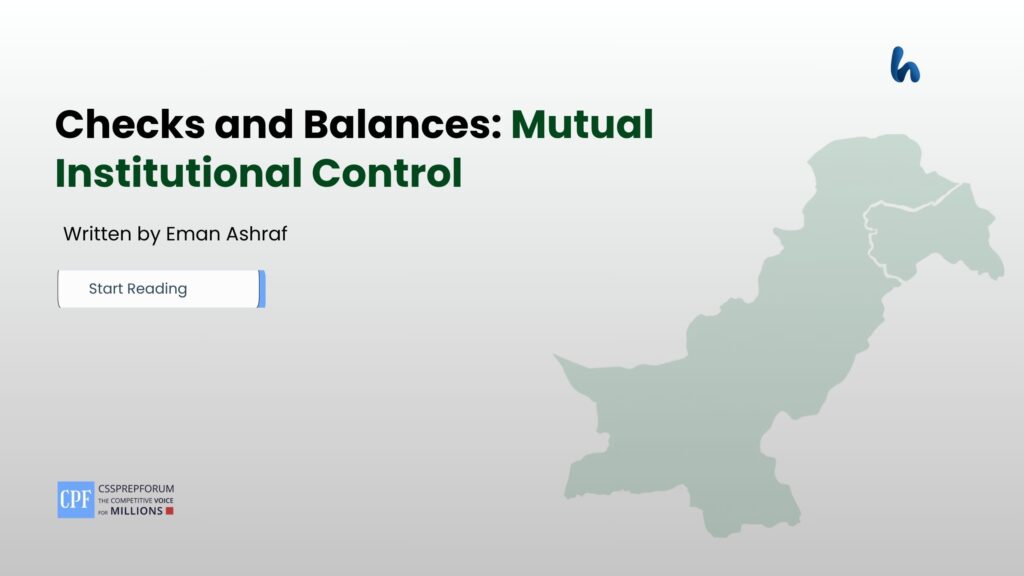
CSS/PMS Political Science | Checks and Balances: Mutual Institutional Control
Checks and balances ensure that state institutions monitor and limit each other’s powers to prevent misuse of authority. Through mutual institutional control, the executive, legislature, and judiciary maintain accountability, rule of law, and democratic stability. This topic holds significant importance in CSS and PMS examinations as it explains the practical functioning of constitutional governance and democratic institutions.

1. Introduction
Every government needs power to run a country. But too much power in one hand is dangerous. History shows that when one person or one institution gets unlimited power, it often leads to dictatorship, corruption, injustice, and abuse.
To prevent this, modern political systems use a mechanism called Checks and Balances. This system ensures that no single branch of government becomes all-powerful, and each branch can control, limit, and correct the others.
- Definition
Checks and Balances is a system of government in which power is divided among different branches, such as the legislature, executive, and judiciary, and each branch has the authority to limit and oversee the actions of the others. This system ensures that no single branch becomes too powerful or uses its authority unfairly. For example, one branch may make laws, another may enforce them, and another may interpret them, while also having the power to stop or correct each other when needed. In simple terms, checks and balances work like a control system that keeps government power balanced, prevents misuse of authority, and protects the rights and freedoms of the people.
According to James Madison in The Federalist Papers:
“Ambition must be made to counteract ambition.”
This famous statement reflects the principle of checks and balances, whereby each branch of government is given sufficient constitutional powers to restrain the others and prevent the concentration of power.
3. Meaning (Explained Simply)
To understand checks and balances, imagine three people running a system together:
- One makes the rules
- One implements the rules
- One judges whether the rules are followed correctly
If any one of them starts acting unfairly, the other two can stop or correct that action.
In government:
- Legislature makes laws
- Executive implements laws
- Judiciary interprets laws
Checks and balances mean:
- The law-makers cannot rule alone
- The government cannot act without limits
- The judges cannot act arbitrarily
Each branch checks the others and balances power.
Characteristics of Checks and Balances
1. Division of Power
In a system of checks and balances, government power is not given to one person or one institution. Instead, it is divided among different branches of government. Each branch has its own role and responsibilities. This division helps ensure that decisions are not controlled by a single authority, which could lead to unfair rule or dictatorship.
2. Mutual Control
Each branch of government has some power to watch, limit, or correct the actions of the other branches. This means no branch can act freely without oversight. If one branch tries to go beyond its limits, the others can step in and stop it. This creates balance and encourages cooperation.
3. Legal Authority
All powers of checking and controlling each other come from the constitution or laws of the country. These powers are not based on personal wishes or emotions. Because everything is written in law, the system works in an organized and fair manner.
4. Prevention of Abuse
The main purpose of checks and balances is to stop the misuse of power. By sharing authority and allowing supervision, the system makes it difficult for any branch to act unfairly, illegally, or in a harmful way. This helps protect citizens from injustice.
5. Independence with Accountability
Each branch of government works independently and performs its own duties without interference. However, independence does not mean complete freedom. Every branch is still answerable for its actions and can be questioned or reviewed by the others. This ensures responsibility along with freedom.
Historical Background
- The idea of checks and balances did not appear suddenly; it comes from political thinking developed many years ago. One of the most important thinkers behind this idea was Montesquieu, a French philosopher of the 18th century. He believed that if all power is given to one person or one institution, it will almost certainly be misused. That is why he said, “Power should be a check to power,” meaning that power can only be safely controlled by giving some power to others who can stop it when necessary.
- Montesquieu’s ideas greatly influenced the makers of the United States Constitution in 1787. They divided government power into three branches, legislative, executive, and judicial, and gave each branch the ability to limit the others. This system was designed to prevent tyranny, protect people’s rights, and ensure that government works in a fair and balanced way. Because of this, the U.S. Constitution became one of the strongest real-life examples of checks and balances in practice.
Major Examples of Checks and Balances
Classical Examples
1. Ancient Greece (Mixed Government Idea)
Greek thinkers believed that power should not rest with only one group. Power was shared between assemblies, councils, and courts so that one body could not dominate others.
2. Roman Republic
Rome divided power among Consuls (executive), the Senate (elite advisory body), and Popular Assemblies (people’s voice). Each had the ability to limit the others, preventing absolute rule.
3. Early Islamic Governance – Hazrat Umar (RA)
During the Caliphate of Hazrat Umar ibn al-Khattab (RA), there were practical forms of checks and balances in government:
Council Consultation (Shura): Hazrat Umar consulted a group of advisors and experts before making major decisions, ensuring the Caliph’s power was not absolute.
Accountability of Governors: Provincial governors were regularly audited and checked. Hazrat Umar sent inspectors (Muhtasib) to ensure justice and prevent misuse of power.
Public Complaints: Citizens had the right to complain against officials, and these complaints were investigated and acted upon.
Rule of Law: Even Hazrat Umar himself was expected to follow Islamic law (Sharia). He personally ensured that justice was upheld, showing that no one was above the law.
Early Modern / Philosophical Examples
4. Montesquieu’s Theory (18th Century)
Montesquieu formally explained checks and balances by arguing that legislative, executive, and judicial powers must be separate and able to restrain one another to prevent tyranny.
Modern / Constitutional Examples
5. United States (1787 – Present)
- Congress makes laws
- President can veto laws
- Courts can declare laws unconstitutional
This is the classic and most famous example of checks and balances.
6. United Kingdom
- Parliament makes laws
- Executive (Prime Minister & Cabinet) runs government
- Courts review government actions
Although Parliament is strong, courts and political conventions act as checks.
7. France
- President shares power with Parliament
- Courts ensure laws follow the constitution
Power is balanced between executive and legislative branches.
Contemporary Examples (Including Developing States)
8. Pakistan
- Parliament makes laws
- Prime Minister executes laws
- Judiciary can strike down unconstitutional actions
Each branch limits the others under the Constitution.
9. India
- Parliament passes laws
- Executive governs
- Supreme Court uses judicial review
Strong judiciary ensures balance.
10. Germany
l Federal Parliament, Executive, and Constitutional Court
- Court strongly checks both legislature and executive
A modern and effective balance system.
International / Supranational Example
11. European Union
- European Commission proposes laws
- European Parliament and Council approve them
- European Court of Justice reviews legality
Power is divided to avoid dominance by any single institution.
In Simple Words
From ancient times to modern states, checks and balances have been used to divide power, limit authority, and prevent misuse, making government more fair, stable, and accountable.
Simple Real-Life Analogy
Think of a school system:
- Teachers teach
- Principal manages
- Examination board checks results
If one starts acting unfairly, others intervene. This is checks and balances in practice.
Why Checks and Balances Are Important in a Government?
Prevents Dictatorship
Checks and balances stop all power from going into the hands of one person or one institution. Because different branches can limit each other, no one can rule absolutely or become a dictator.
Protects Citizens’ Rights
When government decisions or laws are unfair, other branches can review and correct them. This helps protect people from injustice and ensures that their basic rights are not violated.
Ensures Rule of Law
In a system with checks and balances, everyone must follow the law, including those in power. Leaders cannot act according to personal wishes because their actions are controlled by the law.
Promotes Transparency
Government decisions are not made secretly or without review. Since different branches examine each other’s actions, decisions are discussed openly and checked from many sides.
Improves Governance Quality
Because power is shared and supervised, mistakes can be identified and corrected early. This leads to better decisions, fair administration, and a more effective government overall.
Contemporary Relevance: Why Checks and Balances Matter Today
In today’s world, governments have more power than ever, controlling areas like the economy, security, media, and technology. During emergencies such as pandemics, wars, or crises, governments often use special powers to act quickly.
Without strong checks and balances:
- Governments may misuse emergency powers even after the crisis ends.
- Courts may become weak or ignored, unable to stop unfair actions.
- Parliaments may lose authority, and laws may be passed without proper oversight.
With strong checks and balances:
- Democracy is protected by limiting power and ensuring fairness.
- Citizens’ freedoms are safeguarded from misuse of authority.
- Authoritarian tendencies are controlled, preventing leaders from becoming too powerful.
Even today, countries with weak checks and balances often face political instability and human rights violations, showing why this system is still essential for modern governments.
Pakistan-Specific Explanation of Checks and Balances
Pakistan’s 1973 Constitution sets up a federal parliamentary democracy. This means power is shared between different branches of government, and no branch can act freely without oversight. The checks and balances system ensures that each branch, legislature, executive, and judiciary, limits the power of the others, prevents misuse of authority, and protects citizens’ rights.
1. Legislature (Parliament)
Role: Makes laws, approves budgets, and oversees government policies.
How it checks others:
- Can remove the Prime Minister through a vote of no confidence.
- Can amend the Constitution following the proper procedure.
- Can approve or reject government policies and bills to ensure the executive does not act unfairly.
2. Executive (President & Prime Minister)
Role: Runs the government and implements laws passed by Parliament.
How it checks others:
- The President can veto bills, meaning laws passed by Parliament must be reconsidered.
- The Prime Minister and Cabinet are responsible to Parliament, ensuring they remain accountable for their actions.
3. Judiciary (Supreme Court & High Courts)
Role: Interprets laws and ensures they follow the Constitution.
How it checks others:
- Can declare laws or government actions unconstitutional (this is called Judicial Review).
- Protects the fundamental rights of citizens, ensuring the government cannot act unfairly.
4. Historical Examples of Checks and Balances in Pakistan
To understand how checks and balances work in Pakistan, we can look at some real examples from history. These show how each branch of government, judiciary, legislature, and executive, can limit the powers of the others.
Judicial Check – Supreme Court vs. Executive (2012)
In 2012, the Supreme Court of Pakistan disqualified Prime Minister Yousaf Raza Gillani from office.
Why it happened: The Prime Minister had refused to write a letter to Swiss authorities to reopen corruption cases against the President, which the court considered a contempt of court.
What this shows: The judiciary has the power to hold even the Prime Minister accountable if they break the law or act against the Constitution.
Impact: This event reminded everyone that the executive cannot act above the law, and the courts can stop misuse of power.
Legislative Check – Parliament vs. Executive
The Parliament has the authority to pass a no-confidence motion against the Prime Minister.
How it works: If the Prime Minister loses the support of the majority in the National Assembly, members can propose a no-confidence motion.
Result: If the motion passes, the Prime Minister is removed from office.
Example in practice: This ensures that the executive remains accountable to the legislature, and leaders cannot stay in power without the confidence of elected representatives.
Executive Check – President vs. Legislature
The President of Pakistan has the power to veto bills passed by Parliament.
How it works: When Parliament passes a law, the President can refuse to sign it and send it back for reconsideration.
Purpose: This ensures that the legislature’s decisions are carefully reviewed and prevents hasty or unfair laws from being enforced without proper checks.
Significance: It gives the executive a way to check legislative power, making sure that laws are fair and constitutional before becoming final.
In Simple Words:
- The judiciary keeps the executive in check.
- The legislature keeps the executive accountable.
- The executive can check the legislature through veto power.
Together, these examples show how no branch of government in Pakistan is above the law, and each branch can supervise and limit the others to maintain fairness, accountability, and balance.
Contemporary Relevance in Pakistan
Preventing misuse of emergency powers: Article 232 allows emergency powers, but Parliament and the courts can review them.
Safeguarding democracy: Courts and Parliament check military or executive overreach, which has been a historical challenge in Pakistan.
Ensuring accountability: Ministers and officials must answer to the National Assembly and can be investigated or removed if they break the law.
Key Takeaways for Pakistan
- Checks and balances protect democracy and prevent one branch from becoming too powerful.
- They limit and supervise the powers of the executive, legislature, and judiciary.
- A strong system is essential to maintain the rule of law, protect citizens’ rights, and ensure political stability in Pakistan.
Comparison with related forms
Checks and Balances vs Separation of Powers
| Aspect | Separation of Powers | Checks and Balances |
| Meaning | Divides government power into different branches | Gives branches the power to control and limit each other |
| Focus | Who does what (roles of each branch) | Who controls or restrains whom (oversight) |
| Nature | Structural – organizes government framework | Functional – ensures supervision and accountability |
| Example | Legislature makes laws, Executive enforces, Judiciary interprets | Veto, Judicial Review, Impeachment |
Takeaway:
Separation of powers creates a division of responsibilities, while checks and balances ensure that each branch is supervised and power is not misused.
Checks and Balances vs Parliamentary Supremacy
| Aspect | Parliamentary Supremacy | Checks and Balances |
| Meaning | Parliament has the highest authority in government | No branch is supreme; each branch can limit the others |
| Power Distribution | Parliament dominates other branches | Power is shared and regulated among all branches |
| Protection Against Abuse | Limited; executive and judiciary have less control | Strong; each branch can check abuse by the others |
| Example | UK Parliament can pass almost any law without veto | US President can veto, Judiciary can declare laws unconstitutional |
Takeaway:
Parliamentary supremacy gives more power to the legislature, whereas checks and balances provide better protection against misuse of power by any branch.
Checks and Balances vs Judicial Review
| Aspect | Judicial Review | Checks and Balances |
| Meaning | Courts have the power to review laws and actions to ensure they follow the Constitution | All branches have powers to control and limit each other |
| Focus | Limits executive and legislature using judicial authority | Mutual control among all branches, not just courts |
| Nature | Mostly legal and reactive – acts when law is challenged | Functional and ongoing – happens continuously |
| Example | Supreme Court declaring a law unconstitutional | President vetoing a bill, Parliament passing no-confidence motion, Courts reviewing executive actions |
Takeaway:
Judicial Review is one tool of checks and balances that ensures laws and actions follow the Constitution. Checks and balances cover all branches and provide a broader system of control and accountability.
References
- Encyclopaedia Britannica – Checks and Balances
- Stanford Encyclopedia of Philosophy – Constitutionalism
- The Constitution Unit (UCL) – Checks and Balances: What Are They and Why Do They Matter?
- ederalist No. 51 – James Madison
- Dartmouth College – Judicial Checks and Balances
- ConstitutionNet – Constitutional Checks and BalancesEncyclopaedia Britannica Students – Checks and Balances
Important Note for CSS and PMS Aspirants
For aspirants preparing for competitive examinations, exploring solved past papers is essential to understand examiner expectations, analytical answer writing, and paper trends. Therefore, candidates are strongly encouraged to read the following comprehensive solved papers available on CSSPREPFORUM.
- CSS Solved Pakistan Affairs Past Papers
- CSS Solved Current Affairs Past Papers
- CSS Solved Islamiat Past Papers
- CSS Solved General Science and Ability Past Papers
Moreover, aspirants searching for the most credible and result-oriented teachers for CSS and PMS preparation can benefit from the following detailed guidance articles
- Who is the Best CSS PMS Islamiat Teacher in Pakistan?
- Who is the Best CSS PMS Pakistan Affairs Teacher in Pakistan?
- Who is the Best CSS Current Affairs Teacher in Pakistan?
- Who is the Best CSS GSA Teacher in Pakistan?
- Who is the Best CSS PMS English Essay and Precis Teacher in Pakistan?
- Who is the Best English Grammar Teacher in Pakistan?