CSS Islamiat Writing Practice | ‘Universal Mercy’ in the Prophet’s (PBUH) diplomatic dealings
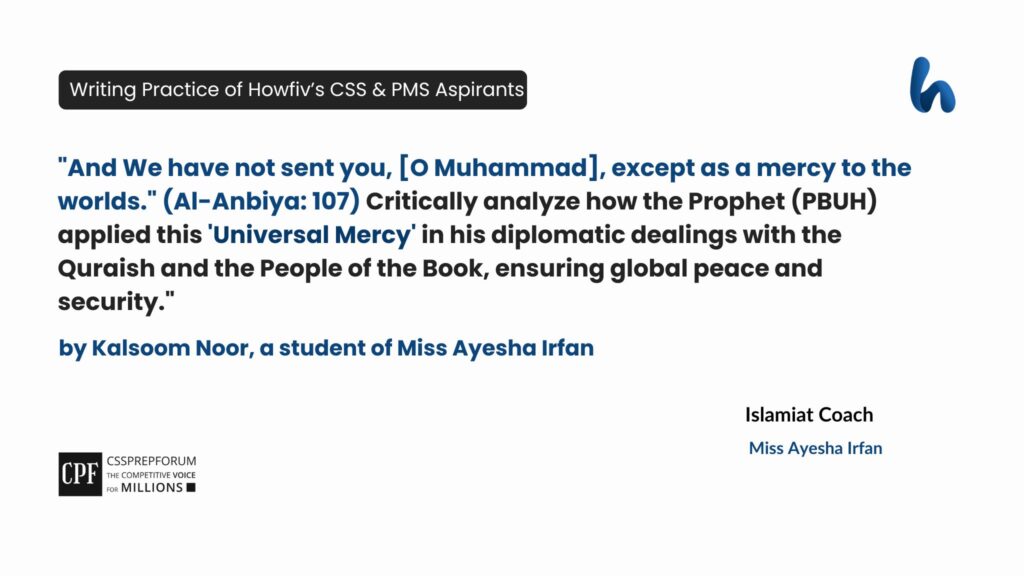
The following question is solved by Kalsoom Noor under the supervision of Miss Ayesha Irfan, a renowned CSS/PMS Islamiat coach in Pakistan. Moreover, this article attempted to use the same pattern taught by Sir Syed Kazim Ali to his students, who have scored the highest marks in compulsory and optional subjects for years. This article is uploaded to help aspirants understand how to crack a topic or question; write relevantly, what coherence is, and how to include and connect ideas, opinions, and suggestions to score the maximum.

Question Breakdown
The question requires a critical analysis of how the Prophet (PBUH) implemented the concept of “mercy to the worlds” in his diplomatic dealings. It specifically focuses on his interactions with the Quraish and the People of the Book, requiring evidence from Islamic history. Furthermore, it demands an evaluation of how these practices contributed to ensuring peace, stability, and security at both societal and broader levels.
Outline
1-Introduction
2- Understanding “Mercy to the Worlds” in the Light of Surah Al-Anbiya
3-Manifestation of Universal Mercy of Prophet (PBUH) in Dealings with the Quraish
- Treaty of Hudaybiyyah: Strategic Peacebuilding
- Conquest of Makkah: Forgiveness and Reconciliation
- Response to Persecution: Patience and Non-violence
- Promotion of Dialogue over Conflict with Quraish
4-Manifestation of Universal Mercy of Prophet (PBUH) in Dealings with the People of the Book
- Charter of Madinah: Inclusive Political Order
- Treaties with Christians of Najran: Religious Freedom
- Protection of Minority Rights and Places of Worship
- Ethical Principles in Conflict with Non-Muslims
5-Contemporary Relevance of Prophetic Diplomacy
6-Conclusion
Answer to the question
Introduction
The Qur’anic declaration, “And We have not sent you, [O Muhammad], except as a mercy to the worlds” (Al-Anbiya: 107), encapsulates the universal mission of Prophet Muhammad as a source of compassion, justice, and guidance for all humanity. Fundamentally, this concept of mercy was not confined to personal ethics; rather, it was profoundly reflected in his diplomatic engagements with both the Quraish and the People of the Book. In this regard, through strategic treaties, forgiveness in victory, and the establishment of pluralistic frameworks, the Prophet (PBUH) transformed potential conflict into avenues of peaceful coexistence. Consequently, his approach demonstrated that mercy, when embedded in diplomacy, serves as a powerful instrument for ensuring not only immediate reconciliation but also long-term global peace and security.
Understanding “Mercy to the Worlds” in the Light of Surah Al-Anbiya
The concept of Universal Mercy in Islam represents a comprehensive principle that governs both individual conduct and collective interactions. The Qur’anic declaration, “And We have not sent you, [O Muhammad], except as a mercy to the worlds” (Al-Anbiya: 107), highlights the universal nature of the Prophet’s (PBUH) mission, extending beyond a single community to all humanity. The life of the Prophet (PBUH) provides practical evidence of this principle, as the Prophet’s (PBUH) interaction with friends and opponents alike was guided by fairness, restraint, and a commitment to peaceful coexistence. Therefore, “mercy to the worlds” represents a comprehensive framework for promoting harmony and stability.
Manifestation of Universal Mercy of Prophet (PBUH) in Dealings with the Quraish
The practical manifestation of mercy is most vividly reflected in the Prophet’s (PBUH) diplomatic dealings with the Quraish, who were not only his staunch opponents but also persistent persecutors. Despite prolonged hostility, he consistently prioritized reconciliation over retaliation and dialogue over confrontation. In doing so, the Prophet (PBUH) established a model of diplomacy rooted in mercy, which paved the way for sustainable peace and stability.
- Treaty of Hudaybiyyah: Strategic Peacebuilding
To begin with, the Treaty of Hudaybiyyah stands as a remarkable example of the Prophet’s (PBUH) strategic use of mercy in diplomacy to ensure long-term peace. When the Prophet and his companions set out for pilgrimage, they were stopped by the Quraysh, leading to tense negotiations. Despite the Muslims’ strong position, the Prophet (PBUH)agreed to terms that appeared unfavorable, such as postponing the pilgrimage and returning certain individuals to Makkah. However, the Qur’an described this treaty as a “clear victory” (Surah Al-Fath: 1), highlighting its deeper wisdom. Critically, although the agreement seemed like a political compromise, it effectively de-escalated conflict and created space for peaceful interaction, which accelerated the spread of Islam. Thus, this event demonstrates that mercy, when strategically applied, functions as a powerful diplomatic tool for achieving sustainable peace and stability.
- Conquest of Makkah: Forgiveness and Reconciliation
Moreover, the Conquest of Makkah exemplifies the Prophet’s (PBUH) embodiment of universal mercy through forgiveness and reconciliation. After years of persecution and expulsion by the Quraysh, the Prophet entered Makkah with overwhelming authority and complete control over his former enemies. Despite this, he declared a general amnesty, stating, “No blame will there be upon you today,” and forgave those who had opposed him, ensuring that no widespread retaliation took place. This act finds support in the Qur’anic principle of forgiveness and restraint in times of power. Critically, while conventional political logic might favor retribution to establish authority, the Prophet’s choice of forgiveness prevented cycles of revenge and fostered unity. Consequently, this approach transformed former enemies into allies, illustrating that reconciliation rooted in mercy ensures long-term peace and internal stability.
- Response to Persecution: Patience and Non-violence
In the same vein, the Prophet’s (PBUH) response to persecution by the Quraish highlights the role of patience and non-violence as manifestations of universal mercy. During the boycott in the valley of Abu Talib, the Muslims faced severe social and economic isolation, yet the Prophet did not resort to violent retaliation and instead maintained composure while seeking a gradual resolution. The Qur’an reinforces this approach: “Repel evil with that which is better” (Fussilat: 34). Critically, while such restraint may appear passive, it was a deliberate and strategic choice that preserved moral legitimacy and prevented escalation. This approach allowed space for the gradual transformation of attitudes and eventual reconciliation. Therefore, it demonstrates that principled non-violence can be more effective than confrontation in achieving durable peace.
- Promotion of Dialogue over Conflict with Quraish
Moreover, the Prophet (PBUH) consistently prioritized dialogue over confrontation in his dealings with the Quraish, emphasizing negotiation as a means of conflict resolution. When tensions arose, particularly at Hudaybiyyah, he chose to engage in discussions rather than initiate confrontation, even accepting compromise to maintain peace. His willingness to listen and negotiate reduced hostility and created mutual understanding between opposing sides. Critically, this approach challenges the assumption that dialogue is ineffective in hostile environments; rather, it demonstrates that sustained engagement can reduce tensions and build mutual understanding. However, this dialogue was balanced with firmness on core principles, highlighting that effective diplomacy requires both flexibility and consistency. Thus, the Prophet’s method underscores the role of dialogue in ensuring peaceful coexistence.
Manifestation of Universal Mercy of Prophet (PBUH) in Dealings with the People of the Book
The Prophet’s (PBUH) mercy extended beyond the Quraish to include the People of the Book, namely Jews and Christians, as well as other non-Muslim communities living under his governance. In all his interactions, he emphasized justice, tolerance, and peaceful coexistence, ensuring that diplomatic agreements and political frameworks reflected ethical principles. This universal approach demonstrated that Islamic mercy was not limited to followers of Islam but encompassed all communities, thereby laying the foundation for inclusive governance and global peace.
- Charter of Madinah: Inclusive Political Order
First, the Charter of Madinah represents a practical manifestation of the Prophet’s (PBUH) mercy in dealing with the People of the Book, particularly the Jewish tribes of Madinah. Upon establishing the Muslim community, he formulated an agreement that defined the rights and responsibilities of Muslims and Jews within a unified political system. Notably, the Charter declared that “the Jews and Muslims are one community, while each retains their own religion,” ensuring religious autonomy and mutual coexistence. It also emphasized collective security, requiring all groups to defend Madinah against external threats. Critically, this arrangement reflects an advanced model of inclusive governance, where peace was maintained through justice and cooperation rather than dominance. Thus, the Charter demonstrates that mercy, when institutionalized through fair agreements, becomes a foundation for long-term stability and interfaith harmony.
- Treaties with Christians of Najran: Religious Freedom
Moreover, the Prophet’s (PBUH) treaty with the Christians of Najran highlights his commitment to religious freedom and peaceful coexistence. When a Christian delegation visited Madinah, they were allowed to practice their faith freely, and a formal agreement was made guaranteeing the safety of their lives, property, and places of worship, reflecting the Qur’anic principle of “no compulsion in religion” (Al-Baqarah: 256). This ensured that they could live without fear under Muslim rule. Critically, this approach challenges misconceptions that religion leads to intolerance, demonstrating instead that Islamic diplomacy upholds pluralism. However, such freedoms were accompanied by responsibilities toward the state, ensuring a balance between rights and obligations. Therefore, this example illustrates that religious freedom, when protected within a just political framework, contributes to harmony and long-term stability.
- Protection of Minority Rights and Places of Worship
Similarly, the protection of minority rights and places of worship represents a key dimension of the Prophet’s (PBUH) universal mercy. Once, the Prophet (PBUH) allowed the Christian delegation from Najran to perform their religious prayers inside Masjid al-Nabawi in Madinah. Despite it being the central place of Islamic worship, the Prophet (PBUH) did not restrict them and instead facilitated their religious practice according to their own beliefs. This practical action was further reinforced by granting them protection for their churches and religious life under a formal agreement. Critically, this incident reflects that the Prophet’s concept of mercy was not limited to tolerance but extended to active respect and accommodation of other faiths. By ensuring both freedom and dignity for minority communities, he established a model of interfaith harmony. Therefore, this example illustrates that safeguarding places of worship through practical actions is essential for achieving lasting peace in a diverse society.
- Ethical Principles in Conflict with Non-Muslims
Next, the Prophet’s (PBUH) conduct during conflict was governed by strict ethical principles rooted in mercy and justice. It is clearly demonstrated during the expedition to Khaybar. When the Muslim forces engaged with the Jewish tribes of Khaybar after repeated hostilities, the Prophet ensured that warfare remained controlled and disciplined. After victory, instead of mass retaliation or destruction, he allowed the local population to continue cultivating their lands under agreed terms, ensuring their economic security and survival. The Prophet stated in a Hadith: “Do not kill women, children, or non-combatants, and do not destroy trees or property” (Sahih Muslim, Book of Jihad, Hadith 1731). Critically, these principles illustrate that even in conflict, the Prophet prioritized justice and mercy over revenge, transforming a potentially destructive situation into a stable arrangement. Therefore, this example demonstrates that ethical regulation of conflict is essential for reducing hostility and establishing long-term peace.
Contemporary Relevance of Prophetic Diplomacy
The diplomatic approach of the Prophet (PBUH) remains highly relevant in the modern world. The Treaty of Hudaybiyyah illustrates how dialogue and compromise can prevent conflict and ensure long-term peace, while the Charter of Madinah provides a model for managing religious diversity through inclusive governance. Similarly, the Prophet’s agreement with the Christians of Najran, ensuring their religious freedom, highlights the importance of protecting minority rights. Critically, these examples demonstrate that sustainable peace depends on ethical diplomacy, justice, and mutual respect rather than coercion. Therefore, the Prophetic model offers practical guidance for achieving global peace and security in contemporary societies.
Conclusion
In conclusion, the Prophet’s (PBUH) embodiment of universal mercy in his diplomatic dealings with both the Quraish and the People of the Book demonstrates that compassion, patience, and ethical conduct are essential for achieving lasting peace and security. Through strategic negotiation, reconciliation, protection of minority rights, and adherence to moral principles even in conflict, he established a model of governance and diplomacy that transformed hostility into cooperation. This example underscores that mercy, when combined with justice and prudence, is not only a moral imperative but also a practical instrument for sustainable peace, offering enduring lessons for contemporary international relations and interfaith harmony.
CSS Solved General Science & Ability Past Papers
Want to read the last ten years’ General Science & Ability Solved Past Papers to learn how to attempt them and to score high? Let’s click on the link below to read them all freely. All past papers have been solved by Miss Iqra Ali & Dr Nishat Baloch, Pakistan’s top CSS GSA coach, having the highest score of their students.
CSS Solved Islamiat Past Papers
Want to read the last ten years’ CSS Islamiat Solved Past Papers to learn how to attempt them and maximize your score? Click the link below to access all papers for free. Each past paper has been meticulously solved by Miss Ayesha Irfan, a top CSS Islamiat coach renowned for producing consistently high-scoring students.