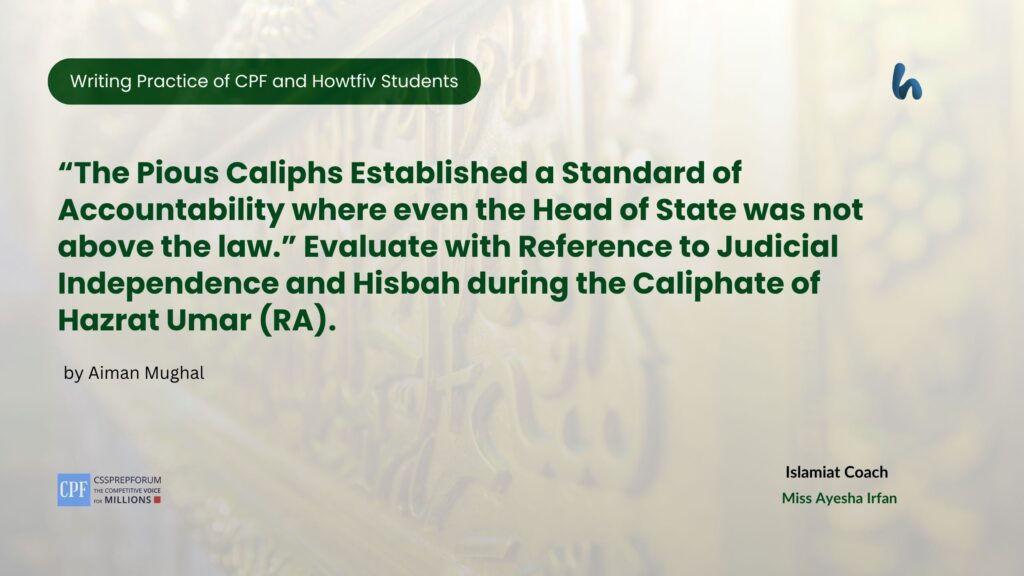
CSS/PMS Islamiat | The Pious Caliphs Established a Standard of Accountability where even the Head of State was not above the law.
The system of accountability established by the Pious Caliphs, especially during the caliphate of Umar ibn al-Khattab, is an important topic of Islamiat for CSS and PMS aspirants because it demonstrated that even the ruler was subject to the law. Through judicial independence and the institution of Hisbah, Hazrat Umar (RA) promoted justice, transparency, and public accountability. His governance model highlights how strong accountability mechanisms strengthen state institutions, protect public rights, and ensure fair administration.

Question Breakdown
The question requires a critical analysis of Hazrat Umar (RA)’s governance by showing how judicial independence and the Hisbah system ensured strict accountability and the rule of law. It specifically focuses on how these institutions made even the Head of State subject to legal and moral scrutiny through transparent, fair, and well-regulated administrative mechanisms.
OUTLINE
I-Introduction
2-Unpacking the Doctrine of Authority as a Divinely Accountable Trust (Amanah) and Its Role in Establishing the Rule of Law
3-Judicial Independence under Hazrat Umar (RA)
- Judicial Autonomy from Executive Control
- Absolute Equality Before Law Regardless of Status or Position
- Institutionalized Due Process and Fair Justice
- Judicial Impartiality through Ethical Insulation
4-Hisbah System (Institutionalized Accountability Mechanism)
- Executive Accountability through Continuous Oversight of Officials
- Financial accountability through Audit and Monitoring of Public Funds
- Independent Investigation of Complaints against Public Officials
- Direct Public Accountability of the Head of State
- Market regulation and Socio-Economic Accountability against Exploitation
- Administrative Ethics and Lifestyle Accountability in Public Office
5-Critical Appraisal of Hazrat Umar’s (RA) Accountability Model and Its Modern Institutional Parallels
6-Conclusion
Answer to the Question
Introduction
The concept of accountability (Muhasba) in Islamic governance is deeply rooted in the principle that political authority is a sacred trust (Amanah) and not an absolute right to power. In the Pious Caliphate, particularly under Hazrat Umar (RA), this principle was transformed into a practical system where governance was strictly bound by the rule of law, moral responsibility, and public oversight. Through the establishment of judicial independence and the institutional mechanism of Hisbah, Hazrat Umar (RA) ensured that justice remained impartial and administrative authority remained accountable. Consequently, even the head of state was not considered above the law, but rather fully subject to it, reflecting a governance model based on equality, transparency, and legal supremacy.
Unpacking the Doctrine of Authority as a Divinely Accountable Trust (Amanah) and Its Role in Establishing the Rule of Law
Before understanding judicial independence under Hazrat Umar (RA), it is crucial to understand the doctrine of authority as a divinely accountable trust (Amanah), which forms the foundational philosophy of Islamic governance. In this framework, authority is not viewed as personal sovereignty but as a responsibility before Allah, where rulers are morally and legally bound to serve justice rather than exercise unchecked power. During the Pious Caliphate, this principle transformed governance into a system of strict accountability, where even the Caliph was answerable to ordinary citizens, as seen in public questioning during sermons and direct scrutiny of state conduct. For instance, citizens openly questioned Hazrat Umar (RA) regarding state resources and personal conduct, and explanations were provided transparently without any notion of immunity. This demonstrates that governance was not based on privilege but on trust, where rulers functioned as caretakers of public welfare rather than absolute authorities. The practical outcome of this concept was the establishment of a rule-based order in which judicial processes and administrative decisions operated independently of personal influence, laying the intellectual and institutional foundation for judicial independence and the Hisbah system of accountability.
Judicial Independence under Hazrat Umar (RA)
After understanding the concept of the doctrine of authority in Islamic governance, it is equally important to understand that under Hazrat Umar (RA), the judiciary functioned independently from executive control, ensuring fair, evidence-based justice where even the ruler was fully accountable before the law.
Judicial Autonomy from Executive Control
To begin with, Hazrat Umar (RA) established a governance model where the judiciary was structurally autonomous and completely free from executive interference, ensuring that justice was delivered purely on merit and legal evidence. This is evident in his famous instructions to Hazrat Abu Musa al-Ash‘ari (RA), where he clearly laid down that judges must treat all individuals equally before the law, emphasizing that the burden of proof lies on the claimant and that decisions must be based on clear evidence rather than influence or social status, even if the case involves powerful personalities or state officials. This demonstrates that Umar (RA) institutionalized a due process system where justice was not arbitrary but strictly evidence-based, while judges were ethically insulated from political and administrative pressure, ensuring impartial decision-making in the courts. Therefore, the judicial independence under Hazrat Umar (RA) reflects a perfect model of the rule of law where even the Head of state was fully accountable before an independent judiciary, making justice a sacred and unbiased pillar of Islamic governance.
Absolute Equality Before Law Regardless of Status or Position
Furthermore, Hazrat Umar (RA) established a governance model where absolute equality before the law was strictly implemented, ensuring that all individuals were treated uniformly without privilege. In a legal system, equality is the foundation that prevents discrimination and strengthens public trust in institutions. This principle was clearly reflected in Umar’s (RA) instructions to judges, where he emphasized that even the caliph himself was subject to the same law as an ordinary citizen. Historical practice shows that no individual, regardless of rank or authority, was given preferential treatment in court proceedings. Hence, this equal application of law under Hazrat Umar (RA) strengthened the rule of law and eliminated the concept of legal superiority based on status.
Institutionalized Due Process and Fair Justice
Moreover, Hazrat Umar (RA) institutionalized due process by establishing evidence-based trials and clearly defined legal procedures for ensuring fair justice. In any judicial system, due process is essential to prevent arbitrary decisions and protect the rights of individuals. This principle was strongly emphasized in his instructions to Hazrat Abu Musa al-Ash‘ari (RA), where he directed that judgments must be based on clear evidence and proper legal reasoning. This evidence shows that the burden of proof was placed on the claimant, ensuring that decisions were not made on assumptions or influence. That is why this structured legal process under Hazrat Umar (RA) guarantees fairness and transparency in judicial decision-making.
Judicial Impartiality through Ethical Insulation
In addition, Hazrat Umar (RA) ensured the ethical insulation of judges, ensuring they remained free from bias, pressure, and external influence while delivering judgments. In a fair judicial system, the impartiality of judges is essential to maintain justice and public confidence. This principle was reflected in Umar’s (RA) governance, where judges were strictly instructed to remain independent in their moral and professional conduct. Historical evidence suggests that judges were shielded from political interference and social pressure, enabling them to render decisions based solely on justice and evidence. Hence, this ethical insulation under Hazrat Umar (RA) ensured impartial judgments and preserved the integrity of the judicial system.

Hisbah System (Institutionalized Accountability Mechanism)
The Hisbah system in Islamic governance was an institutionalized mechanism of accountability aimed at ensuring public welfare, market regulation, and moral discipline within society under state supervision.
Executive Accountability through Continuous Oversight of Officials
Furthermore, Hazrat Umar (RA) established a governance framework where executive accountability was ensured through the strict and continuous supervision of governors and officials to prevent misuse of authority. In any effective administrative system, constant monitoring of officials is necessary to maintain discipline and prevent abuse of power. This principle was clearly reflected in Hazrat Umar’s (RA) practice of personally monitoring governors and regularly reviewing their conduct and performance. It is reported in early Islamic accounts that he appointed supervisors and demanded detailed reports from provincial administrators to ensure transparency in governance. He even removed governors immediately upon receiving complaints of misconduct, demonstrating zero tolerance for administrative corruption. Consequently, this strong system of executive supervision under Hazrat Umar (RA) ensured disciplined governance and prevented misuse of authority at all levels.
Financial accountability through Audit and Monitoring of Public Funds
Moreover, Hazrat Umar (RA) introduced a strong system of financial accountability where a systematic audit of public wealth and strict monitoring of state funds were strictly enforced. In any responsible state, financial transparency is crucial to preventing corruption and ensuring the fair distribution of resources. This principle was evident in Hazrat Umar’s (RA) administration, where he maintained detailed records of state revenue and regularly audited the assets of governors and officials. Contemporary Islamic records indicate that he questioned officials about sudden increases in wealth and confiscated unlawfully acquired assets for the public treasury. This strict financial oversight safeguarded public funds and ensured transparency in the management of the state’s resources. Hence, the fiscal discipline under Hazrat Umar (RA) became a benchmark for accountability-driven governance.
Independent Investigation of Complaints against Public Officials
Additionally, Hazrat Umar (RA) established an independent investigative mechanism to ensure an impartial inquiry into complaints against public officials, free from executive interference. In a fair governance system, investigations must remain free from political pressure to ensure justice. This principle was implemented through special envoys and trusted companions who were sent to investigate allegations against governors and administrators. Early biographical narrations of the Caliphate state that when complaints were received, Hazrat Umar (RA) ordered neutral inquiries and acted strictly on verified findings without favoritism. These investigations were conducted transparently to maintain public trust in the system. As a result, this independent investigative structure ensured fair accountability and unbiased inquiry into administrative misconduct.
Direct public Accountability of the Head of State
Furthermore, Hazrat Umar (RA) ensured direct public accountability of the head of state through open questioning and transparency before citizens. In a truly accountable system, the ruler must remain answerable to the public without barriers or secrecy. This principle was clearly demonstrated when Hazrat Umar (RA) openly allowed citizens to question him in public gatherings and mosques. Classical Islamic narrations highlight that even ordinary individuals questioned his decisions and lifestyle, and he responded without any authority-based resistance. This openness created a culture of transparency and strengthened public trust in leadership. Therefore, this practice of direct accountability established a governance model based on openness and public confidence.
Market regulation and Socio-Economic Accountability against Exploitation
Moreover, Hazrat Umar (RA) introduced market regulation and socio-economic accountability to ensure fair trade practices and protection from fraud and exploitation. In any stable economy, regulation of markets is essential to prevent injustice and maintain fairness among traders and consumers. This principle was enforced through the institution of Hisbah, where market inspectors monitored trade activities and ensured honest dealings. Islamic administrative chronicles mention that Hazrat Umar (RA) personally inspected markets and punished dishonest traders who engaged in deception or hoarding. This system protected consumers from exploitation and ensured economic justice in society. Thus, this regulatory framework promoted fair trade and strengthened socio-economic stability.
Administrative Ethics and Lifestyle Accountability in Public Office
Finally, Hazrat Umar (RA) enforced administrative ethics and lifestyle accountability by requiring officials to maintain simplicity and avoid luxury to uphold public trust. In an ethical governance system, the personal lifestyle of officials directly impacts their credibility and public perception. This principle was reflected in Hazrat Umar’s (RA) strict instructions to governors to live modestly and avoid extravagant living. Reliable early Islamic reports state that he regularly checked the personal conduct and lifestyle of his officials and reprimanded those who adopted luxurious habits. This ensured that rulers remained connected to the common people and avoided creating social distance. Hence, this enforcement of simplicity strengthened moral governance and preserved public confidence in state officials.
Critical Appraisal of Hazrat Umar’s (RA) Accountability Model and Its Modern Institutional Parallels
The accountability framework established by Hazrat Umar (RA) represents one of the most advanced governance systems in early history, yet it also invites critical evaluation when compared with modern institutional structures. On one hand, his model ensured strict oversight of governors, transparent financial monitoring, and direct public access to authority, which collectively minimized corruption and abuse of power. For instance, the documented oversight of provincial officials and immediate questioning of unexplained wealth reflects a governance culture where no administrative actor was beyond scrutiny. On the other hand, modern systems such as parliamentary committees, audit institutions, and investigative agencies replicate similar functions but often face delays, political influence, and bureaucratic inefficiency. However, unlike contemporary frameworks that rely heavily on procedural enforcement, Umar’s system was deeply rooted in personal morality and spiritual accountability, making compliance more internalized than externally enforced. Therefore, the key distinction lies in effectiveness through ethical consciousness versus structural complexity, highlighting both the strength and scalability challenges of the early Islamic model.
Conclusion
The accountability model of Hazrat Umar (RA) stands as a timeless framework that integrates justice, transparency, and ethical governance into a unified system of administration. His governance philosophy ensured that authority remained a trust rather than a privilege, where rulers were continuously answerable to both law and public welfare. The principles he established, ranging from financial scrutiny to administrative discipline, continue to find reflection in modern democratic institutions, although often in a more procedural and less moralized form. Ultimately, Umar’s model demonstrates that sustainable governance is achieved not merely through institutional mechanisms but through the moral integrity of those who operate them. This enduring legacy highlights that true accountability is both a legal structure and a spiritual commitment to justice.
Important Note for CSS and PMS Aspirants
For aspirants preparing for competitive examinations, exploring solved past papers is essential to understand examiner expectations, analytical answer writing, and paper trends. Therefore, candidates are strongly encouraged to read the following comprehensive solved papers available on CSSPREPFORUM
- CSS Solved Pakistan Affairs Past Papers
- CSS Solved Current Affairs Past Papers
- CSS Solved Islamiat Past Papers
- CSS Solved General Science and Ability Past Papers
Moreover, aspirants searching for the most credible and result-oriented teachers for CSS and PMS preparation can benefit from the following detailed guidance articles
- Who is the Best CSS PMS Islamiat Teacher in Pakistan?
- Who is the Best CSS PMS Pakistan Affairs Teacher in Pakistan?
- Who is the Best CSS Current Affairs Teacher in Pakistan?
- Who is the Best CSS GSA Teacher in Pakistan?
- Who is the Best CSS PMS English Essay and Precis Teacher in Pakistan?
- Who is the Best English Grammar Teacher in Pakistan?