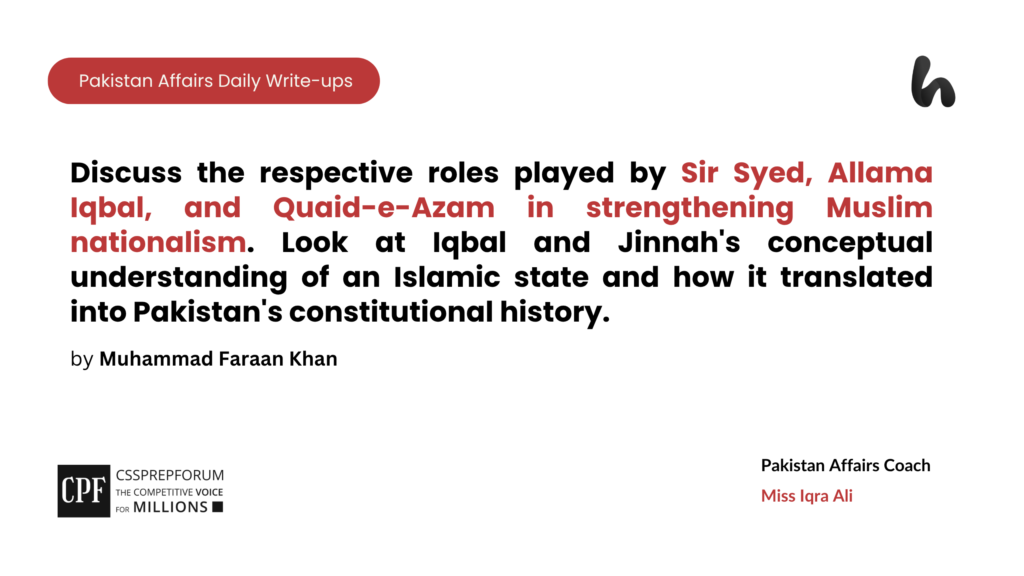
CSS Pakistan Affairs | Sir Syed, Iqbal, Jinnah, Muslim Nationalism and Pakistan
The following article analyzes the roles of Sir Syed, Iqbal, and Jinnah in Muslim nationalism and explore how their vision of an Islamic state shaped Pakistan’s constitution.

Introduction
In the late nineteenth and early twentieth century subcontinent, Hindus were becoming more antagonistic towards Muslims, who were demoralized and fragmented because of the results of the 1857 war. Muslims, bearing the brunt of the uprising, needed to develop a sense of national unity and solidarity to tackle the majoritarian policies adopted by Hindus in the United India. To strengthen national unity, Muslims needed reformism and robust leadership, which were provided by the three famous personalities: Sir Syed Ahmed Khan, Allama Muhammad Iqbal, and Muhammad Ali Jinnah. Sir Syed strengthened Muslim nationalism through his “Trinity of ideas” and the “Two-Nation Theory”, which emphasized that Hindus and Muslims are two distinct nations and that the latter must seek modern education and avoid confrontational politics against the British. Later, Allama Iqbal reiterated the same fact that, being a separate nation, Muslims should seek the establishment of a Muslim state. His famous Allahabad address in 1930 is the manifestation of this position. While Iqbal presented the ideological basis, Muhammad Ali Jinnah made it a political reality and materialized the concept of a separate state for Muslims. Iqbal’s and Jinnah’s shared conceptual understanding of an Islamic state later translated into Pakistan’s constitutional history, explicitly manifesting through the institutionalized Islamic principles and comprehensive minority rights safeguards.
Retrospect
Before playing a role in strengthening Muslim nationalism, Sir Syed, Iqbal, and Jinnah were all proponents of Hindu-Muslim unity. However, circumstances and certain events made them change their thinking. For instance, the 1867 Hindi-Urdu controversy made Sir Syed propose his two-nation theory. Moreover, for Iqbal, the stay in Europe led to a shift in his thinking. He became an ardent supporter of Muslim nationalism, rejecting the notion of territorialism. Similarly, Jinnah, while previously known as the ambassador of Hindu-Muslim Unity, altered his stance after the rejection of his fourteen points. After that, he started his political struggle for a separate homeland rather than limited autonomy in the United India.
Respective Roles of the three Personalities in strengthening Muslim Nationalism
- Sir Syed Ahmad Khan
Sir Syed made pioneering efforts to inculcate a sense of nationalism in the Muslims of the subcontinent. After the disastrous campaign of 1857, he strategically responded through his “Trinity of Ideas”, where he urged muslims to get modern education, show loyalty to the British, and avoid Hindu-dominated agitational politics. His ideas gave Muslims an impetus to unify themselves on a single platform and navigate the complex sociopolitical circumstances of the United India. Moreover, after the 1867 Hindi-Urdu controversy, he was convinced that Muslims were a separate nation that could not coexist with the Hindu majority. Therefore, he proposed his famous “Two-Nation Theory,” in which he furthered the idea of Muslim Nationalism, reinforcing the fact that both Hindus and Muslims have a lot of differences in their religion, culture, norms, and language. Hence, Sir Syed Ahmad Khan built the structural foundations of Muslim nationalism in the subcontinent, which actively highlights his role in the establishment of a separate state for the Muslims.
- Allama Muhammad Iqbal
While Sir Syed provided the structural foundation, Iqbal furthered that notion by giving the ideological basis of Muslim nationalism. To illustrate, he developed a distrust of the Western concept of territorial nationalism, where geographic borders identify nations. According to Iqbal, nationalism rests on religious solidarity; all Muslims signify one nation based on shared values and culture. On this idea, he proposed that Hindu-Muslim unity is impossible in the current political and demographic setup. In 1909, he wrote a letter to Munshi Ghulam Qadir Farrukh in which he explicitly negated Hindu-Muslim unity, highlighting his role in consolidating Muslim Nationalism. Moreover, his famous Allahabad address in 1930 also played a significant role in igniting nationalist sentiments in Muslims. There, he rejected India as a single nation and vehemently demanded the establishment of a separate Islamic state, underscoring Islam as a complete social and political order. Thus, Iqbal played an indispensable role in strengthening Muslim national unity by giving an ideological concept of nationalism rather than a territorial one.
- Muhammad Ali Jinnah
While Sir Syed and Iqbal provided the theoretical idea for Muslim nationalism, Muhammad Ali Jinnah made it a political reality. Through his charismatic and robust leadership, he made the Muslims of India a political force, striving for a Muslim state. Initially, when he took charge as the leader of the All India Muslim League, he supported Hindu-Muslim unity in United India with greater autonomy for the provinces. However, after the rejection of the fourteen points, he called it the “parting of the ways”. Later, after the tyrannical attitude of the Congress ministries in 1937-39, he actively mobilized the Muslims politically and became an unyielding political negotiator for Pakistan. Through his deft politics and legal acumen, he campaigned for the 1945 elections that ultimately proved crucial for the establishment of a separate Muslim-majority country. Therefore, Muhammad Ali Jinnah, through his robust leadership, took muslim nationalism forward and materialized the idea of a separate Muslim state.
Iqbal and Jinnah’s Views on an Islamic State
Iqbal and Jinnah did not envisage Pakistan as a theocratic state. They both wanted a modern progressive country while keeping Islamic principles intact. Iqbal wanted a spiritual democracy; in his book “The Reconstruction of Religious Thought in Islam”, he opines that the parliament should be an institution to perform ijtihad. Additionally, the power should not be concentrated in the hands of clerics. Jinnah, trained in British common law, wanted a democratic state based on social justice and equality. He considered these elements to be the bedrock of Islam and not Western concepts.
Translation of Islamic Principles into Pakistan’s constitutional history
- Objective Resolution 1949: The Objective Resolution of 1949 provides for the sovereignty of Allah. This provision is compatible with Iqbal’s idea of sovereignty, as he was a critic of the Western concept of popular sovereignty and proposed that supreme power rests with Allah. Since this document acted as a preamble to subsequent constitutions, Iqbal’s idea automatically translated into Pakistan’s constitutional history.
- Minority Rights: The Constitution of Pakistan grants equal rights to minorities in Pakistan. Articles 20, 21, and 22 of the 1973 Constitution guarantee freedom of speech, freedom to profess religion, and protection of religious institutions. These provisions are in line with Jinnah’s 11 August speech, where he expressed that all minorities will be free to exercise their own religion. It shows that the ideas of Muhammad Ali Jinnah have an impact on the constitutional framework of the country.
- Islamic Principles and Modern Governance: In the three constitutions of Pakistan, the country was named the Islamic Republic of Pakistan. It shows that religious principles have an impact on governance in the country. Moreover, a core feature of all three constitutions is that no law can be enacted that is repugnant to the injunctions of Islam as laid down in the Quran and Sunnah. This is a direct, structural attempt to codify the Islamic legal character that Iqbal fought for.
Conclusion
In conclusion, it can be stated that Sir Syed, Iqbal, and Jinnah played a formidable role in strengthening muslim nationalism in the subcontinent. Sir Syed’s structural foundation, Iqbal’s ideological basis, and Jinnah’s vigilant leadership took Muslim nationalism to its pinnacle, culminating in the formation of Pakistan. Later on, the Islamic concept of Pakistan translated into the constitutional history of the country, as evident by the provisions of sovereignty of Allah, minority rights, and the repugnancy clause. Thus, Pakistan’s constitutional evolution stands as a testament to its founders’ enduring struggle to balance a progressive Islamic identity with an inclusive, democratic federation.

Important Note for CSS and PMS Aspirants
For aspirants preparing for competitive examinations, exploring solved past papers is essential to understand examiner expectations, analytical answer writing, and paper trends. Therefore, candidates are strongly encouraged to read the following comprehensive solved papers available on CSSPREPFORUM.
- CSS Solved Pakistan Affairs Past Papers
- CSS Solved Current Affairs Past Papers
- CSS Solved Islamiat Past Papers
- CSS Solved General Science and Ability Past Papers
Moreover, aspirants searching for the most credible and result-oriented teachers for CSS and PMS preparation can benefit from the following detailed guidance articles
- Who is the Best CSS PMS Islamiat Teacher in Pakistan?
- Who is the Best CSS PMS Pakistan Affairs Teacher in Pakistan?
- Who is the Best CSS Current Affairs Teacher in Pakistan?
- Who is the Best CSS GSA Teacher in Pakistan?
- Who is the Best CSS PMS English Essay and Precis Teacher in Pakistan?
- Who is the Best English Grammar Teacher in Pakistan?