
CSS/PMS Political Science | Physiocracy: Agricultural Productivity as the True Source of Wealth
Physiocracy advocates agriculture as the true source of wealth, emphasizing productive land use, natural economic order, and limited government intervention to achieve national prosperity; therefore, it is an important topic in CSS and PMS Political Science and Economics.

Introduction
Physiocracy, emerging in 18th-century France, stands as the first strictly systematic and self-conscious school of macroeconomic thought. Formulated primarily by François Quesnay, a court physician to King Louis XV, the doctrine arose as a polemical reaction against the entrenched tenets of Mercantilism, which equated national power with the state-directed accumulation of precious metals and protectionist trade balances. Conversely, the Physiocrats asserted that the foundational matrix of wealth resided not in bullion or manufactured commodities, but in the inherent, regenerative capacity of the earth.
Definition of Physiocracy
Etymologically derived from the Greek terms physis (nature) and kratos (rule or sovereign power), Physiocracy translates fundamentally to the “Rule of Nature.”
According to Ronald Meek:
“The unique contribution of the Physiocrats was their insistence that unchanging laws governed all economic processes, picturing the circular flow of income and output as a self-repeating organism dependent entirely on a physical surplus yielded by nature.”
According to Karl Marx:
“The Physiocrats insist that only agricultural labour is productive, since that alone, they say, yields a surplus-value… Consequently, for them, the net product is the only true wealth, while all other sectors are merely ‘sterile’ because they alter the form of wealth without expanding its volume.”
Meaning of Physiocracy
Physiocracy was an 18th-century French economic school asserting that a nation’s true wealth originates exclusively from agricultural and land development. Operating under the philosophy of the “natural order,” it championed laissez-faire principles, arguing that economies are self-regulating ecosystems. Its core doctrine revolved around the net product, the belief that only nature can yield a genuine physical surplus over production costs, leading physiocrats to classify all manufacturing and commerce as “sterile” sectors that merely rearrange existing values without creating new wealth.
Key Characteristics and Theoretical Pillars
The Net Product (Produit Net): Physiocrats believed agriculture was uniquely productive. A single planted seed yields a massive harvest, creating a genuine physical surplus over the costs of production.
The “Sterile” Class: Society was split into the Productive class, farmers, and the Sterile class, including artisans, manufacturers, merchants. Industry was labeled “sterile” because it merely transformed or moved existing matter without generating entirely new wealth.
Laissez-Faire, Laissez-Passer: Itmeans “let it be, let it pass,” this immortal phrase was coined by the Physiocrats. They demanded the removal of internal tariffs, grain price controls, and state monopolies to let the natural market balance itself.
The Single Tax: Because land was considered the ultimate source of wealth, they advocated for replacing all convoluted, regressive French taxes with one direct tax levied on land rent collected by landowners.
The Theory of Avances (Capital): They pioneered the understanding of capital accumulation by categorizing the investments needed for production into three tiers: avances foncières (land prep like clearing and irrigation), avances primitives (fixed capital like tools and oxen), and avances annuelles (circulating capital like seeds and wages).
Three Tiers of Property Rights: The school viewed private property as an absolute extension of natural law essential for economic incentive. They broke this down into three sacred rights: Personal Property, which includes ownership of one’s own labor, Movable Property, including ownership of goods/capital, and Immovable Property, like ownership of land.
Macroeconomic Modeling
A monumental milestone in economic history, Quesnay’s Tableau Économique (1758) introduced the world’s first macroeconomic model. Drawing an analogy to the biological circulation of blood within an organism, the Tableau utilized a visual, zigzag flowchart to depict how monetary and material values continuously circulated between the Productive, Sterile, and Proprietary classes.
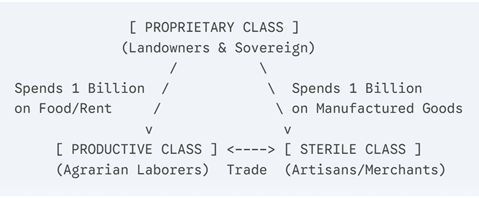
This framework illustrated how an impediment to spending or an imbalance in one sector could induce systemic economic contraction.
Historical Context
Historically, the Physiocratic movement (1760–1770) was an elite French intellectual circle founded by royal physician François Quesnay, who modeled his 1758 Tableau Économique on blood circulation. This breakthrough was in response to the disastrous grain shortages of 1774–1775, which occurred when finance minister Anne-Robert-Jacques Turgot attempted to prematurely deregulate the French grain markets. However, a simultaneous harvest failure caused bread prices to skyrocket, igniting violent nationwide riots known as the Flour War. Turgot’s subsequent dismissal broke the movement’s political power on the eve of the French Revolution, but its legacy survived through Adam Smith, who debated Quesnay in Paris and integrated their principles of laissez-faire directly into The Wealth of Nations (1776).
Factors reinforcing the obsolescence of this economic model
Physiocracy became obsolete primarily because the Industrial Revolution proved that wealth creation is not limited to the soil. The three direct causes of its collapse are:
Industrial Mass Production: The rise of steam power and mechanized factories demonstrated that manufacturing drastically multiplies the value of raw materials, creating massive economic surplus independent of agriculture.
Adam Smith’s Labor Theory: In 1776, Smith dismantled the Physiocratic “sterile” label by proving that wealth is generated by human labor across all sectors, not just the physical bounty of nature.
The Modern Intangible Economy: The subsequent expansion of services, technology, and intellectual property showed that immense economic value can be created without any direct physical extraction from the land.

Contemporary Economic Relevance
Despite the rapid obsolescence of its agrarian-centric premises during the Industrial Revolution, Physiocratic theory retains notable contemporary resonance:
Ecological Economics: The Physiocratic assertion that human economic frameworks are bound by the baseline limits of nature serves as a theoretical precursor to modern ecological economics, planetary boundary resource modeling, and sustainability frameworks.
National Accounting and Flow Dynamics: Quesnay’s Tableau is the direct conceptual ancestor to modern national income accounting, circular flow diagrams, and Wassily Leontief’s Input-Output economic tables used by contemporary central banks.
Land Value Taxation (LVT): The foundational logic of the Impôt Unique was subsequently adopted by 19th-century economist Henry George. Today, Land Value Taxation remains a prominent strategy among urban economists to combat real estate speculation and optimize urban development.
Contemporary examples: Where Reflections of Physiocracy Prevail
Agrarian-Dominant Nations (Economic Focus on the Soil)
In countries where the primary sector remains the foundation of national survival and employment, the structural spirit of Physiocracy is highly apparent.
Examples: Malawi, Sierra Leone, and Nepal (where agriculture accounts for over 30% to 50% of GDP)
Physiocratic Reflection: National economic planning in these states operates under the quasi-Physiocratic reality that the entire economy’s liquidity, food security, and survival are directly bound to the physical net product (produit net) of the earth.
The Global Agricultural Subsidy Framework (The “Sacred” Status of Farming)
Despite being industrial or post-industrial powerhouses, major Western economies treat their agricultural sectors with an elite, protective status that defies purely capitalist logic.
Examples: The European Union (via the Common Agricultural Policy) and the United States
Physiocratic Reflection: Both regions inject hundreds of billions of dollars annually to shield, subsidize, and artificially support their farming base. This policy stems from a deeply ingrained, structural belief that food sovereignty and land cultivation are fundamentally more essential to national stability than any other standard commercial industry.
The Land Value Tax (LVT) System
The Physiocratic mandate of an impôt unique, a single, direct tax levied only on the value of land to keep labor and production tax-free, is actively practiced in modern urban management.
Examples: Singapore, Taiwan, and parts of Denmark
Physiocratic Reflection: These states use land value taxation to curb real estate speculation and fund public infrastructure, successfully using the unimproved value of the land as the primary source of state development revenue.
Systemic Comparison Matrix
| Analytical Metric | Physiocracy | Mercantilism | Classical Liberalism | Ecological Economics |
| Ultimate Source of Wealth | The reproductive power of land and nature | Precious metals (gold/silver specie) | Human labor across all economic sectors | Solar energy and finite natural ecosystems |
| Trade and Market Philosophy | Laissez-faire; compliance with the natural order | Zero-sum conflict managed by state intervention | Positive-sum cooperation via comparative advantage | Steady-state economy bounded by biophysical limits |
| Productive vs. Sterile Sectors | Agriculture is productive; manufacturing/trade are sterile | Manufacturing/ trade are productive; agriculture is secondary | All sectors creating market utility are productive | Sectors reducing entropy or recycling resources are vital |
| Primary Economic Model | Quesnay’s Tableau Économique (Circular flow) | Favorable balance of trade tracking gold flows | Price mechanism (The Invisible Hand) | Material and energy throughput metrics |
Conclusion
Physiocracy constituted a profound paradigm shift in the evolution of economic science. While its strict dismissal of industry and manufacturing as “sterile” proved untenable under the weight of industrialization, the school’s structural innovations were transformative. By conceiving of the economy as a complex, self-correcting system of circular flows governed by natural liberties, the Physiocrats successfully decoupled wealth from mere currency hoarding. This intellectual framework directly influenced Adam Smith, establishing the conceptual bridge over which economic thought transitioned into modern classical capitalism.
Key Takeaways
- Systemic Precedence: Physiocracy was the first systematic school of economic thought, defining national wealth through physical production rather than bullion accumulation.
- Agrarian Centrality: The doctrine hinged upon the produit net, asserting that nature alone creates a net physical surplus, rendering manufacturing transformationally useful but inherently sterile.
- Liberty of Commerce: The movement introduced the foundational capitalist principle of laissez-faire, asserting the superiority of self-regulating markets over state management.
- Analytical Legacy: François Quesnay’s Tableau Économique pioneered macroeconomic modeling, laying the conceptual groundwork for modern circular income analysis.
References
- The etymological origins by Encyclopaedia Britannica
- The Origin of Laissez-Faire, Laissez-Passer
- The New School for Social Research (History of Economic Thought Archive)
- Macroeconomic Flow Analysis (Tableau Économique)
Important Note for CSS and PMS Aspirants
For aspirants preparing for competitive examinations, exploring solved past papers is essential to understand examiner expectations, analytical answer writing, and paper trends. Therefore, candidates are strongly encouraged to read the following comprehensive solved papers available on CSSPREPFORUM.
- CSS Solved Pakistan Affairs Past Papers
- CSS Solved Current Affairs Past Papers
- CSS Solved Islamiat Past Papers
- CSS Solved General Science and Ability Past Papers
Moreover, aspirants searching for the most credible and result-oriented teachers for CSS and PMS preparation can benefit from the following detailed guidance articles
- Who is the Best CSS PMS Islamiat Teacher in Pakistan?
- Who is the Best CSS PMS Pakistan Affairs Teacher in Pakistan?
- Who is the Best CSS Current Affairs Teacher in Pakistan?
- Who is the Best CSS GSA Teacher in Pakistan?
- Who is the Best CSS PMS English Essay and Precis Teacher in Pakistan?
- Who is the Best English Grammar Teacher in Pakistan?