CSS Current Affairs | Chain-Ganging: Alliance Entrapment in Conflicts
Chain-Ganging is an International Relations theory that explains how states can become drawn into conflicts because of their alliance commitments. It is important for understanding alliance politics, security dilemmas, balance of power, and conflict escalation in International Relations and CSS Current Affairs.
Introduction
In international relations, security alliances serve as mechanisms to deter external aggression and balance power. However, these commitments introduce a fundamental structural vulnerability known as chain-ganging. The concept describes a phenomenon where states tie their security unconditionally to their allies, creating a systemic vulnerability where a conflict involving one member automatically drags the entire network into war. Much like prisoners shackled together on a chain gang, when one member stumbles into an abyss, the rest are pulled down with them. This phenomenon sits at the core of the alliance dilemma, highlighting how the quest for absolute security can inadvertently trigger catastrophic, system-wide conflict.
Scholarly Definition of Chain-Ganging
To understand the technical boundaries of the term, scholars define chain-ganging and its associated risk.
According to Kenneth Waltz:
“In a multipolar system, if two states align, they become dependent on each other’s survival. The feeling of shared vulnerability leads to ‘chain-ganging’: the unconditional alignment of states that links their security so tightly that a war involving one becomes a war involving all.”
According to Thomas Christensen and Jack Snyder:
“Chain-ganging occurs when states perceive that the survival of their allies is indispensable to their own security, forcing them to stand unconditionally behind those allies even when those allies act recklessly.”
Meaning of the Term
Chain-ganging refers to a structural pathology in international security arrangements. The core meaning centers on the loss of strategic autonomy. When states chain-gang, they hand over control of their foreign policy to their least stable or most aggressive partner.
The mechanism relies heavily on the fear of abandonment. If a state believes that the collapse of its ally will shift the balance of power permanently in favor of a rival that state feels compelled to back the ally unconditionally. This unconditional guarantee creates a moral hazard: the weaker or more reckless ally (the protégé), knowing it has the total backing of a powerful state (the protector), may engage in riskier behavior or escalate local disputes, confident that its allies must step in to save it.
Key Characteristics
Chain-ganging can be identified through several distinct operational characteristics within an international system:
Perceived Interdependence of Security: Alliance members believe losing a single ally will collapse the global balance of power. Consequently, a minor partner’s peripheral border threat is treated as an existential crisis.
Unconditional Defensive Commitments: Security pacts lack filtering mechanisms, escape clauses, or conditional prerequisites for mobilization. This obligates member states to intervene automatically, regardless of who initiated the conflict.
Loss of Strategic Autonomy: By issuing absolute guarantees, major powers hand over foreign policy control to reckless partners. This strips a state of diplomatic flexibility once military triggers are tripped.
Symmetry of Fatalism: The system becomes vulnerable because the actions of a single localized actor dictate everyone’s fate. This ensures minor geopolitical frictions rapidly convert into system-wide wars.

Historical Context and Evolution
The concept of chain-ganging was formally conceptualized by structural realist Kenneth Waltz in 1979 and empirically expanded by Thomas Christensen and Jack Snyder in 1990. However, its historical relevance spans centuries:
The Peloponnesian War (431–404 BCE)
Early systemic chain-ganging can be traced back to Ancient Greece. The rigid alliance networks led by Athens (the Delian League) and Sparta (the Peloponnesian League) turned a localized dispute between minor states, Corcyra and Corinth, into a destructive, total war that brought down Classical Greek civilization.
The July Crisis of 1914 (World War I)
The definitive historical example of chain-ganging occurred in the lead-up to World War I. Europe was divided into tight, multipolar alliance blocks: the Triple Entente and the Triple Alliance.
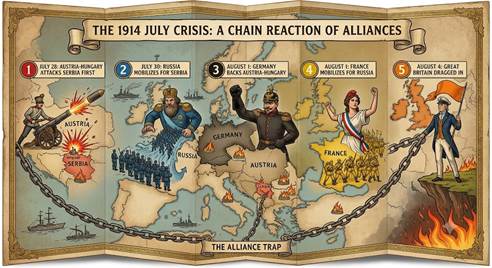
Because Germany felt it could not allow its only reliable ally (Austria-Hungary) to collapse, it offered a “blank check” of unconditional support. This tied Germany to Austro-Hungarian actions, creating a domino effect that dragged Russia, France, and Great Britain into a global conflagration within weeks.
Evolution in the Nuclear Era
The advent of nuclear weapons and the emergence of a bipolar system during the Cold War fundamentally changed the dynamic. In a bipolar world dominated by two superpowers, the survival of minor allies is less critical to the overall global balance of power. Consequently, superpowers became more willing to restrain their clients rather than blindly follow them into war, causing chain-ganging to decrease while other structural pathologies, such as buck-passing, grew more common.
Current Relevance in Global Geopolitics
Chain-ganging remains a highly debated topic in contemporary statecraft, particularly regarding how major global powers manage their commitments to regional partners.
The United States and East Asia
A major flashpoint for potential entrapment involves the United States and its mutual defense treaties. For decades, strategic analysts have debated the risk of the United States being dragged into a major conflict due to unconditional assertions of support.
The Philippines: Heightened tensions over territorial claims in the South China Sea raise concerns that local naval skirmishes could trigger Article IV of the U.S.-Philippines Mutual Defense Treaty, pulling a superpower into direct confrontation.
Taiwan: Although governed by “strategic ambiguity” rather than a formal defense pact, the political commitment to Taiwan’s security creates a constant tightrope walk to prevent Taipei from declaring formal independence (which could provoke war) while deterring Beijing.
NATO and Eastern Europe
The expansion of the North Atlantic Treaty Organization (NATO) highlights the tension between deterrence and chain-ganging. While Article 5 successfully deters Russian aggression, critics argue that extending security guarantees to states directly on Russia’s periphery reduces the strategic buffer zone, increasing the structural risk that a localized border skirmish could automatically spark a wider conflict.
Comparative Analysis with Related Alliance Forms
To clarify the specific nature of chain-ganging, it is useful to contrast it with other common alliance behaviors identified in international relations theory:
| Concept | Primary Driver | Systemic Outcome | Core Danger |
| Chain-Ganging | Fear of abandonment; belief that an ally’s survival is vital. | Over-reaction: Immediate, systemic escalation to war. | Entrapment in a conflict one does not wish to fight. |
| Buck-Passing | Desire to shift costs; belief that others can handle the threat. | Under-reaction: Failure to deter a rising aggressor early on. | Abandonment of vital regional partners; hegemony. |
| Bandwagoning | Fear of a dominant threat; seeking a share of the spoils. | Alliance with the strongest, most threatening power. | Complete loss of independence and sovereignty. |
| Balancing | Desire to check power; preserving systemic independence. | Formation of counter-coalitions against a threat. | Arms races and heightened systemic friction. |
Conclusion
Chain-ganging represents a tragic paradox of international relations: the structures built to guarantee national survival can become the precise vehicles of institutional ruin. When states allow the fear of abandonment to override strategic prudence, alliances cease to operate as instruments of stable deterrence and transform into transmission belts for systemic war. Managing this risk requires sophisticated statecraft capable of balancing ironclad deterrence against strategic conditionalities, ensuring that security commitments never function as blank checks for reckless partners.
Key Takeaways
- The Power Paradox: Chain-ganging flips traditional hierarchies, allowing the weakest, most reckless member of an alliance to dictate the foreign policy of major superpowers.
- Multipolar Vulnerability: The pathology is most dangerous in multipolar international systems where great powers view the survival of every minor ally as existential to the global balance of power.
- The Strategic Antidote: To prevent entrapment, modern alliance managers utilize defensive conditionalities and escape clauses, explicitly stating that defense obligations are void if an ally initiates or intentionally escalates an aggressive conflict.
References
- Chain Gangs and Passed Bucks: Predicting Alliance Patterns in Multipolarity.
- Why Alliances Entangle But Seldom Entrap States.
- How to entrap your protector: Reassessing entrapment in light of the Crimean War crisis.
- Theory of International Politics. McGraw-Hill.
- National Interest Shapes a Country’s Foreign Policy
- Unipolar, Bipolar or Multipolar: New Direction of the World
- Realism: State Survival by Power-Centered Global Politics
Important Note for CSS and PMS Aspirants
For aspirants preparing for competitive examinations, exploring solved past papers is essential to understand examiner expectations, analytical answer writing, and paper trends. Therefore, candidates are strongly encouraged to read the following comprehensive solved papers available on CSSPREPFORUM.
- CSS Solved Pakistan Affairs Past Papers
- CSS Solved Current Affairs Past Papers
- CSS Solved Islamiat Past Papers
- CSS Solved General Science and Ability Past Papers
Moreover, aspirants searching for the most credible and result-oriented teachers for CSS and PMS preparation can benefit from the following detailed guidance articles
- Who is the Best CSS PMS Islamiat Teacher in Pakistan?
- Who is the Best CSS PMS Pakistan Affairs Teacher in Pakistan?
- Who is the Best CSS Current Affairs Teacher in Pakistan?
- Who is the Best CSS GSA Teacher in Pakistan?
- Who is the Best CSS PMS English Essay and Precis Teacher in Pakistan?
- Who is the Best English Grammar Teacher in Pakistan?