CSS Current Affairs | Bandwagoning: Aligning with the Stronger Power
Bandwagoning is an International Relations theory that argues that weaker states align with stronger powers to enhance their security, gain benefits, and avoid potential threats. It is an important topic in International Relations, Political Science, and CSS Current Affairs.

Introduction
Within international relations (IR) theory and political science, states must constantly navigate imbalances of power and emerging structural threats. When a major power rises or exhibits aggressive Revisionism (the desire to alter the international status quo), neighboring or lesser states generally have two structural choices: resist or yield.
While classical balance-of-power theory suggests that states will naturally aggregate their capabilities to counter a dominant threat, the alternative strategy, Bandwagoning, involves a state aligning itself with the stronger, threatening power. This framework explores the foundational dimensions of bandwagoning, dissecting its core scholarly definitions, underlying mechanics, evolutionary history, and contemporary manifestations in modern geopolitics.
Definition of Bandwagoning
To establish an authentic theoretical foundation, the term must be viewed through the specific lenses of prominent IR scholars who formalized the concept:
According to Stephen M. Walt:
“Bandwagoning refers to alignment with the source of danger.”
According to Robert Jervis:
“Bandwagoning is an accommodation to the leading power, accepting a subordinate position in exchange for security, or at least a temporary peace.”
According to Kenneth Waltz:
“Bandwagoning refers to siding with the stronger power in a conflict, usually to avoid being destroyed or to share in the spoils of victory.”
Meaning of the Term
At its core, bandwagoning represents an alliance strategy where a state chooses to align with a stronger, rising, or threatening power rather than partnering with others to oppose it. The term originates from the American political colloquialism “jumping on the bandwagon,” which describes individuals supporting a successful candidate or cause simply because it is popular or winning.
In statecraft, the underlying logic is pragmatic and deeply rooted in asymmetrical power dynamics. Instead of incurring the high material and security costs of resisting a dominant actor, a bandwagoning state concedes a degree of geopolitical autonomy. In return, the state seeks to neutralize the immediate threat to its survival or actively benefit from the dominant power’s success.
Types of bandwagoning
There are two primary types of bandwagoning recognized in international relations theory, which are discussed here.
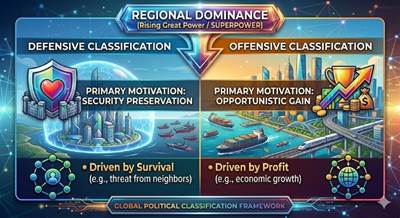
1. Defensive Bandwagoning (Survival-Driven)
This type occurs when a weaker state faces an immediate, powerful, and aggressive neighbor. Because the state lacks the power to resist or find strong allies, it chooses to align with the threat to preserve its basic national integrity.
Core Goal: Appeasement and survival.
Key Cost: The weaker state usually has to make significant autonomy concessions, giving up control over its independent foreign or military policy to satisfy the dominant power.
2. Offensive Bandwagoning (Profit-Driven)
This type is opportunistic rather than fear-induced. A state voluntarily aligns with a rising great power or superpower to maximize its own gains.
Core Goal: Economic growth, trade advantages, and resource acquisition.
Key Benefits: The aligning state enjoys localized advantages, such as preferential market access, increased regional influence, or assistance with secure resource extraction, like oil, gas, or minerals.

Key Characteristics
Asymmetry of Power and Status: Bandwagoning inherently occurs between unequal partners. The bandwagoning state accepts a subordinate position within the structural hierarchy dictated by the dominant power.
Capitulation vs. Profit-Seeking: The strategy is driven by two primary motivations. Defensive bandwagoning is motivated by fear and survival, where a state yields to appease a threat. Offensive bandwagoning is motivated by opportunity, where a secondary state joins a rising revisionist power to gain rewards, territory, or localized influence.
Loss of Foreign Policy Autonomy: By aligning with the primary source of danger or power, the subordinate state often coordinates its diplomatic and military positions to match those of the dominant state.
Systemic Instability: Unlike balancing, which seeks to maintain an equilibrium, widespread bandwagoning behavior creates a “snowball effect.” It increases the power of the strongest actor, accelerating the concentration of systemic power and potentially leading to hegemony.
Historical Context and Evolution
The Classical Realist View
Thucydides documented early examples of defensive bandwagoning during the Peloponnesian War. In the famous Melian Dialogue, the powerful Athenians famously asserted that “the strong do what they can and the weak suffer what they must,” demanding that Melos bandwagon with their empire or face destruction.
The Neorealist Dichotomy
Kenneth Waltz (1979) formalized the structural choice between balancing and bandwagoning. He argued that in an anarchic international system, balancing is the dominant behavior because states seek to maximize security. Waltz asserted that bandwagoning is primarily a strategy used by weaker, vulnerable states that lack the structural capacity to form a viable counter-coalition.
The Refinement: Balance of Threat
Stephen M. Walt (1985) modified Waltz’s structural view by introducing Balance of Threat theory. Walt demonstrated that states do not balance against sheer power alone; they balance against threats. A threat is determined by aggregate power, geographic proximity, offensive capabilities, and perceived aggressive intentions. Consequently, states are more likely to bandwagon when a threatening power is geographically immediate and lacks viable external allies to help resist it.
“Bandwagoning for Profit”
In 1994, Randall Schweller challenged the prevailing assumption that bandwagoning is purely a defensive choice made out of fear. He introduced “bandwagoning for profit,” showing that revisionist, opportunistic states frequently choose to align with a stronger power to alter the status quo and share in the spoils of victory, rather than simply trying to survive.
Current Relevance of the Term in Contemporary Geopolitics
The Indo-Pacific Theater: China’s Economic Hegemony
Economic Profit Accommodation
Southeast Asian nations choose strategic alignment over opposition due to China’s rising material power. Specific states leverage the Belt and Road Initiative (BRI) to secure funding and trade integration, prioritizing immediate economic growth over long-term geopolitical risks.
Security Conciliation and Autonomy Concessions
Geographic proximity forces smaller coastal states to carefully manage relations with Beijing. To avoid trade penalties or military friction, certain capitals limit their participation in Western maritime coalitions, sacrificing foreign policy autonomy to prevent direct conflict.
Eastern Europe & Central Asia: Russia’s Security Perimeter
Defensive Alignment via the CSTO
Smaller post-Soviet states lacking Western alliances face intense structural pressure along Russia’s border. Aligning with Moscow through the Collective Security Treaty Organization (CSTO) serves as a survival mechanism, trading independent defense policy for vital territorial protection.
Energy and Logistic Interdependence
In Central Asia, alignment shifts toward logistics and resource management. Secondary states deliberately integrate their export routes with Russian pipelines and transit corridors, ensuring domestic economic stability by supporting the dominant power’s regional interests.
The Middle East: The United States’ Security Umbrella
Institutional Security Guarantees
Middle Eastern alignment often centers on the United States as an influential external power. Multiple regional actors host American military bases or maintain Major Non-NATO Ally status, trading strategic diplomatic support for advanced defense hardware and regime survival guarantees.
Strategic Resource Cooperation
This dynamic relies on a transactional resource-for-security framework. Bandwagoning states align their energy output and diplomatic actions with Western strategic priorities to neutralize regional adversaries, showing how profit and survival motivations merge in modern statecraft.
Comparative Analysis with Other Related Forms
| Strategic Concept | Primary Objective | Relationship to the Threat / Dominant Power | Risk Level |
| Bandwagoning | Threat appeasement or profit sharing | Direct alignment, acceptance of subordinate status | High (Vulnerable to abandonment or exploitation) |
| Balancing | National security preservation via deterrence | Direct opposition, coalition building against the threat | Moderate (Requires sustained material investment) |
| Hedging | Risk diversification under structural uncertainty | Mixed behavior: soft balancing combined with soft bandwagoning | Low (Avoids taking a definitive side) |
| Buck-Passing | Shifting the cost of balancing onto another state | Relative isolation, waiting for other states to counter the threat | Variable (Fails if the threat defeats the proxy) |
Conclusion
Bandwagoning remains a foundational concept within international relations, highlighting how smaller states navigate structural vulnerability and opportunism. While traditional neorealism viewed it as a rare strategy reserved only for weak states, modern theoretical refinements show that bandwagoning is a nuanced tool of statecraft. Driven by either fear (survival) or ambition (profit), bandwagoning directly shapes the international system. By concentrating power in the hands of dominant actors, it often accelerates transitions toward hegemony or systemic polarization.
Takeaways
- Dual Motivations: States bandwagon either defensively to appease an immediate threat to their survival, or offensively to profit from a dominant power’s revisionist actions.
- Structural Impact: Widespread bandwagoning behavior creates systemic instability by reinforcing the power of the strongest state, shifting the international balance toward a unipolar or heavily polarized order.
- Contemporary Utility: The concept remains highly relevant for understanding how states in Eastern Europe, the Indo-Pacific, and the Middle East manage asymmetrical relationships with global superpowers like the United States, China, and Russia.
References
- Theorizing the hedging strategy: National interests, objectives, and mixed foreign policy instruments.
- Cooperation under the security dilemma.
- Bandwagoning for profit: Bringing the revisionist state back in.
- Bandwagoning in international relations: China, Russia, and their neighbors.
- Balance of Power: A Strategy to Prevent Global Dominance
- Does China’s rise challenge the global political system
- Foreign policy scholars’ argument: transnational actors influence the contours of any country’s foreign policy.
Important Note for CSS and PMS Aspirants
For aspirants preparing for competitive examinations, exploring solved past papers is essential to understand examiner expectations, analytical answer writing, and paper trends. Therefore, candidates are strongly encouraged to read the following comprehensive solved papers available on CSSPREPFORUM.
- CSS Solved Pakistan Affairs Past Papers
- CSS Solved Current Affairs Past Papers
- CSS Solved Islamiat Past Papers
- CSS Solved General Science and Ability Past Papers
Moreover, aspirants searching for the most credible and result-oriented teachers for CSS and PMS preparation can benefit from the following detailed guidance articles
- Who is the Best CSS PMS Islamiat Teacher in Pakistan?
- Who is the Best CSS PMS Pakistan Affairs Teacher in Pakistan?
- Who is the Best CSS Current Affairs Teacher in Pakistan?
- Who is the Best CSS GSA Teacher in Pakistan?
- Who is the Best CSS PMS English Essay and Precis Teacher in Pakistan?
- Who is the Best English Grammar Teacher in Pakistan?