CSS Pakistan Affairs | Importance of Pakistan’s Location in Regional and Global Politics
The following question of CSS Pakistan Affairs is solved by Aiman Mughal under the supervision of Howfiv’s Pakistan Affairs and Current Affairs Coaches: Miss Iqra Ali and Sir Ammar Hashmi. She learnt how to attempt 20 marks question and essay writing from Sir Syed Kazim Ali, Pakistan’s best CSS and PMS English essay and precis teacher with the highest success rate of his students. This solved question is attempted on the pattern taught by Sir to his students, scoring the highest marks in compulsory and optional subjects for years.

Outline
1- Introduction
2- Geographical Overview of Pakistan
3- How Pakistan’s Location Enhances Its Importance in Regional Politics
- Acts as a bridge connecting South Asia with Central Asia and the Middle East
- Central role in Afghanistan’s stability and regional security
- Maintains strategic balance in South Asia due to its defense and nuclear capability
- Facilitates regional trade and energy connectivity (corridor potential)
4- How Pakistan’s Location Enhances Its Importance in Global Politics
- Acts as a key strategic player in great power competition, especially the US–China
- Enhances global trade significance through Gwadar and CPEC
- Plays a key role in international security (War on Terror, maritime routes)
- Connects landlocked regions to global markets
5- Critical Analysis
6- Conclusion
Answer to the Question
Introduction
A state’s strategic worth is often determined by its geography, and Pakistan is a clear example of this principle. Its location provides significant opportunities for regional influence and global engagement, shaping its role in matters of security, trade, and diplomacy. Pakistan’s position enables it to act as a link between different regions, facilitating connectivity and interaction across borders. Historically and in contemporary times, this geographical advantage has contributed to Pakistan’s involvement in regional stability, economic corridors, and international strategic affairs, including its role in global power dynamics and security initiatives. Overall, Pakistan’s geography remains a key factor in determining its strategic relevance on both regional and global stages.
Geographical Overview of Pakistan
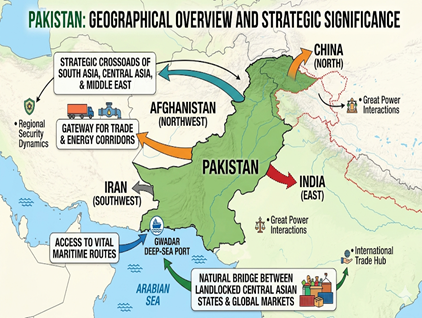
Before delving into the understanding that how Pakistan’s location enhances its importance in regional politics, it is essential to understand the geography of Pakistan. Pakistan is strategically located in South Asia, at the crossroads of South Asia, Central Asia, and the Middle East, sharing borders with India in the east, Afghanistan in the northwest, Iran in the southwest, and China in the north, which connects it to multiple regional powers. To the west, it links with the Middle East and Central Asia, serving as a gateway for trade and energy corridors, while its northern borders connect it to broader Asian regions. The southern coastline along the Arabian Sea, including the deep-sea port of Gwadar, provides access to vital maritime routes, making Pakistan a strategic hub for international trade. This location positions Pakistan as a natural bridge between landlocked Central Asian states and global markets and places it at the center of regional security dynamics and great power interactions, giving it a crucial role in both regional and global politics. Overall, Pakistan’s geographical setting defines its borders and terrain while underpinning its strategic significance in trade, security, and diplomacy.
How Pakistan’s Location Enhances Its Importance in Regional Politics
Having understood the geography of Pakistan, it is crucial to understand how Pakistan’s strategic location shapes its role in regional politics. Positioned at the crossroads of South and Central Asia, it acts as a bridge connecting diverse regions, influencing security, trade, and diplomacy. This setting provides Pakistan with the capacity to play a central and stabilizing role in its neighborhood, which is explored in the following discussion.
- Acts as a bridge connecting South Asia with Central Asia and the Middle East (All suheadings are to be Normal Bold Bullets Text – no heading)
To begin with, Pakistan’s location enables it to act as a natural bridge linking South Asia with Central Asia and the Middle East, enhancing its regional political significance. This connectivity allows Pakistan to facilitate movement of trade, energy, and people across regions, strengthening interdependence among states. For instance, projects like the Turkmenistan–Afghanistan–Pakistan–India (TAPI) gas pipeline highlight Pakistan’s role in regional integration. This project demonstrates how Pakistan serves as a transit corridor for energy resources from Central Asia to energy-deficient South Asia. Therefore, Pakistan’s bridging position strengthens its role as a connector of regional economies and politics.
- Central role in Afghanistan’s stability and regional security
Furthermore, Pakistan’s geographical proximity to Afghanistan gives it a central role in ensuring regional security and stability. Its shared border and historical ties allow it to directly influence peace and conflict dynamics in Afghanistan. For example, Pakistan played a significant role in facilitating peace talks between the Taliban and the United States, leading to the Doha Agreement (2020). This involvement shows how Pakistan contributes to conflict resolution and stability in the region. Hence, Pakistan’s location makes it indispensable in shaping Afghanistan’s security landscape and broader regional peace.
- Maintains strategic balance in South Asia due to its defense and nuclear capability
Moreover, Pakistan’s location, combined with its defense and nuclear capability, helps maintain strategic balance in South Asia. Being situated next to India, Pakistan plays a key role in preventing regional dominance by any single power. For instance, Pakistan’s nuclear tests in 1998 established deterrence against India’s conventional superiority. This nuclear parity has prevented large-scale wars and maintained a balance of power in the region. Thus, Pakistan’s geostrategic position reinforces its role as a stabilizing force in South Asian politics.
- Facilitates regional trade and energy connectivity
In addition, Pakistan’s location enhances its importance by facilitating regional trade and energy connectivity through corridor projects. Its territory provides the shortest route for trade and energy transportation between Central Asia and global markets. A key example is the China-Pakistan Economic Corridor (CPEC), which connects Western China to the Arabian Sea. This corridor highlights Pakistan’s potential as a hub of regional economic activity and energy transit. Consequently, Pakistan’s corridor potential strengthens its economic and political influence in the region.
How Pakistan’s Location Enhances Its Importance in Global Politics
In the same vein, at the global level, Pakistan’s geographical location elevates its significance by linking major regions, trade routes, and power centers. Its position places it within the sphere of global strategic competition, economic connectivity, and international security frameworks. This enables Pakistan to influence not only regional affairs but also broader global dynamics. Therefore, Pakistan’s location acts as a catalyst in enhancing its global political importance.
- Acts as a key strategic player in great power competition, especially the US–China
Additionally, Pakistan’s location makes it a key strategic player in great power competition, particularly between the United States and China. Its position allows it to maintain relations with both powers while serving their strategic interests. For example, Pakistan played a crucial role in facilitating the US–China rapprochement in the 1970s. This historical role highlights Pakistan’s importance as a diplomatic bridge between competing global powers. Hence, Pakistan’s location enhances its relevance in global strategic politics.
- Enhances global trade significance through Gwadar and CPEC
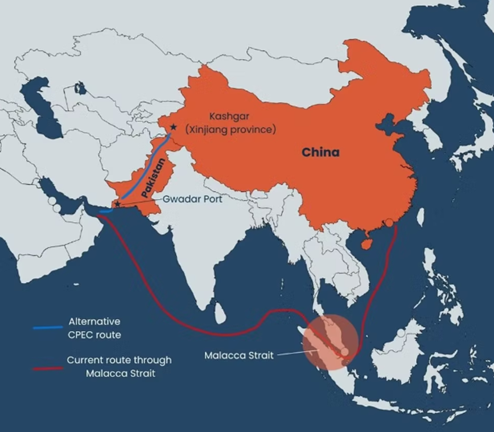
Moreover, Pakistan’s access to the Arabian Sea enhances its global trade importance through Gwadar Port and CPEC. This location provides a shorter and more efficient route for international trade and energy transportation. For instance, Gwadar Port serves as a gateway for Chinese trade to the Middle East and Africa. This reduces China’s reliance on longer maritime routes like the Strait of Malacca. Therefore, Pakistan’s coastal location strengthens its role in global trade networks.
- Plays a key role in international security (War on Terror, maritime routes)
Likewise, Pakistan’s location places it at the center of international security dynamics, particularly in the War on Terror and maritime security. Its proximity to conflict zones makes it a frontline state in global counterterrorism efforts. For example, Pakistan acted as a key ally of the United States in the War on Terror after 2001. This role highlights Pakistan’s contribution to global peace and security initiatives. Thus, Pakistan’s location increases its importance in international security frameworks.
- Connects landlocked regions to global markets
Additionally, Pakistan’s location enables it to connect landlocked regions, especially Central Asian states, to global markets. Its access to the Arabian Sea provides these countries with the shortest trade routes. For example, Central Asian republics rely on transit routes through Pakistan for access to seaports. This connectivity enhances regional trade and global economic integration. Therefore, Pakistan’s geographical position strengthens its role as a gateway to global markets.
Critical Analysis
From a critical perspective, Pakistan’s geostrategic location significantly enhances its importance in regional and global politics; however, in the current scenario, this advantage remains only partially realized due to a combination of internal weaknesses and external constraints. Positioned at the crossroads of South Asia, Central Asia, and the Middle East, Pakistan has strong potential to influence trade, connectivity, and security, yet this potential is limited by changing geopolitical dynamics. In the context of US–China rivalry, Pakistan maintains ties with both powers, which shows its relevance but also creates diplomatic pressure. Although CPEC and Gwadar highlight its role in global trade, their progress remains slow due to security and economic challenges. Moreover, after the US withdrawal from Afghanistan, regional instability has increased Pakistan’s security burden. At the same time, emerging trade routes like IMEC are reducing Pakistan’s centrality in global connectivity. Along with political and economic instability, these factors show a gap between Pakistan’s potential and performance, indicating that effective governance is essential to fully utilize its strategic location.
Conclusion
In a nutshell, Pakistan’s geographical location significantly enhances its importance in both regional and global politics by positioning it at the crossroads of key regions, trade routes, and strategic interests. At the regional level, it acts as a bridge, a stabilizing force, and a connector of economies and security frameworks, while at the global level, it contributes to great power dynamics, international trade, and security cooperation. However, the true potential of this geostrategic advantage remains dependent on effective governance, political stability, and the ability to respond to emerging global challenges. Thus, while Pakistan’s location provides a strong foundation for influence and relevance, its optimal utilization is essential to transform geographic advantage into sustainable political and economic power.

CSS Solved Past Papers’ Essays
Looking for the last ten years of CSS and PMS Solved Essays and want to know how Sir Kazim’s students write and score the highest marks in the essays’ papers? Then, click on the CSS Solved Essays to start reading them.
CSS Solved Essays
CSS Solved Islamiyat Past Papers
Want to read the last ten years’ Islamiyat Solved Past Papers to learn how to attempt them and to score high? Let’s click on the link below to read them all freely. All past papers have been solved by Pakistan’s top CSS Islamiyat coaches having the highest score of their students.
CSS Solved Islamiyat
CSS Solved General Science & Ability Past Papers
Want to read the last ten years’ General Science & Ability Solved Past Papers to learn how to attempt them and to score high? Let’s click on the link below to read them all freely. All past papers have been solved by Pakistan’s top CSS GSA coachez having the highest score of their students.
CSS Solved General Science & Ability
CSS Solved Pakistan Affairs Past Papers
Want to read the last fifteen years’ Pakistan Affairs Solved Past Papers to learn how to attempt them and to score high? Let’s click on the link below to read them all freely. All past papers have been solved by Pakistan’s top CSS Pakistan Affairs coaches having the highest score of their students.
CSS Solved Pakistan Affairs
CSS Solved Current Affairs Past Papers
Want to read the last fifteen years’ Current Affairs Solved Past Papers to learn how to attempt them and to score high? Let’s click on the link below to read them all freely. All past papers have been solved by Pakistan’s top CSS Current Affairs coaches having the highest score of their students.
CSS Solved Current Affairs