A CSS essay topic you’ve never prepared for can feel like wasted preparation. Drawing on CSS (PAAS Officer) and PCS qualifier Aqsa Khan’s experience under Sir Syed Kazim Ali’s mentorship, this article shows how to break an unfamiliar topic into manageable questions, narrow its scope, build a defensible thesis, and construct evidence-based arguments, regardless of how the question is worded.
One of the most difficult moments in the CSS essay paper is opening the question paper and finding a topic you have never prepared for before.
You may have read extensively, memorised quotations, studied current affairs, prepared outlines, and practised previous essay topics. Yet a single unfamiliar topic can make all that preparation feel useless.
The problem, however, is often not a lack of information. It is the inability to break an unfamiliar topic into manageable questions, develop a defensible position, and organise relevant ideas around it.

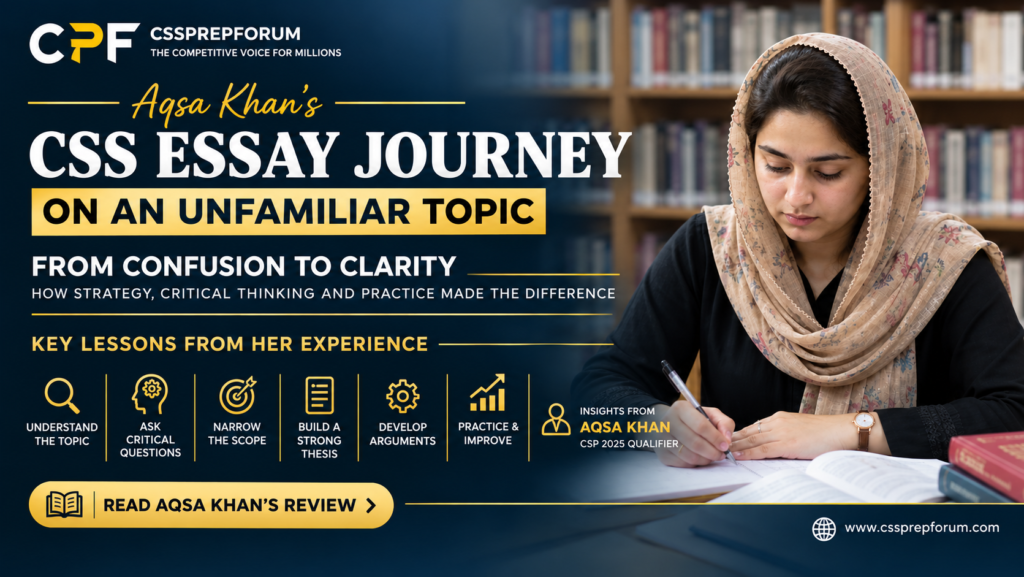
Aqsa Khan, a science student (physicist) who qualified for both CSS 2025 for the PAAS cadre and PCS Balochistan, describes precisely this aspect of her essay preparation in her review on the best PCS and CSS English teacher in Balochistan. Her experience with Sir Syed Kazim Ali focused not merely on writing essays but on learning how to interpret topics, narrow their scope, generate critical questions, formulate a thesis, and develop arguments through different approaches. She also highlights the importance of critical thinking, evidence, and continuous evaluation in becoming adaptable enough to handle unfamiliar topics under examination conditions.
So, how can a CSS aspirant prepare for an essay topic that does not look familiar?
Do not try to predict every essay topic
A common approach to CSS essay preparation is to collect likely topics and prepare outlines for them. There is nothing inherently wrong with studying previous questions or practising important themes; the problem occurs when preparation becomes dependent on prediction.
CSS can present a topic in a form that does not resemble the exact questions you prepared. If your preparation has taught you only how to reproduce an outline on “climate change,” “democracy,” or “education,” a differently worded question can immediately create confusion.
The more useful objective is therefore not to memorise an answer to every possible topic. It is to develop the ability to understand and construct an answer when the topic changes. That requires a different kind of preparation.
First, understand what the topic is actually asking
When an unfamiliar topic appears, the first instinct may be to start brainstorming everything you know about it. That can make the situation worse. Instead, begin by asking what exactly the topic is asking you to discuss.
A CSS essay topic may contain several ideas within a single sentence. Some words establish the subject, while others establish the relationship, argument, limitation, comparison, or direction of discussion. Before generating arguments, separate the topic into its components.
For example, suppose a topic concerns whether technological progress is making human beings more isolated. You should not immediately start writing everything you know about technology. First identify what is meant by technological progress, what form of isolation is being discussed, whether the statement is claiming that technology causes isolation, whether that relationship is absolute or conditional, whether there are circumstances in which technology actually increases social connection, and what evidence can support either side.
These questions transform an intimidating statement into a series of manageable problems. This process of breaking down a topic is one of the skills Aqsa identifies as important in her training: understanding the scope of a topic, generating critical questions, and developing an appropriate thesis rather than approaching every essay through one rigid pattern.
Narrow the scope before you build your outline
An unfamiliar topic can feel difficult because it appears too broad. The solution is not to write about everything connected to it. The solution is to narrow its scope.
Consider a broad topic related to artificial intelligence and employment. You could discuss automation, unemployment, new professions, productivity, education, reskilling, inequality, economic growth, workplace transformation, or government regulation. All of these may be relevant, but relevance alone does not produce a coherent essay. You need to determine which dimensions actually answer the question.
This is where scope becomes important. Ask yourself what the essay should include, and what it should deliberately leave out. A strong outline is selective: it does not demonstrate everything you know about a subject. Instead, it demonstrates that you understand which knowledge belongs in the answer.

Turn the unfamiliar topic into familiar questions
You do not necessarily need to know everything about an unfamiliar topic. Instead, you need to know how to question it. A useful brainstorming technique is to convert the topic into questions: What is it? Why does it happen? How does it happen? Who is affected? What are its consequences? What are the opposing arguments? What evidence supports the claim? Where does the claim have limitations? What can be done about the problem?
These questions give you different directions for analysis. Aqsa’s experience emphasises precisely this kind of critical questioning. Rather than relying on one fixed formula for every topic, she describes learning multiple approaches for breaking complex topics down into simpler components, a flexibility that becomes particularly valuable when the topic is unfamiliar.
Your thesis should come after understanding the topic
Another common mistake is trying to write the thesis statement too quickly. A thesis is not merely a sophisticated sentence placed at the end of an introduction; it represents the central position that the essay will establish. Therefore, you should understand the topic before deciding what you are going to argue. Start with the problem, explore its dimensions, consider possible counterarguments, and then determine your position.
For example, if the topic concerns whether social media strengthens democracy, your initial thoughts may point in several directions. Social media can increase access to information, give marginalised groups a platform, and facilitate political mobilisation. But it can also spread misinformation, intensify polarisation, and create information bubbles.
The thesis should emerge from this analysis rather than being selected before the analysis begins. This is why analytical brainstorming is more useful than simply memorising introductions.
An unfamiliar topic does not mean you have no knowledge
Many students panic when they see a topic they have not studied directly, but an unfamiliar topic may contain familiar concepts. Suppose the topic discusses a new technological development. You may not know the technical details of that particular technology, but you may understand broader concepts such as innovation, employment, education, inequality, regulation, economic growth, privacy, and social change.
The task is to identify the relevant connections. This is where general knowledge becomes useful. You are not expected to produce an encyclopaedic report on every subject; you are expected to develop a coherent discussion around the proposition given in the question.

Use multiple approaches instead of one rigid essay formula
Aqsa specifically describes learning multiple ways of approaching essay topics. This is important because not every topic behaves in exactly the same way. Some questions are primarily causal; others require comparison; some ask you to evaluate a proposition; and others may require discussion of a problem and its possible solutions. Likewise, some are abstract and philosophical, while others are concrete and policy-oriented.
Trying to force every topic into exactly the same outline can create artificial arguments. Instead, identify the nature of the question first.
For a cause-and-effect topic
You may organise the essay around: causes → mechanisms → consequences → responses.
For an evaluative topic
You may examine: claim → supporting arguments → limitations → counterarguments → reasoned position.
For a problem-based topic
You may explore: problem → causes → effects → institutional/social dimensions → solutions.
For a comparative topic
You may examine: dimension one → dimension two → similarities → differences → implications.
The structure should serve the question. The question should not be forced to serve a memorised structure.
Build arguments, not just headings
A common problem with CSS essay outlines is that they contain attractive headings but very little actual reasoning: for example, “Technology and education,” “Technology and healthcare,” and “Technology and economy.” These headings may be relevant, but they do not automatically constitute arguments.
A stronger outline asks what you are actually proving. For example: “Technology expands access to education by reducing geographical barriers to learning.” That is an argument. You can then explain how technology produces this effect, provide evidence or examples, acknowledge limitations, and connect it back to the thesis.
A useful argument should therefore answer: what am I claiming, why is it true, how can I support it, and how does it prove my thesis? This connection between claim, reasoning, evidence, and thesis is what turns an outline into an analytical essay.
Evidence should support your argument
Aqsa’s review also highlights the importance of presenting a stance based on genuine evidence. Evidence does not exist simply to make an essay appear knowledgeable; its purpose is to strengthen an argument. If you claim that a particular policy has affected literacy, for example, a relevant statistic, institutional report, study, or concrete example can strengthen the argument. But evidence should not replace explanation: a statistic without interpretation does not automatically become an argument.
After presenting evidence, explain what it demonstrates, why it is relevant to your argument, and how it supports your thesis. That final connection is often what separates information from analysis.
Learn to write under time constraints
An essay that looks excellent when written without a time limit may become difficult under examination conditions. CSS preparation therefore needs to include timed practice.
Aspirants should gradually practise understanding a topic within a limited period, narrowing its scope, generating arguments, selecting relevant evidence, developing an outline, writing an introduction, maintaining coherence throughout the essay, and completing the conclusion within the available time.
Aqsa explains that the techniques she learned helped her present ideas under examination conditions and approach unfamiliar topics with greater confidence. That confidence does not come from knowing every possible topic; it comes from knowing what to do when you encounter something you do not recognise immediately.
Evaluation is where preparation becomes improvement
Writing an essay once does not tell you whether you are improving. You need someone to examine the writing critically. Aqsa describes detailed evaluation of her essays and precis, including identification of flaws and suggestions for improvement, and she emphasises the cycle of writing, feedback, and revision as an important part of the learning process.
This matters because many writing problems are difficult to notice while you are writing. You may think an argument is clear when the reader cannot follow it. You may believe two paragraphs are connected when the relationship between them is weak. And you may have included relevant information without actually answering the question. Evaluation exposes these problems, and revision then gives you the opportunity to correct them.
How to prepare for unfamiliar CSS essay topics
A practical preparation routine can therefore look like this.
Step 1: Practise unfamiliar topics
Do not practise only the topics you already know. Occasionally select a question from a bank of CSS solved essays that you have never prepared before.
Step 2: Analyse before writing
Spend time identifying the key terms, scope, assumptions, and demands of the question.
Step 3: Generate critical questions
Ask what, why, how, who, consequences, counterarguments, and solutions may be relevant.
Step 4: Develop your position
Decide what your essay is actually going to establish.
Step 5: Build arguments
Turn your ideas into clear claims rather than vague headings.
Step 6: Add evidence
Use relevant facts, examples, studies, reports, historical events, or other credible evidence where appropriate.
Step 7: Organise logically
Arrange your arguments so that one idea leads naturally to the next.
Step 8: Write under time pressure
Practise producing the essay within realistic examination conditions, ideally using Howtests resources to simulate the real thing.
Step 9: Get it evaluated
Identify weaknesses in structure, reasoning, expression, relevance, and coherence.
Step 10: Rewrite
Do not simply read the teacher’s comments and move on. Apply them in your next piece of writing. That final step is what turns feedback into a skill.
Can you master CSS essay writing in one or two months?
Aqsa’s own experience provides a useful answer, although her timeline should not be treated as a universal rule for every aspirant. She states that it took her around four to five months to fully understand CSS and PCS essay-writing concepts and develop the ability to structure arguments effectively, followed by at least another month of intensive practice and evaluation, all under the mentorship of Sir Syed Kazim Ali.
The important lesson is not the exact number of months. It is that essay writing involves several interconnected skills: language fundamentals, analytical thinking, topic interpretation, thesis development, argument construction, organisation, practice, and revision. Trying to compress all of these into memorised outlines and a few practice essays can leave major weaknesses untouched.
What should a CSS aspirant do when an essay topic looks completely new?
Do not immediately conclude that you cannot write about it. Pause. First, break the topic down, and identify its key terms. Then determine its scope; turn it into questions; connect it with concepts you already understand, considering different perspectives. Afterwards, develop a defensible thesis, and finally, select only those arguments that directly serve the thesis.
This is the central lesson that can be drawn from Aqsa Khan’s experience with how to write a CSS essay: the ability to tackle an unfamiliar essay topic depends less on predicting the question and more on developing a method for understanding it.
Final Takeaway
A difficult CSS essay topic is not necessarily a test of whether you have memorised enough material. It is also a test of whether you can think with the material you know.
Aqsa Khan’s experience demonstrates the value of learning how to analyse a topic, narrow its scope, generate critical questions, formulate a thesis, construct evidence-based arguments, and adapt your approach when the question changes, a discipline that transfers directly to precis writing as well, where understanding a passage always has to come before compressing it.
That is why preparation for unfamiliar topics should focus less on predicting the exact question and more on developing a repeatable thinking and writing process. When you know how to break down the question, you are no longer completely dependent on having seen it before.
And that is one of the most valuable skills a CSS essay aspirant can develop, especially under the guidance of a mentor like Sir Syed Kazim Ali, the Founder of Howfiv, CPF, and Howtests.

Frequently Asked Questions
How do I write a CSS essay on an unfamiliar topic?
Start by analysing the wording of the topic instead of immediately recalling memorised material. Identify its key concepts; narrow its scope; generate critical questions; develop a thesis; and build arguments that directly address the question.
What if I do not have enough knowledge about the essay topic?
Look for broader concepts within the topic that you already understand. Then use reasoning, examples, and relevant evidence to construct a focused discussion. The goal is not to demonstrate knowledge of everything related to the subject.
How important is brainstorming in CSS essay writing?
Brainstorming helps you move from a broad or unfamiliar topic towards specific arguments. Effective brainstorming should involve questioning the topic rather than simply listing everything you know about it.
Should every CSS essay follow the same structure?
Not necessarily. A basic essay structure is useful, but the internal organisation should reflect the demands of the topic. An evaluative question, a causal question, and a problem-solution question may require different argumentative arrangements.
How can I improve my ability to handle difficult CSS essay topics?
Practise with unfamiliar questions; analyse their scope; develop multiple possible approaches; write under time limits; obtain detailed evaluation from a subject expert like Sir Syed Kazim Ali; and rewrite your work based on feedback.
Is memorising CSS essay outlines enough?
Memorised outlines can provide background knowledge, but they cannot replace the ability to interpret a new question and construct an original argument. Flexible analytical thinking is particularly important when the examination topic differs from what you prepared.