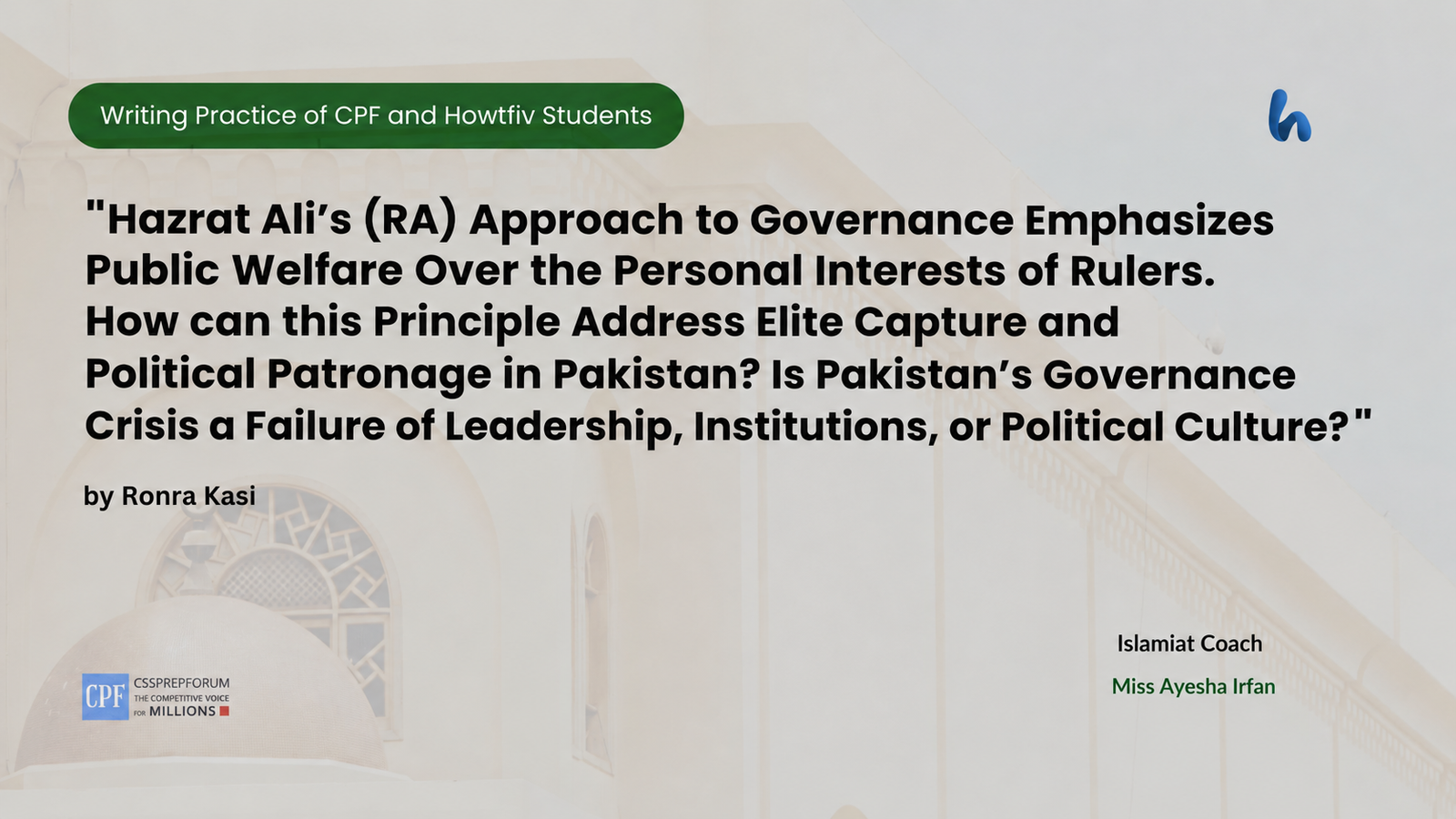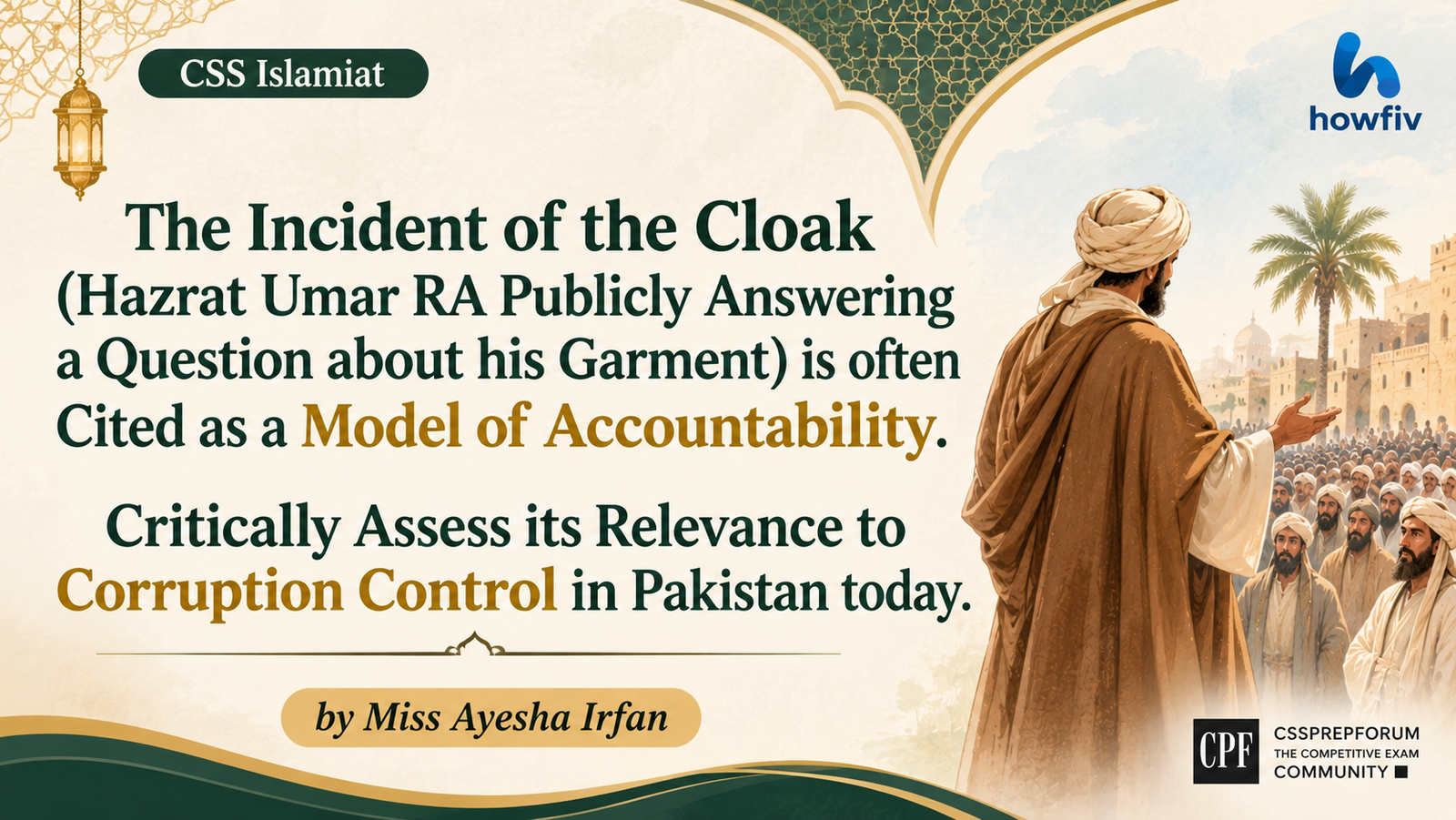
CSS Islamiat | Hazrat Ali’s (RA) Approach to Governance Emphasizes Public Welfare Over the Personal Interests
The following question of CSS Islamiat is solved by Ronra Kasi under the supervision of Howfiv’s Islamiat coach, Miss Ayesha Irfan. She learnt how to attempt 20 marks question and essay writing from Sir Syed Kazim Ali, Pakistan’s best CSS and PMS English essay and precis teacher with the highest success rate of his students. This solved question is attempted on the pattern taught by Sir to his students, scoring the highest marks in compulsory and optional subjects for years.

Outline
1-Introduction
2-Public Welfare Under Strain: Why Hazrat Ali’s (RA) Standard of Governance Is Tested by Pakistan’s Present Circumstances
3- How Can Hazrat Ali’s (RA) Approach to Governance Address Elite Capture in Pakistan?
- 3.1 Power as a Trust, not a Possession: Treating Public Office as an Accountable Duty Curbs Privilege Concentrated in Few Hands
- 3.2 The Many Before the Few: Putting Ordinary Citizens’ Needs First Corrects Unequal Access to Public Resources
- 3.3- No Exemption for the Ruler’s Circle: Applying Justice Equally to Relatives and Favourites Ends Impunity Among the Powerful
4-How Can Hazrat Ali’s (RA) Approach to Governance Address Political Patronage in Pakistan?
- 4.1- Office by Merit, Not Favor: Testing Candidates for Competence and Integrity Reduces Politicized Postings and Transfers
- 4.2- Public Money for Public Need: Barring Rewards for Supporters from Common Resources Limits Discretionary Funds and Political Largesse
- 4.3- Watching the Officials, Shielding the Honest: Pairing Oversight with Protection Weakens Loyalty-Based Administration
5-Diagnosing the Crisis: Is Pakistan’s Governance Failure Rooted in Its Leaders, Its Institutions, or Its Political Culture?
- 5.1- The Leadership Argument: Does Governance Fail Because of the Character, Vision, and Integrity of Those in Power?
- 5.2- The Institutional Argument: Do Weak, Politicized, and Poorly Designed Institutions Make Good Governance Impossible?
- 5.3- The Political Culture Argument: Do Clientelism, Personalized Politics, and Low Civic Accountability Sustain the Crisis?
- 5.4- A Self-Reinforcing Cycle: How Leaders, Institutions, and Culture Entrench One Another
6-Synthesis: Why Political Culture Is the Primary Driver of Pakistan’s Governance Crisis
7-The Way Forward: Reforming Leadership, Strengthening Institutions, and Reshaping Political Culture
- Leadership: Merit-Based Selection and Public Asset Declarations, in Line with Hazrat Ali’s (RA) Principle of Public Welfare
- Institutions: Fixed Tenures and Legal Protection for Civil Servants
- Culture: Civic Education and Voter Accountability.
8-Conclusion

Answer to the Question
Introduction
Hazrat Ali’s (RA) approach to governance rests on the principle that a ruler holds power as a trust (amanah) for the public, and not as a possession for himself. This principle challenges elite capture, where a small group controls state resources for its own benefit, and political patronage, where jobs, contracts, and funds are exchanged for loyalty. Both problems weaken governance in Pakistan. Yet leaders and institutions are only part of the story; the deeper root lies in a political culture that rewards favour over merit. Lasting reform must begin by restoring public office as a duty owed to the people.
Public Welfare Under Strain: Why Hazrat Ali’s (RA) Standard of Governance Is Tested by Pakistan’s Present Circumstances
Across Pakistan today, many citizens feel a growing gap between what they expect from the state and what they experience in daily life. This situation tests the idea that governance exists for the people. The World Bank’s October 2026 regional update reports that Pakistan’s poverty rate at the $3-a-day line rose by 6.4 percentage points between 2018-19 and 2024-25. Shocks such as inflation and floods played a part, but the lasting question is who carries the burden when such shocks arrive. When ordinary households face such costs, they naturally judge the state by whether it protects them first. This is exactly the test Hazrat Ali (RA) set for a ruler: public welfare before personal interest. Therefore, This standard becomes a useful tool for judging the problems of elite capture and patronage in Pakistan.
How Can Hazrat Ali’s (RA) Approach to Governance Address Elite Capture in Pakistan?
- Power as a Trust, not a Possession: Treating Public Office as an Accountable Duty Curbs Privilege Concentrated in Few Hands
In the first instance, when public office is seen as a duty and not as a prize, it becomes harder for a few people to turn it into a source of privilege. To illustrate, in Nahj al-Balagha, Hazrat Ali (RA) tells Malik al-Ashtar that Allah has placed him in charge of the people’s affairs as a test. Additionally, he forbids him from taking for himself what the people share equally. The Quran gives the same principle a strong base, because Surah An-Nisa (4:58) commands believers to return trusts to those entitled to them and to judge with justice. Consequently, this matters in Pakistan because the opposite attitude has produced very large benefits for powerful groups. For instance, according to the UNDP National Human Development Report 2020, the economic privileges of Pakistan’s powerful groups at PKR 2,660 billion (USD 17.4 billion) in 2017-18. This figure shows what happens when office is treated as a possession and not as a trust. If rulers truly believed that power is a test, such a large share of national wealth would not flow to a few hands. Therefore, the teaching of trust is the first step in reducing elite capture.
- The Many Before the Few: Putting Ordinary Citizens’ Needs First Corrects Unequal Access to Public Resources
In the same vein, treating power as a trust is only the start, because the trust must also be used to serve ordinary people before the powerful. For instance, Hazrat Ali (RA) tells Malik that the displeasure of the common people outweighs the approval of the chiefs. Accordingly, he calls the privileged the costliest in ease and the least helpful in hardship. He also fixes a share of public funds for the poorest. The Quran supports this thinking in Surah Al-Hashr (59:7), which directs fay (gains taken without fighting) to the needy so that wealth does not circulate only among the rich. Pakistan’s own data shows how far the country is from this ideal. As an illustration, according to the UNDP, the richest 1% held 9% of national income in 2018-19, against only 0.15% for the poorest 1%. The UNDP also found that reducing elite privileges by about 24% could double the benefits reaching the poor. This means that fairness is not out of reach, since a small cut in privilege could make a big difference to poor families. Hence, putting the many before the few is both a moral duty and a practical solution.
- No Exemption for the Ruler’s Circle: Applying Justice Equally to Relatives and Favourites Ends Impunity Among the Powerful
In addition to the above, even a fair system of spending cannot work if the powerful are free from the law. For this reason, Hazrat Ali (RA) orders Malik to do justice even against his own near ones and favourites. He warns that the ruler’s close circle tends to misappropriate, and he forbids land grants to hangers-on. The Quran gives the same message in Surah An-Nisa (4:135), which tells believers to stand firm for justice even against themselves, their parents or their relatives, whether rich or poor. In Pakistan, global indices suggest that this principle is not being followed. As a matter of illustration, the WJP Rule of Law Index 2025 ranks Pakistan 130th of 143 overall and 104th of 143 on Constraints on Government Powers, which measures how well those in power are held accountable under the law. Transparency International’s 2025 index also scores Pakistan 28 and ranks it 136th of 182. Together, these results show that the powerful still face few limits on their behaviour. To conclude, equal justice for the ruler’s circle is necessary to end impunity, which means freedom from punishment.
How Can Hazrat Ali’s (RA) Approach to Governance Address Political Patronage in Pakistan?
- Office by Merit, Not Favour: Testing Candidates for Competence and Integrity Reduces Politicized Postings and Transfers
Moving ahead, political patronage begins when jobs are given as favours, so the first cure is to give them by merit. Hazrat Ali (RA) tells Malik to appoint officials after testing and not through partiality or favouritism, which he calls sources of injustice. He also tells Malik to pay them well so that they do not covet the funds in their custody. The Quran supports this approach, because in Surah Al-Qasas (28:26) it quotes one of the two daughters saying that the best person to hire is the strong and trustworthy. Pakistan’s courts have raised the same concern about political pressure on civil servants. According to Dawn, the Supreme Court’s Anita Turab judgment held that civil servants owe allegiance to the law and the Constitution and not to individual politicians. In 2013, the Court observed that the premature transfer of at least 20 senior officers seemed to violate this judgment. Such transfers show that postings are still used to reward or punish officers. To sum up, hiring and keeping officers by merit would reduce this political interference.
- Public Money for Public Need: Barring Rewards for Supporters from Common Resources Limits Discretionary Funds and Political Largesse
In the same vein, a fair system of appointments also needs fair control over public money, because funds can be used as rewards just like jobs. Hazrat Ali (RA) tells Malik to make no land grants to hangers-on or supporters, since the benefit goes to them and the blame comes to the ruler. He also tells Malik to recover what officials have misappropriated. Moreover, Surah Al-Baqarah (2:188) supports this by forbidding people from consuming one another’s wealth unjustly or offering it to rulers as a bribe to take a share of others’ property sinfully. Consequently, Pakistan’s experience shows why these matters. For instance, in 2013, the Supreme Court declared the discretionary distribution of development funds to parliamentarians illegal. Yet the Express Tribune (30 November 2025) reported that the government approved Rs43 billion, which meant Rs250 million for each treasury-bench member of the National Assembly, for development spending in 2025-26. This shows that a court ruling alone does not end the habit of rewarding supporters with public money. To put it succinctly, keeping common resources for common needs is a clear way to limit political largesse, which means generous gifts given for political benefit.
- Watching the Officials, Shielding the Honest: Pairing Oversight with Protection Weakens Loyalty-Based Administration
Merit and clean spending will not last unless officials are watched and honest officers are protected. Hazrat Ali (RA) tells Malik to have truthful reporters check officials secretly and to punish and disgrace those proven to have misappropriated. He also tells him to give the chief judge a rank that protects him from the ruler’s circle. Surah Aal-e-Imran (3:104) supports this idea of shared responsibility, because it requires a group among the believers to call to good, enjoin what is right and forbid what is wrong; this as a collective duty. In Pakistan, protection for officials has weakened over time. To illustrate, the Supreme Court noted that the 1973 Constitution gives civil servants less protection than the 1956 and 1962 constitutions did. It also issued contempt notices over transfers that violated the Anita Turab judgment. When officers can be moved or removed at will, they learn to please politicians and not to serve the law. Pairing strong oversight with real protection would therefore make loyalty to the law more rewarding than loyalty to a person.
Diagnosing the Crisis: Is Pakistan’s Governance Failure Rooted in Its Leaders, Its Institutions, or Its Political Culture?
- The Leadership Argument: Does Governance Fail Because of the Character, Vision, and Integrity of Those in Power?
One common explanation is that governance fails because the people at the top lack character, vision and honesty. The Quran supports the idea that character matters in leadership. Surah Al-Baqarah (2:124) says that Allah made Ibrahim a leader for the people, and when Ibrahim asked about his descendants, Allah replied that His covenant does not include the wrongdoers. This means that leadership depends on the leader’s character, not on family or position. In Pakistan, the record of leaders seems to support this view. To illustrate, according to an Al Jazeera factbook (2022), the Supreme Court disqualified Prime Minister Nawaz Sharif in the Panama case on 28 July 2017, and no Pakistani prime minister has completed a full five-year term. These events suggest that leadership in Pakistan is often unstable and open to question. However, a court removing a leader can also be read as an institutional problem, which shows that leadership cannot be separated from the system around it. Therefore, the leadership argument is important but incomplete.
- The Institutional Argument: Do Weak, Politicized, and Poorly Designed Institutions Make Good Governance Impossible?
A second explanation looks beyond individuals and blames weak institutions, which are the rules and organizations that run the state. The Quran points to the importance of structure in Surah Al-Hadid (57:25), which says that Allah sent His messengers with clear proofs and sent down with them the Book and the Balance so that people may uphold justice. The “Balance” can be understood as a fair system, which shows that justice needs a standard larger than any one person. Pakistan’s administration shows what happens when this system is weak. According to The News, senior officials said the average tenure of provincial secretaries in Punjab has been under four months. They also said that four IGPs (Inspectors General of Police) of Khyber Pakhtunkhwa and five of Punjab were transferred in 18 months. When top officers change this quickly, no policy can be completed, and no official can be held fully responsible. This weakness explains why good plans often fail even when leaders mean well. Consequently, the institutional argument is strong, but it still leaves open the question of why these institutions stay weak.
- The Political Culture Argument: Do Clientelism, Personalized Politics, and Low Civic Accountability Sustain the Crisis?
A third explanation goes deeper and points to political culture, which means the habits, beliefs and expectations that shape how politics works. In Surah Al-Baqarah (2:170), the Quran says that when people are told to follow what Allah has revealed, they answer that they will follow what they found their fathers doing, even though their fathers understood nothing and were not guided. In other words, this verse shows how a community can hold on to old habits even when they are wrong. In Pakistan, one of those habits is loyalty to clan and local power. To illustrate, Dr Raza Khan argued that parliamentary politics since the 1970s strengthened tribe and biradari (clan) ties, so no major party can ignore “electable” (candidates who win through local influence). Because parties need such candidates to win, they give them space and protection, and this keeps clientelism alive. Clientelism means giving benefits to supporters in return for votes or loyalty. Thus, the political culture argument explains why the same problems return no matter who is in power.
- A Self-Reinforcing Cycle: How Leaders, Institutions, and Culture Entrench One Another
The three explanations are not separate, because each one feeds the others in a cycle. Surah Al-Baqarah (2:188) condemns using wealth to win the help of rulers or judges in taking others’ property, and this warning describes how money and favours can corrupt the whole system. The earlier evidence shows this cycle at work. Rulers are removed before completing their terms, so leaders remain unstable and keep reshuffling officials for loyalty. Officers are transferred within months, so institutions cannot protect leaders or officials from that pressure. Both problems then push politicians to depend on local power brokers, which strengthens the culture of patronage. In other words, unstable leaders weaken institutions, weak institutions leave leaders exposed, and the culture rewards both behaviours. To sum up, breaking this cycle requires change at all three levels, and not at only one.
- Synthesis: Why Political Culture Is the Primary Driver of Pakistan’s Governance Crisis
Although the three causes are linked, political culture is the strongest driver because it decides who gets elected and which institutions are allowed to survive. In other words, if voters and parties expect favours, then leaders will be chosen for the favours they can give, and institutions will be shaped to protect that system. As an illustration, a 2025 CEPR paper by Mirza, Malik and Platteau supports this view. It found that, under competitive clientelism, Punjab’s historical political families have a worse development impact than non-historic families. This study covers Punjab only, so it cannot be applied to the whole country without care, but it shows clearly how a culture of patronage can harm development. However, some may argue that strong institutions can change culture over time, as seen in countries that reformed through rule enforcement. This is true in principle, but in Pakistan the institutions are themselves shaped by the same patronage culture, so they cannot easily lead the change. Therefore, culture comes first, and it is the main reason why Pakistan’s governance crisis continues.
The Way Forward: Reforming Leadership, Strengthening Institutions, and Reshaping Political Culture
Leadership: Merit-Based Selection and Public Asset Declarations, in Line with Hazrat Ali’s (RA) Principle of Public Welfare
Reform must begin with the people who hold power, because they set the example for everyone else. Further, choosing leaders and officials by merit, and requiring them to make their assets public, would turn Hazrat Ali’s (RA) idea of power as a trust into a rule that can be checked. As a result, when citizens can see what their leaders own, it becomes harder to hide wealth gained from public office. In the end, this step also supports the next reform, because honest leaders are more willing to protect honest institutions.
- Institution: Fixed Tenures and Legal Protection for Civil Servants
Once leaders are chosen well, institutions must be given the stability to do their work. Furthermore, fixed tenures and legal protection for civil servants would stop the habit of moving officers for political reasons, which was seen in the transfer cases earlier. Similarly, officers who know they cannot be removed at will can follow the law without fear. Therefore, this stability also prepares the ground for a change in public attitudes, which is the final and hardest reform.
- Culture: Civic Education and Voter Accountability
Lasting change needs a change in how citizens think about politics. Besides, civic education and voter accountability would teach people to judge candidates by service and honesty and not by clan or favours. As a result, as voters change what they ask for, parties will have less reason to depend on electable, and patronage will lose its power. Thus, this cultural change completes the reform, because it supports honest leaders and stable institutions together.
Conclusion
The inescapable conclusion is that Hazrat Ali’s (RA) principle of public welfare over personal interest offers a clear remedy for elite capture and political patronage in Pakistan. Merit, equal justice, fair sharing of resources, and oversight with protection all follow from one idea: office is a trust. Leaders, institutions and political culture do reinforce one another, but culture is the soil in which the other two grow. As a direct consequence, a system that rewards favour will keep producing leaders who give favours and institutions that bend to them. Therefore, lasting reform must change what society expects from power. Until public office is seen as a duty to the people and not a reward for loyalty, Pakistan’s governance crisis will remain unsolved.
Searching for CSS or PMS Solved Islamiat Past Papers?
Are you preparing for the CSS or PMS and searching for solved Islamiat past papers, notes, books, PDFs, and MCQs? Explore them for free on Howtests and Cssprepforum. All content is fully solved and written by Miss Ayesha Irfan. For your convenience, the links are provided below. Simply click on any to start reading and preparing.