CSS/PMS Islamiat | Five Schools of Thought Every CSS Aspirant Should Understand Before Attempting Islamiat
This article outlines the five major Islamic schools of thought, Hanafi, Maliki, Shafi’i, Hanbali, and Ja’fari, highlighting their core jurisprudential principles (Usul al-Fiqh) and legal methodologies (Ijtihad). Designed for CSS aspirants, it demonstrates how understanding Islamic pluralism (Ikhtilaf) fosters the analytical rigor needed to tackle complex exam questions and navigate contemporary socio-legal issues, making it a key topic in CSS/PMS Islamiat.

Introduction
To view Islam through a monolithic lens is to fundamentally misread both its historical trajectory and its profound scholarship. Beneath the surface of conventional narratives lies a rich, dynamic intellectual tradition that has anchored Muslim civilization for over a millennium. Far from adhering to a singular, rigid dogma, Muslim jurists and scholars across centuries have continuously engaged with the Qur’an and Sunnah to address the shifting exigencies of their contemporary political, socio-economic, and cultural landscapes. The resulting tapestry of legal methodologies, theological frameworks, and reform movements was designed not to alter the core tenets of faith, but to enhance the Ummah’s capacity to apply divine guidance to a complex, evolving world.
For candidates navigating Pakistan’s competitive civil service examinations, comprehending this intellectual pluralism is no longer a mere academic exercise, it is a strategic necessity. Over the last decade, the Federal Public Service Commission (FPSC) has executed a noticeable paradigm shift in its assessment criteria. The traditional paradigm of rote learning, heavy on memorized citations but light on critical inquiry, has given way to an evaluation framework that demands analytical depth, conceptual clarity, and the ability to apply timeless Islamic precepts to contemporary policy issues. Aspirants who rely on flat, descriptive narratives invariably find themselves at a disadvantage; conversely, those equipped with a nuanced grasp of Islamic intellectual history produce the well-rounded, balanced, and mature arguments that top-tier examiners demand.
Understanding the Concept of a School of Thought
At its core, a school of thought represents a coherent intellectual framework anchored in shared principles of interpretation, structured methodology, and analytical reasoning. Within Islamic history, the emergence of these distinct schools was neither accidental nor disruptive; rather, it was a pragmatic response to the rapid expansion of Islam beyond the Arabian Peninsula into the diverse socio-political terrains of Persia, Central Asia, North Africa, Andalusia, South Asia, and Southeast Asia. As Muslim societies intersected with new legal, philosophical, and institutional reality, scholars were confronted with unprecedented governance and social challenges that demanded rigorous intellectual engagement.
While the Qur’an and Sunnah remained the immutable, foundational bedrock of guidance, scholars inevitably differed on the precise methodologies required to extract rulings and apply revelation to complex contexts. Far from signaling institutional decay or socio-political disunity, these methodological divergences catalyzed a vibrant intellectual ecosystem. They gave rise to sophisticated legal frameworks (Usul al-Fiqh), theological inquiry (Kalam), philosophical discourse (Falsafah), and constructive reform traditions. Crucially, this pluralism demonstrated Islam’s extraordinary capacity to adapt to diverse cultures and evolving historical epochs without compromising its foundational core.
Indeed, the legitimacy of contextual reasoning and interpretive flexibility was recognized at the very inception of the Islamic polity by the Prophet Muhammad (PBUH). Following the Battle of the Trench, during the expedition to Banu Qurayzah, he instructed his companions:
“None of you should pray the ‘Asr prayer except at Banu Qurayzah.”
Faced with the constraint of time, the companions split in their execution: one group adopted a strict, literal adherence, delaying the prayer until arrival, while the other deduced the underlying strategic intent, to hasten their march, and performed the prayer route. When presented with these contrasting decisions, the Prophet (PBUH) validated both approaches. This pivotal moment underscores an enduring principle: nuanced, sincere differences in methodological interpretation are not a source of friction, but a validated tradition of intellectual adaptability that has sustained Islamic civilization through changing times.
Why Did Different Schools of Thought Emerge?
The expansion of early Islamic civilization was not merely a territorial conquest, but a dynamic fusion of diverse cultures, geographical realities, and intellectual traditions. Following the rapid growth of the state beyond the Arabian Peninsula, jurists encountered unprecedented administrative, social, and economic challenges. To address these novel realities, scholars developed varied methodologies for interpreting primary sources, leading to rich legal diversity. Ultimately, the emergence of distinct schools of thought (Madhabs) was driven by geographic dispersion, local administrative needs, varying access to prophetic traditions, and distinct legal methodologies rather than theological conflict.
Expansion of the Muslim World
The rapid expansion during the Rashidun and Umayyad Caliphates transformed a localized Arabian society into a multi-ethnic, transcontinental empire. As the Prophet’s Companions (Sahabah) relocated to newly established garrison cities such as Kufa, Basra, Damascus, and Fustat, they carried distinct memories of prophetic precedents. These scholars settled in regions with unique historical, economic, and customary frameworks. Consequently, regional centers of learning developed independently, laying the structural foundation for distinct jurisprudential approaches long before formal legal schools were codified.
Diversity of Intellectual Centres
Geographical separation between major intellectual hubs naturally fostered distinct legal environments adapted to local customs (‘Urf). In Medina, jurists worked within a homogeneous society steeped in unbroken prophetic traditions. Conversely, in cosmopolitan Kufa, scholars faced complex legal questions arising from Persian administrative traditions. Historical records show that Imam Malik relied heavily on the continuous practice of the people of Medina (‘Amal Ahl al-Madinah) as a primary legal source, whereas Imam Abu Hanifa in Iraq operated in a highly urbanized setting that demanded flexible legal reasoning to address complex commercial transactions. This geographical contrast shaped fundamentally different juristic viewpoints.
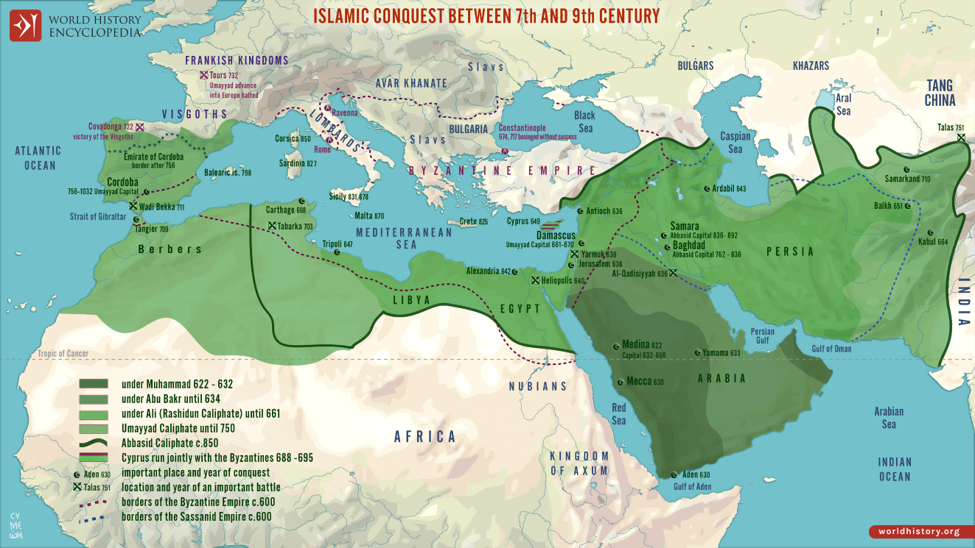
The legal and intellectual landscape of early Islam was shaped by its regional centers. As the Caliphate expanded across vast geographic distances, cities like Madinah, Kufa, Baghdad, and Andalusia each developed a distinct legal and philosophical character shaped by local demographics, socio-political needs, and historical traditions.
Source: World History Encyclopedia
The expansion of early Islamic civilization established distinct regional hubs, each shaping legal and philosophical thought according to its unique environment, socio-political realities, and historical heritage.
- Madinah (The Living Tradition): Anchored in the physical home of the early community, jurists like Imam Malik relied on the unbroken communal practices of its inhabitants (‘Amal Ahl al-Madinah). They prioritized preserved prophetic customs and living precedents over abstract deduction.
- Kufa (Systematic Reasoning): Facing rapid urbanization, multicultural trade, and novel civil disputes, scholars like Imam Abu Hanifa pioneered rationalist legal methodologies. They relied heavily on analogical deduction (Qiyas) and juristic preference (Istihsan) to formulate flexible legal solutions.
- Baghdad (Synthesis of Law and Philosophy): As the Abbasid capital and home to the House of Wisdom, Baghdad became the epicenter where traditionalist and rationalist traditions met. Here, Imam al-Shafi’i standardized formal legal principles (Usul al-Fiqh), while scholars used speculative theology (Kalam) to harmonize divine revelation with classical philosophy.
- Andalusia (Integration of Philosophy and Science): In Islamic Spain, scholars seamlessly combined jurisprudence with natural sciences and rational philosophy. Master jurist and philosopher Ibn Rushd (Averroes) demonstrated that divine revelation and rational truth do not conflict, creating a body of work that profoundly influenced both Islamic and European intellectual histories.
Diversity Is a Sign of Intellectual Vitality
Contrary to popular misconceptions, scholarly disagreement (ikhtilāf) has long been regarded as a sign of intellectual vitality rather than a source of weakness.
Imam al-Shāfiʿī famously observed:
“My opinion is correct, though it may be mistaken; the opinion of others is mistaken, though it may be correct.”
This statement embodies the intellectual humility that defined the classical Islamic scholarly tradition. Scholars understood that while divine revelation is perfect and infallible, human interpretation is inherently fallible and therefore always open to review, refinement, and respectful disagreement.
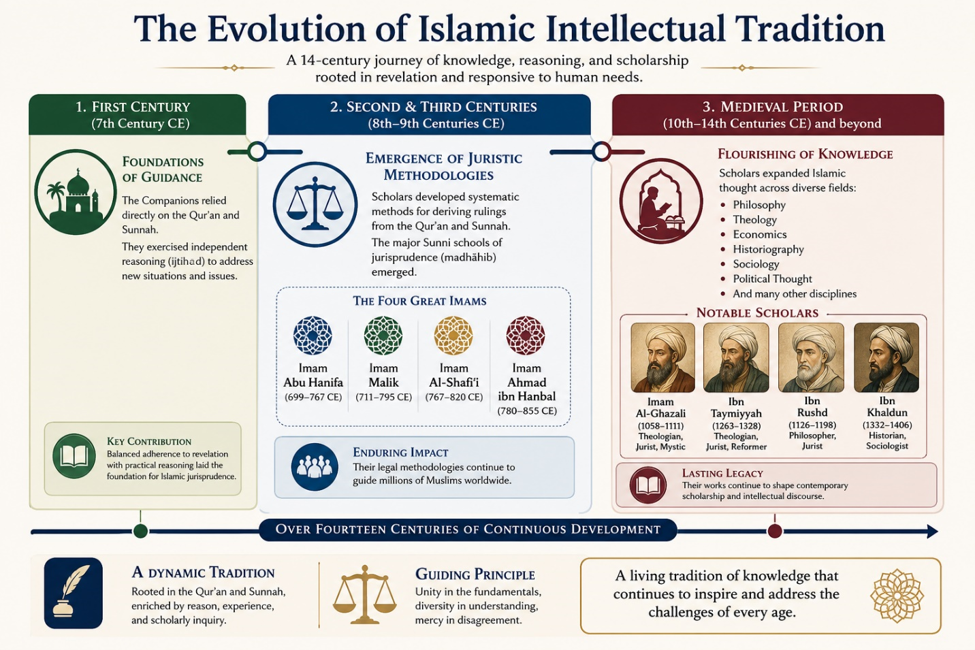
The Islamic intellectual tradition did not emerge fully formed. Rather, it evolved over more than fourteen centuries through continuous engagement with the Qur’an, the Sunnah, changing social realities, and rigorous scholarly inquiry. Each generation built upon the contributions of its predecessors, creating a rich and dynamic legacy that continues to inform Islamic thought today.
The First Century (7th Century CE)
During the lifetime of the Prophet Muhammad (PBUH) and the generation of his Companions, religious guidance came directly from the Qur’an and the Sunnah. As Islam spread into new regions and Muslims encountered unfamiliar circumstances, the Companions exercised ijtihād (independent legal reasoning) to address issues not explicitly covered by the primary sources. Their approach established the foundations of Islamic jurisprudence by combining fidelity to revelation with careful reasoning.
The Second and Third Centuries (8th–9th Century CE)
As Muslim societies expanded and legal questions became increasingly complex, scholars developed systematic methodologies for interpreting Islamic law. This period witnessed the emergence of the major Sunni schools of jurisprudence (madhāhib), each distinguished by its own legal principles while remaining rooted in the Qur’an and the Sunnah.
Among the most influential jurists were:
- Imam Abu Hanifah (699–767 CE)
- Imam Malik ibn Anas (711–795 CE)
- Imam al-Shafi’i (767–820 CE)
- Imam Ahmad ibn Hanbal (780–855 CE)
Although these scholars differed on certain legal issues, they shared a commitment to preserving the integrity of Islamic teachings. Their legal methodologies have endured for over a millennium and continue to guide millions of Muslims around the world.

The Medieval Period
The medieval era marked a remarkable flourishing of Islamic intellectual life. Muslim scholars made significant contributions not only to jurisprudence but also to theology (kalām), philosophy (falsafah), ethics, economics, political thought, historiography, sociology, and the natural sciences. Their scholarship reflected a tradition that encouraged critical inquiry, reasoned debate, and the pursuit of knowledge across diverse disciplines.
Among the most influential figures of this period were:
- Imam al-Ghazali, whose works bridged theology, law, ethics, and spirituality.
- Ibn Taymiyyah, renowned for his contributions to theology, jurisprudence, and legal reform.
- Ibn Rushd (Averroes), celebrated for his philosophical writings and legal scholarship.
- Ibn Khaldun, widely regarded as a pioneer of historiography and sociology through his groundbreaking analysis of civilization and social development.
The works of these scholars continue to be studied across the Muslim world and beyond, shaping contemporary discussions in Islamic law, theology, philosophy, and the social sciences. Their enduring legacy illustrates that the Islamic intellectual tradition has always been characterized by thoughtful engagement, scholarly diversity, and a commitment to understanding revelation in light of changing human circumstances.
The Modern Era: (18th Century to the Present)
The modern period marked one of the most consequential phases in the evolution of Islamic intellectual history. The encounter with European colonialism, the rise of industrialization, the spread of secular political ideas, the emergence of nationalism, and later the forces of globalization and rapid technological change fundamentally reshaped Muslim societies. These transformations generated questions that earlier generations had not faced in the same form, compelling Muslim scholars to reconsider how enduring Islamic principles could be applied to an increasingly complex world.
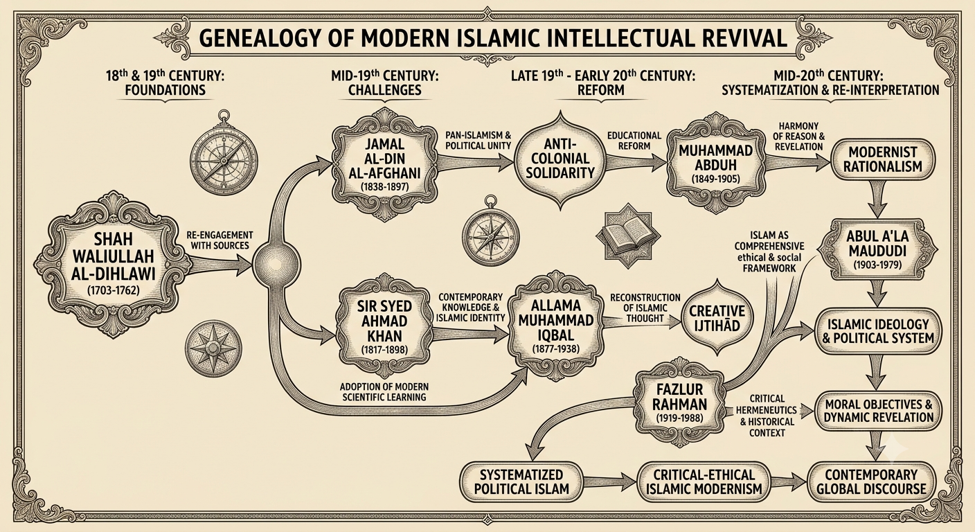
Rather than viewing modernity as a simple choice between tradition and change, many Muslim intellectuals approached it as an opportunity for renewal. They argued that while the Qur’an and the Sunnah remained the immutable foundations of Islam, their application to new political, economic, scientific, and social realities required rigorous scholarship, intellectual openness, and renewed ijtihād (independent reasoning). Their objective was not to replace the classical tradition but to extend it, ensuring that it remained relevant to contemporary challenges.
Several thinkers played a pivotal role in this intellectual revival.
Shah Waliullah al-Dihlawi sought to reconnect Muslims with the foundational sources of Islam while promoting reconciliation among the established schools of jurisprudence. Jamal al-Din al-Afghani emphasized intellectual awakening, educational reform, and political solidarity as essential responses to colonial domination. Muhammad Abduh advocated a harmonious relationship between reason and revelation, arguing that Islam encouraged rational inquiry rather than resisting it.
In South Asia, Sir Syed Ahmad Khan championed modern education and scientific learning, believing that Muslim societies could engage confidently with contemporary knowledge without abandoning their religious identity. Allama Muhammad Iqbal called for the reconstruction of Islamic thought through creative ijtihād, presenting Islam as a dynamic civilization capable of responding to the intellectual currents of the modern age. Abul A’la Maududi explored the implications of Islam as a comprehensive ethical and social framework, while Fazlur Rahman advanced influential methods of Qur’anic interpretation that emphasized both historical context and the enduring moral objectives of revelation.
Although these scholars differed in their conclusions and methodologies, they shared a common conviction: that Islam possesses a living intellectual tradition capable of engaging constructively with changing historical circumstances. Their debates reflected not a crisis of faith, but the vitality of a civilization seeking to reconcile continuity with change.
Today, the questions they grappled with remain central to contemporary Muslim discourse. Issues such as constitutional governance, economic justice, scientific advancement, bioethics, artificial intelligence, environmental stewardship, and global interconnectedness continue to demand thoughtful engagement. The modern era therefore demonstrates that Islamic intellectual history is not merely a record of past achievements; it is an ongoing conversation in which every generation is called upon to interpret enduring principles in light of new realities.
Why FPSC Expects Knowledge of Different Schools?
The CSS Islamiat syllabus increasingly focuses on analytical themes rather than isolated religious facts. Questions concerning democracy, women’s rights, economic justice, environmental ethics, science, bioethics, governance, and international relations require candidates to appreciate diverse scholarly perspectives.
For example, when discussing Islamic governance:
- A Traditionalist may emphasize classical jurisprudence.
- A Reformist may advocate renewed Ijtihad.
- A Revivalist may argue for Islam as a comprehensive socio-political system.
- A Modernist may explore compatibility between Islamic principles and constitutional democracy.
- A Maqasid scholar may evaluate governance based on justice, public welfare, and human dignity.
A candidate who understands these perspectives can produce balanced and sophisticated answers instead of presenting simplistic assertions.
Why Intellectual Diversity Strengthens, Rather Than Weakens, Islam?
The existence of multiple schools demonstrates the universality and adaptability of Islam. Across fourteen centuries, Muslim scholars have addressed changing political systems, economic structures, scientific discoveries, and social transformations while remaining committed to the Qur’an and Sunnah.
The Qur’an itself encourages reflection:
“Will they not then reflect upon the Qur’an?” (Surah Muhammad 47:24)
It also praises those:
“…who listen to what is said and follow the best of it.” (Surah Az-Zumar 39:18)
These verses establish reflection, reasoning, and intellectual engagement as essential components of Islamic scholarship.
Conclusion
Understanding the major schools of thought is indispensable for every CSS aspirant seeking excellence in Islamiat. These traditions represent different methodologies for interpreting the same divine sources, demonstrating that Islamic scholarship has always combined fidelity to revelation with engagement with changing historical realities. Rather than viewing intellectual diversity as a source of division, candidates should recognize it as one of the greatest strengths of Islamic civilization, a strength that has enabled Muslim scholars to respond creatively to new challenges across centuries.

Important Note for CSS and PMS Aspirants
For aspirants preparing for competitive examinations, exploring solved past papers is essential to understand examiner expectations, analytical answer writing, and paper trends. Therefore, candidates are strongly encouraged to read the following comprehensive solved papers available on CSSPREPFORUM.
- CSS Solved Pakistan Affairs Past Papers
- CSS Solved Current Affairs Past Papers
- CSS Solved Islamiat Past Papers
- CSS Solved General Science and Ability Past Papers
Moreover, aspirants searching for the most credible and result-oriented teachers for CSS and PMS preparation can benefit from the following detailed guidance articles
- Who is the Best CSS PMS Islamiat Teacher in Pakistan?
- Who is the Best CSS PMS Pakistan Affairs Teacher in Pakistan?
- Who is the Best CSS Current Affairs Teacher in Pakistan?
- Who is the Best CSS GSA Teacher in Pakistan?
- Who is the Best CSS PMS English Essay and Precis Teacher in Pakistan?
- Who is the Best English Grammar Teacher in Pakistan?