CSS Current Affairs | Critical Evaluation of Future Scenarios of Israel-Palestine Statehood
The following assignment question for CSS Current Affairs is solved by Malaika Tabasum under the supervision of Howfiv’s Pakistan Affairs and Current Affairs Coaches: Miss Iqra Ali and Sir Ammar Hashmi. She learnt how to attempt 20 marks question and essay writing from Sir Syed Kazim Ali, Pakistan’s best CSS and PMS English essay and precis teacher with the highest success rate of his students. This solved question is attempted on the pattern taught by Sir to his students, scoring the highest marks in compulsory and optional subjects for years.

Outline
1-Introduction
2-Historical Overview of the Relations Between Palestine and Israel
3-Understanding the Three Future Scenarios of Palestine
- One-State Reality of Unequal Rights
- State-Minus or Enclave State
- Internationally Imposed Two-State Solution
4-Comparative Evaluation of the Three Scenarios
- Based on International law
- Based on geopolitical feasibility
- Based on Palestinian human rights
5-Most Likely Scenario to Materialize: One-State Reality of Unequal Rights
6-Way Forwards
- To revive credible multilateral peace diplomacy under UN-backed guarantees
- To halt settlement expansion and protect Palestinian territorial contiguity
- To ensure humanitarian relief, reconstruction, and long-term economic recovery in Gaza and the West Bank
7-Conclusion
Answer to the question
Introduction
The Palestine question remains one of the longest and most contentious unresolved conflicts in modern international politics, shaped by the collapse of the peace process, the steady expansion of Israeli settlements, the fragmentation of Palestinian territory, and the repeated failure of international mediation to produce a just settlement. In this context, the future of Palestine is increasingly imagined through three possible scenarios: first, a one-state reality of unequal rights, in which Israel maintains effective control over the entire territory while Palestinians remain deprived of equal political and civil rights; second, a state-minus or enclave state, where Palestinians are granted a nominal statehood without genuine sovereignty over borders, security, resources, or territorial continuity; and third, an internationally imposed two-state solution, under which a sovereign Palestinian state would be established alongside Israel through decisive external pressure and international guarantees. Although the two-state solution remains the most legitimate and internationally recognized option under international law, the most likely near-term outcome appears to be the continuation of a one-state reality of unequal rights, possibly accompanied by elements of a state-minus arrangement, because Israel already exercises overwhelming territorial and military control, international actors have shown little willingness to enforce legal norms, Palestinian politics remains fragmented, and global as well as regional powers increasingly prioritize strategic and geopolitical interests over a meaningful resolution of the Palestinian question.
Historical Overview of the Relations Between Palestine and Israel
Historically, relations between Israel and Palestine have been rooted in conflict, displacement, and competing national claims over the same land. The roots of the dispute lie in the late Ottoman and British Mandate periods, when both Arab Palestinians and Jewish Zionists began asserting political claims to Palestine. Tensions intensified after the Balfour Declaration of 1917, in which Britain supported the establishment of a Jewish national home in Palestine, alarming the Arab majority. The conflict deepened with increasing Jewish immigration, communal violence, and Britain’s inability to reconcile the two communities. In 1947, the United Nations Partition Plan proposed dividing Palestine into separate Arab and Jewish states, but while Jewish leaders accepted it, Arab leaders rejected it as unjust. The creation of Israel in 1948 led to the first Arab-Israeli war and the mass displacement of Palestinians, known as the Nakba, which became the defining trauma of Palestinian history. Since then, relations have been shaped by wars, occupation, resistance, and failed peace efforts. Israel’s occupation of the West Bank, Gaza Strip, and East Jerusalem after the 1967 war transformed the conflict from an inter-state dispute into a prolonged occupation marked by settlements, military control, and recurring violence. Palestinian nationalism strengthened through organizations such as the PLO, while uprisings like the First and Second Intifadas reflected deep frustration against occupation. Although peace initiatives such as the Oslo Accords raised hopes for coexistence, they failed to resolve core issues including borders, refugees, Jerusalem, and settlements. As a result, Palestine-Israel relations remain historically defined by asymmetry of power, unresolved grievances, and the persistent struggle between occupation, resistance, and the search for a just political settlement.
Understanding The Three Future Scenarios of Palestine
- One-State Reality of Unequal Rights
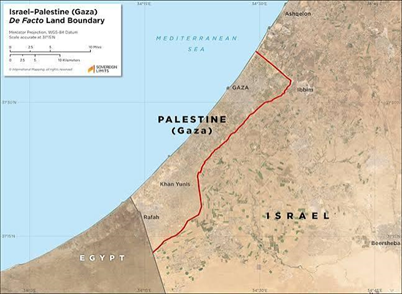
The first possible future scenario is a one-state reality of unequal rights, in which the territory stretching from the Jordan River to the Mediterranean Sea remains under effective Israeli control, but Palestinians continue to live without equal citizenship, sovereignty, or political rights. In this arrangement, Israel would retain control over borders, security, land, and movement, while Palestinians in the West Bank, East Jerusalem, and Gaza would remain fragmented under different legal and administrative systems. Such a scenario would not create a democratic binational state; rather, it would institutionalize a single political reality marked by unequal legal status, restricted mobility, and denial of national self-determination for Palestinians. This scenario is often described as a form of de facto annexation, because although the land is effectively controlled by one state, the people living within it do not enjoy equal rights under one sovereign legal order. A significant piece of evidence supporting this interpretation comes from Amnesty International’s 2022 report, Israel’s Apartheid against Palestinians, which concluded that Israel has established a system of domination based on “territorial fragmentation, segregation and control, dispossession of land and property, and denial of economic and social rights” against Palestinians, amounting to apartheid under international law. This report strengthens the argument that the present trajectory is moving not toward peace or sovereignty, but toward a consolidated one-state order of structural inequality.
- State-Minus or Enclave State
The second likely scenario is the emergence of a state-minus or enclave state, in which Palestinians are granted a nominal state but without the essential attributes of genuine sovereignty. Under this arrangement, Palestine would exist as a fragmented political entity composed of disconnected enclaves in the West Bank and Gaza, lacking control over borders, airspace, water resources, external trade, natural resources, and security policy. In practice, such a “state” would function less as a truly independent sovereign country and more as a limited self-governing territory under overarching Israeli dominance. It would provide the appearance of Palestinian statehood while preserving Israel’s strategic control over the land and key instruments of power. The weakness of this model is that it substitutes symbolism for substance: Palestinians may receive flags, institutions, and administrative authority in urban pockets, but not meaningful independence or territorial continuity. Evidence for the viability of this concern appears in World Bank assessments of the West Bank and Gaza, which repeatedly note that Israeli movement and access restrictions continue to severely constrain Palestinian economic development and have created conditions “akin to a nearly closed economy on Gaza,” while also limiting development prospects in the West Bank. Such findings demonstrate that Palestinian territory is already economically and geographically fragmented in a way consistent with the logic of enclavization, making a “state-minus” arrangement a plausible but deeply deficient future model.
- Internationally Imposed Two-State Solution
The third scenario is an internationally imposed two-state solution, under which an independent Palestinian state would be created alongside Israel based on the pre-1967 borders with negotiated land swaps, with East Jerusalem serving as the capital of Palestine and security guarantees provided to both sides. Unlike the previous two models, this scenario seeks to restore Palestinian sovereignty through a legally recognized and territorially defined state, while also preserving Israel as a separate state within secure boundaries. However, because direct bilateral negotiations have repeatedly failed, this model would likely require strong and sustained external diplomatic pressure from major powers and international institutions to compel implementation. Its significance lies in the fact that it remains the most consistent with international law and the long-standing global consensus on the conflict’s resolution. The clearest evidence for this is the repeated position of the United Nations, which has consistently reaffirmed its commitment to a two-state settlement based on the 1967 lines, emphasizing the Palestinian people’s right to self-determination and an independent state living side by side with Israel in peace and security. Thus, while the two-state solution remains the most lawful and normatively just option, its realization depends not merely on diplomatic rhetoric but on enforceable international guarantees, political will, and pressure strong enough to reverse the realities created by occupation and settlement expansion.
Comparative Evaluation of the Three Scenarios
- Based on International law
From the standpoint of international law, the internationally imposed two-state solution is the most compatible scenario because it aligns with the Palestinian people’s right to self-determination, the inadmissibility of acquiring territory by force, and the long-standing international consensus on a sovereign Palestinian state alongside Israel on the 1967 borders with negotiated adjustments. By contrast, the state-minus or enclave state is only partially compliant because it may symbolically recognize Palestinian statehood but would still deny meaningful sovereignty over borders, security, and resources, thereby hollowing out the substance of self-determination. The one-state reality of unequal rights is the least compatible with international law because it normalizes indefinite occupation, settlement expansion, and unequal legal status for Palestinians under a single controlling authority. Strong support for this ranking comes from the International Court of Justice’s 2024 advisory opinion, which declared Israel’s continued presence in the Occupied Palestinian Territory unlawful, called for an end to settlement activity, and reaffirmed that Palestinians possess a right to self-determination that cannot be overridden by prolonged occupation or annexation.
- Based on geopolitical feasibility
In terms of geopolitical feasibility, the one-state reality of unequal rights appears the most likely because it already exists in practice through Israeli control over borders, settlements, movement, and security across the occupied territories, while the international community has largely failed to reverse these realities on the ground. The state-minus or enclave state is moderately feasible because it offers a compromise formula that allows external actors to claim diplomatic progress without forcing Israel to relinquish strategic control; in other words, it can function as a conflict-management model rather than a conflict-resolution model. By contrast, an internationally imposed two-state solution is presently the least feasible because it would require extraordinary international pressure, Israeli territorial concessions, Palestinian political unity, and enforcement mechanisms that major powers have so far been unwilling to apply. Evidence for this imbalance can be found in the UN General Assembly resolution of September 2024, passed after the ICJ opinion, which demanded that Israel end its unlawful presence and cease settlement activity; despite overwhelming international support, there has been no meaningful implementation on the ground, showing that legal endorsement of a two-state framework has not translated into geopolitical enforceability.
- Based on Palestinian human rights
When judged by the criterion of Palestinian human rights, the internationally imposed two-state solution is the most protective because it offers the best chance for restoring Palestinian sovereignty, freedom of movement, political representation, territorial integrity, and control over resources. The state-minus or enclave state may improve some administrative or municipal conditions, but it would remain structurally unjust because Palestinians would still live in fragmented enclaves without full control over their borders, economy, or security, leaving their rights dependent on an external power. The one-state unequal reality is the most harmful scenario because it entrenches systemic discrimination, land dispossession, movement restrictions, family separation, and the denial of equal citizenship and national self-determination. A powerful piece of evidence comes from Amnesty International’s 2022 report, Israel’s Apartheid against Palestinians, which argues that Palestinians are subjected to a system of domination based on territorial fragmentation, segregation, dispossession, and denial of basic rights; this strongly suggests that continuation of the current one-state reality would remain the worst outcome for Palestinian human dignity and freedoms.
Most Likely Scenario to Materialize: One-State Reality of Unequal Rights
The most likely future scenario is the continuation of a one-state reality of unequal rights, possibly accompanied by a state-minus facade, because this arrangement already exists in de facto form on the ground. Israel retains overwhelming military, territorial, and administrative control over the land between the Jordan River and the Mediterranean, while the expansion of settlements, bypass roads, checkpoints, and territorial fragmentation has steadily eroded the possibility of a viable and contiguous Palestinian state. At the same time, international actors continue to express rhetorical support for Palestinian statehood, yet they have shown little willingness to impose the political, diplomatic, or economic costs necessary to reverse Israeli policies or enforce international law. Palestinian political fragmentation between the West Bank and Gaza further weakens collective leverage, while Arab and global powers are increasingly preoccupied with normalization, regional rivalries, economic interests, and great-power competition rather than sustained pressure for a just settlement. As a result, the most probable outcome is not a genuine sovereign Palestinian state, but rather a hybrid model in which a one-state unequal reality is repackaged in the language of a “state-minus” arrangement, offering Palestinians limited autonomy, aid, and symbolic institutions without meaningful sovereignty. This reading is reinforced by the International Court of Justice’s 2024 advisory opinion, which held that Israel’s continued presence in the Occupied Palestinian Territory is unlawful and that settlement expansion has undermined Palestinian self-determination, thereby confirming that the present trajectory is moving less toward a negotiated peace and more toward the consolidation of an unequal one-state order.
Way Forwards
- To revive credible multilateral peace diplomacy under UN-backed guarantees
To revive credible multilateral peace diplomacy under UN-backed guarantees is essential because the traditional bilateral peace process has repeatedly failed to resolve the Palestine question, largely due to asymmetry of power between Israel and Palestine and the absence of enforceable international commitments. A durable settlement now requires a broader diplomatic framework in which the United Nations, major powers, Arab states, and European actors collectively guarantee negotiations, ceasefire implementation, security arrangements, and the eventual realization of Palestinian statehood. This is especially important because unilateral policies, settlement expansion, and recurring wars have steadily eroded trust in direct negotiations. Real-time developments show that the international community is trying to revive such diplomacy: in 2025, the High-Level International Conference for the Peaceful Settlement of the Question of Palestine and the Implementation of the Two-State Solution, co-chaired by Saudi Arabia and France, produced the New York Declaration, endorsed by a large majority in the UN system, reaffirming an “irreversible pathway” toward a two-state solution. This demonstrates that multilateral diplomacy remains the most viable mechanism for restoring political momentum and international legitimacy to the peace process.
- To halt settlement expansion and protect Palestinian territorial contiguity
To halt settlement expansion and protect Palestinian territorial contiguity is indispensable because continued Israeli settlement growth in the West Bank and East Jerusalem is systematically undermining the geographical basis of any future Palestinian state. Settlements, bypass roads, land expropriation, and settler violence are not merely demographic or security issues; they are reshaping the territory in ways that fragment Palestinian communities into disconnected enclaves and make a sovereign, contiguous state increasingly impossible. In practical terms, if settlement expansion continues, the two-state solution will survive only as diplomatic rhetoric while the territorial reality shifts irreversibly toward annexation and permanent occupation. This danger is evident in real-time evidence: the UN Human Rights Office (OHCHR) reported in March 2026 that Israel had accelerated unlawful settlement expansion and annexation of large parts of the occupied West Bank, forcibly displacing over 36,000 Palestinians, while the UN Secretary-General’s 2025 report on Resolution 2334 also confirmed that settlement activity continues to alter the character, status, and demographic composition of the occupied territory. These developments show that stopping settlements is not a symbolic demand but a precondition for preserving the territorial viability of Palestine.
- To ensure humanitarian relief, reconstruction, and long-term economic recovery in Gaza and the West Bank
To ensure humanitarian relief, reconstruction, and long-term economic recovery in Gaza and the West Bank is necessary because no political solution can endure if Palestinians remain trapped in humanitarian catastrophe, mass displacement, and economic collapse. Years of blockade, repeated military offensives, destruction of infrastructure, restrictions on movement, and shrinking livelihoods have devastated Palestinian society, particularly in Gaza, where humanitarian survival has become inseparable from political stability. Relief efforts must therefore go beyond emergency aid to include reconstruction of homes, schools, hospitals, water systems, and agricultural livelihoods, as well as long-term recovery plans that restore trade, employment, and institutional resilience. Current evidence underscores the urgency of this need: the UN OCHA 2026 Flash Appeal states that $4 billion is required to deliver life-saving assistance to 3.6 million people across Gaza and the West Bank, while the FAO’s June 2026 humanitarian response update reports that Gaza’s food system alone has suffered $1.44 billion in damages and that a ten-year recovery and reconstruction Programme (2026–2036) has been developed to address the collapse of agriculture and food security. These figures show that humanitarian relief and reconstruction are no longer secondary concerns but central pillars of any realistic future peace framework.
Conclusion
In conclusion, the future of Palestine is most likely to unfold within one of three broad scenarios: a one-state reality of unequal rights, a state-minus or enclave state, or an internationally imposed two-state solution. Among these, the two-state solution remains the most legitimate, lawful, and morally defensible option because it aligns with international law, the Palestinian right to self-determination, and the global consensus on sovereign coexistence between Israel and Palestine. However, when assessed against present-day realities, the one-state reality of unequal rights appears the most probable outcome, as Israel continues to exercise effective control over Palestinian territory, settlements keep expanding, and international actors remain unable or unwilling to enforce a just settlement. The possibility of a state-minus arrangement further complicates the picture, as it may offer symbolic Palestinian statehood without genuine sovereignty, thereby serving as a diplomatic cover for continued domination. Thus, the central tragedy of the Palestinian question lies in the widening gap between what is legally and ethically justified and what is politically and geopolitically likely to materialize, making Palestine not only a conflict over land, but also a test of the credibility of international law, human rights, and global justice. solutions will enable SMEs to become even more effective contributors to the country’s economic development.

CSS Solved Past Papers’ Essays
Looking for the last ten years of CSS and PMS Solved Essays and want to know how Sir Kazim’s students write and score the highest marks in the essays’ papers? Then, click on the CSS Solved Essays to start reading them.
CSS Solved Essays
CSS Solved Islamiyat Past Papers
Want to read the last ten years’ Islamiyat Solved Past Papers to learn how to attempt them and to score high? Let’s click on the link below to read them all freely. All past papers have been solved by Pakistan’s top CSS Islamiyat coaches having the highest score of their students.
CSS Solved Islamiyat
CSS Solved General Science & Ability Past Papers
Want to read the last ten years’ General Science & Ability Solved Past Papers to learn how to attempt them and to score high? Let’s click on the link below to read them all freely. All past papers have been solved by Pakistan’s top CSS GSA coachez having the highest score of their students.
CSS Solved General Science & Ability
CSS Solved Pakistan Affairs Past Papers
Want to read the last fifteen years’ Pakistan Affairs Solved Past Papers to learn how to attempt them and to score high? Let’s click on the link below to read them all freely. All past papers have been solved by Pakistan’s top CSS Pakistan Affairs coaches having the highest score of their students.
CSS Solved Pakistan Affairs
CSS Solved Current Affairs Past Papers
Want to read the last fifteen years’ Current Affairs Solved Past Papers to learn how to attempt them and to score high? Let’s click on the link below to read them all freely. All past papers have been solved by Pakistan’s top CSS Current Affairs coaches having the highest score of their students.
CSS Solved Current Affairs