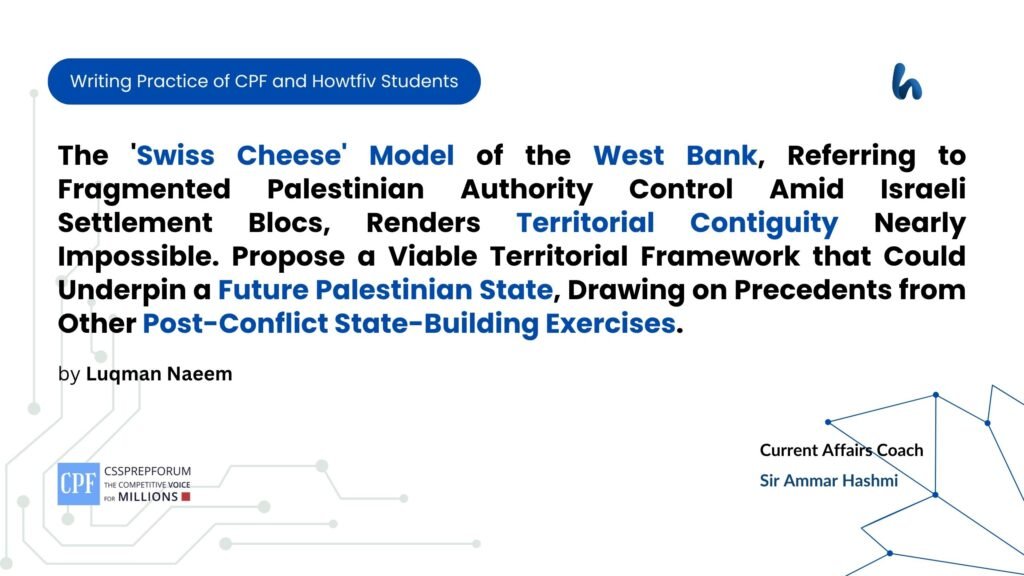
CSS Current Affairs | The ‘Swiss Cheese’ Model of the West Bank and Territorial Contiguity
The following assignment question for CSS Current Affairs is solved by Luqman Naeem under the supervision of Howfiv’s Pakistan Affairs and Current Affairs Coaches: Miss Iqra Ali and Sir Ammar Hashmi. She learnt how to attempt 20 marks question and essay writing from Sir Syed Kazim Ali, Pakistan’s best CSS and PMS English essay and precis teacher with the highest success rate of his students. This solved question is attempted on the pattern taught by Sir to his students, scoring the highest marks in compulsory and optional subjects for years.
Outline
1-Introduction
2-Historical Context of the Palestine Issue
3-Analysing the “Swiss Cheese” Model of the West Bank
4-Proposing a Viable Territorial Framework that could Underpin a Future Palestinian State
- Mutually Agreed Land Swaps to Ensure Territorial Continuity
- A Sovereign Corridor Connecting the West Bank and Gaza
- Dissolving areas A, B, and C
- Shared or divided sovereignty in Jerusalem
- Demilitarised border security
5-State-Building Lessons from Post-Conflict Experiences
- Political Inclusion and Constitutional Design
- Transitional Justice and Reconciliation
- Temporary International Mandate for Border Control
- Lessons from Post-Conflict State-Building Experiences
6-Critical Challenges to Implementation
7-Conclusion
Answer to the question
Introduction
Exploring the historical foundations and physical realities of the Israeli-Palestinian conflict, shifting the focus from rigid political deadlocks to the lived, human experiences on the ground. It traces the origins of competing territorial claims from the late 19th century through the pivotal events of 1948 and 1967, which left a legacy of displacement and military occupation. Moving into the present day, the text analyzes the severe geographic fragmentation of the West Bank, often described as a “Swiss Cheese” model, and illustrates how internal administrative zones and physical barriers disrupt the daily lives, economies, and movements of ordinary families. Finally, the passage outlines a forward-looking, compassionate plan for a viable Palestinian state. By proposing practical frameworks such as land swaps, sovereign travel corridors, dissolved internal borders, a shared Jerusalem, and demilitarized border security, it offers a blueprint for replacing a high-friction existence with geographic dignity, safety, and lasting coexistence.
Historical Context of the Palestine Issue
The history of the Palestinian issue centers on competing claims to land, originating in the late 19th century with the simultaneous rise of Zionism and Arab nationalism under Ottoman rule. Tensions escalated under the British Mandate, leading to the UN partition plan in 1947, which was accepted by Jewish leaders but rejected by Arab leaders. The 1948 establishment of Israel and the subsequent war resulted in the Nakba, displacing hundreds of thousands of Palestinians. Further complicating the conflict, the 1967 Six-Day War saw Israel capture the West Bank, East Jerusalem, and Gaza, initiating a long-term military occupation. Despite initiatives like the 1990s Oslo Accords, core issues such as borders, the status of Jerusalem, and the right of return remain unresolved. Today, the conflict continues to drive a deep humanitarian crisis, characterized by a persistent, daily struggle for security and self-determination for both Palestinians and Israelis.
Analysing the “Swiss Cheese” Model of the West Bank
The “Swiss Cheese” model of the West Bank describes a landscape where Palestinian communities are isolated pockets of land surrounded by Israeli-controlled areas, making a connected Palestinian state nearly impossible. This fragmentation shapes the daily reality of millions of individuals, turning routine travel into a complex navigation of barriers. The West Bank is divided into three distinct zones, A, B, and C, created as temporary steps toward peace. Palestinian towns and cities sit like isolated holes in a block of cheese, while the surrounding “cheese” consists of Israeli settlements, military bases, and restricted bypass roads. Because the land is broken into hundreds of disconnected fragments, simple tasks like visiting family or driving to work mean crossing invisible boundaries controlled by foreign authorities. For regular families, this geographic division creates a high-friction existence defined by physical checkpoints, concrete walls, and permit systems. A short trip between neighbouring Palestinian towns can take hours due to unpredictable roadblocks. Farmers find themselves cut off from their own olive groves, and businesses struggle to transport goods across fragmented zones. This division prevents communities from growing naturally together. When a city cannot expand because it is hemmed in by surrounding settlement blocs, housing costs soar, and green spaces disappear. Local governments cannot easily build connected water lines, electrical grids, or public transit systems, forcing each isolated pocket to manage its resources independently.
The central challenge of the “Swiss Cheese” model is not simply the division of land, but the absence of continuous territorial control, reliable movement, and unified administration. A viable Palestinian state would therefore require more than connected roads between isolated towns. It would need agreed borders, uninterrupted transport links, control over land-use planning and natural resources, and the authority to govern its territory. Without these arrangements, Palestinian areas could remain physically connected in places but politically and economically fragmented. Territorial contiguity must therefore be the guiding principle behind any proposed settlement.
Proposing a Viable Territorial Framework that could Underpin a Future Palestinian State
- Mutually Agreed Land Swaps to Ensure Territorial Continuity
Land swaps help to offer a deeply human solution to one of the most difficult parts of the conflict: the tangled map of homes, neighbourhoods, and history. Instead of forcing hundreds of thousands of everyday people to pack up and leave communities they have lived in for decades, a land swap works like a fair, practical trade. Under this framework, Israel would keep some of its largest, well-established neighbourhood blocs right along the original border. In return, Israel would hand over an exactly equal amount of high-value, highly usable land to Palestine elsewhere. For regular families on the ground, this peaceful compromise means that permanent borders could finally be drawn without destroying lives, tearing down houses, or uprooting young children from their familiar schools. It shifts the focus away from a rigid political deadlock and toward a realistic compromise that respects human stability above all else. Ultimately, this arrangement ensures that a future Palestinian state receives a fair, continuous territory to build its economy and safely grow, while simultaneously honouring the physical reality of where people actually live today, paving a meaningful and lasting path forward for both sides.
For land swaps to create a viable Palestinian state, the exchanged territory must be assessed not only by its size but also by its location, agricultural value, access to water, and potential for urban and economic development. The agreement should preserve the continuity of Palestinian communities and prevent settlement blocs from dividing the West Bank into isolated enclaves. Any exchange must be mutually agreed upon and provide Palestine with territory of comparable value and practical use. Otherwise, equal land area on paper may still produce an unequal and fragmented state.
- A Sovereign Corridor Connecting the West Bank and Gaza
A sovereign travel corridor offers a deeply human bridge to heal one of the most painful realities of the conflict: the physical separation of families, friends, and communities between the West Bank and Gaza. For decades, regular people have lived just forty kilometers apart, yet they are completely cut off from each other by a heavily guarded border. A dedicated, high-speed rail and highway link would change daily life completely, allowing people in Gaza to safely visit their relatives in Ramallah without asking for impossible military permits. This corridor would belong entirely to the Palestinian state, built on elevated bridges or through underground tunnels to ensure uninterrupted, free movement. It means a student could attend university, a business could ship goods, and a family could celebrate weddings together without foreign checkpoints stopping them. By stitching these two separated lands back together, the corridor does more than just pave roads; it restores a broken sense of national unity. It allows millions of individuals to finally move freely across their own country, transforming a fractured map into a single, breathing homeland where people can plan a shared future together.
- Dissolving Areas A, B, and C
Ending the division of the West Bank into Areas A, B, and C would be an essential step towards establishing a territorially contiguous Palestinian state. However, abolishing the existing administrative categories alone cannot achieve this change. It requires a negotiated transfer of territorial and administrative authority to the Palestinian government, along with agreements on land-use planning, Jewish settlements, security responsibilities, and access to natural resources. These arrangements should enable Palestine to exercise effective governance across its territory and prevent Palestinian towns and cities from remaining isolated enclaves. Therefore, the restructuring of Areas A, B, and C must form part of a comprehensive political settlement that guarantees territorial continuity and meaningful Palestinian sovereignty.
- Shared or divided sovereignty in Jerusalem
Shared or divided sovereignty in Jerusalem offers a compassionate path forward for a city that holds the hearts, prayers, and identities of millions of people. For decades, Jerusalem has been a place of deep devotion but also profound division, where neighbourhoods are split by political tension and heavy security. A shared sovereignty framework approaches the city not as a prize to be won, but as a home to be shared. Under this model, East Jerusalem would become the capital of Palestine, while West Jerusalem remains the capital of Israel. For everyday residents, this means no new walls or physical barriers would divide their streets. Instead, an open, unified city would allow a Palestinian shopkeeper and an Israeli commuter to live alongside one another with equal rights and dignity. A joint council or international body would protect holy sites, ensuring that Christians, Muslims, and Jews can all walk the ancient alleyways and pray in peace without fear. By honouring the deep emotional connection both peoples have to the same sacred soil, this framework transforms Jerusalem from a flashpoint of conflict into a living symbol of peaceful coexistence and mutual respect.
- Demilitarised border security
Demilitarized border security offers a peaceful, reassuring framework that addresses the deep human need for safety and dignity on both sides of the frontier. For decades, the presence of heavily armed soldiers and military watchtowers along the borders, particularly in the Jordan Valley, has been a constant source of daily anxiety for residents and a stark symbol of foreign occupation. By replacing combat troops with a mix of international peacekeepers, advanced monitoring technology, and neutral observers, the border shifts from a flashpoint of tension into a zone of quiet stability. For regular Palestinian families, this transition means they can finally manage their own external borders and international trade with a true sense of national sovereignty and freedom. Simultaneously, this arrangement provides Israelis with verifiable security guarantees, ensuring that their neighbours’ territory will not become a launchpad for regional threats or violence. Removing the machinery of war from the landscape allows everyday people to live without the fear of sudden conflict. It replaces suspicion with a reliable system of mutual protection, showing that true safety comes from shared agreements rather than loaded weapons.
State-Building Lessons from Post-Conflict Experiences
- Political Inclusion and Constitutional Design
Political inclusion and constitutional design are the vital foundations needed to sustain a post-conflict Palestinian state and ensure its long-term stability. For a new government to earn the trust of its citizens, the constitution-making process must look past political factions and reach directly into everyday communities. This framework acts as a protective shield, embedding fair power-sharing agreements and proportional voting systems into the supreme law of the land. For regular families, this thoughtful design ensures that diverse voices, including women, independent youth movements, civil society leaders, and refugees, have a permanent, legally protected seat at the decision-making table. By anchoring fundamental human rights, local governance, and independent courts into the constitution, the state transforms from a source of political rivalry into a shared space for compromise. It replaces the deep-seated fear of political marginalization with a genuine sense of shared national ownership. When individuals see their rights, identities, and daily needs reflected in the law, national institutions gain real domestic legitimacy. Ultimately, this inclusive approach proves that a sustainable Palestinian state cannot be built through centralized control, but by ensuring every community has a meaningful, democratic stake in a peaceful tomorrow.
- Transitional Justice and Reconciliation
Transitional justice and reconciliation offer a deeply compassionate path to healing the profound emotional wounds necessary to sustain a post-conflict Palestinian state. True, lasting stability cannot be achieved simply by signing political treaties; it requires acknowledging the intergenerational trauma and painful experiences of regular people on the ground. This framework creates safe, respectful spaces, such as community-led truth forums, where everyday families who have lost loved ones, lands, or homes can share their stories and have their suffering formally recognized. For ordinary citizens, this process shifts the focus away from a cycle of bitter resentment and toward collective healing. By combining legal accountability with community-based initiatives, like joint counselling and historical archives, former adversaries and fractured factions can slowly learn to live alongside one another again. Addressing historical grievances openly, rather than burying them, restores broken social trust and establishes the domestic stability a new state needs to thrive. Ultimately, this human-centered approach ensures that a traumatized society can finally process its painful past, break the cycle of violence, and build a unified, peaceful future grounded in empathy, dignity, and mutual respect for all its citizens.
- Temporary International Mandate for Border Control
A temporary international mandate for border control offers a reassuring, neutral framework to manage frontiers during the delicate transition to a stable Palestinian state. Drawing on global precedents like the UN missions in the Balkans or the Sinai Peninsula, this approach replaces unilateral military checkpoints with a multinational peacekeeping force or an international oversight body. For regular families on the ground, this mandate dramatically alters daily life by transforming high-friction borders into zones of predictable, orderly movement. Instead of facing unpredictable closures, everyday citizens, students, and merchants can cross borders, access agricultural lands, and transport goods under transparent rules monitored by the international community. Simultaneously, this arrangement provides necessary security guarantees to neighboring Israel, using advanced monitoring technology and neutral verification to ensure the territory is not used for hostility. By taking immediate control of borders out of the hands of former adversaries, the mandate lowers political and military tensions. It gives a young Palestinian state the secure breathing room it needs to build its own professional border police, develop its economy, and establish full sovereign control without sparking immediate conflict. Ultimately, this framework shows that initial border security is best achieved through international legal guarantees and mutual verification, paving a safe path toward lasting independent coexistence.
- Lessons from Post-Conflict State-Building Experiences
International state-building experiences offer useful lessons, although no single model can be directly transferred to Palestine. The Dayton Agreement in Bosnia and Herzegovina demonstrates how an internationally supported settlement can establish post-conflict institutions, but its complex governance structure also highlights the risks of prolonged political deadlock. Kosovo’s experience shows that international supervision cannot substitute for local participation, effective institutions, and a clear path toward self-government. For Palestine, the key lesson is to combine internationally supported agreements with accountable Palestinian institutions, clear territorial arrangements, and meaningful local representation.
Critical Challenges to Implementation
Despite their potential, these proposals face serious political and security obstacles. Land swaps require agreement on borders and settlements, while a sovereign corridor between Gaza and the West Bank would require negotiated arrangements for access, security, and uninterrupted movement. Removing the existing divisions between Areas A, B, and C would also require a transfer of territorial and administrative authority, not simply the abolition of internal boundaries. International monitoring could support a transition, but it would need a clear mandate, the consent of relevant parties, and a credible path toward Palestinian control. Therefore, the framework’s success depends on negotiated implementation, enforceable guarantees, and genuine Palestinian sovereignty.
Conclusion
The Israeli-Palestinian conflict is a deeply human story of land, identity, and fragmented geography that shapes the daily lives of millions. To understand the path forward, one must first look at the historical root of the issue, where competing claims to the same soil sparked decades of displacement, war, and enduring military occupation. Today, this history is visibly etched into the landscape of the West Bank, where a “Swiss Cheese” layout of isolated towns and restrictive zones creates a high-friction existence for ordinary families. Overcoming this severe territorial division requires moving past rigid political deadlocks toward compassionate, practical solutions.
Lessons from Bosnia and Herzegovina and Kosovo suggest that international assistance can support the transition, but cannot replace local legitimacy and genuine sovereignty. Ultimately, a viable Palestinian state requires territorial continuity, a reliable link between the West Bank and Gaza, effective governance, and negotiated security arrangements. Although significant political obstacles remain, a framework combining mutually agreed land swaps, connected territory, and accountable institutions offers a more credible basis for Palestinian statehood than a collection of disconnected enclaves will enable SMEs to become even more effective contributors to the country’s economic development.
CSS Solved Past Papers’ Essays
Looking for the last ten years of CSS and PMS Solved Essays and want to know how Sir Kazim’s students write and score the highest marks in the essays’ papers? Then, click on the CSS Solved Essays to start reading them.
CSS Solved Essays
CSS Solved Islamiyat Past Papers
Want to read the last ten years’ Islamiyat Solved Past Papers to learn how to attempt them and to score high? Let’s click on the link below to read them all freely. All past papers have been solved by Pakistan’s top CSS Islamiyat coaches having the highest score of their students.
CSS Solved Islamiyat
CSS Solved General Science & Ability Past Papers
Want to read the last ten years’ General Science & Ability Solved Past Papers to learn how to attempt them and to score high? Let’s click on the link below to read them all freely. All past papers have been solved by Pakistan’s top CSS GSA coachez having the highest score of their students.
CSS Solved General Science & Ability
CSS Solved Pakistan Affairs Past Papers
Want to read the last fifteen years’ Pakistan Affairs Solved Past Papers to learn how to attempt them and to score high? Let’s click on the link below to read them all freely. All past papers have been solved by Pakistan’s top CSS Pakistan Affairs coaches having the highest score of their students.
CSS Solved Pakistan Affairs
CSS Solved Current Affairs Past Papers
Want to read the last fifteen years’ Current Affairs Solved Past Papers to learn how to attempt them and to score high? Let’s click on the link below to read them all freely. All past papers have been solved by Pakistan’s top CSS Current Affairs coaches having the highest score of their students.
CSS Solved Current Affairs