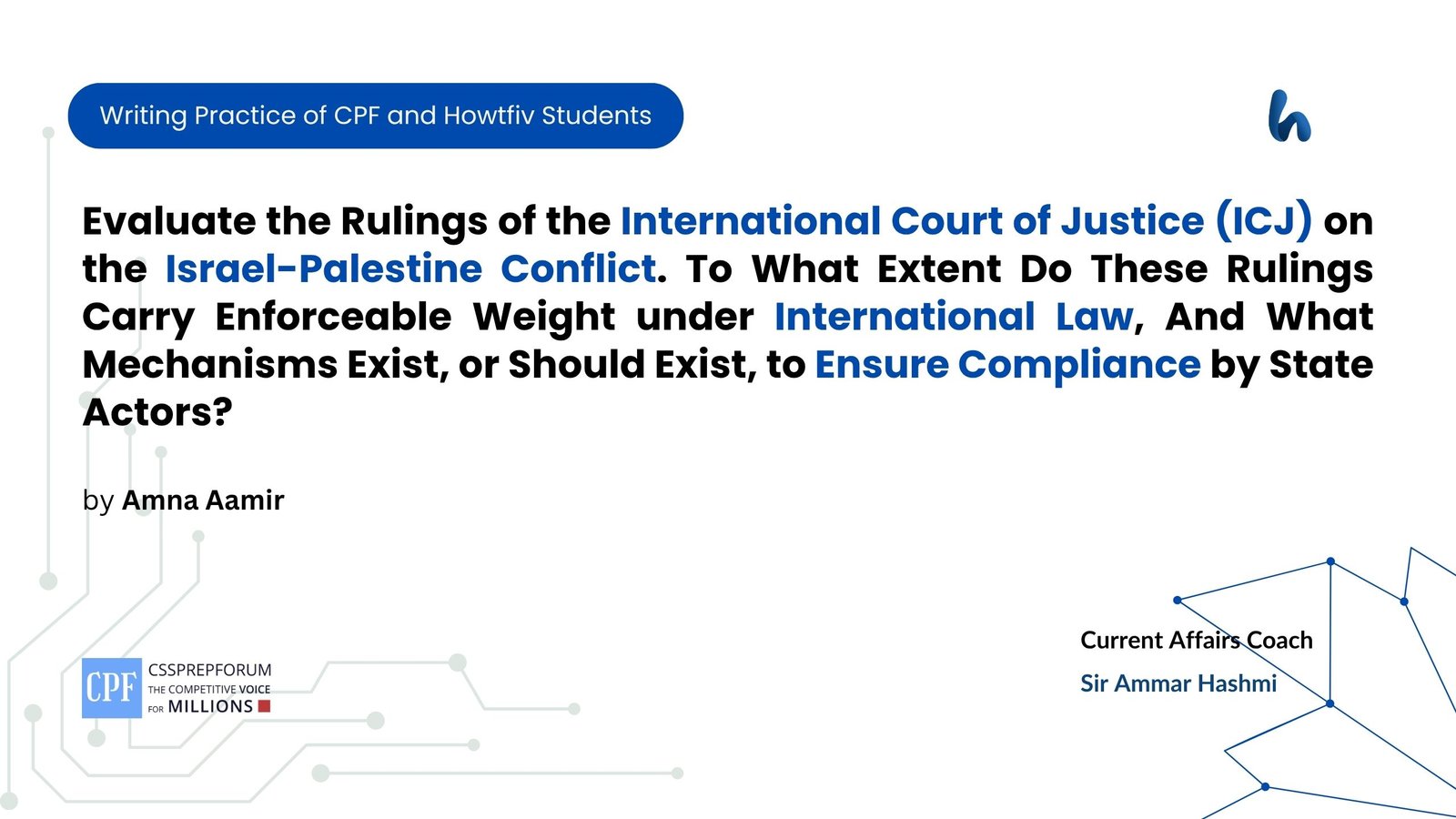
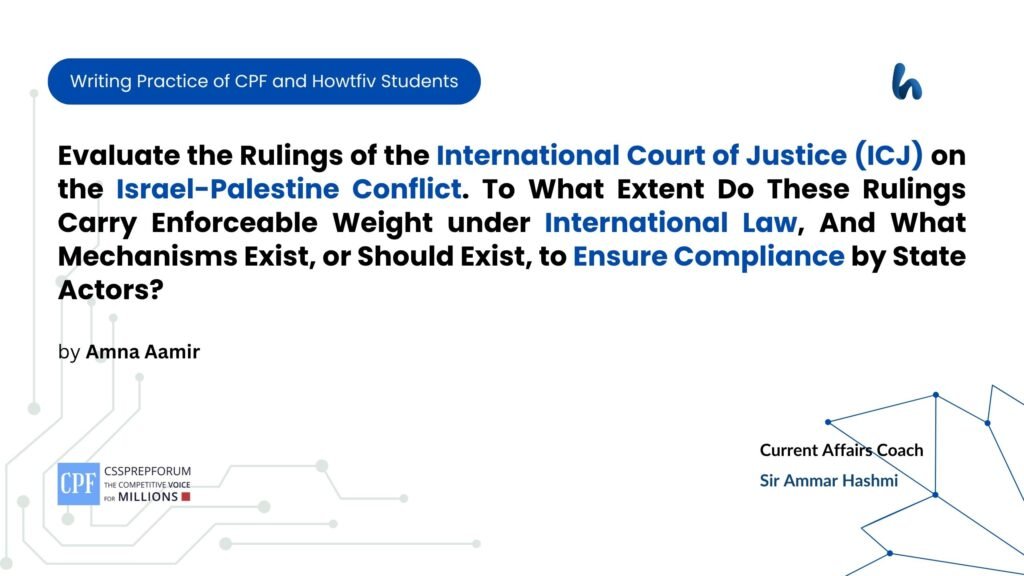
CSS Current Affairs | Rulings of the International Court of Justice (ICJ) on the Israel-Palestine Conflict
The following assignment question for CSS Current Affairs is solved by Amna Aamir under the supervision of Howfiv’s Pakistan Affairs and Current Affairs Coaches: Miss Iqra Ali and Sir Ammar Hashmi. She learnt how to attempt 20 marks question and essay writing from Sir Syed Kazim Ali, Pakistan’s best CSS and PMS English essay and precis teacher with the highest success rate of his students. This solved question is attempted on the pattern taught by Sir to his students, scoring the highest marks in compulsory and optional subjects for years.

Outline
1-Introduction
2-Brief Overview of the International Court of Justice (ICJ) and Its Jurisdiction
3-Evaluation of Recent ICJ Interventions and Rulings on the Israel-Palestine Conflict
- The Contentious Track: Ordering Emergency Steps to Prevent a Plausible Risk of Genocide
- The Landmark Advisory Opinions: The Illegality of the Occupation and Israel’s Obligations Towards UNRWA
- Verifying Systemic Discrimination: Identifying Apartheid under the Racial Discrimination Treaty
4-To What Extent Do These International Court of Justice (ICJ) Rulings Carry Enforceable Weight under International Law?
- The Operative Scope of Article 59 of the ICJ Statute
- The Enforcement Deficit of a Decentralized Legal Infrastructure
- The Disconnect between Legal Supremacy and Real-World Impotence
5-Critical Analysis of Current Enforcement Paths and the Barriers of Power Politics
- The Functional Failure of Article 94(2) of the UN Charter
- The Strategic Use of the P5 Veto as an Absolute Geopolitical Shield
- Transnational Litigation: Utilizing Domestic Courts to Enforce IHL Obligations
6-Reformative Mechanisms That Should Exist to Ensure Future Compliance
- To Activate the “Uniting for Peace” (Resolution 377A) for Collective Countermeasures
- To Enforce Global Duties Nationally through Automatic Customs and Trade Sanctions
- To Link State Liability to Individual Criminal Arrest Warrants at the ICC
7-Conclusion
Answer to the question
Introduction
The escalating reliance on international judicial bodies has transformed the legal landscape of the long-standing Israel-Palestine conflict. This shift reflects a growing effort by state actors to use global forums to challenge decades of territorial occupation and systemic rights violations. To address these deep-rooted disputes, the International Court of Justice (ICJ) has issued historic decisions regarding territorial sovereignty and state accountability. However, these landmark rulings face a severe enforcement deficit because the international legal structure lacks a centralized executive body to compel compliance on the ground. Furthermore, while the Court provides unmatched legal clarity, its decisions are routinely paralyzed by geopolitical interests and big-power vetoes within the United Nations Security Council. Therefore, although these judicial interventions possess supreme legal authority, their real-world impact remains entirely dependent on the willingness of individual third-party states to enforce them through national economic and diplomatic sanctions.
Brief Overview of the International Court Of Justice (ICJ) and Its Jurisdiction
To begin with, the International Court of Justice (ICJ), established under the Charter of the United Nations in 1945, serves as the principal judicial organ of the United Nations. Its primary function is to settle legal disputes between states in accordance with international law and to issue advisory opinions legally referred by authorized UN and specialized agencies. Consequently, the Court exercises both contentious jurisdictions, through which its judgments are legally binding upon the parties to a dispute, and advisory jurisdiction, through which it provides authoritative interpretations of international law without creating directly binding obligations. This distinction between binding judgments and advisory opinions is fundamental to evaluating the legal authority and practical enforceability of the Court’s rulings in the Israel-Palestine conflict.
Evaluation of Recent ICJ Interventions and Rulings on the Israel-Palestine Conflict
- The Contentious Track: Ordering Emergency Steps to Prevent Genocidal Plausible Risk
In the first place, emergency interventions issued under the Court’s contentious jurisdiction have established binding obligations for immediate civilian protection in ongoing conflicts. This fast-acting legal channel serves to freeze escalating territorial violence before human damage occurs on the ground. Specifically, the International Court of Justice (ICJ) issued critical provisional measures in the South Africa-Israel case, confirming a “plausible risk” to Palestinian rights and ordering the unhindered entry of life-saving medical supplies and basic services. This mandatory intervention is legally significant because it shifts the parameters of the crisis from a standard military operation into an explicit international treaty obligation that cannot be bypassed. Consequently, these provisional orders establish an undeniable, institutional standard of state accountability that remains fully active regardless of continuous political non-compliance by the targeted actor.
- The Landmark Advisory Opinions: The Illegality of the Occupation and Israel’s Obligations towards UNRWA
Similarly, the court has systematically utilized its advisory jurisdiction to comprehensively evaluate the legal status of prolonged territorial control and administrative blockades. In this regard, these detailed legal opinions do not just address the immediate actors but explicitly define the obligations of all United Nations member states toward the conflict zone. Specifically, the ICJ’s July 2024 Advisory Opinion declared that Israel’s continued presence in the Occupied Palestinian Territory is entirely unlawful and must be brought to an end rapidly. This sweeping ruling clarified that policies such as settlement expansion, natural resource exploitation, and systemic restrictions on agencies like the United Nations Relief and Works Agency (UNRWA) violate the right to self-determination and constitute a de facto annexation. Hence, the advisory path has effectively dismantled the legal cover for prolonged occupation, transforming it from a political debate into an explicit breach of international law.
- Verifying Systemic Discrimination: Identifying Apartheid under the Racial Discrimination Treaty
Furthermore, the court’s recent jurisprudence has gone beyond standard humanitarian violations to evaluate whether the institutional structures in the occupied territories constitute systemic discrimination. Instead of viewing individual human rights abuses in isolation, the judicial findings have focused on the overarching legal regimes that separate populations based on identity. For instance, the 2024 Advisory Opinion concluded that Israel’s administrative separation and land policies breach Article 3 of the International Convention on the Elimination of All Forms of Racial Discrimination (ICERD). This specific finding means that the court officially recognizes the presence of systemic segregation and apartheid-like structures within the occupied West Bank and East Jerusalem. Therefore, this judicial characterization places a heavy moral and legal duty on the global community to completely withhold any recognition or assistance from these discriminatory administrative structures.
To What Extent Do These International Court of Justice (ICJ) Rulings Carry Enforceable Weight under International Law?
- The Operative Scope of Article 59 of the ICJ Statute
Moving forward to the question of legal power, the decisions issued under the court’s contentious track carry a clear, binding obligation for the specific state actors involved in the litigation. This internal treaty rule ensures that once a state consents to the court’s jurisdiction, it cannot legally ignore the final judgment by citing domestic laws or security. Under Article 59 of the ICJ Statute, decisions of the court have binding force explicitly between the parties and in respect of that particular case. This means that while the ICJ does not operate on a system of binding judicial precedent for third parties, its orders create an absolute, non-negotiable legal obligation for the state of Israel to comply with the mandated provisional measures. Thus, within the strict textual boundaries of international law, the court’s contentious rulings possess full, uncompromised legal validity.
- The Enforcement Deficit of a Decentralized Legal Infrastructure
However, the primary challenge to the court’s authority lies in the decentralized nature of international legal structures, which lack a centralized enforcement force to compel compliance. Because the international order is built on state sovereignty, the transition from a written judicial order to practical field enforcement relies entirely on political bodies. Legal scholars repeatedly point to this structural gap as the “enforcement deficit,” where the ICJ possesses the authority to declare the law (jus dicere) but completely lacks the physical power to execute it (jus exsequendi). This structural deficit allows a defiant state to easily ignore provisional measures or continue settlement activities, knowing that the court itself cannot dispatch an independent force to stop illegal demolitions or open border crossings. Ultimately, this gap proves that the enforceable weight of international law is fundamentally weakened by its reliance on voluntary state compliance.
- The Disconnect between Legal Supremacy and Real-World Impotence
Ultimately, this structural friction creates a deep and painful disconnect between highest judicial authority and actual ground-level reality. This operational divide means that while a country can win a flawless moral and legal victory inside the courtroom, that victory does not automatically change the physical landscape of the conflict. As a case in point, the absolute legal clarity of the Court’s rulings has failed to stop ongoing settlement expansion, military operations, or administrative blockades inside the occupied zones of Gaza. This frustrating gap occurs because international law possesses supreme authority to define what is right but lacks the physical muscle to stop a state from continuing its violations. Therefore, this gridlock leaves the victims of the crisis caught in a permanent contradiction where they hold total victory on paper but remain entirely unprotected in practice.
Critical Analysis of Current Enforcement Paths and the Barriers of Power Politics
- The Functional Failure of Article 94(2) of the UN Charter
Turning to the existing paths for forcing state compliance, the primary diplomatic route provided by the global community routinely fails due to systemic institutional design. This executive route was built to act as the ultimate enforcement arm by allowing states to appeal directly to the United Nations Security Council (UNSC) when court orders are ignored. For instance, Article 94(2) of the UN Charter explicitly states that if a party fails to perform obligations under a judgment, the other party may have recourse to the Security Council, which may make recommendations or decide upon measures. However, this channel functions as a dead end because the Security Council evaluates legal requests through a purely political lens rather than an objective judicial one. As a result, this structural layout turns a supreme legal mandate into a highly politicized diplomatic debate, rendering the UN’s primary enforcement tool practically useless.
- The Strategic Use of the P5 Veto as an Absolute Geopolitical Shield
Undoubtedly, the deepest flaw within this Security Council enforcement track is the absolute paralysis caused by the voting privileges of the world’s major powers. This structural blockage occurs because the executive machinery of the UN is entirely governed by the strategic alliances of its five permanent members (P5). Specifically, historical voting records show that the United States has repeatedly deployed its veto power to block resolutions aimed at penalizing or investigating the occupying power’s defiance of international orders. This consistent use of the veto acts as an impenetrable shield that completely isolates a non-compliant nation from facing global economic blocks or collective security punishments. Consequently, this veto privilege creates an unfair double standard in international politics, proving that power politics can easily freeze the enforcement of the World Court’s highest rulings.
- Transnational Litigation: Utilizing Domestic Courts to Enforce IHL Obligations
Consequently, as traditional international bodies are completely blocked by power politics, human rights lawyers are shifting the battlefield to national legal forums. This innovative strategy relies on using third-party domestic courts to turn global judgments into immediate financial and military restrictions for the violating state. For example, legal advocacy groups inside countries like the Netherlands and the United Kingdom have used the ICJ’s formal rulings to file domestic lawsuits that forced local courts to halt parts exports for F-35 fighter jets. These local cases succeed because they prove to domestic judges that continuing weapons trade directly violates national laws against aiding and abetting verified international war crimes. Thus, this transnational approach currently stands as the most practical enforcement path, since it transforms distant international decrees into hard, domestic legal bans.
Reformative Mechanisms That Should Exist To Ensure Future Compliance
- To Activate the “Uniting For Peace” (Resolution 377A) for Collective Counter-Measures
In response to permanent executive blockades, the global community must utilize alternative statutory pathways within the United Nations to enforce judicial orders. This systemic realignment allows the wider community of nations to bypass a paralyzed Security Council whenever a major power deploys its veto against international law. Specifically, the UN General Assembly can formally activate Resolution 377A, known as the “Uniting for Peace” framework, which shifts the responsibility for global peace and security directly to the voting majority of member states. This historical mechanism provides the legal foundation required to recommend collective countermeasures, such as universal trade restrictions and diplomatic blockades, without facing a permanent big-power veto. Consequently, activating this statutory path effectively strips non-compliant states of their geopolitical cover by changing the final enforcement authority from the selective Security Council to the collective General Assembly.
- To Enforce Global Duties Nationally through Automatic Customs And Trade Sanctions
Furthermore, individual member states must reform their domestic legal frameworks to ensure that global court rulings trigger immediate economic consequences. This national legislative approach is designed to eliminate the reliance on erratic political will by turning international declarations into automatic domestic enforcement laws. For example, third-party parliaments can pass specialized customs legislation directing an immediate ban on all commercial imports originating from territories declared occupied and illegal by the ICJ. This automatic economic mechanism bypasses long diplomatic delays by using local border control agencies and trade ministries to halt supply lines the moment a violation is judicially verified. Therefore, embedding global court findings directly into domestic customs enforcement ensures that judicial declarations carry immediate financial penalties that no state actor can ignore.
- To Link State Liability to Individual Criminal Arrest Warrants at the ICC
Last but not least, the international community must bridge the institutional divide between state responsibility and personal accountability to effectively deter continuous treaty violations. This structural integration combines civil state liability with immediate, punitive criminal investigations targeting the individual political leaders who design illegal administrative policies. For example, the Rome Statute of the International Criminal Court (ICC) can be amended to dictate that an official ICJ finding of state-level illegal occupation automatically triggers the immediate issuance of individual arrest warrants for the ruling cabinet ministers. This direct institutional link changes the strategic calculus of non-compliant leaders by transforming state-level legal disputes into restrictive personal criminal trials. As a result, linking state liability to individual criminal accountability ensures that political elites face real personal costs, such as international arrest and asset freezes, for ignoring global mandates.
Conclusion
In conclusion, the crisis of enforcement surrounding international court rulings in the Israel-Palestine conflict cannot be resolved through temporary diplomatic compromises or symbolic General Assembly resolutions that lack mandatory teeth. Adding new judicial declarations to a structurally deficient international framework has simply changed the path of the problem rather than solving it, shifting the dilemma from an unacknowledged territorial occupation into an unmanageable institutional and geopolitical gridlock. Moving forward, the global community must implement two critical structural remedies to address this ongoing human rights issue. First, the United Nations General Assembly must operationalize Resolution 377A under the “Uniting for Peace” framework to bypass Security Council vetoes and implement collective global trade blocks. Second, individual third-party nations must pass mandatory domestic customs laws that automatically transform the ICJ’s judgments into immediate national trade sanctions, permanently balancing the rules-based international order against the raw overreach of power politics.

CSS Solved Past Papers’ Essays
Looking for the last ten years of CSS and PMS Solved Essays and want to know how Sir Kazim’s students write and score the highest marks in the essays’ papers? Then, click on the CSS Solved Essays to start reading them.
CSS Solved Essays
CSS Solved Islamiyat Past Papers
Want to read the last ten years’ Islamiyat Solved Past Papers to learn how to attempt them and to score high? Let’s click on the link below to read them all freely. All past papers have been solved by Pakistan’s top CSS Islamiyat coaches having the highest score of their students.
CSS Solved Islamiyat
CSS Solved General Science & Ability Past Papers
Want to read the last ten years’ General Science & Ability Solved Past Papers to learn how to attempt them and to score high? Let’s click on the link below to read them all freely. All past papers have been solved by Pakistan’s top CSS GSA coachez having the highest score of their students.
CSS Solved General Science & Ability
CSS Solved Pakistan Affairs Past Papers
Want to read the last fifteen years’ Pakistan Affairs Solved Past Papers to learn how to attempt them and to score high? Let’s click on the link below to read them all freely. All past papers have been solved by Pakistan’s top CSS Pakistan Affairs coaches having the highest score of their students.
CSS Solved Pakistan Affairs
CSS Solved Current Affairs Past Papers
Want to read the last fifteen years’ Current Affairs Solved Past Papers to learn how to attempt them and to score high? Let’s click on the link below to read them all freely. All past papers have been solved by Pakistan’s top CSS Current Affairs coaches having the highest score of their students.
CSS Solved Current Affairs