CSS Pakistan Affairs| Kashmir Dispute is an Unfinished Agenda of Partition
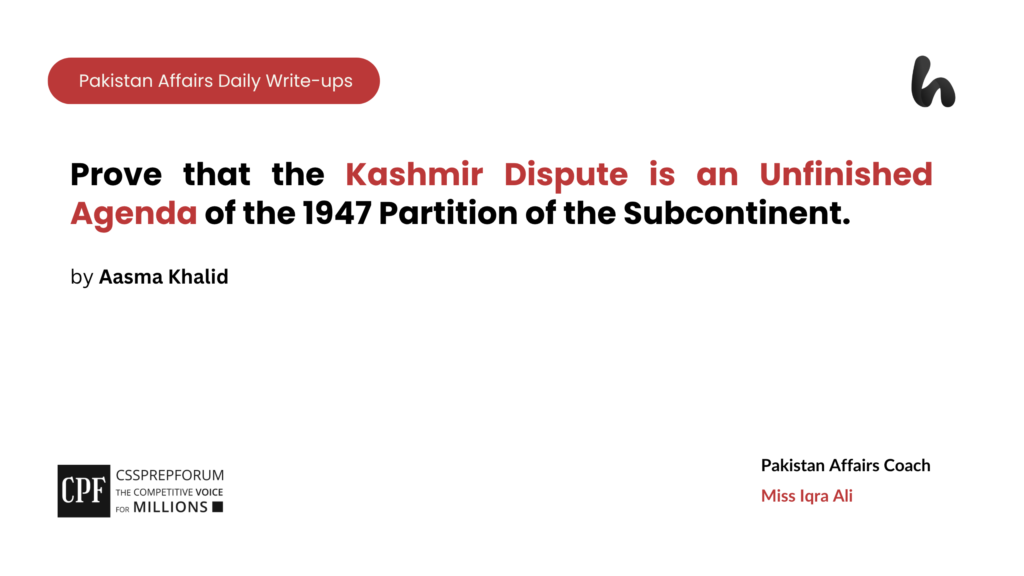
The following assignment question for CSS Pakistan Affairs is solved by Asma Khalid under the supervision of Howfiv’s Pakistan Affairs and Current Affairs Coaches: Miss Iqra Ali and Sir Ammar Hashmi. She learnt how to attempt 20 marks question and essay writing from Sir Syed Kazim Ali, Pakistan’s best CSS and PMS English essay and precis teacher with the highest success rate of his students. This solved question is attempted on the pattern taught by Sir to his students, scoring the highest marks in compulsory and optional subjects for years.

Outline
1-Introduction
2-Historical Background of Partition of British India
3-How Kashmir Issue is an Unfinished Agenda of 1947 Partition?
- Failure to Implement the 3rd June Plan in case of Princely States
- Controversial Role of the British Authorities in the Kashmir Accession
- Controversy Surrounding the Instrument of Accession
- Failure to Hold the Proposed Plebiscite
4-Conclusion
Answer to the question
Introduction
The Partition of British India in 1947 was intended to provide a peaceful political settlement by creating two independent dominions, Pakistan and India. However, the question of the accession of Jammu and Kashmir remained unresolved at the time of Partition. The non-implementation of 3rd June plan, controversy over the Instrument of Accession, the debated role of the British authorities, and the failure to implement the proposed plebiscite prevented a mutually accepted settlement of the state. Consequently, Kashmir became the principal source of conflict between Pakistan and India. Therefore, the Kashmir dispute is rightly regarded as the unfinished agenda of the 1947 Partition.
Historical Background of Partition of British India
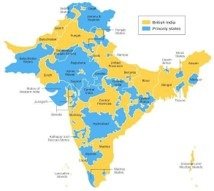
At the time of partition of British India, according to 3rd June plan of 1947, the British India was divided into two dominions; Pakistan and India in August 1947. Whereas, all the princely states across the region were given a choice to accede either to Pakistan or India based on their geographical location, decision of their ruler according to the will of people and majority of population in the respective states. Kashmir was a Muslim majority princely state ruled by a hindu ruler Hari Singh. The ruler of Jammu and Kashmir decided to remain independent, causing uprising in the state. Resultantly, in 1948 the state was divided into Azad Jammu and Kashmir and Indian Illegally Occupied Jammu and Kashmir. Furthermore, the controversy over the Maharaja’s accession to India, the debated role of the British authorities, and the failure to implement the proposed UN-sponsored plebiscite left the question of Kashmir’s final status unresolved, making it an unfinished agenda of the 1947 Partition.
How is the Kashmir Issue an Unfinished Agenda of the 1947 Partition?
The partition of British India was meant to provide a political settlement and peace in the region, but the following factors left the partition of princely state Kashmir unfinished.
- Failure to Implement the 3rd June Plan in Princely States
The 3rd June Plan of 1947, also known as the Mountbatten Plan, was the official British blueprint for partitioning British India into two independent dominions, India and Pakistan. Along with other key provisions, the plan gave princely states the option to join either India or Pakistan, with no option to remain independent, based on two major factors: geographical contiguity and the people’s wishes. At the time of partition, the ruler of Jammu and Kashmir, Hari Singh, decided not to join either dominion and chose to remain independent. He offered to sign standstill agreements with both of the dominions. Pakistan immediately accepted, but India asked for further discussions. Thus, the question of Jammu and Kashmir’s accession remained unresolved at the time of Partition, demonstrating that the partition process failed to provide a final settlement of the territory.
- Controversial Role of the British Authorities in the Kashmir Accession
Lord Mountbatten came to India in March 1947 as the last viceroy with the primary mission of overseeing the British Parliament’s transfer of power to Indian hands. Firstly, the controversial handling of the partition process by the British authorities created grievances among the people of princely states. Later, allegations of partiality towards India emerged, with the Radcliffe Award being cited as one example. The award controversially transferred a portion of the Muslim-majority Gurdaspur district to India. Furthermore, the ruler of Kashmir, Hari Singh, against the will of his people, signed an instrument of accession with the Indian government, which was accepted by the then Governor-General of India, Lord Mountbatten. However, Mountbatten’s letter of acceptance stated, “As soon as law and order have been restored in Kashmir and her soil cleared of the invader, the question of the state’s accession should be settled by reference to the people.” This statement clarifies that despite recognizing the importance of public opinion, the promised mechanism for determining the people’s will was never implemented, leaving the accession issue unresolved.
- Controversy over the Instrument of Accession
The Instrument of Accession of Jammu and Kashmir remains one of the most controversial aspects of the Kashmir dispute. Maharaja Hari Singh decided to accede his state to India, and the document was accepted by Lord Mountbatten, the Governor-General of India. Pakistan disputed the legality of this accession, arguing that it was inconsistent with the wishes of the Muslim-majority population of Kashmir and that the standstill agreement with Pakistan was still in effect. On the other hand, India maintains that the accession was legally valid because it was signed by the legitimate ruler of Jammu and Kashmir after an armed tribal invasion created a security crisis requiring military assistance. Furthermore, Mountbatten’s acceptance of the accession included a commitment that the final status of the state would be decided according to the wishes of the people after restoration of peace. However, the proposed plebiscite was never conducted, making the accession issue a continuing source of political and legal disagreement between Pakistan and India. The controversy surrounding the Instrument of accession prevented a mutually accepted settlement of Kashmir at the time of partition, making it an unfinished agenda of 1947.
- Failure to Hold the Proposed Plebiscite
When the first Indo-Pak tension arose over Kashmir, the Maharaja acceded to the Union of India and India airlifted troops in Oct 1947. Fighting between Pakistani militias and Indian troops ensued. India took a dispute with Pakistan to the UN Security Council, which passed Resolution 47 of 1948. It called for the withdrawal of Pakistani fighters and Indian troops from Jammu and Kashmir. It also called for a plebiscite to determine Jammu and Kashmir’s future. The plebiscite has never been held. Later on, statements from many British-Indian politicians came to the surface; Nehru, in a letter to the PM of Pakistan, wrote, “Kashmir should decide the question of accession by plebiscite or referendum under international auspices, such as those of the United Nations.”
Conclusion
In a nutshell, the Kashmir dispute remains the unfinished agenda of the 1947 Partition because the issue of Jammu and Kashmir’s accession was never settled in a manner acceptable to all parties. The controversy over the Instrument of Accession, the disputed role of the British authorities, and the non-implementation of the proposed plebiscite kept the dispute alive. As a result, Kashmir has continued to fuel wars, diplomatic tensions, and instability in South Asia. Therefore, only a peaceful, just, and mutually acceptable settlement through dialogue and diplomacy can finally complete the unfinished process of Partition and bring lasting peace to the region.

CSS Solved Past Papers’ Essays
Looking for the last ten years of CSS and PMS Solved Essays and want to know how Sir Kazim’s students write and score the highest marks in the essays’ papers? Then, click on the CSS Solved Essays to start reading them.
CSS Solved Essays
CSS Solved Islamiyat Past Papers
Want to read the last ten years’ Islamiyat Solved Past Papers to learn how to attempt them and to score high? Let’s click on the link below to read them all freely. All past papers have been solved by Pakistan’s top CSS Islamiyat coaches having the highest score of their students.
CSS Solved Islamiyat
CSS Solved General Science & Ability Past Papers
Want to read the last ten years’ General Science & Ability Solved Past Papers to learn how to attempt them and to score high? Let’s click on the link below to read them all freely. All past papers have been solved by Pakistan’s top CSS GSA coachez having the highest score of their students.
CSS Solved General Science & Ability
CSS Solved Pakistan Affairs Past Papers
Want to read the last fifteen years’ Pakistan Affairs Solved Past Papers to learn how to attempt them and to score high? Let’s click on the link below to read them all freely. All past papers have been solved by Pakistan’s top CSS Pakistan Affairs coaches having the highest score of their students.
CSS Solved Pakistan Affairs
CSS Solved Current Affairs Past Papers
Want to read the last fifteen years’ Current Affairs Solved Past Papers to learn how to attempt them and to score high? Let’s click on the link below to read them all freely. All past papers have been solved by Pakistan’s top CSS Current Affairs coaches having the highest score of their students.
CSS Solved Current Affairs