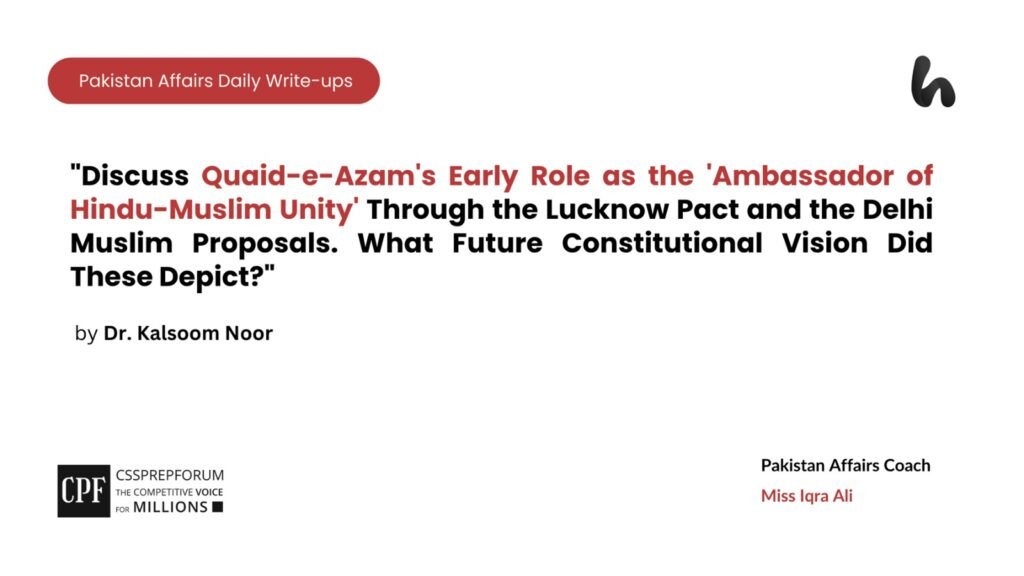
CSS Pakistan Affairs | Quaid-e-Azam’s Early role as the ‘Ambassador of Hindu-Muslim Unity
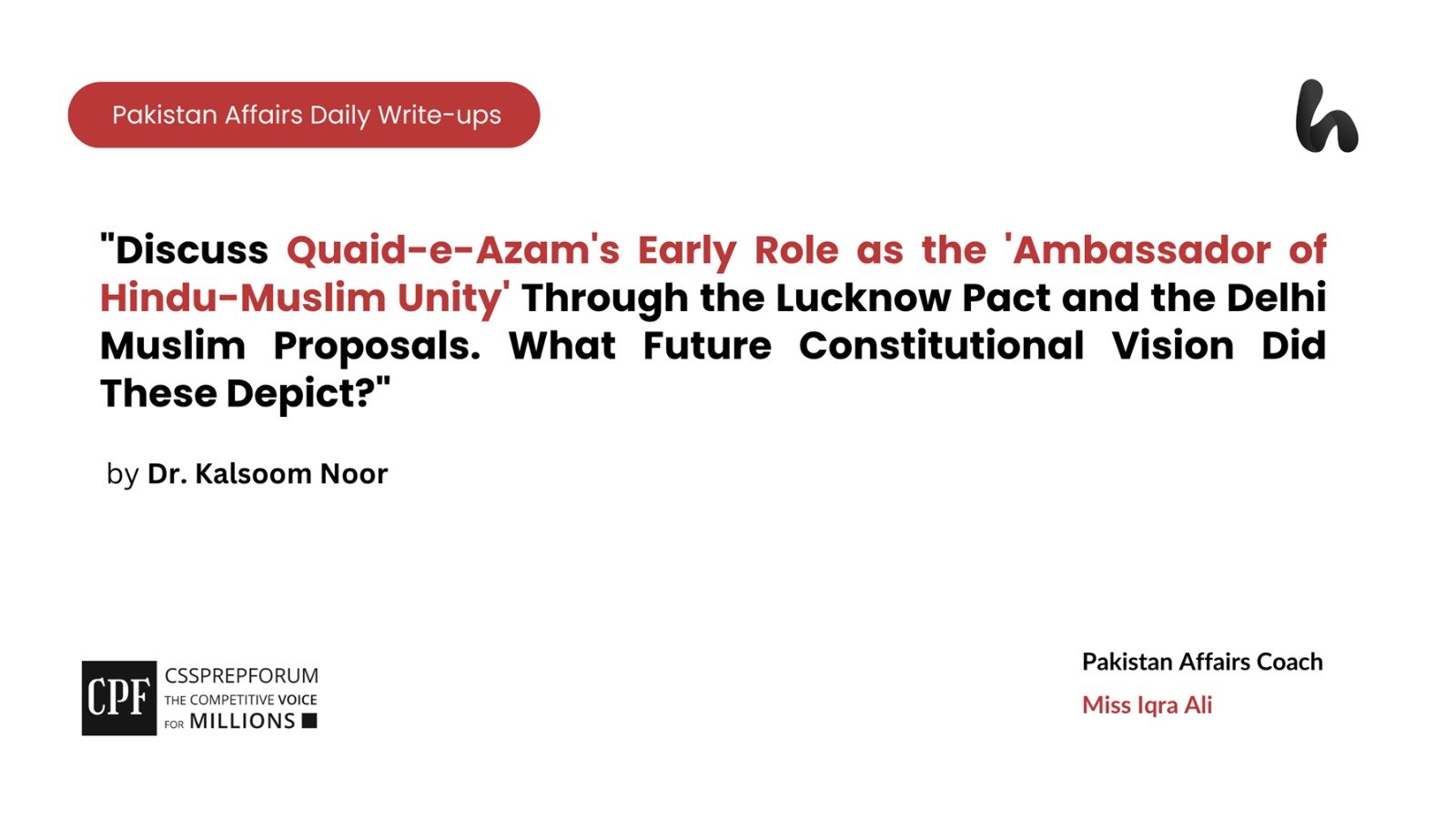
This article explores Quaid-e-Azam’s early role as the “Ambassador of Hindu-Muslim Unity” through the Lucknow Pact (1916) and Delhi Muslim Proposals (1927), highlighting how these key milestones shaped his constitutional vision for Muslim rights and self-governance in India.

Outline
1- Introduction
2- Overview of Early Political Role of Quaid-e-Azam
3- Role of Quaid-e-Azam as an Ambassador of Hindu-Muslim Unity through the Lucknow Pact
- ✓Bringing Congress and Muslim League on One Platform
- ✓Protecting Muslim Political Rights through Mutual Agreement
- ✓Developing Unity against British Rule
- ✓Strengthening Trust between Hindus and Muslims
4- Role of Quaid-e-Azam as an Ambassador of Hindu-Muslim Unity through Delhi Muslim Proposals
- ✓Making Constitutional Compromises for Hindu-Muslim Unity
- ✓Creating Another Opportunity for Hindu-Muslim Agreement
- ✓Giving Equal Importance to National Unity and Muslim Rights
- ✓Trying to Resolve Constitutional Differences through Dialogue
5-Future Constitutional Vision Reflected by these Events
- ✓United India with Equal Rights for All Communities
- ✓Federal System with Provincial Autonomy
- ✓Protection of Minority Rights through the Constitution
- ✓Settlement of Political Issues through Dialogue and Agreement
6- Critical Analysis
7- Conclusion
Answer to the question
Introduction
Quaid-e-Azam Muhammad Ali Jinnah firmly believed that India’s constitutional future depended on cooperation between Hindus and Muslims. Throughout his early political career, he worked to reduce communal differences through dialogue, constitutional negotiations, and mutual compromise rather than confrontation. He consistently emphasized that the political rights and interests of both communities could be protected within a constitutional framework based on justice and representation. His impartial approach, commitment to national unity, and ability to bring the Indian National Congress and the All-India Muslim League closer on constitutional issues earned him the title of the “Ambassador of Hindu-Muslim Unity.” This role was most clearly reflected in the Lucknow Pact of 1916 and the Delhi Muslim Proposals of 1927.
Overview of Early Political Role of Quaid-e-Azam
Quaid-e-Azam Muhammad Ali Jinnah was a firm believer in constitutional politics, democratic principles, and peaceful political struggle. During the early phase of his political career, he worked tirelessly to promote harmony between Hindus and Muslims by encouraging dialogue, mutual understanding, and political cooperation. He believed that India’s progress and self-government could only be achieved if both communities worked together while respecting each other’s political rights and interests. His commitment to constitutional negotiations, balanced leadership, and efforts to build trust between the two major communities earned him the title of the “Ambassador of Hindu-Muslim Unity.”
Role of Quaid-e-Azam as an Ambassador of Hindu-Muslim Unity through the Lucknow Pact
- Bringing Congress and Muslim League on One Platform
Quaid-e-Azam Muhammad Ali Jinnah played a leading role in bringing the Indian National Congress and the All-India Muslim League together on a common constitutional platform. Through continuous dialogue and negotiations, he persuaded both parties to set aside their differences and jointly demand constitutional reforms from the British government. This cooperation resulted in the Lucknow Pact of 1916, marking the first major agreement between the two organizations and demonstrating Jinnah’s ability to promote political harmony.
- Protecting Muslim Political Rights through Mutual Agreement
Jinnah ensured that Muslim political interests were protected without disrupting national unity. Under the Lucknow Pact, Congress accepted separate electorates and agreed to one-third Muslim representation in the Central Legislature, along with weightage for Muslims in minority provinces. These mutually accepted safeguards reflected Jinnah’s efforts to secure Muslim rights through constitutional negotiations rather than political confrontation.
- Developing Unity against British Rule
The Lucknow Pact enabled Congress and the Muslim League to present a united constitutional front before the British government. By encouraging both organizations to cooperate on common political objectives, Jinnah strengthened the demand for self-government and constitutional reforms. This unity increased political pressure on the British and demonstrated that inter-communal cooperation could strengthen India’s constitutional struggle.
- Strengthening Trust between Hindus and Muslims
The agreement created an atmosphere of confidence between the two major communities by recognizing each other’s political concerns. Congress acknowledged Muslim constitutional demands, while the Muslim League extended its cooperation in the broader nationalist movement. Jinnah’s balanced leadership and commitment to dialogue strengthened mutual trust and reinforced his reputation as the “Ambassador of Hindu-Muslim Unity.”
Role of Quaid-e-Azam as an Ambassador of Hindu-Muslim Unity through the Delhi Muslim Proposals
- Making Constitutional Compromises for Hindu-Muslim Unity
The Delhi Muslim Proposals of 1927 reflected Quaid-e-Azam Muhammad Ali Jinnah’s willingness to make constitutional compromises for the sake of Hindu-Muslim unity. He showed flexibility by expressing readiness to reconsider separate electorates, provided that Muslims received adequate constitutional safeguards, including one-third representation at the Centre and provincial autonomy. This demonstrated that Jinnah preferred constitutional accommodation over political confrontation.
- Reviving Efforts for Hindu-Muslim Agreement
At a time when communal differences were increasing, Jinnah used the Delhi Muslim Proposals to revive the process of constitutional negotiations between the Congress and the Muslim League. By presenting a set of mutually acceptable proposals, he attempted to restore the spirit of cooperation that had earlier been achieved through constitutional dialogue and political understanding.
- Giving Equal Importance to National Unity and Muslim Rights
Jinnah believed that national unity could only be achieved if the legitimate political rights of Muslims were fully protected. Therefore, while supporting a common constitutional settlement for India, he insisted that Muslim representation and provincial interests should not be compromised. His balanced approach reflected his commitment to both national harmony and the constitutional protection of Muslim interests.
- Trying to Resolve Constitutional Differences through Dialogue
Rather than adopting an aggressive political approach, Jinnah sought to resolve constitutional disputes through negotiations and mutual understanding. The Delhi Muslim Proposals provided a constitutional basis for discussion between the major political parties and reflected his belief that lasting political solutions could only emerge through dialogue and consensus.
Future Constitutional Vision Reflected by these Events
- United India with Equal Rights for All Communities
The Lucknow Pact and the Delhi Muslim Proposals reflected Jinnah’s vision of a united India in which Hindus and Muslims could coexist under a common constitutional framework. Rather than promoting separation, he sought to ensure that every community enjoyed equal political status and participated in national affairs without fear of domination by any single group.
- Federal System with Provincial Autonomy
These constitutional initiatives also highlighted Jinnah’s support for a federal system in which provinces enjoyed substantial autonomy. He believed that greater provincial powers would protect the interests of different communities and regions while preserving the unity of India under a single constitutional structure.
- Protection of Minority Rights through the Constitution
Jinnah envisioned a constitutional order in which the rights of minorities were guaranteed through legal and constitutional safeguards rather than left to the goodwill of the majority. The emphasis on adequate representation and political safeguards reflected his belief that constitutional protection was essential for maintaining communal harmony and political stability.
- Settlement of Political Issues through Dialogue and Agreement
Another important feature of Jinnah’s constitutional vision was the peaceful settlement of political disputes through dialogue, negotiations, and mutual agreement. Instead of confrontation or coercion, he believed that constitutional consensus among different political groups was the most effective way to achieve stable and representative governance.
Critical Analysis
Quaid-e-Azam Muhammad Ali Jinnah’s efforts through the Lucknow Pact and the Delhi Muslim Proposals represented sincere attempts to achieve Hindu-Muslim unity through constitutional means. His emphasis on dialogue, compromise, and minority safeguards reflected a democratic and inclusive approach to India’s constitutional future. However, these initiatives failed to produce a lasting constitutional settlement due to the growing communal divide, conflicting political interests, and the unwillingness of major political parties to sustain mutual compromise. Consequently, the collapse of these efforts marked a turning point in Jinnah’s political journey, gradually leading him to conclude that the constitutional rights of Muslims could not be adequately protected within a united India.
Conclusion
Quaid-e-Azam Muhammad Ali Jinnah’s role in the Lucknow Pact and the Delhi Muslim Proposals demonstrates that his early political struggle was founded on constitutionalism, dialogue, and Hindu-Muslim cooperation. These initiatives reflected his sincere efforts to build a united India based on political justice, minority safeguards, and mutual understanding. Although these constitutional efforts ultimately failed, they remain a significant chapter in the constitutional history of the subcontinent and illustrate the evolution of Jinnah’s political thought.

Important Note for CSS and PMS Aspirants
For aspirants preparing for competitive examinations, exploring solved past papers is essential to understand examiner expectations, analytical answer writing, and paper trends. Therefore, candidates are strongly encouraged to read the following comprehensive solved papers available on CSSPREPFORUM.
- CSS Solved Pakistan Affairs Past Papers
- CSS Solved Current Affairs Past Papers
- CSS Solved Islamiat Past Papers
- CSS Solved General Science and Ability Past Papers
Moreover, aspirants searching for the most credible and result-oriented teachers for CSS and PMS preparation can benefit from the following detailed guidance articles
- Who is the Best CSS PMS Islamiat Teacher in Pakistan?
- Who is the Best CSS PMS Pakistan Affairs Teacher in Pakistan?
- Who is the Best CSS Current Affairs Teacher in Pakistan?
- Who is the Best CSS GSA Teacher in Pakistan?
- Who is the Best CSS PMS English Essay and Precis Teacher in Pakistan?
- Who is the Best English Grammar Teacher in Pakistan?