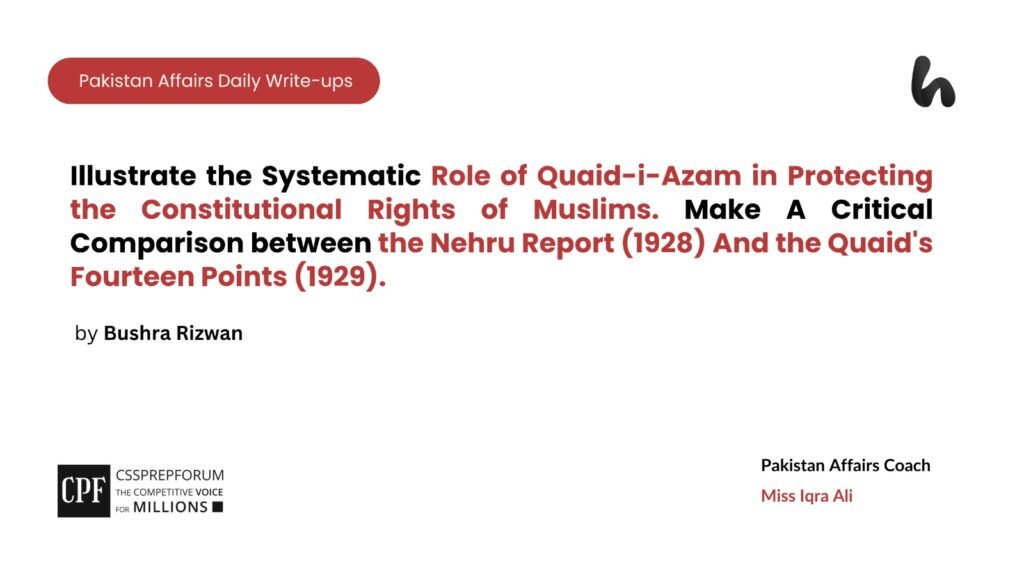
CSS Pakistan Affairs | Role of Quaid-i-Azam in Protecting the Constitutional Rights of Muslims
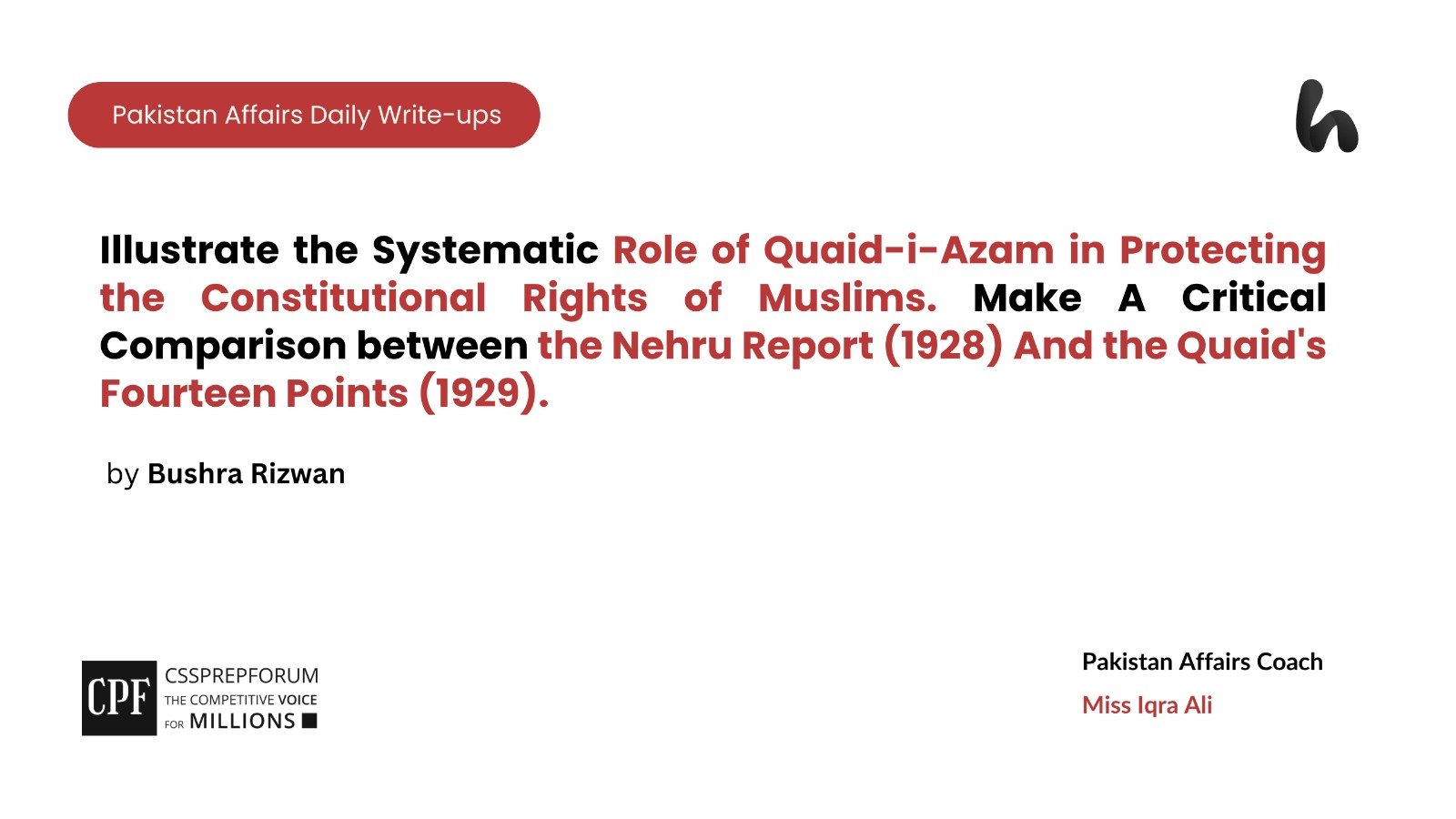
This article illustrates Quaid-i-Azam’s systematic struggle to protect Muslim constitutional rights, featuring a critical comparative analysis between the Nehru Report (1928) and his decisive counter-formula, the Fourteen Points (1929).

Outline
1-Introduction
2-Overview of the Emergence of Quaid-e-Azam as a Political Leader, guiding Indian Muslims through their Constitutional Struggle in United India
3-What is the Systematic Role of Quaid-i-Azam in protecting the Constitutional Rights of Muslims?
- ✓Led to initial recognition of separate electorate by Congress through Lucknow Pact
- ✓Presented reforms for Muslim province formation through Delhi proposals
- ✓Responded to the Nehru Report through his 14-points
- ✓Proposed a separate Muslim homeland in the Lahore Resolution(1940)
4-How can the Nehru Report (1928) and the Quaid’s Fourteen Points (1929) be Compared Critically?
- ✓Federal form of government with strong centre vs Federal constitution with residuary powers to provinces
- ✓Rejection of separate electorate for Muslims and controversial seat reservation vs strong emphasis on separate electorate for Muslims
- ✓Inadequate Muslim representation at centre vs mandatory one-third Muslim representation at centre
- ✓Advocated for provincial autonomy but with residuary powers at centre vs advocated for provincial autonomy but with residuary powers at provinces
5-Conclusion

Answer to the question
Introduction
Quaid-e-Azam Muhammad Ali Jinnah, the undisputed architect and founding father of Pakistan, stands as a towering figure of modern history, whose relentless struggle and unwavering resolve led to the creation of an independent homeland for the muslims of the Indian subcontinent. Furthermore, his vision of constitutional rights of muslims became the root cause of his systematic role in the creation of Pakistan. Quaid-e-Azam led to the initial recognition of separate electorate by Congress through the Lucknow Pact, presented reforms for muslim province formation through the Delhi Proposals, responded to the Nehru Report through his 14-points, and proposed a separate homeland for muslims in the Lahore Resolution (1940). Meanwhile, the era of the 1920s marked a deepening divergence in political aspirations between the Indian National Congress, largely representing the Hindu majority, and the All India Muslim League, articulating demands for the Muslim minority. As a result, two documents emerged: the Nehru Report of 1928 and Muhammad Ali Jinnah’s 14 Points of 1929. Though both documents aimed at independent India, their differing approaches to federalism, the critical question of electoral systems, and the nature of minority safeguards proved intractable, profoundly shaping muslim political consciousness. Thus, these two documents played a role in setting the trajectory of eventual separation of India.
Overview of the Emergence of Quaid-e-Azam as a Political Leader, Guiding Indian Muslims through their Constitutional Struggle in United India
The vision of Quaid-e-Azam Muhammad Ali Jinnah for Pakistan was not a static concept but one that evolved significantly over his long and distinguished political career, shaped by the socio-political realities of British India and the aspirations of the Muslim community. Initially, a staunch advocate for Hindu-Muslim unity and a unified India, Jinnah’s disillusionment with the communal politics of the time and intransigence of the Indian National Congress gradually led him to believe that muslim rights needed to be secured in a Hindu-majority India through a separate electorate. As a result, securing significant representation and religious freedom for muslims became his prime motive.
What is the Systematic role of Quaid-i-Azam in protecting the Constitutional Rights of Muslims?
- Led to initial recognition of separate electorate by Congress through Lucknow Pact
To begin with, Quaid-e-Azam played a visible role in the Lucknow Pact, as a result of which Congress agreed on some muslim demands. This accord presented a united front against the British and led to a brief period of hindu-muslim unity. Congress accepted a separate electorate for muslims, communal veto, and one-third representation of muslims in the central legislature. The pact’s significance is symmetrical, as in 1909, the British had accepted the Muslims’ separate electorate and, in 1916, the Congress and Hindus had accepted it. Consequently, Jinnah, through this pact, not only made the position of the Muslim League as a muslim party clear but also safeguarded the basic rights of muslims.
- Presented reforms for Muslim province formation through Delhi proposals
Moreover, in 1927, Quaid-e-Azam led muslim leaders to a striking electoral question-the Delhi proposals. These proposals strengthened demands for one-third muslim representation at the centre, and religious freedom for muslims at the social level. Quaid-e-Azam proposed separation of Sindh from Bombay, as the former was muslim concentrated province, entitled to provincial autonomy so that muslims could run their own affairs rather than be governed by Hindu-majority Bombay. And the proposed reforms were extended to North-West Frontier Province and Balochistan, raising their status from Chief Commissioner province to that of full provincial autonomy. Hence, Jinnah demanded formation of muslim-majority provinces to ensure administrative leverage for muslims.
- Responded to the Nehru Report through his 14-points
Moving further, when the British had demanded constitutional frameworks from Indians, two different documents came forward: The Nehru Report(1928) and Quaid’s 14-points(1929). As Muslims had concerns regarding the Nehru Report published in 1928, Quaid-e-Azam put forward his 14-points to present muslim constitutional demands before the British. Among the 14-points, He presented provincial demands (four points), muslim representation in the centre and executive (five points), constitutional safeguards(three points), religious and cultural guarantees (two points). In opposition to a joint electorate and a strong federal government with residuary powers vested in the centre, He proposed a separate electorate and federal government with residuary powers vested in provinces. As a consequence, He made sure that muslim demands were considered by the British while making a new constitution for British India.
- Proposed a separate Muslim homeland in Lahore Resolution (1940)
After Congress resignations, came the Lahore Resolution of 1940, at the 27th annual session of the All-India Muslim League. Even before the session, Quaid-e-Azam had made it clear to the British that India is a heterogeneous land, where a democratic system suited for homogeneous nations does not work. In the text of the resolution, presided over by Muhammad Ali Jinnah, and moved by Maulvi A.K. Fazul Haq, “No constitutional plan would be acceptable to muslims unless geographically contiguous units are demarcated into regions, constituted with such territorial readjustments as may be necessary, so that the areas in which muslims are in numerically in a majority, the North-Western and Eastern zones of India, are grouped to constitute inndependent states… ”. This mention of independent states is a clear reference to Pakistan. Hence, through the Lahore Resolution, presided over by Jinnah, the idea of Pakistan was propagated, leading to its final creation.
How can the Nehru Report (1928) and the Quaid’s Fourteen Points (1929) be compared critically?
- Federal form of government with strong centre vs Federal constitution with residuary powers to provinces
The Nehru report advocated a federal form of government but with a strong centre where residuary powers would be vested. Hindu majority central government would override the legislative and administrative autonomy of muslim majority provinces. This fear was rooted in the fact that muslims were a demographic minority (25-30%) in British India, and were concentrated in specific provinces. On the other hand, Quaid-e-Azam, in his 14 points, clearly stated the demand for a federal constitution where residuary powers are possessed by provinces. Through this, Jinnah aimed at creating a truly centralized federation where muslim-majority provinces(like Punjab, Bengal, Sindh, NWFP)possess greater autonomy and legislative authority, thus providing a crucial bulwark against potential domination by a Hindu-majority central government. As NEXT IAS confirms this demand, it “called for a federal constitution that allocated residual powers to the provinces.” Thus, both the Nehru Report and Quaid’s 14 Points demand two different forms of government and two different structures of power distribution, highlighting the fundamental differences in muslim and Hindu demands from British rulers.
- Rejection of separate electorate for Muslims and controversial seat reservation vs separate electorate for muslims
Second, the report rejected separate electorate for muslims, a safeguard that had been granted by the Minto-Morley reforms of 1909 and reaffirmed in the Lucknow Pact of 1916. Instead, it proposed joint electorates with the reservation of seats for minorities only in provinces where they were numerically small. Crucially, no reservation of seats for muslims in Punjab and Bengal, despite these being Muslim-majority provinces. On the other hand, Jinnah insisted on continuation of separate electorates as an indispensable safeguard for ensuring genuine muslim representation and protecting their distinct political identity, arguing that without them, muslim representatives would be dependent on Hindu votes and unable to truly represent their community’s interests. “Representation of communal groups shall continue to be by means of separate electorates as at present, provided it shall be open to any community, at any time, to abandon its separate electorate in favour of joint electorate”. This provision shows flexibility but underscored that the choice lay with the community, not imposed on it. Therefore, separate electorate for muslims was a salient feature of Quaid’s proposal and a key reason for opposition to the Nehru Report by the Muslim League.
- Inadequate Muslim representation at centre vs mandatory one-third Muslim representation at centre
Third, the report proposed lesser representation for muslims than what was demanded by them in the Delhi proposals. Moreover,muslim leaders viewed this as inadequate, arguing it would diminish their voice and influence in Central decision-making. The report proposed one-fourth (25%) muslim representation at the centre. On the other hand, Quaid-e-Azam, in his 14 points, demanded a 1/3rd share for muslims to protect their interests againt legislative driven by the majority. As NEXT IAS notes, this “acknowledged the significant muslim population in India” and their political weight. Thus, the two leaders widely disagreed on the ratio of muslim representation in the centre: Nehru demanding lesser muslim representation, while Jinnah demanding adequate and effective one-third muslim representation at the centre.
- Secular state vs. Religious liberty
Fourth, the report explicitly advocated for a secular state, with complete disassociation of state from religion, which was against dominant muslim political thought. According to Trek to Pakistan by Ahmed Saeed, the secularism that the Nehru report proposed was perceived as potentially undermining muslim laws and cultural identity in a Hindu-majority secular state, especially in the absence of explicit safeguards. On the other hand, Quaid-e-Azam emphasized true religious liberty for all groups. “Full religious liberty shall be granted to all communities ’’. Indeed, he specifically emphasized the religious freedom of muslims so that their religious rights were constitutionally secured. Therefore, the Muslim League desired a united India where religious rights were granted to all, while Congress wanted a secular state with no concept of religious rights in the constitution.
Conclusion
In conclusion, Quaid-e-Azam Muhammad Ali Jinnah’s vision for Pakistan was a profound and comprehensive blueprint for a modern, progressive, and just nation, meticulously crafted from his deep understanding of constitutionalism and the aspirations of the subcontinent’s Muslims. He put forward muslim demands before the British through the Delhi Proposals, 14-points, and Lahore Resolution. Quaid’s 14 points were a formal response to the Nehru Report. While Quaid demanded a federation with residuary powers vested in provinces, Nehru desired a strong federation with residuary powers vested in the centre. While Quaid emphasized separate electorate, Nehru demanded a joint electorate. Therefore, these points made the differences in Hindu and muslim demands more evident.

Important Note for CSS and PMS Aspirants
For aspirants preparing for competitive examinations, exploring solved past papers is essential to understand examiner expectations, analytical answer writing, and paper trends. Therefore, candidates are strongly encouraged to read the following comprehensive solved papers available on CSSPREPFORUM.
- CSS Solved Pakistan Affairs Past Papers
- CSS Solved Current Affairs Past Papers
- CSS Solved Islamiat Past Papers
- CSS Solved General Science and Ability Past Papers
Moreover, aspirants searching for the most credible and result-oriented teachers for CSS and PMS preparation can benefit from the following detailed guidance articles
- Who is the Best CSS PMS Islamiat Teacher in Pakistan?
- Who is the Best CSS PMS Pakistan Affairs Teacher in Pakistan?
- Who is the Best CSS Current Affairs Teacher in Pakistan?
- Who is the Best CSS GSA Teacher in Pakistan?
- Who is the Best CSS PMS English Essay and Precis Teacher in Pakistan?
- Who is the Best English Grammar Teacher in Pakistan?