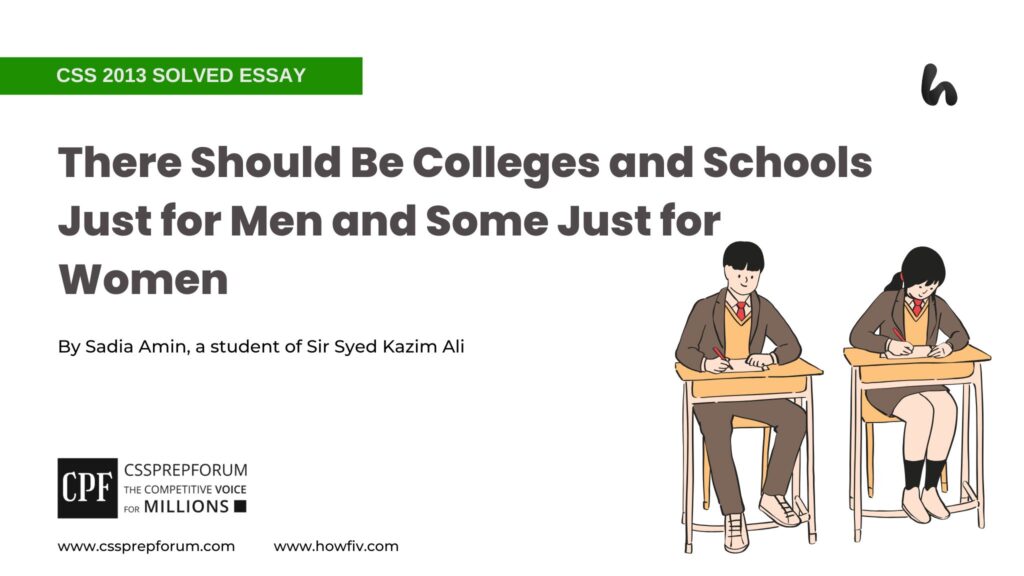
Looking for the CSS 2013 essay “There Should Be Colleges and Schools Just for Men and Some Just for Women”? Cssprepforum is Pakistan’s largest community with all CSS past paper essays and CSS solved essays. Continue reading!
Sadia Amin, a student of Sir Syed Kazim Ali, has attempted the CSS 2013 essay “There Should Be Colleges and Schools Just for Men and Some Just for Women” using Sir Kazim’s proven essay writing pattern and strategy. As Pakistan’s leading CSS and PMS English Essay and Precis coach, Sir Syed Kazim Ali has been the only English mentor with the highest success rate of his students in Essays and Precis for over a decade. The essay is uploaded to help other competitive aspirants learn and practice essay writing techniques and patterns to qualify for the essay paper.

Outline
1- Introduction
Although proponents advocate for gender-segregated academic institutions, in reality, a unified coeducational framework should be preferred in Pakistan, as it optimizes limited national resources, fosters essential socio-behavioural development, and prepares youth for an integrated global workforce
2- Understanding the concepts of co-education and segregated education
3- The global evolution and adoption of co-education: a brief historical overview
4- The Status of Co-Education within Pakistan’s Contemporary Education System
5- How can co-education be beneficial for both men and women in Pakistan?
5.1- Promotes gender equality and social inclusivity
- ✓Case in point: According to UNESCO-IBE, global pioneers like Finland and Sweden deliberately leverage coeducational systems to challenge structural gender stereotypes and secure world-leading levels of social equality.
5.2- Systematically reduces deep-seated gender stereotypes
- ✓Case in point: UNESCO Gender Equality Report notes that gender-inclusive educational environments expand career horizons and vocational aspirations for both boys and girls by dismantling traditional social barriers.
5.3- Enhances collaborative problem-solving and interpersonal communication skills
- ✓Case in point: According to the OECD PISA 2015 report, students with strong collaborative problem-solving skills show better teamwork, communication, and interpersonal abilities.
5.4- Encourages equal leadership opportunities across academic domains
- ✓Case in point: According to OECD indicators, the U.S. promotes coeducation, supporting equal participation and leadership for both boys and girls.
5.5- Builds cooperative decision-making capabilities
- ✓Case in point: According to the OECD Education 2030 Framework, education should promote collaboration and shared decision-making, often developed in coeducational systems like Australia.
5.6- Accelerates socio-economic and national development
- ✓Case in point: World Bank data shows that countries like Norway achieve high GDP per capita and female employment through coeducation and equal skill development.
5.7- Reduction of Social Hesitation and Hyper-Segregation Anxiety
- ✓Case in point: OECD and UNESCO research shows coeducation in Sweden and Finland improves confidence and cross-gender communication in adolescents.
6- On what grounds do opponents argue that there should be separate colleges and schools for men and women?
- ✓Counterargument 1: Students may feel more comfortable participating in class discussions and extracurricular activities when studying among members of the same gender.
- Refutation: Comfort may increase participation temporarily, but coeducation builds the confidence and communication skills needed to thrive in real-world mixed-gender environments.
- ✓Counterargument 2: Separate institutions align with the traditions and values of many societies.
- Refutation: Cultural values can be preserved through ethical education and proper conduct rather than segregation. Coeducation allows students to uphold their values while learning to cooperate and coexist in a diverse society.
7- Way Forward for Promoting Co-education in Pakistan
✓7.1- To formulate a unified national curriculum embedded with gender-sensitization
✓7.2- To integrate gender-sensitization programs into the education system
✓7.3- To train teachers in facilitating collaborative and inclusive classroom environments
✓7.4- To encourage participation of all students in decision-making bodies within educational institutions
8- Conclusion
There Should Be Colleges and Schools Just for Men and Some Just for Women
Norway, Sweden, and Finland share no border with each other’s reputation by accident. All three built coeducational school systems decades ago. All three now rank among the world’s highest in GDP per capita, female workforce participation, and adolescent confidence. Coming to Pakistan, the country’s resource-strained education sector cannot afford to build and staff two separate systems when one integrated system already exists. Pakistan should adopt coeducation, not gender segregation, in its schools and colleges. It optimises limited resources, builds essential social skills, and prepares youth for an integrated global workforce. In fact, coeducation promotes gender equality and systematically dismantles the stereotypes that segregated schooling reinforces from childhood onward. It enhances collaborative problem-solving and interpersonal communication, skills that separate institutions structurally cannot replicate. It encourages equal leadership opportunities and accelerates socio-economic development, as coeducational nations consistently outperform segregated ones. Yet proponents argue that separate institutions align with the cultural traditions and values many Pakistani communities hold deeply. However, cultural values can be preserved through ethical education and proper conduct rather than physical segregation. Coeducation allows students to uphold their values while learning to cooperate in a diverse society. Comfort built through isolation never survives contact with the integrated world graduates must eventually enter. This essay investigates why coeducation should replace gender segregation across Pakistan’s educational institutions by exposing what segregated schooling costs a resource-constrained nation that cannot afford duplication.
Before exploring the benefits of co-education for men and women in Pakistan, it is important to understand the concepts of co-education and segregated education. Coeducation is a system of education in which male and female students study together in the same institution and share the same academic environment. It is based on the principle of equal access to learning opportunities for all students regardless of gender. Moreover, this system allows students to participate in the same educational activities and experiences. In contrast, segregated education is a system where male and female students are educated separately in different schools, classes, or sections. Furthermore, it organizes learning environments according to gender and maintains distinct educational settings. Therefore, both coeducation and segregated education represent different approaches to structuring educational institutions.
Tracing the historical trajectory of coeducation reveals a paradigm shift from rigid gender segregation to integrated learning models. Historically, formal education was predominantly a male privilege, reflecting patriarchal structures across ancient civilizations. However, the rise of modern democratic ideals, human rights frameworks, and global feminist movements gradually dismantled these traditional barriers. Consequently, Western nations began transitioning toward coeducation in the nineteenth and twentieth centuries to promote institutional efficiency and gender parity. Furthermore, international bodies such as UNESCO have institutionalized coeducation as a cornerstone of sustainable development and universal literacy. In the contemporary era, the global adoption of mixed-gender education stands as an empirical norm, reflecting the integrated demands of the modern global workforce. Ultimately, this historical trajectory underscores that coeducation is not a contemporary novelty, but a globally validated evolutionary milestone.
Furthermore, in Pakistan, the status of coeducation reflects a gradual but uneven transformation influenced by cultural, economic, and institutional factors. In urban areas, coeducational institutions are increasingly common, particularly in private schools and universities, where both men and women study together in shared academic environments. Moreover, this trend is gradually promoting greater gender interaction, confidence-building, and preparation for professional life. However, in contrast, many rural and conservative areas still rely heavily on segregated education due to social norms and traditional perceptions of gender roles. Consequently, gender dynamics in education remain complex, with disparities in access and acceptance across regions. Nevertheless, coeducation is slowly gaining recognition as a practical and progressive model that supports inclusivity and equality in Pakistan’s evolving educational landscape.
Initiating the discussion with the promotion of gender equality and social inclusivity, unified learning systems offer a significant advantage for Pakistan. Gender-segregated environments breed institutional division, whereas coeducation fosters a shared space where Pakistani women and men are treated as intellectual equals. For instance, according to UNESCO-IBE, global pioneers like Finland and Sweden deliberately leverage coeducational systems to challenge structural gender stereotypes and secure world-leading levels of social equality. This international data clearly demonstrates that when young men and women collaborate daily on equal footing, deep-seated prejudices naturally dissolve. In addition, implementing this model in Pakistan would shift student perceptions away from archaic patriarchal roles and redirect focus toward individual merit. Moreover, adopting this unified system helps Pakistan overcome its current gender disparities and establish a sustainable foundation for socio-economic inclusivity.
Moving beyond the promotion of gender equality and social inclusivity, systematically reducing deep-seated gender stereotypes stands as a transformative benefit of coeducation in Pakistan. Moreover, separate schools often reinforce traditional biases, whereas shared learning spaces actively challenge fixed notions about what men and women can achieve. For instance, the UNESCO Gender Equality Report notes that gender-inclusive educational environments expand career horizons and vocational aspirations for both boys and girls by dismantling traditional social barriers. This global insight clearly demonstrates that regular interaction in academic settings replaces prejudice with empirical evidence of individual capability. In addition, introducing this unified model across Pakistan would allow young minds to look past rigid patriarchal roles and view each other as equal intellectual partners. Furthermore, breaking these societal stereotypes early ensures that both genders can confidently pursue any professional field, directly maximizing Pakistan’s human capital.
Furthermore, enhancing collaborative problem-solving and interpersonal communication skills stands as another vital benefit of coeducation in Pakistan. Moreover, separate institutions create structural communication barriers, whereas mixed classrooms cultivate the psychological comfort needed for healthy team dynamics. For instance, the OECD PISA Collaborative Problem-Solving Report proves that integrated academic environments directly foster superior teamwork and interpersonal competencies among diverse student bodies. This international assessment clearly demonstrates that learning together teaches youth how to resolve conflicts and exchange ideas effectively. Therefore, implementing this framework across Pakistan will allow male and female students to overcome traditional social hesitation and build professional trust. In addition, mastering these collaborative skills early guarantees that graduates can confidently navigate and succeed within Pakistan’s modern, mixed-gender workforce.
Additionally, encouraging equal leadership opportunities across academic domains serves as a foundational pillar of coeducation in Pakistan. Moreover, segregated institutions often restrict female access to high-profile administrative networks, whereas mixed campuses provide an open platform where both genders contest for leadership on equal terms. For instance, OECD Education Indicators highlight that progressive coeducational frameworks, such as those utilized in the United States, provide balanced opportunities for both genders to participate in student governance and institutional leadership. This global metric clearly demonstrates that a shared political and academic ecosystem prepares young women to compete alongside male peers on equal institutional terms. Consequently, implementing this balanced system across Pakistan would dismantle the glass ceilings that currently limit female representation in public spheres. Furthermore, cultivating these institutional leadership skills ensures that Pakistani graduates can confidently direct, innovate, and govern within the national mainstream.
Expanding the scope of coeducational benefits further, building cooperative decision-making capabilities serves as another crucial advantage of coeducation in Pakistan. Segregated environments encourage isolated problem-solving, whereas mixed-gender classrooms cultivate the strategic mindset required for inclusive consensus building. For instance, the OECD Education Framework underscores that collaborative learning and shared decision-making models, heavily embedded in Australia’s coeducational schools, prepare youth for mature, real-world consensus-building. This international standard clearly demonstrates that learning to navigate diverse viewpoints directly strengthens collective analytical skills. In addition, adopting this integrated framework across Pakistan would train young men and women to make joint, balanced socio-economic decisions. Furthermore, mastering these cooperative skills early guarantees that future Pakistani leaders can effectively collaborate on a national scale.
Shifting the focus towards macro-level outcomes, accelerating socio-economic and national development stands as the ultimate, overarching benefit of coeducation in Pakistan. Moreover, running duplicate, single-sex school systems places an unsustainable financial burden on a resource-constrained country like Pakistan. For instance, World Bank Labour statistics demonstrate that highly developed nations like Norway achieve immense GDP per capita and high female employment by utilizing coeducation to ensure equal skill development across the entire population. This economic indicator clearly demonstrates that a country cannot achieve its full financial potential while isolating or under-utilizing half of its available talent pool. In addition, implementing this efficient model across Pakistan would drastically boost female labor force participation. Furthermore, maximizing human capital through shared academic training ensures long-term economic stability and global competitiveness for the nation.
Finally, addressing the psychological dimension of student development, dismantling social hesitation and gender-based anxiety stands as a unique psychological benefit of coeducation in Pakistan. Moreover, absolute segregation during formative academic years breeds mutual awkwardness and communication barriers between young men and women. For instance, OECD and UNESCO education research on highly coeducational and socially integrated systems in countries such as Sweden and Finland indicates that early mixed-learning environments reduce social discomfort and improve confidence in cross-gender communication during adolescence. This behavioural evidence clearly demonstrates that sustained interaction in structured academic settings helps students develop natural ease in social engagement. In addition, implementing unified campuses across Pakistan normalizes daily professional interactions, transforming initial hesitation into mutual respect. Furthermore, utilizing coeducation ensures that graduates confidently step out of their academic comfort zones and interact maturely in modern, integrated public spaces.
Critics argue that students may feel more comfortable participating in class discussions and extracurricular activities when studying among members of the same gender, as it reduces hesitation and social pressure. However, this view prioritizes short-term comfort over long-term skill development. Coeducation, on the other hand, helps students build confidence and communication skills needed in real-life mixed-gender environments and future workplaces. For instance, evidence from the United Nations and the World Bank, including comparative education findings from countries such as Finland and Canada, shows that coeducational systems support stronger collaboration, improved gender interaction, and better workplace readiness. Therefore, coeducation is more effective in developing lasting adaptability, stronger interpersonal abilities, and practical social confidence beyond the classroom.
Another criticism is that separate institutions align with the cultural traditions and values of many societies, meaning that segregated educational environments help preserve moral boundaries and social norms. However, this view overlooks the fact that cultural preservation does not necessarily depend on physical separation. On the contrary, UNESCO reports on global education systems highlight that countries such as Malaysia and Indonesia maintain strong cultural and religious values within coeducational frameworks through ethical instruction, disciplined conduct, and institutional codes of behaviour. This evidence clearly demonstrates that values can be safeguarded without enforcing segregation. In addition, coeducation allows students to uphold their principles while learning to cooperate and coexist in a diverse society. Furthermore, it prepares individuals to engage respectfully in multicultural and mixed-gender environments. Therefore, coeducation ensures both the preservation of values and practical social readiness without reinforcing unnecessary division.
Looking ahead, promoting coeducation in Pakistan requires a structured and forward-thinking approach. One important step is to formulate a unified national curriculum embedded with gender sensitization, ensuring that students develop awareness, respect, and equal interaction between genders from an early stage. Such a curriculum would help reduce stereotypes and encourage inclusive learning environments across schools. Furthermore, integrating gender-sensitive content into textbooks and classroom practices can strengthen mutual understanding and cooperation among students. In addition, teacher training programs should be aligned with these reforms to effectively deliver inclusive education. Therefore, a unified national curriculum with gender sensitization can play a crucial role in strengthening coeducation and promoting equality in Pakistan’s education system.
In addition, integrating gender-sensitization programs into the education system is an important way forward for strengthening co-education in Pakistan. In the context of Pakistan, where traditional norms and cultural perceptions often shape gender relations, such programs are particularly significant. Moreover, they help students in co-educational institutions understand the values of equality, respect, and mutual cooperation. Consequently, they contribute to reducing deeply rooted gender stereotypes, leading to more positive interactions between male and female students. Furthermore, learners develop balanced attitudes that support inclusivity and harmony in classrooms. In addition, teachers can play an effective role in reinforcing these values through classroom practices and guidance. Ultimately, gender-sensitization ensures that co-education goes beyond mere academic sharing of space and promotes true social integration. Therefore, this initiative helps build a more inclusive, tolerant, and progressive society in Pakistan.
Furthermore, training teachers in facilitating collaborative and inclusive classroom environments is essential for strengthening the effectiveness of co-education in Pakistan. In addition, well-trained teachers can play a pivotal role in promoting teamwork and positive interaction between male and female students. Moreover, through proper guidance, they can create a classroom atmosphere that values respect, equality, and mutual understanding. Consequently, students become more confident in expressing ideas and engaging in healthy academic discussions. In addition, such training enables teachers to manage diversity in learning styles and ensure equal participation of all students. Ultimately, this approach enhances both academic performance and interpersonal skills. Therefore, investing in teacher training is crucial for making co-education more productive, inclusive, and beneficial for the overall development of students in Pakistan.
Moreover, encouraging the participation of all students in decision-making bodies within educational institutions is an important step toward promoting equality in co-education in Pakistan. In addition, it ensures that both male and female students are given equal opportunities to develop leadership skills and express their perspectives. Furthermore, such participation fosters a sense of responsibility, confidence, and mutual respect among students. Consequently, decision-making processes become more balanced, inclusive, and reflective of diverse viewpoints. In addition, it helps break traditional stereotypes that often limit leadership roles to one gender. Moreover, students learn to collaborate effectively and understand the importance of shared responsibility. Ultimately, this practice strengthens the true spirit of co-education by empowering all students equally, contributing to building a more democratic, inclusive, and progressive educational environment in Pakistan.

In conclusion, while gender-segregated academic institutions are still supported by some sections of society, a well-structured coeducational framework remains highly relevant for Pakistan’s educational and social development. Furthermore, this model helps optimize limited public resources, challenges deep-rooted gender stereotypes, and reduces social barriers between young men and women. In addition, learning in mixed environments prepares students to meet the demands of the modern workforce with greater mutual respect and collaborative competence. Moreover, adopting an inclusive academic system enables the country to fully develop and deploy its human capital. While cultural sensitivities remain a legitimate consideration, they are best addressed through ethical instruction and institutional conduct codes, not through the duplication of an already strained national education infrastructure. Ultimately, prioritizing coeducation supports Pakistan’s gradual transition toward a more progressive, balanced, and socially integrated society.
CSS 2013 Solved Essays!
Interested in learning all the CSS 2013 Solved Essays? Click on any to continue reading. Each essay is meticulously attempted by Sir Syed Kazim Ali’s students, who have either qualified for CSS or PMS or secured the highest marks in the essay paper.
| 1- There Should Be Colleges and Schools Just for Men/Boys and Some Just for Women/Girls. |
| 2- Let Me Take Care of Today, Tomorrow Shall Take Care of Itself. |
| 3- The Traditional Male Role Changed in the Last 20 Years. |
| 4- Gender Equality Is a Myth. |
| 5- Meaning and Purpose of Education. |
| 6- If Gold Rust What Shall the Iron Do. |
| 7- Country Life Is Better Than City Life. |
| 8- Free Speech Should Have Limitations. |
| 9- Not Economy but Politics Is a Key to Success. |
| 10- Modern Day Communication Via Social Networks Puts an End of True and Sincere Relationships. |

CSS Solved Past Papers’ Essays
Looking for the last ten years of CSS and PMS Solved Essays and want to know how Sir Kazim’s students write and score the highest marks in the essays’ papers? Then, click on the CSS Solved Essays to start reading them.
CSS Solved Essays
CSS Solved General Science & Ability Past Papers
Want to read the last ten years’ General Science & Ability Solved Past Papers to learn how to attempt them and to score high? Let’s click on the link below to read them all freely. All past papers have been solved by Miss Iqra Ali & Sir Ammar Hashmi, Pakistan’s top CSS GSA coach having the highest score of their students.