CSS Current Affairs | Import Substitution Industrialization (ISI): Promoting Domestic Industries through Protectionism
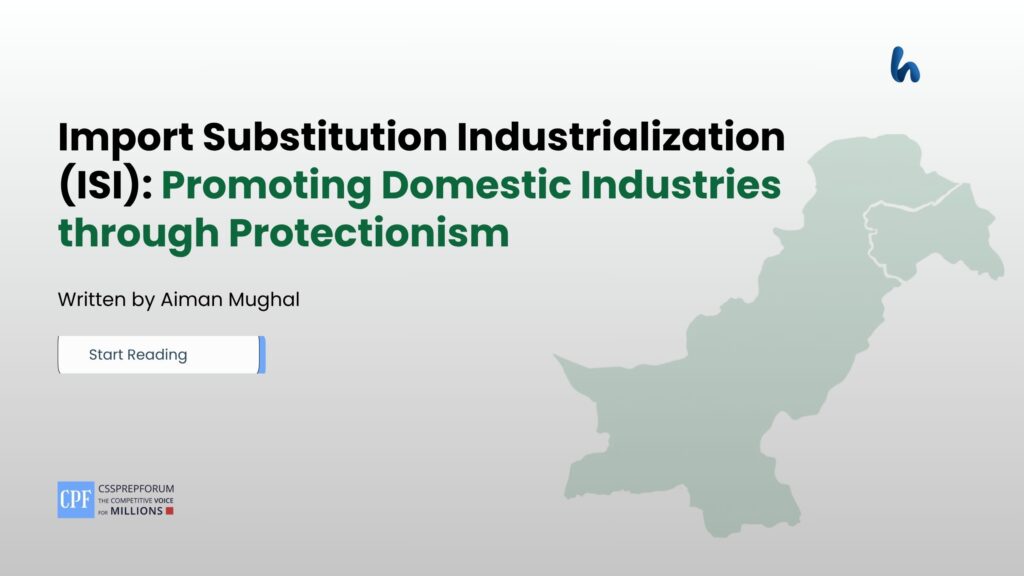
Import Substitution Industrialization (ISI) argues that protecting domestic industries through trade barriers and state support promotes industrial growth and economic self-reliance. It is a key concept in CSS Current Affairs.

Introduction
Import Substitution Industrialization (ISI) is a prominent development strategy within Development Economics that seeks to reduce a country’s dependence on imported manufactured goods by encouraging domestic production. The strategy emerged primarily in developing countries during the mid-twentieth century as policymakers sought to accelerate industrialization, create employment opportunities, and reduce external economic dependence. ISI argues that developing economies often remain trapped in underdevelopment because they rely heavily on exporting raw materials while importing expensive manufactured products. Therefore, governments should protect and nurture domestic industries through tariffs, quotas, subsidies, and other policy measures until they become competitive enough to compete internationally.
Definition
According to Raúl Prebisch:
“Industrialization in developing countries requires protection from international competition until domestic industries become sufficiently developed.”
This definition reflects the Structuralist belief that state intervention and protection of infant industries are essential for long-term industrial development.
Core Idea and Functional Understanding
Import Substitution Industrialization is based on the idea that developing countries should produce domestically the goods they previously imported. Instead of relying on foreign manufacturers, governments encourage local industries through trade protection and financial support. The strategy assumes that young domestic industries cannot initially compete with large and technologically advanced foreign firms. Therefore, temporary protection is necessary to allow these industries to grow, acquire experience, and achieve economies of scale. For example, many Latin American countries such as Brazil and Argentina used high tariffs on imported consumer goods to encourage local manufacturing industries. This approach helped create domestic industrial capacity and reduced reliance on foreign products.
Rationale Behind Import Substitution Industrialization
The ISI strategy emerged as a response to structural weaknesses in developing economies. Many countries depended heavily on exporting primary commodities while importing manufactured products, creating unfavorable trade relationships. Structuralist economists argued that this pattern prevented industrial development and increased vulnerability to global market fluctuations.Furthermore, developing countries often faced deteriorating terms of trade, where the prices of raw material exports grew more slowly than the prices of imported industrial goods. As a result, governments adopted ISI policies to strengthen domestic production, reduce import dependency, and promote economic self-sufficiency.
Major Policy Instruments of ISI
| Policy Instrument | Purpose | Expected Outcome |
| Tariffs | Increase the cost of imported goods | Protect local industries |
| Import Quotas | Restrict quantity of imports | Encourage domestic production |
| Subsidies | Financial support for local firms | Industrial growth |
| State-Owned Enterprises | Government participation in key sectors | Strategic industrial development |
| Exchange Rate Controls | Limit foreign competition | Reduced import dependence |
Economic Benefits of Import Substitution Industrialization
ISI contributed significantly to industrial development in several developing countries. By protecting domestic industries, governments created employment opportunities, promoted manufacturing growth, and reduced dependence on imported products. The strategy also encouraged technological learning and industrial diversification.For example, Brazil developed strong automobile, steel, and manufacturing industries through ISI policies. Similarly, Mexico expanded its industrial base by protecting local firms from foreign competition. These experiences demonstrate how government support can stimulate industrialization during the early stages of economic development.
Challenges and Limitations of ISI
Despite its initial success, ISI faced several long-term challenges. Protected industries often became inefficient because they faced limited competition. Excessive government intervention sometimes encouraged corruption, rent-seeking behavior, and resource misallocation. Furthermore, many domestic industries remained dependent on imported machinery and technology, limiting their competitiveness.For instance, several Latin American countries experienced fiscal deficits, inflation, and industrial inefficiency after maintaining protectionist policies for extended periods. These challenges led many governments to adopt more market-oriented reforms during the 1980s and 1990s.
Contemporary Relevance in the Global Economy
Although traditional ISI policies have declined, the underlying idea of supporting strategic domestic industries remains relevant today. Many countries continue to protect critical sectors such as technology, renewable energy, semiconductors, and defense industries. Governments increasingly recognize the importance of industrial resilience, supply-chain security, and technological self-reliance.For example, India’s “Make in India” initiative seeks to expand domestic manufacturing capacity and reduce dependence on imported products. Similarly, several advanced economies have recently introduced industrial policies to strengthen domestic production in strategic sectors.

Comparative Analysis of Import Substitution Industrialization with Related Development Strategies
| Basis | Import Substitution Industrialization (ISI) | Export-Oriented Industrialization (EOI) | Structuralism |
| Core Objective | Replace imports with domestic production | Promote exports and global competitiveness | Structural transformation through industrialization |
| Trade Policy | Protectionist | Open and export-focused | Selective protection and state guidance |
| Role of State | Strong intervention | Strategic support | Active planning and intervention |
| Industrial Focus | Domestic market industries | Internationally competitive industries | Broad industrial development |
| Examples | Brazil, Argentina, Mexico | South Korea, Taiwan, Singapore | Latin American economies |
| Main Goal | Economic self-sufficiency | Export-led growth | Structural transformation |
Real-World Case Studies and Economic Outcomes
Several countries have implemented ISI with varying degrees of success. Brazil used tariffs and subsidies to develop a large manufacturing sector and became one of Latin America’s leading industrial economies. Argentina similarly expanded domestic production through protectionist measures but later faced inefficiency and inflationary pressures. In contrast, South Korea initially protected domestic industries but eventually shifted toward export-oriented industrialization, achieving higher levels of competitiveness and economic growth. These experiences suggest that while ISI can successfully initiate industrialization, long-term success often requires innovation, efficiency, and integration into global markets.
Theoretical Evaluation: Strengths and Limitations
Import Substitution Industrialization provides a practical framework for helping developing countries build domestic industrial capacity and reduce dependence on foreign goods. Its primary strength lies in protecting infant industries and encouraging industrial diversification. The strategy can generate employment, promote technological learning, and strengthen national economic resilience. However, critics argue that excessive protection can reduce competition, create inefficient industries, and burden governments with high fiscal costs. Additionally, prolonged isolation from international markets may limit innovation and productivity growth. Therefore, many economists view ISI as most effective when used selectively and temporarily rather than as a permanent development strategy.
Conclusion
Import Substitution Industrialization is an important development strategy that seeks to promote domestic industrial growth by reducing dependence on imported manufactured goods. Through tariffs, subsidies, and government support, ISI aims to strengthen local industries and encourage economic self-sufficiency. Although the strategy has faced criticism for creating inefficiencies and reducing competitiveness, its role in promoting early-stage industrialization remains significant. Its central lesson,that developing countries often require strategic support to build industrial capacity,continues to influence modern industrial policy debates.
Key Takeaways
- ISI promotes domestic production to replace imported manufactured goods.
- Raúl Prebisch strongly supported protection of infant industries.
- Tariffs, quotas, and subsidies are major policy tools of ISI.
- The strategy aims to reduce economic dependence on foreign products.
- ISI contributed to industrial growth in countries such as Brazil and Mexico.
- Long-term protection can create inefficiency and reduce competitiveness.
- Many modern industrial policies still reflect ISI principles.
- Strategic industrial support remains important for developing economics
References
- Import Substitution Industrialization Explained – Economics Help (YouTube)
- Britannica – Development Economics
- Britannica – Raúl Prebisch
- CSSPrepForum – Import Substitution Industrialization (ISI)
- World Bank – Industrial Policy for Development
- Encyclopaedia Britannica – Import Substitution Industrialization
Important Note for CSS and PMS Aspirants
For aspirants preparing for competitive examinations, exploring solved past papers is essential to understand examiner expectations, analytical answer writing, and paper trends. Therefore, candidates are strongly encouraged to read the following comprehensive solved papers available on CSSPREPFORUM.
- CSS Solved Pakistan Affairs Past Papers
- CSS Solved Current Affairs Past Papers
- CSS Solved Islamiat Past Papers
- CSS Solved General Science and Ability Past Papers
Moreover, aspirants searching for the most credible and result-oriented teachers for CSS and PMS preparation can benefit from the following detailed guidance articles
- Who is the Best CSS PMS Islamiat Teacher in Pakistan?
- Who is the Best CSS PMS Pakistan Affairs Teacher in Pakistan?
- Who is the Best CSS Current Affairs Teacher in Pakistan?
- Who is the Best CSS GSA Teacher in Pakistan?
- Who is the Best CSS PMS English Essay and Precis Teacher in Pakistan?
- Who is the Best English Grammar Teacher in Pakistan?