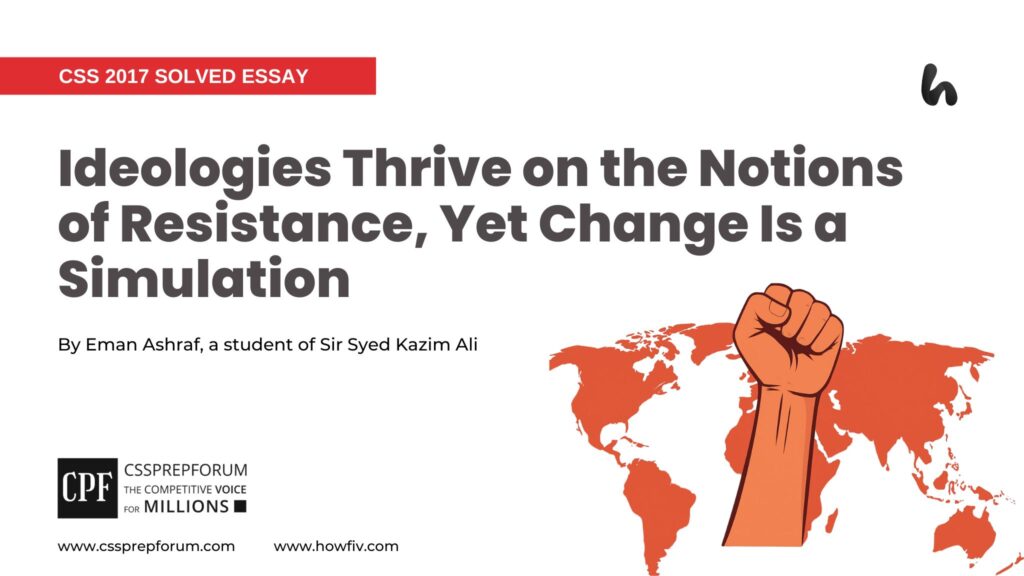
Looking for the CSS 2017 essay “Ideologies Thrive on the Notions of Resistance, Yet Change Is a Simulation”. Cssprepforum is Pakistan’s largest community with all CSS past paper essays and CSS solved essays. Continue reading!
Eman Ashraf, a student of Sir Syed Kazim Ali, has attempted the CSS 2017 essay “Ideologies Thrive on the Notions of Resistance, Yet Change Is a Simulation” using Sir Kazim’s proven essay writing pattern and strategy. As Pakistan’s leading CSS and PMS English Essay and Precis coach, Sir Syed Kazim Ali has been the only English mentor with the highest success rate of his students in Essays and Precis for over a decade. The essay is uploaded to help other competitive aspirants learn and practice essay writing techniques and patterns to qualify for the essay paper.

Outline
1- Introduction
Although proponents argue that ideological resistance generates meaningful social and political transformation, in reality, dominant power structures strategically absorb, commercialise, institutionalise, and proceduralise dissent, converting radical challenges into symbolic reforms that preserve existing hierarchies, thereby producing a simulation of change rather than genuine structural transformation.
2- Dissent as the engine of ideological evolution
3- Facade and the illusion of systemic change
4- The perpetual cycle: Ideological recurrence and simulated progress
5- How does the strategic co-option of ideological resistance neutralize genuine transformation, ultimately producing systemic simulation?
5.1- In Political Sphere
- ✓The Containment of Radicalism
- Evidence: Post-Cold War collapse of the Soviet Union led to the “End of History”, locking in neoliberal consensus.
- ✓The Bureaucratic Neutralization of Dissent
- Evidence: Arab Spring protests were funneled by NGOs into procedural goals, such as elections and financial audits, that left core institutional power untouched.
5.2- In Economic Sphere
- ✓The Commodification of Environmental Conscience
- Evidence: Carbon Credit and Offset Markets allow polluters to purchase moral legitimacy instead of structurally reducing emissions.
- ✓The Crisis as Centralization Engine
- Evidence: 2008 Financial Crisis bailouts protected and consolidated “too-big-to-fail” banks, reinforcing the same flawed structure.
5.3- In Social Sphere
- ✓The Commercialization of Identity
- Evidence: Corporate Pride Month and Pinkwashing substitute symbolic inclusion for genuine material equity or labor protection.
- ✓The Privatization of Systemic Conflict
- Evidence: The corporate response to #MeToo converted public critique into internal HR reporting mechanisms, thereby protecting leadership and insulating the power structure from collective accountability.
5.4- In Cultural Sphere
- ✓The Museumification of Radical Art
- Evidence: Street Art (Banksy) and graffiti are sanctioned by the high-value market, turning a rebellious aesthetic into a luxury asset.
- ✓The Hyperreal Substitution of Experience
- Evidence: Baudrillard’s analysis of Disneyland and The Las Vegas Strip demonstrates that these hyperreal spaces function as controlled fantasies that neutralize the public’s desire to critique or change real life.
6- On what basis do the opponents argue that ideological resistance leads to actual, systemic transformation?
6.1- Legal and Political Transformation
- ✓Counterargument: Resistance yields genuine transformation because movements like the Civil Rights struggle achieved irreversible structural change by codifying new rights that fundamentally redefined the state’s legal powers.
- Refutation: This change is a simulation of equality because the state only granted legal status while preserving the core economic and social hierarchies, effectively shifting the blame for persistent inequality onto individual failure.
6.2- Economic Redistribution and Welfare
- ✓Counter-Argument: Resistance leads to real material change through the establishment of collective social provision, such as the Welfare State (post-WWII), which permanently reallocated wealth away from pure capitalism, like universal healthcare.
- Refutation: The Welfare State is a systemic simulation designed to stabilize capitalism by neutralizing revolutionary threats, as proven by the successful rollback and privatization of these provisions under neoliberalism.
7- Case Study: Co-option and the Illusion of Structural Change
- ✓The Simulacrum of Algorithmic Control in the Digital Age
8- Conclusion
Ideologies Thrive on the Notions of Resistance, Yet Change Is a Simulation
Banksy’s street art was born as urban rebellion against commodified culture, but now sells for millions at Sotheby’s. Corporate boardrooms display Pride flags while paying poverty wages to their LGBTQ+ workforce. Similarly, carbon credit markets allow oil companies to purchase moral legitimacy without reducing a single emission. The Welfare State, born from revolutionary socialist pressure, was dismantled by the same capitalist system it was built to resist. This is not a failure of resistance. This is resistance successfully absorbed, domesticated, and converted into the system’s most powerful tool of self-preservation. In fact, resistance is real, but the change it produces is a simulation. Power does not suppress dissent: it absorbs and neutralises it, preserving every structure resistance sought to dismantle. In political and economic spheres, dissent is neutralised and crises weaponized, channelling resistance into procedural outcomes that leave power intact. In social and cultural spheres, identity movements are commercialised and radical aesthetics museumified, which substitutes symbolic performance for material transformation. Across all spheres, the system recycles resistance into managed simulation, granting surface change while power’s architecture remains structurally undisturbed. However, opponents contend that resistance yields genuine transformation, as Civil Rights movements codified irreversible legal rights that permanently redefined state power. Yet rights were granted while economic hierarchies were preserved, converting a structural demand into an individual responsibility. Equality was legislated. Poverty was not abolished. The simulation was complete. This essay investigates why ideological resistance produces systemic simulation rather than genuine structural transformation. It exposes what power strategically preserves through the absorption of every radical challenge. It argues how recognising the simulation is the prerequisite for any resistance that genuinely intends to dismantle it.

Before engaging in an in-depth exploration, it is essential to comprehend resistance as the driving force for the evolution of ideological frameworks. Dissent has long served as the engine of ideological evolution, steadily guiding societies toward new ways of thinking. Across history, resistance has not simply opposed authority; it has opened critical space for fresh ideas to emerge. For instance, Enlightenment critiques weakened the grip of absolute monarchy and paved the way for modern liberal thought. In recent times, movements for civil rights and digital freedoms have further expanded the boundaries of social and political imagination. At every stage, dissent has forced old frameworks to their breaking point, creating the ideological space within which new possibilities emerge.
Paradoxically, even as dissent drives ideological evolution, a contrasting reality profoundly complicates this narrative. Ideological resistance movements, though claiming transformation, often yield the paradoxical outcome of apparent change that leaves the core foundations of power untouched. Reforms are introduced, rhetoric shifts, and institutions adopt new language, creating a convincing facade of progress. However, beneath this surface, the underlying hierarchies and the deep structure of institutional dominance remain intact. A clear example is Corporate Social Responsibility (CSR) campaigns, celebrated as progressive shifts, yet largely crafted to maintain public trust while preserving existing economic and political arrangements, illustrating how change can be constructed rather than achieved.
Beneath the illusion of change lies a persistent cycle, where dominant powers perpetuate themselves through recurring forms of control. Ideologies, movements, and institutional reforms may emerge in diverse forms, yet they often converge to reinforce the same underlying hierarchies, creating the illusion of transformation while maintaining structural continuity. History demonstrates this pattern, as monarchies gave way to representative governments, revolutionary ideals inspired new constitutions, and corporate or state reforms promised equity, all while central power remained concentrated in elite hands. This cycle repeats across epochs, granting each era a sense of ideological novelty, but ultimately sustaining the core mechanisms of authority and illustrating the enduring adaptive resilience of dominant structures.
The political sphere reveals most clearly how the strategic absorption of ideological resistance turns the possibility of real change into a managed display. When radical demands surface, dominant institutions often take up their rhetoric in diluted form, reshaping disruptive impulses into acceptable, non-threatening discourse. This dynamic was evident after the Cold War, when the fall of the Soviet Union enabled the “End of History” narrative, presenting neoliberal democracy as the unquestionable and final arrangement. By presenting this system as the final and unchangeable truth, such narratives discouraged people from imagining anything different. In the end, what looks like progress becomes just a controlled show, preventing any real transformation.
Furthermore, bureaucratic processes often neutralize dissent by redirecting energy into safe, procedural channels. When protests or transformative movements arise, institutions and organizations can steer these efforts toward technical or administrative objectives, keeping deeper power structures intact. A striking example is the Arab Spring, where widespread public protests demanding systemic change were guided by NGOs toward procedural tasks such as organizing elections or conducting financial audits. While these actions addressed visible issues, they left the core political and institutional powers untouched. This demonstrates how bureaucratic mechanisms can absorb popular energy, creating the appearance of responsiveness while ensuring that true transformative change remains blocked.
In the economic sphere, even environmental concern can be turned into a marketable commodity that shields existing systems from real change. Corporations and industries facing pressure to act sustainably often purchase moral legitimacy rather than addressing the root causes of pollution. This is evident in carbon credit and offset markets, where polluters can buy credits to claim environmental responsibility instead of structurally reducing emissions. These mechanisms create the appearance of action and accountability, yet the underlying practices that harm the environment largely continue unchecked. Consequently, the commodification of environmental conscience sustains the status quo while displacing genuine ecological reform with the performance of responsibility.
Moreover, crises often reveal who really holds power, showing that emergencies can serve the interests of the few rather than trigger real change. When systems face major shocks, those in control frequently use the situation to centralize authority and protect key players. A clear example is the 2008 financial crisis, where government bailouts rescued “too-big-to-fail” banks, ensuring their survival and consolidating their dominance. Instead of prompting fundamental reforms, these interventions reinforced the very structures that caused the collapse, leaving the financial system vulnerable to similar risks in the future. Thus, crises often function as tools for consolidating power rather than driving meaningful transformation.
In the social sphere, identity itself can become a commodity, allowing corporations to signal inclusion without delivering substantive change. Corporations often adopt the symbols and language of social causes, presenting an image of support without making meaningful changes that benefit marginalized communities. A prominent example is Corporate Pride Month and ‘pinkwashing.’ As LGBTQ+ rights movements gained momentum in the 2010s, demanding equality, visibility, and workplace protections, corporations responded with symbolic displays of support. Yet, while companies publicly celebrate LGBTQ+ identity, they often fail to implement genuine policies such as equitable pay, labor protections, or structural inclusion. Hence, the commercialization of identity transforms authentic social struggles into marketing tools, diverting attention from the need for real change.
Further, systemic conflicts are often privatized, turning public outcry into contained processes that protect leadership rather than challenge entrenched power. For example, the #MeToo movement exposed widespread sexual harassment and abuse across industries, mobilizing public outrage and demanding systemic accountability. Corporations responded by emphasizing internal HR reporting procedures, which gave employees a way to report misconduct individually but avoided addressing the structural culture that enabled abuse. This approach allowed organizations to demonstrate responsiveness publicly while keeping leadership insulated from meaningful scrutiny or collective accountability. Thus, the privatization of systemic conflict preserves existing hierarchies under the guise of reform.
In the cultural sphere, dissent is polished into decoration almost as soon as it appears. Radical artistic expression can be neutralized through its conversion into sanctioned, high-value commodities. Banksy’s rise illustrates this clearly: what began as rebellious street art meant to challenge authority was later removed from its original walls, sold at auction, and displayed in museums as expensive collectibles. Once this happens, the artwork no longer disrupts public space or questions power; instead, it becomes part of the very system it once criticized. The “radical” edge is preserved only on the surface, as an aesthetic, not as a threat. In this way, turning street art into luxury items creates only the appearance of rebellion, masking the absence of real cultural challenge.
Additionally, in today’s culture, experience itself is increasingly simulated, leaving little room for real critique or engagement. This means that instead of encountering the complexities and challenges of real life, people are increasingly offered carefully controlled, curated experiences that feel authentic but are entirely constructed. For instance, Baudrillard’s analysis of Disneyland and the Las Vegas Strip illustrates this phenomenon, showing how these spaces offer meticulously crafted fantasies that feel immersive but remove any connection to actual social realities. By satisfying desires symbolically rather than materially, these hyperreal spaces dull the public’s impulse to challenge or change society. Ultimately, these constructed environments replace genuine experience with illusion, pacifying critical thought and reinforcing existing social structures.

Nevertheless, the opponents argue that ideological resistance leads to actual, systemic transformation. They cite legal and political victories, such as the Civil Rights Movement, which codified new rights and reshaped the state’s legal powers, suggesting that organized resistance can achieve lasting structural reform. However, this view misses the deeper dynamics. Such transformations often simulate equality, as the state grants formal rights while preserving core economic and social hierarchies. Persistent racial and economic disparities in housing, education, and employment, decades after legal reforms, attest to this reality. These patterns show that laws changed, but structural inequalities remain, shifting responsibility for failure onto individuals. Thus, legal victories often create the illusion of change while sustaining existing hierarchies.
They further argue that ideological resistance produces real material change by reshaping economic structures. They cite the post-World War II Welfare State, which reallocated wealth and introduced programs like universal healthcare, as proof that resistance can curb capitalism’s excesses. Yet, closer examination reveals that these measures functioned primarily to neutralize revolutionary pressure rather than transform the capitalist structure itself. This is demonstrated by the rollback and privatization of welfare programs under neoliberal reforms, which limited public provision and restored market-based inequalities. These examples demonstrate that social redistribution offered temporary relief but left the core capitalist structure intact. Hence, welfare reforms create the appearance of change while safeguarding the underlying system.
Advancing further, the digital age offers a striking illustration of how structural change can be simulated rather than realized. Platforms and algorithms are often presented as neutral tools for empowerment or democratization, yet they are designed to shape behavior, prioritize profitable content, and consolidate corporate power. Social movements, online petitions, and participatory algorithms allow users to resist and engage with the system, creating the appearance of influence. Yet the system co-opts these actions, neutralizing genuine change while reinforcing existing hierarchies. Thus, the simulacrum of algorithmic control shows that even in advanced digital spheres, apparent structural change can function as a controlled spectacle, preserving existing power.

In conclusion, ideological resistance, while essential for evolving thought and challenging authority, is repeatedly co-opted by entrenched systems, producing the illusion rather than the reality of structural change. Across political, economic, social, and cultural spheres, movements that appear transformative are absorbed, redirected, or commodified, leaving core hierarchies intact. Legal reforms, welfare policies, corporate initiatives, and digital platforms may offer surface-level adjustments, yet they function primarily to stabilize existing power and pacify dissent. Ultimately, history demonstrates that while resistance refines ideology and inspires imagination, the strategic co-option of opposition ensures that true systemic transformation remains rare, and the appearance of progress conceals enduring domination.
CSS 2017 Solved Essays!
Interested in learning all the CSS 2017 Solved Essays? Click on any to continue reading. Each essay is meticulously attempted by Sir Syed Kazim Ali’s students, who have either qualified for CSS or PMS or secured the highest marks in the essay paper.
| Is Colonial Mentality Impeding Pakistan’s Progress? |
| Brexit Means Globalization Is the Rhetoric of the Privileged, And Capitalism Will Return Ferociously as Ever. |
| More And More International Military Engagements By the United Nations; Is the World Moving Towards Peace? |
| Modernity Is an Unending Project. |
| Feminism Is Not Really a Third World Issue. |
| Literature Is a Lonely Planet of Idealists. |
| Being a Minority Is a Fate No One Wants. Can Nationalism Be Really Inclusive? |
| Ideologies Thrive on the Notions of Resistance, Yet Change Is a Simulation. |
| Are Modern Wars Not Holy Wars? |
| Life without Controversy is No Life. But Why One Should Not Choose the Save Haven of Conformism? |

CSS Solved Past Papers’ Essays
Looking for the last ten years of CSS and PMS Solved Essays and want to know how Sir Kazim’s students write and score the highest marks in the essays’ papers? Then, click on the CSS Solved Essays to start reading them.
CSS Solved Essays
CSS Solved General Science & Ability Past Papers
Want to read the last ten years’ General Science & Ability Solved Past Papers to learn how to attempt them and to score high? Let’s click on the link below to read them all freely. All past papers have been solved by Miss Iqra Ali & Sir Ammar Hashmi, Pakistan’s top CSS GSA coach having the highest score of their students.