The CSS English Precis & Composition Paper has consistently remained one of the most decisive and technically demanding components of the Central Superior Services (CSS) Examination. Year after year, a large number of aspirants fail to score well in this paper, not due to a lack of knowledge, but because they approach it without a clear strategy, sound structural understanding, and a good grip of the specific techniques the examiner expects.
In this CSS 2026 Solved English Precis and Composition Paper, I have gone beyond merely providing solved answers. Each question has been addressed with a pedagogical purpose, explaining not only what is correct but why it is correct. Alongside complete solutions, this guide offers expert insights, examiner-oriented techniques, and practical tips drawn from years of professional teaching and evaluation experience.
The objective of sharing this solved paper is to help serious aspirants develop precision, clarity, and confidence in their writing, align their responses with CSS marking criteria, and ultimately secure maximum marks in one of the most score-determining papers of the CSS examination.
CSS 2026 Solved English Precis and Composition Paper
This CSS 2026 Solved English Precis and Composition Paper has covered the following:
- Synonyms
- Antonyms
- Sentence Corrections
- Prepositions
- Pair of Words
- Punctuation Solutions
- Urdu-to-English Translation
- Comprehension Passage
- Solved Precis with Title
CSS 2026 English Precis and Composition Paper: Full Solution
CSS 2026 Solved Synonyms
1. Enigma
- Stature
- Axiom
- Adage
- Conundrum
Explanation
- Enigma (n.) refers to something mysterious, puzzling, or difficult to understand, often provoking curiosity because its meaning is unclear. It denotes a situation or thing that cannot be easily explained or solved. Similarly, a “Conundrum” (n.) is a confusing and complex problem that challenges understanding. Therefore, “Conundrum” is the closest synonym to “Enigma.”
2. Hackneyed
- Unplanned
- Intriguing
- Stubborn
- Cliched
Explanation
- Hackneyed (adj.) describes something that has been used or repeated so often that it has lost its originality and freshness. It refers to ideas or expressions that sound dull because of overuse. Similarly, “Clichéd” (adj.) means overused to the point of being trite or unoriginal. Therefore, “Clichéd” is the closest synonym to “Hackneyed.”
3. Panacea
- Elixir
- Destitution
- Deprivation
- Predicament
Explanation
- Panacea (n.) means a remedy or solution believed to cure all problems or diseases. It conveys the idea of a universal cure that completely removes difficulties. Similarly, an “Elixir” (n.) is a medicinal substance believed to have the power to heal or restore. Therefore, “Elixir” is the closest synonym to “Panacea.”
4. Cajole
- Lure
- Intimidate
- Harass
- Tease
Explanation
- Cajole (v.) means to persuade someone gently through flattery, coaxing, or sweet talk rather than force. It involves winning compliance by pleasing or tempting words. Similarly, to “Lure” (v.) is to attract or persuade someone subtly by presenting something appealing. Therefore, “Lure” is the closest synonym to “Cajole.”
5. Inscrutable
- Unattainable
- Mysterious
- Obstinate
- Vigilant
Explanation
- Inscrutable (adj.) describes something difficult or impossible to understand, interpret, or read clearly. It often refers to a person, expression, or situation whose meaning remains hidden. Similarly, “Mysterious” (adj.) denotes something unknown or not easily comprehended. Therefore, “Mysterious” is the closest synonym to “Inscrutable.”
6. Reverie
- Palimpsest
- Phantom
- Daydream
- Curio
Explanation
- Reverie (n.) refers to a state of pleasant, dreamy, and abstracted thinking, especially when one’s mind wanders away from reality. It denotes being lost in thoughts or imagination. Similarly, a “Daydream” (n./v.) is a spontaneous and fanciful flow of thoughts detached from the present moment. Therefore, “Daydream” is the closest synonym to “Reverie.”
7. Sumptuous
- Delirious
- Gorgeous
- Perilous
- Luxurious
Explanation
- Sumptuous (adj.) describes something rich, splendid, and expensive in appearance, often associated with luxury and magnificence. It conveys the idea of lavishness and high quality. Similarly, “Luxurious” (adj.) refers to something providing great comfort, elegance, and richness. Therefore, “Luxurious” is the closest synonym to “Sumptuous.”
8. Appall
- Delirious
- Covered
- Dismay
- Confuse
Explanation
- Appall (v.) means to shock, horrify, or fill someone with sudden disgust or distress. It implies causing a strong negative emotional impact. Similarly, “Dismay” (v./n.) refers to a feeling of shock, fear, or disappointment caused by something disturbing. Therefore, “Dismay” is the closest synonym to “Appall.”
9. Abject
- Indigent
- Desire
- Despondent
- Extreme
Explanation
- Abject (adj.) describes a state of extreme misery, hopelessness, or degradation, often implying a low or humiliating condition. Similarly, “Indigent” (adj.) means extremely poor or lacking basic necessities, closely matching the sense of severe destitution conveyed by abject. Therefore, “Indigent” is the most appropriate synonym for “Abject.”
10. BESPOKE
- Tailored
- Quiet
- Gentle
- Handsome
Explanation
- Bespoke (adj.) refers to something made specifically to order, especially clothing that is custom-made for an individual. Similarly, “Tailored” (adj./v.) means carefully made or adjusted to fit a particular person or purpose, making it the closest synonym to “Bespoke.”
CSS 2026 Solved Antonyms
11. Candour
- Rebuttal
- Evasiveness
- Restraint
- Candidness
Explanation
- Option (B) is the right answer as “Candour” denotes the quality of being open, honest, and sincere in expression while “Evasiveness” refers to the tendency to avoid directness or precision, typically to conceal the truth or avoid commitment.
- On the contrary, “Rebuttal” is a formal legal or argumentative term for a contradiction or counter-evidence intended to refute a claim. Moreover, “Restraint” refers to the unemotional or moderate manifestation of a feeling; it is a measure of self-control rather than a lack of honesty. Finally, “Candidness” is a direct synonym of “Candour,” representing the same attribute of frankness and forthrightness.
12. Colloquial
- Vernacular
- Informal
- Literary
- Quarrelsome
Explanation
- Option (C) is the right answer as “Colloquial” refers to language used in ordinary or familiar conversation rather than formal or literary contexts while “Literary” pertains to the formal, elevated style characteristic of books and scholarly writing.
- On the contrary, “Vernacular” is a synonym referring to the native dialect of a specific population. Similarly, “Informal” is another synonym describing a relaxed style of speech. Lastly, “Quarrelsome” refers to a person’s tendency to argue and is semantically unrelated to the given word.
13. Euphoria
- Ecstasy
- Obnoxious
- Nostalgic
- Melancholy
Explanation
- Option (D) is the right answer as “Euphoria” denotes a state of intense excitement and happiness while “Melancholy” signifies a deep, pensive, and long-lasting sadness.
- On the contrary, “Ecstasy” is a synonym representing an overwhelming feeling of great happiness. Moreover, “Obnoxious” describes extremely unpleasant or offensive behavior, and finally, “Nostalgic” refers to a sentimental longing for the past.
14. Surrogate
- Proxy
- Soothing
- Forbidden
- Real
Explanation
- Option (D) is the right answer as “Surrogate” refers to a substitute or a person/thing acting in place of another whereas “Real” denotes the authentic, original, or actual entity.
- On the other hand, “Proxy” is a synonym meaning the authority to represent someone else. Moreover, “Soothing” means having a gentle, calming effect. Lastly, “Forbidden” means not allowed or banned.
15. Oblivious
- Ignorant
- Conscious
- Sober
- Flamboyant
Explanation
- Option (B) is the right answer as “Oblivious” means not aware of or concerned about what is happening around one; however, “Conscious” means being fully aware of and responding to one’s surroundings.
- On the contrary, “Ignorant” is a near-synonym indicating a lack of knowledge or awareness. Moreover, “Sober” refers to not being intoxicated or being serious/sensible. Lastly, “Flamboyant” describes a tendency to attract attention because of exuberance or style.
16. Ameliorate
- Impair
- Rectify
- Precipitate
- Renew
Explanation
- Option (A) is the right answer as “Ameliorate” means to make something bad or unsatisfactory better while “Impair” means to weaken or damage something, particularly a human faculty or a functional condition.
- On the contrary, “Rectify” is a synonym meaning to put right or correct. Moreover, “Precipitate” means to cause an event to happen suddenly or prematurely. And “Renew” means to resume after an interruption or to re-establish something.
17. Benign
- Amiable
- Effective
- Boost
- Malicious
Explanation
- Option (D) is the right answer as “Benign” describes a condition or person that is gentle, kind, or not harmful in effect whereas “Malicious” describes the intention or desire to do harm or cause injury.
- On the contrary, “Amiable” is a synonym meaning having or displaying a friendly and pleasant manner; “Effective” means successful in producing a desired result, and “Boost” means to help or encourage something to increase or improve.
18. Cacophony
- Noise
- Disaster
- Stillness
- Rattle
Explanation
- Option (C) is the right answer as “Cacophony” refers to a harsh, discordant mixture of sounds while “Stillness” refers to the absence of movement or sound.
- On the other hand, “Noise” is a general synonym for a loud or unpleasant sound. Moreover, “Disaster” refers to a sudden accident or natural catastrophe. Lastly, “Rattle” is a specific type of rapid succession of short, sharp sounds.
19. Doleful
- Witty
- Rich
- Empty
- Vivacious
Explanation
- Option (D) is the right answer as “Doleful” means expressing sorrow or being mournful while “Vivacious” characterizes a person who is attractively lively and animated.
- Contrarily, “Witty” refers to showing or characterized by quick and inventive verbal humor. Moreover, “Rich” pertains to wealth or intensity. Lastly, “Empty” denotes a lack of content or substance.
20. Elan
- Inelegance
- Stupidity
- Obscure
- Despair
Explanation
- Option (D) is the right answer as “Elan” represents energy, style, and enthusiastic vigor whereas “Despair” refers to the complete loss or absence of hope and spirit.
- On the other hand, “Inelegance” refers to a lack of grace or refinement, which is a narrower contrast than the loss of spirit. Moreover, “Stupidity” refers to a lack of intelligence, and lastly, “Obscure” means not discovered or known about.
CSS 2026 Solved Sentence Correction
Sentence Correction – 1
It is a fact that I almost drowned makes me very careful about water safety whenever I go swimming.
Sentence Correction
- It is a fact that I almost drowned, which makes me very careful about water safety whenever I go swimming.
- The fact that I almost drowned makes me very careful about water safety whenever I go swimming.
Explanation of Errors and Corrections
In the given sentence, two ideas are incorrectly joined without proper grammatical connection. The clause “that I almost drowned” cannot directly act as the subject of “makes me very careful” without clarification.
In the first corrected version, “which” refers back to the entire fact of almost drowning and correctly links it to the result (makes me very careful). Revise the “Adjective Clause Lecture”.
In the second version, “The fact that…” is used as a noun clause functioning as the subject of the verb makes, which is grammatically clear and correct. Revise the lecture “What can be the subject of a sentence?”
Therefore, the original sentence is incorrect because it lacks a proper connector and results in a faulty sentence structure.
Sentence Correction – 2
The amount they receive in wages is greater than twenty years ago.
Sentence Correction
- The amount they receive in wages is greater than what it was twenty years ago.
Explanation of Errors and Corrections
The given sentence makes an incomplete comparison. The phrase “greater than twenty years ago” compares an amount with a time, which is illogical.
A comparison must be made between two comparable things. Here, the comparison should be between: the amount they receive now, and the amount they received twenty years ago. Revise the sentence correction lecture.
By adding “what it was”, we clearly state that the comparison is between amounts, not between an amount and time. Hence, the corrected sentence is grammatically and logically sound.
Sentence Correction – 3
Playing a game regularly is better than to read books always.
Sentence Correction
- Playing a game regularly is better than reading books all the time.
Explanation
In comparisons, we must keep the grammatical form parallel on both sides of than.
Here, “playing” is a gerund, so it should be compared with another gerund, “reading,” not with an infinitive (to read). Revise gerund and infinitive and parallelism lecture.
Also, “all the time” is the natural idiomatic expression in English, whereas “always” sounds awkward in this construction. Revise tenses and expressions lecture.
So, the corrected sentence is grammatically balanced and idiomatic.
Sentence Correction – 4
It is one of the best speeches that ever been made in the General Assembly.
Sentence Correction
- It is one of the best speeches that has ever been made in the General Assembly.
Explanation
In the structure “one of the + superlative + plural noun + that …”, the relative clause introduced by “that” refers to the plural noun (speeches), not to one. Revise adjective or relative clauses lecture.
Therefore, we must use the present perfect form “has/have been made.” Since “ever” refers to experience up to the present, present perfect is required. The correct auxiliary here is “has”, agreeing with the idea of one speech taken individually from the group.
So, “that has ever been made” is grammatically and stylistically correct.
Sentence Correction – 5
Ever since they had heard about the burglaries in neighbourhood they kept on the light all the time and close all the doors and the windows very carefully.
Sentence Correction
- Ever since they heard about the burglaries in the neighbourhood, they have kept the lights on all the time and have closed all the doors and windows very carefully.
Explanation
The given sentence has several grammatical mistakes, such as wrong tense with “ever since”, incorrect verb form, article agreement, and parallel structure.
Remember, “ever since” refers to a point in the past continuing to the present, so the present perfect tense is required. Revise tenses lecture.
The verb “close” should be “closed” to agree with the present perfect tense. And the auxiliary “have” must be repeated or understood for parallel verbs.
Next, “the light” should be “the lights”, as more than one light is implied.
Finally, to follow parallelism and maintain grammatical balance, we have to say “have kept the lights on” and “have closed the doors and windows”.
Sentence Correction – 6
When Susan realized that all of her bottles of the nail polish dries out she decides to keep them for decoration.
Sentence Correction
- When Susan realized that all of her bottles of nail polish had dried out, she decided to keep them for decoration.
Explanation
The given sentence has several grammatical mistakes, such as wrong tense sequence, use of past perfect, verb agreement and form, and article usage.
We know that “Realized” is in the past tense, so the actions connected to it must also be in the past. So, “Had dried out” is correct because the drying happened before Susan decided to keep the bottles.
Moreover, “nail polish” is an uncountable noun, and we know we don’t use any article before the uncountable noun, if it comes for the first time in a sentence. Revise nouns, articles, modifiers lecture.
Sentence Correction – 7
It was late in night and a boy rode his bike along the path when suddenly he stopped in shock as his head lamp was not working anymore.
Sentence Correction
- It was late at night, and a boy was riding his bike along the path when suddenly he stopped in shock because his headlamp was no longer working.
Explanation
The sentence contains errors in prepositions, tense consistency, word form, and punctuation. We know that “At night” is the correct idiomatic expression in English.
For ongoing past action, we use past continuous. And this ongoing past action is interrupted by a sudden event (“stopped”). So, we have to say “was riding”, not “rode”.
Moreover, “Headlamp” is written as one word in English.
Next, instead of saying “not working anymore”, we say “no longer working” because it is more formal and appropriate English expression.
Finally, we always use comma to connect two independent clauses. So, we must use a comma after “night”, which helps separate ideas clearly and improves readability.
Sentence Correction – 8
The girl told the conductor that she lost her train ticket and knew not how she would get home.
Sentence Correction
- The girl told the conductor that she had lost her train ticket and did not know how she would get home.
Explanation
The sentence has issues with tense consistency and verb form.
The reporting verb “told” is in the past tense, so the verbs in the reported clause should also shift back. So, “she lost her train ticket” should be changed to “she had lost her train ticket”.
Moreover, “Knew not” is archaic and unnatural in modern English. So, we must say “did not know how she would get home”.
CSS 2026 Solved Prepositions
Preposition – 1
Nobody is certain ______ the future but some are convinced ______ the past.
Correction
- Nobody is certain about the future but some are convinced of the past.
Explanation
First, we need to understand the meaning of the sentence to choose the correct prepositions. The sentence contrasts uncertainty about what has not yet happened (the future) with strong belief about what has already happened (the past).
“Certain of” and “certain about” are often used interchangeably to express confidence or certainty, as both convey a strong sense of assurance. However, there is a subtle distinction in usage. “Certain of” is more commonly found in formal or academic contexts and typically refers to certainty regarding a fact, outcome, or belief. In contrast, “certain about” is frequently used in everyday language and tends to emphasize confidence about a particular situation, matter, or detail. Hence, since the future is unknown and speculative, we say “certain about the future.”
Both “convince of” and “convince about” are grammatically acceptable and are used to express the act of causing someone to believe in the truth or certainty of something. However, “convince of” is far more common and preferred, especially in formal and academic usage. It is typically used when referring to specific facts, claims, guilt, innocence, or conclusions (e.g., convince someone of his innocence).
“Convince about,” while correct, is less frequent and is generally used in a broader or less precise sense, often referring to general ideas, situations, or viewpoints rather than definite facts. For this reason, in formal writing and examinations, “convince of” is usually the safer and more appropriate choice.
More Examples
- She is certain about her decision.
- I am convinced of his honesty.
- No one is certain about tomorrow.
- Historians are convinced of the facts.
Preposition – 2
He was familiar ______ the author but not knowledgeable in depth ______ him.
Correction
- He was familiar with the author but not knowledgeable in depth about him.
Explanation
First, we need to understand the sentence’s meaning to place appropriate prepositions. The sentence contrasts surface-level acquaintance with deep understanding.
The phrase “familiar ______ the author” requires a preposition that shows general acquaintance or recognition. The adjective “familiar” is followed by the preposition “with” when we mean having basic knowledge or awareness of a person, thing, or subject. Therefore, familiar with the author means he knew the author in a general or limited way.
The phrase “knowledgeable in depth ______ him” refers to having detailed, thorough knowledge. The adjective “knowledgeable” is followed by the preposition “about” when talking about deep understanding of a person, subject, or topic. Hence, knowledgeable about him correctly expresses in-depth knowledge.
More Examples
- She is familiar with the rules of the game.
(She knows them generally.) - He is knowledgeable about world history.
(He has deep understanding.) - I am familiar with the writer’s name but not knowledgeable about his work.
(Difference between surface knowledge and depth.)
Preposition – 3
After weighing ______ all the options we decided to plump ______ the first design.
Correction
- After weighing up all the options, we decided to plump for the first design.
Explanation
First, we need to understand the sentence’s meaning to place appropriate prepositions. The sentence describes a decision-making process: first considering all possibilities carefully, and then choosing one option.
The phrase “weighing ______ all the options” uses the verb “weigh up,” which is a fixed phrasal verb meaning to consider or evaluate carefully before making a decision. Therefore, the correct preposition here is “up.”
The phrase “plump ______ the first design” requires a preposition that shows making a definite choice. The verb “plump for” is an idiomatic expression meaning to choose something suddenly or decisively after consideration. Hence, “for” is the correct preposition.
More Examples
- She weighed up the advantages and disadvantages before applying.
(Considered carefully) - After much discussion, they plumped for the cheaper option.
(Chose decisively) - He weighed up all the offers and finally plumped for the best one.
(Evaluation followed by choice)
Preposition – 4
The accused declared that he had no credible motive ______ revenge and denied ______ the charges.
Correction
- The accused declared that he had no credible motive for revenge and denied the charges.
Explanation
First, we need to understand the sentence’s meaning to choose the correct prepositions and structures. The sentence talks about a legal defence: the accused claims he had no reason for revenge and rejects the accusations made against him.
The phrase “motive ______ revenge” requires a preposition that expresses purpose or reason. The noun “motive” is followed by the preposition “for” when it refers to the reason behind an action. Therefore, motive for revenge is the correct and idiomatic expression.
The phrase “denied ______ the charges” does not require a preposition before the charges. The verb “deny” takes a direct object, not a preposition. Hence, we say deny the charges, not deny of / deny about the charges.
Preposition – 5
The party’s withdrawal ______ the elections was widely seen as an obstacle ______ the success of the peace plan.
Correction
- The party’s withdrawal from the elections was widely seen as an obstacle to the success of the peace plan.
Explanation
First, we need to understand the sentence’s meaning to place appropriate prepositions. The sentence describes a political situation where a party pulls out of elections, and this action negatively affects the success of a peace plan.
The phrase “withdrawal ______ the elections” requires a preposition that shows movement away or separation. The noun “withdrawal” is regularly followed by the preposition “from” to indicate leaving or pulling out of something. Therefore, withdrawal from the elections is correct.
The phrase “an obstacle ______ the success” needs a preposition that shows hindrance or blockage. The noun “obstacle” is followed by the preposition “to”, not “of” or “for.” We say an obstacle to progress / success / peace because it indicates something that blocks movement toward a goal.
Preposition – 6
They agreed to cooperate ______ police ______ these matters.
Correction
- They agreed to cooperate with the police on these matters.
Explanation
First, we need to understand the sentence’s meaning to place appropriate prepositions. The sentence describes an agreement to work together with authorities regarding specific issues.
The phrase “cooperate ______ police” requires a preposition that shows working jointly with someone. The verb “cooperate” is always followed by the preposition “with” when it refers to collaboration between people or groups. Therefore, cooperate with the police is the correct and idiomatic expression.
The phrase “______ these matters” needs a preposition that introduces the subject or issue being discussed. The preposition “on” is used when referring to topics, issues, or matters. Hence, on these matters correctly indicates the issues concerning which cooperation is taking place.
Examples
- The company agreed to cooperate with the investigators.
(Working jointly) - They are cooperating with the government on security issues.
(Collaboration on a topic) - She worked with her team on the project.
(Joint effort on a matter)
Preposition – 7
I don’t advise ______ anyone. I just listen ______ their complaints.
Correction
- I don’t advise against anyone. I just listen to their complaints.
Explanation
First, we need to understand the sentence’s meaning to place appropriate prepositions. The speaker is saying that they do not discourage or warn people against someone, but instead simply hear what people have to say.
The phrase “advise ______ anyone” needs a preposition that shows warning or discouraging. The verb “advise” is followed by “against” when it means to warn someone not to support or trust a person or action. Therefore, advise against anyone is the correct usage.
The phrase “listen ______ their complaints” requires a preposition that shows paying attention to what is said. The verb “listen” is always followed by the preposition “to.” Saying listen their complaints is grammatically incorrect.
Preposition – 8
The landscape ______ the Pampas is in places similar ______ the Dutch landscape.
Correction
- The landscape of the Pampas is in places similar to the Dutch landscape.
Explanation
First, we need to understand the sentence’s meaning to place appropriate prepositions. The sentence compares the natural features of the Pampas with those of the Dutch landscape.
The phrase “the landscape ______ the Pampas” requires a preposition that shows possession or association. The preposition “of” is used to indicate that the landscape belongs to or is characteristic of a particular place. Therefore, the landscape of the Pampas is the correct expression.
The phrase “similar ______ the Dutch landscape” needs a preposition used for comparison. The adjective “similar” is always followed by the preposition “to,” not “with” or “as.” Hence, similar to the Dutch landscape is grammatically correct.
CSS 2026 Solved Paragraph
Urdu Paragraph
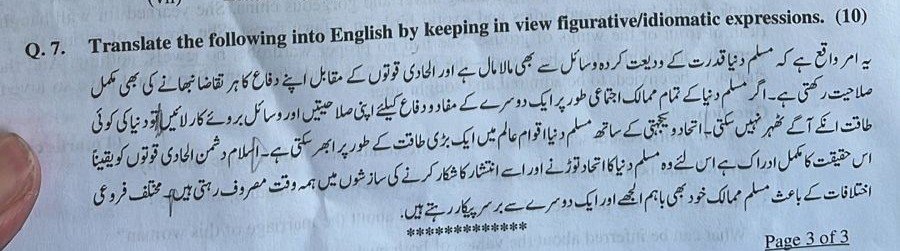
یہ امر واقعہ ہے کہ مسلم دنیا قدرت کے ودیعت کردہ وسائل سے بھی مالا مال ہے اور الحادی قوتوں کے مقابل اپنے دفاع کا ہر تقاضا نبھانے کی بھی مکمل صلاحیت رکھتی ہے۔ اگر مسلم دنیا کے تمام ممالک اجتماعی طور پر ایک دوسرے کے مفاد و دفاع کیلئے اپنی صلاحیتیں اور وسائل بروئے کار لائیں تو دنیا کی کوئی طاقت انکے آگے ٹھہر نہیں سکتی۔ اتحاد و یکجہتی کے ساتھ مسلم دنیا اقوام عالم میں ایک بڑی طاقت کے طور پر ابھر سکتی ہے۔ اسلام دشمن الحادی قوتوں کو یقیناً اس حقیقت کا مکمل ادراک ہے اس لئے وہ مسلم دنیا کا اتحاد توڑنے اور اسے انتشار کا شکار کرنے کی سازشوں میں ہمہ وقت مصروف رہتی ہیں۔ مختلف فروعی اختلافات کے باعث مسلم ممالک خود بھی باہم الجھے اور ایک دوسرے سے برسرِ پیکار رہتے ہیں۔
Translations by Sir Syed Kazim Ali
Translation-1
It is a well-established fact that the Muslim world is abundantly endowed with natural resources bestowed by nature and also possesses the complete capacity to fulfill all the requirements of self-defence against atheistic forces. If all Muslim countries collectively utilize their capabilities and resources for one another’s mutual interest and defence, no power in the world can stand against them. Through unity and solidarity, the Muslim world can emerge as a major force among the nations of the world.
Anti-Islam atheistic powers are fully aware of this reality; therefore, they remain constantly engaged in conspiracies aimed at breaking the unity of the Muslim world and pushing it towards division and instability. Owing to various secondary and sectarian differences, Muslim countries themselves also remain entangled in conflicts with one another and are often found confronting each other.
Translation-2
It is an established reality that the Muslim world is abundantly blessed with natural resources and possesses sufficient capability to meet the requirements of collective defence. If Muslim countries were to pool their resources and capacities for mutual interest and security, no global power could challenge their strength. Thus, unity and solidarity have the potential to elevate the Muslim world as a significant force among nations.
Nevertheless, anti-Islam and atheistic powers fully recognize this potential and therefore actively engage in efforts to undermine Muslim unity. At the same time, internal divisions and sectarian disputes among Muslim countries further weaken their collective position.
Translation-3
The Muslim world is undeniably endowed with immense natural resources and possesses the strategic potential necessary to ensure comprehensive self-defence. If Muslim states were to transcend narrow interests and collectively employ their resources for shared security and prosperity, no global power could effectively challenge them. Through unity, cohesion, and strategic vision, the Muslim world could rise as a formidable force in the international system.
However, anti-Islam and atheistic forces, fully aware of this latent power, remain persistently engaged in efforts to undermine Muslim unity and promote instability. More alarmingly, internal sectarian and political divisions within the Muslim world continue to fuel mutual confrontation, thereby weakening its collective resolve and global influence.
CSS 2026 Solved Pair of Words
1-Dependant & Dependent
Dependant (n.)
- A person, typically a family member, who relies on someone else for financial support or care
Sentence
- As a single parent, Ayesha worked tirelessly to provide her two young dependants with sufficient food, quality education, and a safe, nurturing home.
Dependent (adj.)
- Relying on someone or something else for support, aid, or existence
Sentence
- The success of the small business was dependent on securing the government contract, which accounted for nearly half of its annual revenue.
Explanation
- “Dependant” (n.) refers to a person, usually a family member, who relies on another for financial or other support. Whereas, “Dependent” (adj.) describes the state of relying on someone or something for support, aid, or existence.
2- Funeral & Funereal
Funeral (n.)
- A ceremony held to honor and bury or cremate a deceased person
Sentence
- The entire town attended the funeral of the beloved teacher, paying their last respects with solemnity and reverence.
Funereal (adj.)
- Having the mournful, gloomy, or solemn qualities associated with a funeral
Sentence
- The abandoned mansion had a funereal silence, with cobweb-covered furniture and darkened hallways that seemed to mourn the lives once lived there.
Explanation
- “Funeral” (n.) refers to the ceremony conducted to honor and dispose of a deceased person. Whereas, “Funereal” (adj.) describes something that has the mournful, solemn, or gloomy characteristics typical of a funeral.
3-Fain & Feign
Fain (adj.)
- Willing or eager; gladly or happily inclined to do something
Sentence
- After hours of negotiation, the CEO was fain to accept the compromise, recognizing it would secure the company’s long-term growth.
Feign (v.)
- To pretend or give a false appearance of something, often to deceive
Sentence
- She tried to feign confidence during the interview, but her trembling hands betrayed her nervousness.
Explanation
- “Fain” (adj.) means being willing or eager to do something gladly or happily. Whereas, “Feign” (v.) means to pretend or put on a false appearance, often with the intention of deceiving others.
4-Gamble & Gambol
Gamble (v.)
- To take a risky action or chance, especially involving money or uncertain outcomes
Sentence
- Instead of investing cautiously, Tariq decided to gamble on the volatile stock market, hoping for a huge profit.
Gambol (v.)
- To skip, leap, or frolic about in a playful or lively manner
Sentence
- The puppies gamboled across the garden, tumbling over each other in joyful abandon.
Explanation
- “Gamble” (v.) means to take a risk or chance, often with potential loss or gain. Whereas, “Gambol” (v.) means to leap, skip, or frolic playfully and energetically.
5-Hoard & Horde
Hoard (v.)
- To accumulate and store a large quantity of something, often secretly or greedily
Sentence
- During the economic uncertainty, the family decided to hoard canned food and supplies, fearing shortages in the coming months.
Horde (n.)
- A large, often disorderly crowd or group of people
Sentence
- A horde of fans surrounded the celebrity as she stepped out of the car, making it nearly impossible to move forward.
Explanation
- “Hoard” (v.) means to accumulate and store items, often excessively or secretly. Whereas, “Horde” (n.) refers to a large, frequently unruly group or crowd of people.
6-Ingenious & Ingenuous
Ingenious (adj.)
- Marked by cleverness, originality, or inventive skill
Sentence
- The engineer designed an ingenious solution to purify water using minimal resources, impressing the entire research team.
Ingenuous (adj.)
- Innocent, candid, and straightforward; lacking in cunning or deceit
Sentence
- Shumaila’s ingenuous nature made her an easy target for scams as she trusted people too readily.
Explanation
- “Ingenious” (adj.) means showing cleverness, originality, or inventive skill. Whereas, “Ingenuous” (adj.) means being innocent, candid, and straightforward, often implying naivety or lack of deceit.
7-Luxuriant & Luxurious
Luxuriant (adj.)
- Rich, abundant, and growing profusely, primarily referring to vegetation or hair
Sentence
- The garden was filled with luxuriant greenery, with flowering plants and vines spreading in every direction.
Luxurious (adj.)
- Providing great comfort, elegance, or wealth; indulgently rich
Sentence
- The family stayed at a luxurious resort during vacations, where every room had a private pool and panoramic ocean views.
Explanation
- “Luxuriant” (adj.) means rich, abundant, and profuse, often describing growth. Whereas, “Luxurious” (adj.) means showing great comfort, elegance, or wealth, emphasizing indulgence or opulence.
8-Moat & Mote
Moat (n.)
- A deep, wide ditch surrounding a castle or fort, typically filled with water, used for defense
Sentence
- The medieval castle was nearly impregnable, surrounded by a wide moat that deterred invaders.
Mote (n.)
- A tiny particle or speck, often of dust
Sentence
- A mote of dust floated in the sunlight streaming through the library window, barely noticeable yet shimmering in the golden light.
Explanation
- “Moat” (n.) refers to a deep, wide ditch around a castle or fort, usually for protection. Whereas, “Mote” (n.) refers to a tiny particle or speck, often of dust.
CSS 2026 Solved Punctuation
Orignal Passage
Scientists and philosophers of science tend to speak as if “scientific language” were intrinsically precise as if those who use it must understand one another’s meaning even if they disagree but in fact scientific language is not as different from ordinary language as is commonly believed it too is subject to imprecision and ambiguity and hence to imperfect understanding moreover new theories or arguments are rarely if ever constructed by way of clear-cut steps of induction deduction and verification or falsification neither are they defended rejected or accepted in so straightforward a manner in practice scientists combine the rules of scientific methodology with a generous admixture of intuition aesthetics and philosophical commitment the importance of what are sometimes called extra-rational or extra-logical components of thought in the discovery of a new principle or law is generally acknowledged
Solved Passage
Scientists and philosophers of science tend to speak as if “scientific language” were intrinsically precise: as if those who use it must understand one another’s meaning, even if they disagree. But, in fact, scientific language is not as different from ordinary language as is commonly believed. It, too, is subject to imprecision and ambiguity and, hence, to imperfect understanding. Moreover, new theories or arguments are rarely, if ever, constructed by way of clear-cut steps of induction, deduction, and verification or falsification; neither are they defended, rejected, or accepted in so straightforward a manner. In practice, scientists combine the rules of scientific methodology with a generous admixture of intuition, aesthetics, and philosophical commitment; the importance of what are sometimes called “extra-rational” or “extra-logical” components of thought in the discovery of a new principle or law is generally acknowledged.
CSS 2026 Solved Precis
Original Passage
One of the outstanding features of the century has been the improvement of living of working man, greater political power, more wealth and leisure, and better facilities for health, security and education. In early civilizations, most communities were sharply divided into two classes, those who labored and those who did not. The small number of rulers- kings, priests, military leaders lived in great comfort, and did very little work. The vast majority of the population enjoyed very few comforts, did lot of work, and had scarcely any political power. In some societies, there was an even more wretched class, the slaves, who had no rights at all. The Industrial Revolution of Europe led to the production of vast quantities of goods, and workers began to be dissatisfied with their poverty. The factory owners needed skilled workers, and gradually they realized that they must show goodwill to their workforce, in order to stay in business. As in many other reforms, some enlightened slowly spread that workers were entitled to some consideration. Since men were free to work for any master they chose, good master soon had the pick of the workers and old-fashioned employers found themselves with a factory full of lower-grade workforce. Such a situation soon led to an all-round improvement in standards, and good employers tried to raise working conditions still higher. These improvements were speeded up by the increased organization of workers in Trade Union movements, particularly in low- standard factories, where the owner often had to deal with strike action by dissatisfied workers. Now that the working classes are getting better and better working conditions, the need to strike has lessened considerably; and employers and workers alike have come to realise that they depend on each other for their livelihood.
Solved Precis
Below is the list of difficult words from the passage along with their meanings
| Wretched | (Of a person) in a very unhappy or unfortunate state; of poor quality |
| Goodwill | Friendly, helpful, or cooperative feelings or attitude |
| Pick of the | The best or most desirable among a group |
| Strike action | A work stoppage caused by the mass refusal of employees to work, usually to protest or make demands |
| Enlightened | Having or showing a rational, modern, and well-informed outlook |
| Livelihood | A means of securing the necessities of life |
Solved Precis
The century witnessed a notable improvement in workers’ living conditions, political power, wealth, and access to health, security, and education. Initially, societies were divided into ruling elites and laboring masses, with some having no rights. However, industrialization led to worker dissatisfaction, prompting employers to show goodwill. Moreover, workers’ freedom to select masters and the organization of Trade Unions gradually raised factory standards. As conditions improved, the need for strikes decreased. Hence, both employers and workers understood their mutual dependence for sustaining livelihoods.
- Original Words in the Passage: 293
- Precis Word Count: 82
- Title: The Rise of Labor Welfare
CSS 2026 Solved Comprehension
Original Passage
She was one of those pretty, charming women who are born, as if by an error of Fate, into a petty official’s family. She had no dowry, no hopes, nor the slightest chance of being loved and married by a rich man – so she slipped into marriage with a minor civil servant. Unable to afford jewels, she dressed simply: But she was wretched, for women have neither caste nor breeding – in them beauty, grace, and charm replace pride of birth. Innate refinement, instinctive elegance, and wit give them their place on the only scale that counts and these make humble girls the peers of the grandest ladies. She suffered, feeling that every luxury should rightly have been hers. The poverty of her rooms – the shabby walls, the worn furniture, the ugly upholstery caused her pain. All these things that another woman of her class would not even have noticed, made her angry. The very sight of the little Breton girl who cleaned for her awoke rueful thoughts and the wildest dreams in her mind. She dreamt of rooms with Oriental hangings, lighted by tall, bronze torches, and with two huge footmen in knee breeches made drowsy by the heat from the stove, asleep in the wide armchairs. She dreamt of great drawing rooms upholstered in old silks, with fragile little tables holding priceless knickknacks, and of enchanting little sitting rooms designed for tea-time chats with famous, sought-after men whose attentions all women longed for. She sat down to dinner at her round table with its three-day-old cloth, and watched her husband lift the lid of the soup tureen and delightedly exclaim: “Ah, a good homemade beef stew! There’s nothing better!” She visualized elegant dinners with gleaming silver and gorgeous china. She yearned for wall hangings peopled with knights and ladies and exotic birds in a fairy forest. She dreamt of eating the pink flesh of trout or the wings of grouse. She had no proper wardrobe, no jewels, nothing. And those were the only things that she loved – she felt she was made for them. She would have so loved to charm, to be envied, to be admired and sought after.
Solved Comprehension
1-Which word best describes the actual living conditions of the couple and why?
The most apt word for the couple’s living conditions is modest. It encapsulates an environment that, while functional, is marked by wear, neglect, and a lack of aesthetic appeal. Moreover, the passage explicitly mentions the deteriorating state of the walls and furniture in the house, which collectively signify a household struggling to maintain a facade of middle-class respectability. While the couple is not destitute, as they employ a girl to do housework, their surroundings lack the elegance and luxury the wife craves, creating a clear contrast between her material reality and lofty aspirations.
2-Which line best demonstrates the couple’s true economic standing and why?
The line mentioning the reused, soiled dining linens and the husband’s enthusiasm for a basic meat broth serves as the most revealing indicator of the couple’s financial status. To illustrate, the couple’s reliance on aged household items and the celebration of inexpensive, home-cooked meals confirms they lack the resources for refined living. Consequently, this specific scene exposes the wide gap between their humble reality and the grandeur the wife dreams of.
3-According to the passage, what can be stated about the marriage of this woman?
This marriage was a result of social necessity, instead of personal preference or romantic aspiration. It represents a fundamental mismatch between the woman’s internal desire for grandeur and the bland reality of her domestic life. Thus, the marriage functions as a constant source of dissatisfaction for her, reminding her daily of the status she feels has been unfairly denied to her.
4-What can be inferred about the values of both husband and wife?
A significant divide exists between the superficial priorities of the wife and the simple contentment of the husband. Specifically, the former values material wealth, social envy, and external validation above all else; conversely, the man finds genuine satisfaction in basic domestic comforts and practical nourishment. In short, while she is consumed by a longing for what she lacks, he is at peace with their current reality.
5-What is the main idea of the passage?
The passage describes the persistent mental distress of a woman who feels her natural beauty entitles her to a life of aristocratic luxury. In other words, the narrative highlights the deep-seated friction between her current modest reality, defined by a low-ranking marriage and plain surroundings, and her vivid, internal fantasies of high-society grandeur. Therefore, the primary focus is on the psychological burden of living with material aspirations that are entirely disconnected from one’s actual socio-economic status.
CSS Solved English Precis & Composition Papers!
Interested in learning the CSS past paper solved English precis and composition papers solved by Sir Syed Kazim Ali? Click on any to start reading.
How Can You Score High in CSS Precis and Composition Paper?
Achieving a high score in the CSS English Precis & Composition Paper is a goal that requires a well-organized and targeted approach. Success in this challenging examination hinges not only on strong grammar skills and a comprehensive vocabulary but also on a thorough understanding of precis writing techniques. Unfortunately, many aspirants find this paper difficult, not due to a lack of English proficiency but because they do not grasp the best methods to tackle each section effectively. Nevertheless, to excel, candidates must develop a structured strategy that outlines their approach to every part of the paper. This structure always guides them through the exam, ensuring they stay on track and cover all necessary points.
Moreover, strong grammar skills (not basic ones) play a crucial role in articulating ideas clearly and correctly; hence, aspirants should focus on refining their advanced grammar skills to avoid common pitfalls that can undermine their written communication. Furthermore, a rich vocabulary is essential for expressing nuanced thoughts and ideas; expanding one’s lexicon can greatly enhance the quality of written responses.
Indeed, the skill of precis writing is critical, as it demands the ability to distil lengthy texts into concise summaries without losing the core message. Many candidates overlook the intricacies of this vital skill, which can lead to incomplete or ineffective answers. By sharpening these techniques, aspirants can improve their performance and ultimately achieve the scores they aspire to. In summary, while proficiency in English is important, understanding how to approach the CSS English Precis and Composition Paper is equally critical to success. With the right tools and strategies, any dedicated candidate can conquer this paper and succeed in their examination journey.
Key Strategies to Score 70+ Marks in CSS Precis Paper
- Master Precis Writing: Develop summarization, coherence, and conciseness skills.
- Enhance Vocabulary & Grammar: Build a strong word bank and understand grammar rules.
- Improve Comprehension Skills: Learn to extract key ideas and answer accurately.
- Perfect Your Urdu-to-English Translation: Translate meaningfully, not word-for-word.
- Practice Past Papers: Solve previous years’ questions and get expert feedback.
Aspirants who follow these strategies and practice consistently can secure 70+ marks, significantly improving their overall CSS written exam score.
Best Tips for Precis Writing in CSS 2026
The process of writing a precis is arguably one of the most vital components of the CSS English examination, as it can significantly influence a candidate’s overall success or failure. A good precis should be:
- Concise (at least 1/3 of the original passage)
- Logically structured
- Written in simple, formal English
- Free from redundancy and repetition
How to Write a Perfect Precis?
A significant number of CSS aspirants find writing effective precis difficult. This challenge originates mainly from the fact that they have come to rely on artificial intelligence tools like ChatGPT and DeepSeek, which they often mistake for being capable of producing a precis. However, it’s important to understand that these tools are primarily designed to generate summaries, which differ fundamentally from a precis. To help you master this vital skill, I have outlined step-by-step instructions on writing the perfect precis.
- Step 1: Read the Passage Carefully and try to identify the main idea and supporting details.
- Step 2: Highlight Key Points, try to extract important information, and eliminate unnecessary details.
- Step 3: Write in Your Own Words: Never try to copy sentences from the passage.
- Step 4: Maintain Coherence: Always try to ensure a smooth flow of ideas.
- Step 5: Choose an Appropriate Title: Always choose a title that reflects the core idea of the passage in a few words, usually in phrases.
- Step 6: Review & Edit: When done, always check for grammar, punctuation, and clarity.
Example: If the passage is about “The Role of Technology in Education,” the precis should summarize the impact, benefits, and challenges concisely while maintaining clarity and logical flow.
Effective Strategies for English Grammar & Vocabulary
Having a solid understanding of grammar and a rich vocabulary is crucial for achieving top marks in the CSS Precis & Composition Paper. Many candidates frequently make grammatical errors, which can significantly detract from their overall scores. These mistakes not only undermine the clarity of their arguments but also reflect poorly on their language proficiency, making it imperative for students to refine their skills in these areas to enhance their performance.
How to Improve English Grammar for CSS?
Many CSS aspirants believe that studying local English grammar books or resources like Wren and Martin will give them a solid understanding of English grammar. However, it’s crucial to realize that basic English grammar skills do not directly correlate with success in the CSS examination. This exam prioritizes your command of the English language, your ability to convey your thoughts clearly, and your communication effectiveness. Take a moment to examine your grammar books and note how few sentence corrections, prepositions, pairs of words, and punctuation corrections actually come from them: you’ll likely be surprised. English grammar for CSS is about honing advanced writing and communication skills, specifically targeting the common pitfalls that non-native speakers encounter. To truly enhance your English grammar for CSS, seek guidance from a reputable and experienced professor rather than opting for a social media instructor.
Before diving into advanced English skills or enrolling with a teacher, it’s crucial to assess your foundational grammar level. If you’re unsure, I’ve developed a tailored test specifically for CSS and PMS aspirants. This assessment will help you gain a clear understanding of your current English and grammar proficiency. Once you’ve successfully completed the test, it’s time to take the next steps to enhance your English writing and grammar skills for CSS.
- Master the following: tenses, subject-verb agreement, articles, conjunctions, adjectives, adverbs, interrupters, clauses, phrases, and prepositions. My students must revise their first two months of lectures, where we learn each thing from basics to advanced level before learning essay writing.
- Learn and practice sentence structure by understanding complex, compound, and simple sentences. My students must revise their first two months of lectures, where we learn each thing from basics to advanced level before learning essay writing.
- Work on punctuation because incorrect punctuation can change the meaning of a sentence. My students must revise their first two months of lectures, where we learn each thing from basics to advanced level before learning essay writing.
- Practice Sentence Correction; for this, try to solve past paper error-detection questions. My students must revise their first two months of lectures, where we learn each thing from basics to advanced level before learning essay writing.
- Improve Active & Passive Voice and learn conversion techniques.
How to Improve Vocabulary for CSS?
- Read Daily: Newspapers, articles and essays, available on the Cssprepforum website, to improve your knowledge of the word.
- Learn 10 New Words Daily: Use a CSS vocabulary list and revise regularly. My students follow the vocabulary pattern and words that I have provided.
- Use Words in Sentences: Remember, memorizing vocabulary is useless without application, so always use the memorized words in your daily sentences.
- Study Common Idioms & Phrases: A comprehensive list is available on the Cssprepforum website. They are enough to help you build your expressions if you prepare them.
- Practice One-Word Substitutions (OWS) & Pair of Words: A comprehensive list is available on the Cssprepforum website. They are enough to help you build your expressions if you prepare them.
- Study Common English Expressions: A comprehensive list is available on the Cssprepforum website. They are enough to help you build your expressions if you prepare them.
How to Attempt Urdu-to-English Translation?
The Urdu-to-English translation challenge evaluates an aspirants’ proficiency in converting ideas from one language to another with precision and fluidity. It not only assesses their vocabulary and understanding of both languages but also measures their ability to uphold correct grammatical rules and coherent sentence structure throughout the translation process. This question requires not just linguistic skills but also a deep appreciation for cultural nuances embedded in the original text.
Steps to Translate Urdu to English Effectively
- Do not rush into translating immediately.
- Read the passage twice or thrice to understand the main idea, tone, and key details. Revise my lectures where I taught you how to drag the passage’s main ideas.
- Identify any complex words or idioms and think about their English equivalents. Some Urdu words don’t have direct translations, so use meaning-based translation. Prepare or revise the vocabulary my admins sent you, including vocabulary words, idioms, POW, OWS, common English expressions, and fixed English expressions.
- Focus on the tense and subject of the passage (past, present, or future). Revise the tenses lecture, sequence of tenses lecture, subjects’ detail lecture, and ideas sequencing lecture.
- Use proper sentence structure and avoid word-for-word translation; instead, focus on meaning.
- Maintain flow and coherence to ensure smooth transitions between sentences.
- Avoid literal translations: for example, instead of “بادل گرج رہے تھے” (The clouds were roaring), write “Thunder rumbled in the sky.”
Common Mistakes to Avoid in Translation
- Literal translation always makes the sentence unnatural.
- Ignoring tenses always leads to incorrect translations.
- Misinterpreting vocabulary always leads to incorrect translations.