CSS Islamiat | Islamic Administration Differs from Western Secular Models of Public Management
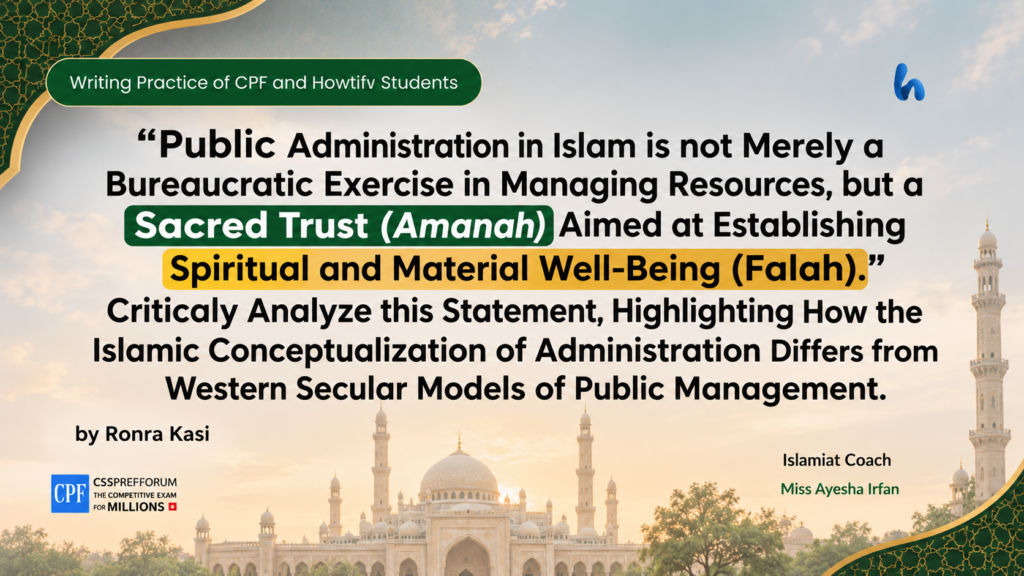
The following question of CSS Islamiat is solved by Ronra Kasi under the supervision of Howfiv’s Islamiat coach, Miss Ayesha Irfan. She learnt how to attempt 20 marks question and essay writing from Sir Syed Kazim Ali, Pakistan’s best CSS and PMS English essay and precis teacher with the highest success rate of his students. This solved question is attempted on the pattern taught by Sir to his students, scoring the highest marks in compulsory and optional subjects for years.

Outline
1-Introduction
2-Dissecting the Statement: Public Administration in Islam is not Merely a Bureaucratic Exercise in Managing Resources, but a Sacred Trust (Amanah) Aimed at Establishing Spiritual and Material Well-Being (Falah)
3-Contrasting Islamic Conceptualization of Administration with Western Secular Models of Public Management
- Divine Khilafah (Vicegerency) vs. Popular Sovereignty
- Amanah (Sacred Trust) vs. Legal-Contractual Accountability
- Adl (Justice) as Absolute Divine Command vs. Procedural Legal Justice
- Justice Even Against Self-Interest (4:135) vs. Interest-Based Policy Making
- Shura (Consultation) vs. Secular Representative Democracy
- Zakat as Divine Right of the Poor vs. Welfare as State Discretion
- Mizan (Balance/Justice) as Civilizational Purpose vs. GDP or Efficiency Metric
- Falah (Success in Both Worlds) as the End-Goal vs. Utilitarian Welfare Maximization
4-Critical Analysis
5- Conclusion
Answer to the Question
Introduction
Public administration in Islam refers to the divinely-ordained management of state affairs as a sacred trust (Amanah), not a mere bureaucratic exercise in handling resources. However, Islamic teachings, rooted in the Quran and Sunnah, direct rulers toward both spiritual and material well-being (Falah), unlike Western secular models that separate administration from morality and confine it to efficiency and legality alone. Moreover, concepts like Khilafah, Shura, and accountability before Allah distinguish this framework sharply. To sum up, Islamic public administration remains a comprehensive, God-conscious system aimed at holistic human welfare.
Dissecting the Statement: Public Administration in Islam is not Merely a Bureaucratic Exercise in Managing Resources, but a Sacred Trust (Amanah)
This statement carries a dual claim that forms the very heart of Islamic political thought. First, it rejects the idea that public administration is a neutral, mechanical process of managing files, budgets, and manpower, the way modern bureaucracy often treats it. Second, it elevates administration to the level of Amanah, a sacred trust placed upon the ruler by Allah Himself, for which he is directly answerable on the Day of Judgment, not just to an institution or the public. Additionally, this trust isn’t meant to serve worldly efficiency alone; rather, its ultimate purpose is Falah, success that covers both spiritual and material dimensions of human life. In other words, an Islamic administrator is not just solving problems of roads, taxes, and law and order, he’s also responsible for the moral and spiritual health of the society he governs. In other words, this is precisely what separates Islamic administration from a purely technical, results-driven Western model: one measures success in output and GDP, the other measures it in justice, accountability, and closeness to Allah.
Contrasting Islamic Conceptualization of Administration with Western Secular Models of Public Management
- Divine Khilafah (Vicegerency) vs. Popular Sovereignty
To begin with, Islam roots political authority in a divine appointment, not in human will alone. The ruler is not a self-made master of the land but a trustee placed there by Allah Himself, answerable to Him for every decision. To illustrate, this idea comes straight from the Quran, where Allah says, “I will make upon the earth a vicegerent (khalifah)” (Surah Al-Baqarah 2:30). To be sure, this verse tells us that man’s authority on earth is borrowed, not owned, and every administrator carries this responsibility whether he realizes it or not. On the contrary, Western liberal thought have completely different point of view. For instance, thinkers like Rousseau and Locke placed sovereignty entirely in “the people” through a social contract, meaning legitimacy comes from public consent, not divine will. In this view, a ruler answers only to the electorate or the law, with no higher moral court to fear. Clearly, the Islamic model builds in a permanent sense of accountability that no election cycle can ever replace.
- Amanah (Sacred Trust) vs. Legal-Contractual Accountability
Further to this, public office in Islam is treated as a trust, and trust brings a weight that ordinary jobs do not carry. Moreover, an administrator is not simply doing a task;instead, he is guarding something that belongs to Allah and the people, and one day he will have to answer for how he handled it. As an illustration, the Quran makes this crystal clear: “Allah commands you to render trusts to whom they are due” (Surah An-Nisa 4:58). To be sure, this verse shows that fulfilling duties honestly is not just professional ethics in Islam, it is a religious command. Notwithstanding this, Western system have a different approach. To illustrate, in the Western concept, accountability mostly comes from legal-contractual mechanisms, civil service codes, employment law, and audits enforced by courts and institutions. Here, an officer is answerable to paperwork and procedure, not to conscience. Stemming from this reality, the Islamic concept clearly goes deeper, since even where the law falls short, the sense of divine trust still holds a person back from wrongdoing.
- Adl (Justice) as Absolute Divine Command vs. Procedural Legal Justice
Adding on to the above, justice in Islam is not something to be adjusted or negotiated, it is a straight order from Allah with zero exceptions. Whether or not the law technically allows something, if it is not just, a Muslim administrator has no room to justify it. In particular, the Quran states, “Allah commands justice and good conduct” (Surah An-Nahl 16:90). Accordingly, this one line makes justice a moral obligation of the heart, not just a legal box to tick. On the other side, Western administrative justice runs on procedure: due process, statutory compliance, and codified law. Compounding this further, as long as the paperwork is correct and the process was followed, the outcome is considered “just,” even if a loophole was used to escape real fairness. To summarize, this is exactly where the Islamic model wins, because it closes the very loopholes that a purely procedural system leaves wide open.
- Justice Even Against Self-Interest vs. Interest-Based Policy-Making
Hand in hand with this, Islam doesn’t just ask for justice in general, it demands justice even when it costs you personally. Undeniably, this is one of the toughest tests of sincerity in leadership: standing for truth even against one’s own family or one’s own benefit. For instance, the Quran commands, “Stand firmly for justice… even if it be against yourselves or parents” (Surah An-Nisa 4:135). Moreover, this verse removes every excuse a person could use to bend the rules for someone close to them. In sharp contrast to this, Western pluralist models, where interest-group theory and lobbying are treated as a normal, even necessary, part of policy-making. Here, competing self-interests are not something to rise above, they’re baked into the system as legitimate inputs. Therefore, Islamic approach is clearly superior here, since it asks leaders to rise above self-interest completely, rather than just balancing it politically.
- Shura (Consultation) vs. Secular Representative Democracy
In the same vein, consultation in Islam is not a political strategy, it is treated almost like an act of worship. Its worth noting that, when a ruler consults his people, he is not just being practical, he’s fulfilling a spiritual duty tied directly to his faith. To illustrate, the Quran says, “Their affair is [determined by] consultation among themselves” (Surah Ash-Shura 42:38), placing shura right alongside prayer and charity in the same passage. Without a shadow of doubt, this shows consultation is a moral value, not just a governance tool. On the other hand, Western representative democracy institutionalizes consultation through periodic elections, party competition, and majority voting, a purely procedural mechanism repeated every few years. To be sure, it is mechanical, tied to timelines and vote counts, not to any deeper sense of moral duty. The Islamic model again stands out, because it makes consultation a continuous moral habit rather than a scheduled political event.
- Zakat as Divine Right of the Poor vs. Welfare as State Discretion
Adding on, in Islam, the poor do not have to beg for help, they already own a share in the wealth of the rich, whether the rich person agrees or not. Accordingly, this completely changes how redistribution is viewed, it is not charity from above, it is a right owed from below. For instance, the Quran confirms this: “In their wealth was a rightful share for the beggar and the deprived” (Surah Adh-Dhariyat 51:19). To be sure, this verse makes the poor’s share a fixed obligation, not a favor. On the contrary, comparing this to Western welfare states, this works entirely different. To illustrate, the redistribution in Western system is treated as a policy choice, shifting with budgets, elections, and changing ideologies, sometimes expanding, sometimes cut back entirely through austerity. To sum up, Islam’s model is clearly stronger here, owing to it protects the poor’s rights from ever being erased by a change in government mood or economic policy.
- Mizan (Balance/Justice) as Civilizational Purpose vs. GDP or Efficiency Metrics
Equally significant, Islam sees justice not as one goal among many, but as the entire reason governance and revelation exist in the first place. Nothing, not even economic progress, is allowed to come before it. As an illustration, the Quran asserts, “We sent down the Book and the Balance that people may uphold justice” (Surah Al-Hadid 57:25). Indeed, this is tying divine guidance directly to the establishment of justice on earth. Likewise, this means a Muslim administrator’s real success is measured by fairness, not figures. At the same time, Western public management, especially under New Public Management, measures success through efficiency, cost-effectiveness, and GDP-style growth indicators, numbers that say nothing about whether ordinary people are actually being treated fairly. Therefore, the Islamic model is clearly more meaningful here, since it refuses to let numbers replace justice as the true measure of good governance.
- Falah (Success in Both Worlds) as the End-Goal vs. Utilitarian Welfare Maximization
At the end of the day, Islam does not just want people comfortable in this life, it wants them successful in both this world and the next. This dual goal, Falah, is what separates Islamic governance from every purely worldly system. For instance, the Quran reinforces this same spirit: “Indeed, Allah commands justice, grace, as well as generosity to close relatives. He forbids indecency, wickedness, and aggression. He instructs you so perhaps you will be mindful” (Surah An-Nahl 16:90). In no uncertain terms, this verse shows that moral conduct here is directly tied to a person’s ultimate success, not just their present comfort. In contrast, Western utilitarian models, following thinkers like Bentham and modern cost-benefit analysis, define “the good” purely as maximizing material welfare or happiness, with no accountability beyond this worldly life at all. To conclude, Islam’s vision is clearly the more complete one, because it ties every administrative action to a purpose that outlasts this world entirely.
Critical Analysis
Ironically, the modern Muslim world has drifted far from this ideal of Amanah and Falah that the statement demands. Instead of treating public office as a sacred trust, corruption, nepotism, and self-interest have become the defining features of administration in many Muslim-majority states, including Pakistan. To illustrate, Transparency International’s Corruption Perceptions Index 2025 places Pakistan at 136th out of 182 countries with a score of just 28 out of 100, far below the global average of 42, reflecting how deeply public trust has been compromised in practice. The main reason behind this gap is the near-total replacement of Islamic accountability (Ihtisab) with Western bureaucratic procedure, where officials fear audits and courts but rarely fear Allah in their daily conduct. Therefore, it is necessary to revive genuine Amanah-based governance through moral training of civil servants alongside institutional reform, so that administration once again becomes a means of Falah rather than a tool of personal gain.
Conclusion
The inescapable conclusion is, public administration in Islam is not a mere bureaucratic exercise in resource management but a sacred trust (Amanah) demanding justice, consultation, and accountability before Allah, aimed at Falah in both worlds. However, Western secular models, though efficient, confine administration to law and utility, detached from moral or spiritual accountability. Of particular significance here is, this not only distinguishes Islam’s holistic vision from mechanical Western governance but also offers a corrective for today’s crisis-ridden bureaucracies. In short, Islamic administration remains a complete, God-conscious code for just and humane governance.
Searching for CSS or PMS Solved Islamiat Past Papers?
Are you preparing for the CSS or PMS and searching for solved Islamiat past papers, notes, books, PDFs, and MCQs? Explore them for free on Howtests and Cssprepforum. All content is fully solved and written by Miss Ayesha Irfan. For your convenience, the links are provided below. Simply click on any to start reading and preparing.