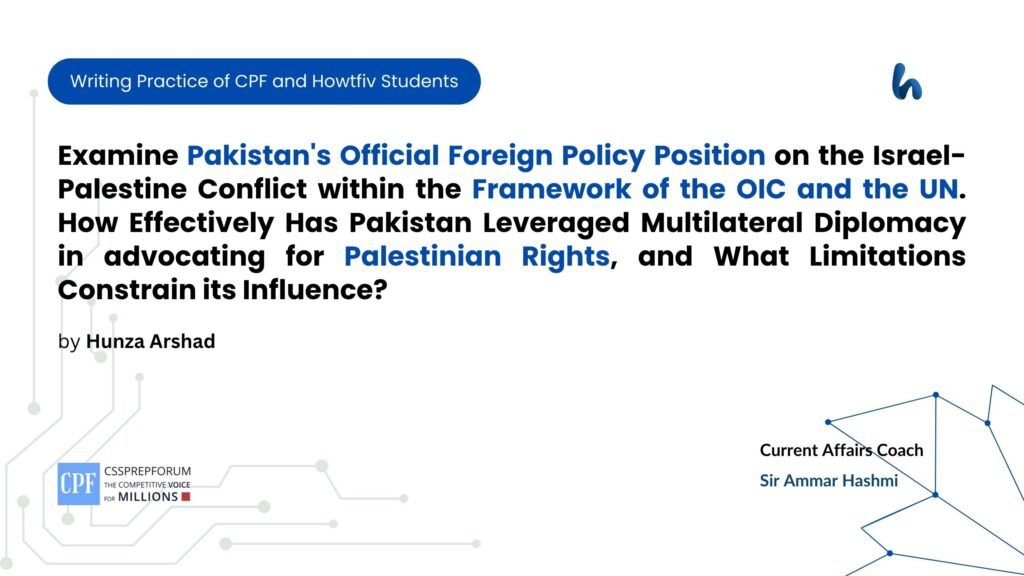
CSS Current Affairs | Pakistan’s Official Foreign Policy Position on the Israel-Palestine Conflict
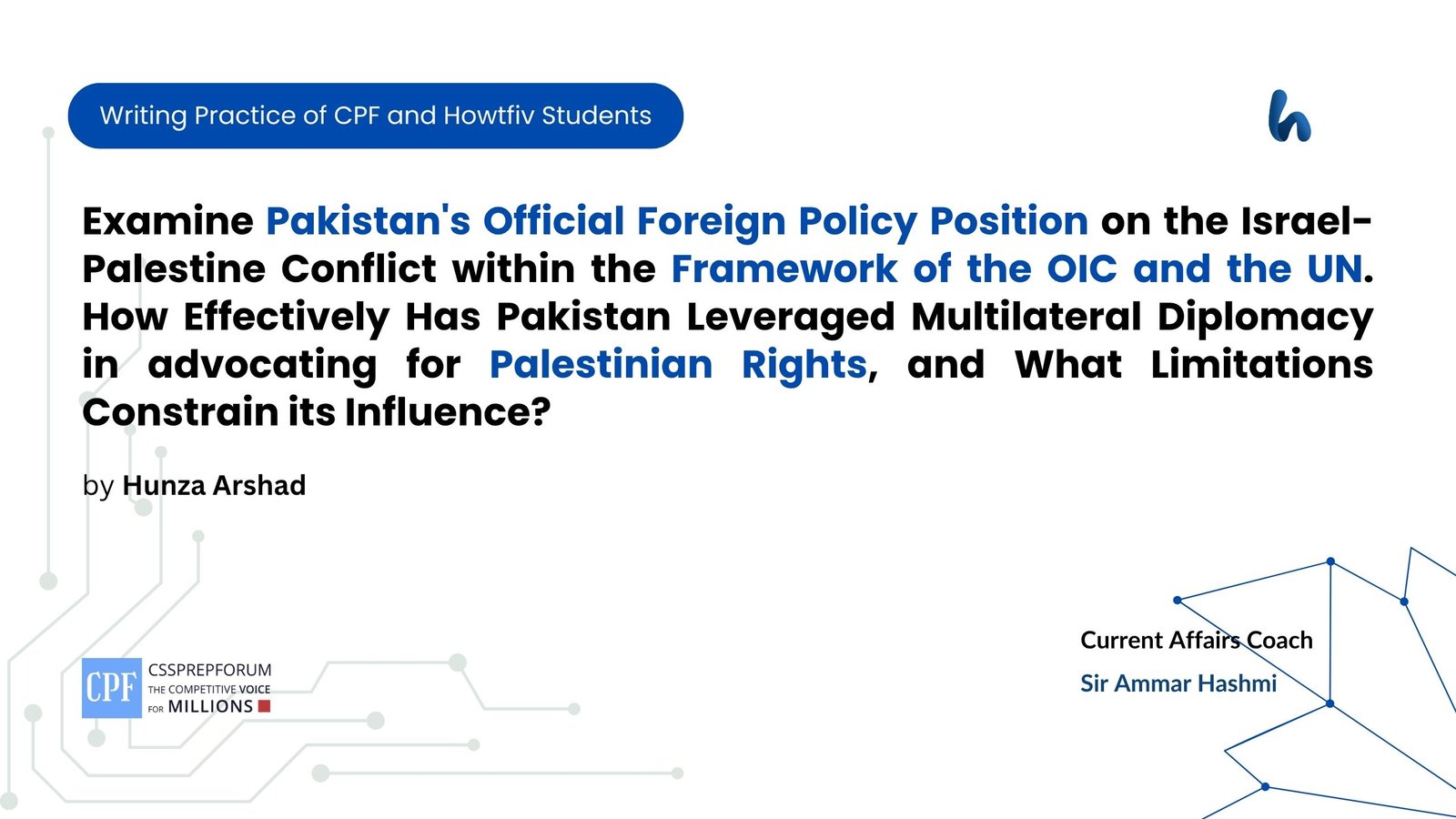
The following assignment question for CSS Current Affairs is solved by Hunza Arshad under the supervision of Howfiv’s Pakistan Affairs and Current Affairs Coaches: Miss Iqra Ali and Sir Ammar Hashmi. She learnt how to attempt 20 marks question and essay writing from Sir Syed Kazim Ali, Pakistan’s best CSS and PMS English essay and precis teacher with the highest success rate of his students. This solved question is attempted on the pattern taught by Sir to his students, scoring the highest marks in compulsory and optional subjects for years.
Outline
1-Introduction
2-Pakistan’s Foreign Policy Position on the Palestine-Israel Issue within the UN and OIC
- Pakistan’s Foreign Policy Position on the Palestine-Israel Issue in the United Nations (UN) Arena
- Utilizing the UN General Assembly (UNGA) to mobilize the Global South.
- Advocacy for humanitarian pauses, ceasefires, and UNRWA funding during escalations.
- Engaging with legal mechanisms (e.g., supporting International Court of Justice (ICJ) advisory opinions on the occupied territories).
- Pakistan’s Foreign Policy Position on the Palestine-Israel Issue in the Organization of Islamic Cooperation (OIC) Arena
- Pakistan’s historical role as a founding member and frequent driver of OIC resolutions.
- Leveraging the OIC to forge a collective Muslim bloc consensus.
- Enforcing symbolic and practical state-level mandates (e.g., travel/passport restrictions).
3-Evaluation of Effectiveness: How Pakistan Leverages Its Diplomacy
- Coalition Building: Aligning with the Arab Group and the Non-Aligned Movement (NAM) to pass majority resolutions in the UNGA.
- The “Vocal Champion” Role: Acting as a diplomatic bridge and orator for the Muslim world when Arab states face geopolitical constraints.
- Legal & Normative Contributions: Contributing to the documentation of human rights violations at the UN Human Rights Council (UNHRC).
4-Systemic and Structural Limitations Constraining Pakistan’s Influence
- The Changing Middle Eastern Landscape: The impact of the Abraham Accords and the normalization of ties between Israel and key Gulf nations (Pakistan’s traditional financial benefactors)
- Economic Dependency and Vulnerability: How Pakistan’s reliance on Western-dominated financial institutions (IMF/World Bank) and Gulf aid limits its retaliatory or aggressive diplomatic leverage
- Great Power Politics: The structural power imbalance within the UNSC (specifically the US veto power) which neutralizes Pakistan’s UNGA-level successes.
5-Critical Analysis
6-Conclusion
Answer to the question
Introduction
Pakistan’s stance on the Israel-Palestine conflict is not merely a geopolitical calculation; it is a foundational pillar of the international identity. Even before the inception of Pakistan, Muhammad Ali Jinnah deliberately advocated for Palestinian self-determination and vehemently opposed the Zionist project of a Greater Israel. Upon independence in 1947, Pakistan firmly institutionalized this ideological commitment and consistently refused the de jure recognition of Israel. While Pakistan maintains a principled, unyielding stance on Palestinian self-determination across multilateral forums, its actual diplomatic efficacy is increasingly constrained by systemic global power shifts, regional realignments in the Middle East, and domestic economic vulnerabilities.
Pakistan’s Foreign Policy Position on the Palestine-Israel Issue within the UN and OIC
- Pakistan’s foreign policy position on the Palestine-Israel issue in the United Nations (UN) Arena
- Utilizing the UN General Assembly (UNGA) to mobilize the Global South
Pakistan’s approach to the UNGA is its reaction to the structural gridlock mechanism of the United Nations Security Council, where resolutions on Palestine get vetoed and paralyzed. Pakistan treats the UNGA as the world’s parliament, where democratic numbers override exceptional veto privileges. This voting attitude on the UNGA platform escalates the issue in the Global South, where every country, following the rule of one state, one vote, demonstrates collective strength and promotes a normative coalition. Meanwhile, Pakistan is also actively coordinating with the Non-Aligned Movement (NAM) and the Arab Group to solidify its stance. Additionally, Pakistan has highlighted the issue in the Emergency Special Session during the United Nations General Assembly. It frames the conflict not only as a regional dispute but also as a universal issue of International law, Human rights, and the Right to self-determination.
- Advocacy for humanitarian pauses, ceasefires, and UNRWA funding during escalations
Pakistan’s multilateral diplomacy is active not just during quiet diplomatic periods but also becomes highly intensive during active escalation, where Pakistan shifts its focus toward immediate life-saving intervention and protecting the international institutional framework that keeps Palestinians alive. Pakistan utilizes every multilateral pulpit to demand immediate, unconditional, and permanent ceasefires and humanitarian pauses. Moreover, when Western donors periodically freeze or threaten UNRWA’s funding due to political pressure, Pakistan serves as a fierce, vocal defender of the agency because UNRWA is not only a charity but also an indispensable and irreplaceable lifeline for millions of refugees in Palestine.
- Engaging with legal mechanisms (e.g., supporting International Court of Justice (ICJ) advisory opinions on the occupied territories)
Pakistan shows its stance, which is built on solid International Law rather than political or emotional rhetoric, by engaging the International Court of Justice(ICJ). Pakistan actively participated in the ICJ proceedings concerning the Legal Consequences arising from policies and practices of Israel in the Occupied Palestinian Territory. The state has submitted robust written statements and delivered oral arguments at The Hague, declaring that Israel’s prolonged occupation amounts to de facto annexation and systematic apartheid. Moreover, the country has used its diplomatic weight to demand the full, immediate implementation of the ICJ’s historic advisory opinions, particularly those affirming the inalienable right of Palestinians to self-determination and declaring the settlements illegal.
- Pakistan’s foreign policy position on the Palestine-Israel issue in the Organization of Islamic Cooperation (OIC) Arena
- Pakistan’s historical role as a founding member and frequent driver of OIC resolutions
Pakistan is a founding member of the Organization of Islamic Cooperation (OIC), and under Article 40 of the Constitution of Pakistan, Pakistan is strengthening ties with the Muslim world, which elevates Pakistan’s OIC diplomacy from mere policy to supreme state law. Pakistan plays leadership roles at the OIC, such as taking charge of the chairmanship of the OIC Council of Foreign Ministers (CFM), and occupying one of the six seats of the OIC Committee of Six on Palestine. The state is enforcing a unified “Pan-Islamic Front” by using these bodies to ensure the maintenance of a collective position on ceasefires and blockades in Palestine, despite massive external geopolitical pressures. This tactic of the country turns the OIC into a platform where it protects Palestinian rights while simultaneously validating its own foundational foreign policy narratives.
- Leveraging the OIC to forge a collective Muslim bloc consensus
Pakistan strategically utilizes the OIC to forge a uniform, non-negotiable baseline across all 57 member states and keeps the resolutions strictly aligned with Palestinian-vetted priorities; meanwhile, it ensures that no Muslim nation can quietly dilute the collective stance under external geopolitical pressure. Additionally, Pakistan’s continued building of bullet proof consensus on Palestine strengthens the OIC’s consensus, while utilizing pan-Islamic solidarity to fortify its own core national security narrative. Moreover, Pakistan uses the OIC group, especially in Geneva and New York, to maintain a strict policy of non-engagement with Israel. As the Ministry of Foreign Affairs frequently reiterates, Pakistan works through the OIC bloc to push back against any backdoor attempts to accommodate normalizing frameworks, keeping the collective focus entirely on accountability, ceasefire, and the legal ruling of the ICJ.
- Enforcing symbolic and practical state-level mandates (e.g., travel/passport restrictions)
Pakistan is not only holding refusal to recognize Israel just rhetorically but also demonstrating that it is explicitly coded into its legal and bureaucratic identity document carried by every single one of its citizens. Pakistan is one of the few countries that enforces an absolute, state-level travel ban and passport invalidation regarding Israel, which is serving as a practical enforcement of non-recognition. Moreover, under Pakistan’s passport and immigration laws, using alternate routes or secondary documents to bypass this restriction is treated as a serious criminal offense, potentially leading to the revocation of citizenship, blacklisting, or criminal prosecution under state exit control laws. Thus, these all function as a shield against global diplomatic trends
Evaluation of Effectiveness: How Pakistan Leverages Its Diplomacy
- Coalition Building: Aligning with the Arab Group and the Non-Aligned Movement (NAM) to pass majority resolutions in the UNGA.
Pakistan recognizes that it cannot influence the Israel-Palestine conflict through raw military or economic power alone; therefore, it engages in force multiplication by aligning its voting patterns, text drafting, and diplomatic lobbying with powerful, pre-existing voting blocs like the NAM and the Arab Group. Whenever the USA vetoes a ceasefire or structural resolution in the UNSC, Pakistan works closely with the Arab Group to immediately trigger Emergency Special Sessions in the General Assembly and helps secure overwhelming majorities by pooling votes with NAM, which represents over 120 developing nations. As thus, Pakistan utilizes the NAM/Global South coalition to pass its historic and annual flagship UNGA resolution on the Universal Realization of the Right of Peoples to Self-Determination, and after getting this sponsored text, it skillfully embeds the Palestinian cause into a broader, globally accepted anti-colonial legal framework.
- The “Vocal Champion” Role: Acting as a diplomatic bridge and orator for the Muslim world when Arab states face geopolitical constraints
Due to heavy economic, security, and diplomatic dependency on Western powers, many frontline Arab states frequently find themselves structurally constrained, unable to offer aggressive rhetoric or push for highly punitive actions against Israel or its allies without risking severe bilateral fallout. In contrast, Pakistan, geographically detached from the immediate borders of the Levant yet structurally integrated into the Muslim world, acts as an unconstrained “orator” or “vocal champion” for the wider Muslim Ummah. Pakistan’s strategic importance and its strong, multi-decade defense ties with Gulf states allow it to articulate what Arab capitals might privately support but cannot publicly champion, as Pakistan utilized diplomatic machinery at the UN and OIC to hold the line, loudly demanding that any regional integration is strictly conditional on a sovereign Palestinian state. Hence, Pakistan’s vocal leadership helps bridge the gap between Arab states and the wider world, and by leading the narrative charge, it ensures that the Palestine issue remains framed as a universal pan-Islamic struggle rather than a localized, purely ethnic Arab dispute.
- Legal & Normative Contributions: Contributing to the documentation of human rights violations at the UN Human Rights Council (UNHRC)
Pakistan works systematically to document violations, establish accountability mechanisms, and formalize international human rights law in the United Nations Human Rights Council (UNHRC), Geneva. Its role is not just about voting but also about building a permanent, legally binding record of abuses. Pakistan leverages this to ensure that violations, ranging from the expansion of illegal settlements to systemic discrimination, are formally catalogued by the UN, preventing them from being ignored by the international community. Pakistan’s Permanent Representative to the UN in Geneva regularly introduces crucial resolutions on behalf of the OIC group, such as the landmark text, “Human rights situation in the Occupied Palestinian Territory, including East Jerusalem, and the obligation to ensure accountability and justice.” This is a demonstration of the practical legal diplomacy of Pakistan, which is leading to the establishment of independent investigations into crimes like genocide and ethnic cleansing.
Systemic and Structural Limitations Constraining Pakistan’s Influence
- The Changing Middle Eastern Landscape: The impact of the Abraham Accords and the normalization of ties between Israel and key Gulf nations (Pakistan’s traditional financial benefactors)
The primary structural constraint on the efficacy of Pakistan’s Palestine diplomacy is the rapidly evolving geopolitical landscape of the Middle East, catalyzed by the expansion of normalization frameworks like the Abraham Accords. Historically, Pakistan’s multilateral strategy relied on a highly predictable, unified Arab front that maintained an absolute diplomatic and economic boycott of Israel. However, the decision of key Gulf Arab nations, traditionally Pakistan’s closest strategic and ideological allies, to formalize diplomatic, economic, and security ties with Tel Aviv has fundamentally fractured this Pan-Islamic consensus. As these vital regional powers pivot toward a pragmatic, interest-driven bilateral alignment with Israel, Pakistan’s traditional rhetoric of total diplomatic isolation becomes increasingly decoupled from the regional reality, reducing the tangible impact of its resolution within bodies like the Organization of Islamic Cooperation (OIC).
- Economic Dependency and Vulnerability: How Pakistan’s reliance on Western-dominated financial institutions (IMF/World Bank) and Gulf aid limits its retaliatory or aggressive diplomatic leverage
Pakistan’s chronic payments crisis forces it into successive, highly restrictive structural adjustment programs with the International Monetary Fund (IMF) and the World Bank, which carry the major influence of the US and affect Pakistan’s economic survival and bind its institutional frameworks in the background of the Middle East. Besides it, according to recent assessments, workers’ remittances from the Gulf account for over 55% of Pakistan’s total inflow, translating to roughly 9% of national GDP. This cash injection acts as the literal floor, keeping the domestic consumer economy and balance of payments afloat. As these traditional financial benefactors navigate their own pragmatic, interest-driven regional realignment, Pakistan’s diplomatic room for maneuver shrinks.
- Great Power Politics: The structural power imbalance within the UNSC (specifically the US veto power) which neutralizes Pakistan’s UNGA-level successes
The most insurmountable institutional limitation constraining Pakistan’s Palestine diplomacy is the rigid, asymmetric power architecture of the United Nations itself. Pakistan excels at normative coalition building, routinely marshaling overwhelming majorities within the UNGA to pass high-principled resolutions regarding self-determination, humanitarian pauses, and the illegality of settlements. This structural division creates a permanent bottleneck that consistently neutralizes Pakistan’s multilateral achievements. Whenever Pakistan, working in tandem with the Arab Group and the Non-Aligned Movement (NAM), successfully elevates a crisis to the global stage, the strategic deployment of the permanent veto power by the United States acting on behalf of its key regional ally serves as a terminal roadblock. Whether blocking demands for permanent ceasefires or shielding the occupying power from international legal accountability, the unilateral UNSC veto renders Pakistan’s hard-won legislative majorities operationally toothless. Consequently, this deep power asymmetry highlights a tragic reality within contemporary multilateralism: no matter how flawlessly Pakistan rallies global diplomatic or moral consensus, its normative successes cannot override the realpolitik defense mechanisms of a veto-wielding superpower.
Critical Overview
The core of Pakistan’s Palestine diplomacy is defined by a deep, structural paradox. On one hand, Islamabad operates as a highly successful normative entrepreneur in international law. Its work rallying voting majorities at the UN General Assembly (UNGA), codifying human rights breaches at the UNHRC, and presenting robust legal arguments at the International Court of Justice (ICJ) is structurally flawless. Pakistan successfully elevates a localized territorial occupation into a universal, anti-colonial campaign for the right to self-determination. However, this normative power constantly collides with material vulnerabilities. Pakistan’s structural dependency on international financial institutions (like the IMF) and liquidity injections, deferred oil credits, and remittances from Gulf Arab monarchies creates a hard ceiling. This asymmetry means that while Pakistan possesses the sovereign autonomy to draft global law, it lacks the material leverage to enforce it. It cannot pursue aggressive, retaliatory statecraft without threatening its own domestic economic survival.
Conclusion
Pakistan’s Palestine diplomacy exemplifies an ideological-realpolitik paradox, combining highly successful normative advocacy through global voting blocs like the OIC and NAM with strict administrative mandates like sovereign passport bans to assert its non-recognition policy. However, this value-driven statecraft consistently collides with an invisible diplomatic ceiling imposed by structural economic vulnerabilities, including a deep reliance on Western-dominated financial institutions and Gulf aid corridors. Ultimately, restricted by a rigid United Nations architecture where the United States’ veto routinely neutralizes General Assembly consensus, Pakistan’s unyielding domestic consensus allows it to hold its red lines and remain an indispensable principled anchor in a fragmenting Middle Eastern landscape.

CSS Solved Past Papers’ Essays
Looking for the last ten years of CSS and PMS Solved Essays and want to know how Sir Kazim’s students write and score the highest marks in the essays’ papers? Then, click on the CSS Solved Essays to start reading them.
CSS Solved Essays
CSS Solved Islamiyat Past Papers
Want to read the last ten years’ Islamiyat Solved Past Papers to learn how to attempt them and to score high? Let’s click on the link below to read them all freely. All past papers have been solved by Pakistan’s top CSS Islamiyat coaches having the highest score of their students.
CSS Solved Islamiyat
CSS Solved General Science & Ability Past Papers
Want to read the last ten years’ General Science & Ability Solved Past Papers to learn how to attempt them and to score high? Let’s click on the link below to read them all freely. All past papers have been solved by Pakistan’s top CSS GSA coachez having the highest score of their students.
CSS Solved General Science & Ability
CSS Solved Pakistan Affairs Past Papers
Want to read the last fifteen years’ Pakistan Affairs Solved Past Papers to learn how to attempt them and to score high? Let’s click on the link below to read them all freely. All past papers have been solved by Pakistan’s top CSS Pakistan Affairs coaches having the highest score of their students.
CSS Solved Pakistan Affairs
CSS Solved Current Affairs Past Papers
Want to read the last fifteen years’ Current Affairs Solved Past Papers to learn how to attempt them and to score high? Let’s click on the link below to read them all freely. All past papers have been solved by Pakistan’s top CSS Current Affairs coaches having the highest score of their students.
CSS Solved Current Affairs