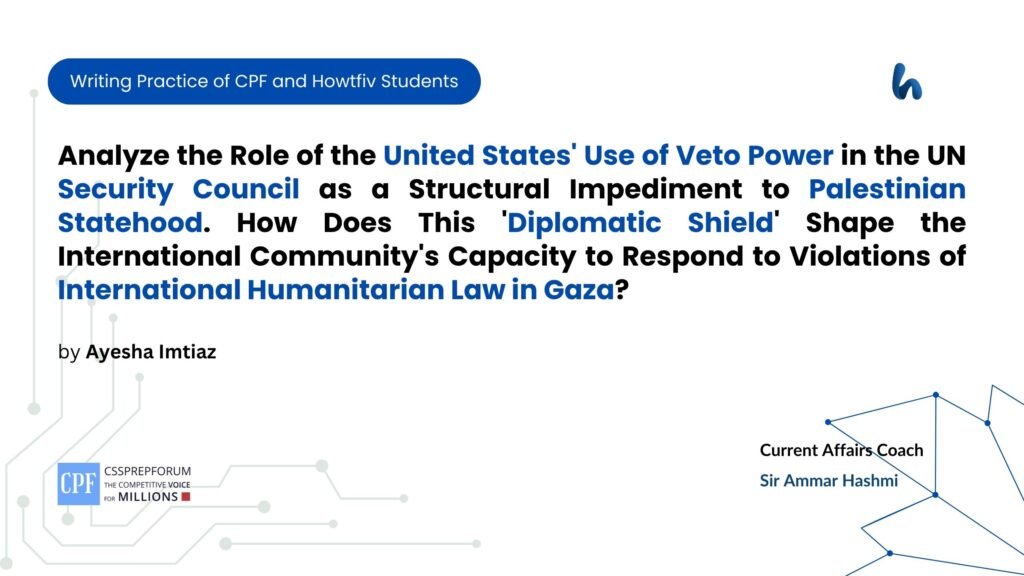
CSS Current Affairs | Role of the US Veto Power in the UNSC as a Structural Impediment to Palestinian Statehood
The following assignment question for CSS Current Affairs is solved by Ayesha Imtiaz under the supervision of Howfiv’s Pakistan Affairs and Current Affairs Coaches: Miss Iqra Ali and Sir Ammar Hashmi. She learnt how to attempt 20 marks question and essay writing from Sir Syed Kazim Ali, Pakistan’s best CSS and PMS English essay and precis teacher with the highest success rate of his students. This solved question is attempted on the pattern taught by Sir to his students, scoring the highest marks in compulsory and optional subjects for years.
Outline
1-Introduction
2-The US Position Within the UNSC P5
3-Analyzing the U.S. Security Council Veto as a Structural Barrier to Palestinian Statehood
- The Constitutional Gatekeeper: How the U.S. Veto Halts Full UN Membership at the Security Council
- Enforcing Bilateralism: Bypassing Multilateral UN Frameworks in Favor of Direct Israel-Palestine Talks
- Creating Legal Limbo: Undermining International Court Consensus and Restricting Global Legal Status
- Redefining “Peace and Security”: Shielding Israeli Settlements and Framing Occupation as a Regional Necessity
4-How the U.S. Diplomatic Shield Paralyses International Humanitarian Law in Gaza
- Blocking Access to the UN: How the U.S. Veto Preemptively Halts Palestine’s Path to Full Membership
- Forcing Bilateral Negotiations: Using the Veto to Bypass Multilateral UN Frameworks in Favor of Direct Talks
- Instituting Legal Limbo: Undermining International Court Consensus and Stripping Palestine of Global Legal Protections
5-Conclusion
Answer to the question
Introduction
The United States’ use of its veto power in the UN Security Council is a major structural barrier to Palestinian statehood. It serves as a permanent diplomatic shield, preventing the international community from enforcing global rules. Ironically, this action hinders the UN’s potential to protect civilians or to respond effectively to violations of international humanitarian law in Gaza. And this international law has been reduced to a set of moral suggestions. Ultimately, this deadlock leaves the conflict unaddressed, which deeply damages the credibility of the United Nations itself, alongside impeding the Palestinians’ right to independent land.
The US Position Within the UNSC P5
The United States holds a deeply powerful position among the five permanent members (the P5) of the UN Security Council. Because the US helped create the UN, it has the special power to veto, or block, any major global decision it dislikes. This means no major UN rule can pass if the US says no. Additionally, it allies with the UK and France to promote Western interests and global security. However, this powerful position also puts the US in a constant struggle with Russia and China. Because those two countries also have veto power, they often block US plans. This power tussle hampers the very basic structure of the UN, leading to failure in resolving several global conflicts.
- The Constitutional Gatekeeper: How the U.S. Veto Halts Full UN Membership at the Security Council
The United States is one of the P5 countries whose veto power enforces the Constitutional Gatekeeper Rule. The United States can use its power to block Palestine’s application, preventing it from ever reaching the General Assembly for a vote. Under Chapter II, Article 4 of the UN Charter, admitting any new country to full UN membership requires a strict, two-step constitutional process. First, the Security Council must issue a formal recommendation, requiring at least 9 affirmative votes and zero vetoes from the five permanent members. This means that because the United States is one of the five permanent members, its single “no” vote acts as a permanent lock on the UN’s doorway, hindering Palestine’s journey to statehood before it can even begin. Therefore, by keeping this gate firmly shut, the U.S. veto serves as a permanent, built-in roadblock that keeps Palestinian statehood out of reach.
- Enforcing Bilateralism: Bypassing Multilateral UN Frameworks in Favor of Direct Israel-Palestine Talks
The United States uses its veto power to enforce its foreign policy, advancing the idea that Palestine should only become an independent country through direct, private talks with Israel, not through UN orders. By blocking UN resolutions that support a sovereign Palestinian state, the US veto keeps the issue trapped. Although bilateral negotiations have not been effective, the US still insists that Palestine negotiate directly with Israel. Unfortunately, this American veto power keeps the conflict stuck in a loop, thereby directly hampering the establishment of a Palestinian state.
- Creating Legal Limbo: Undermining International Court Consensus and Restricting Global Legal Status
The U.S. veto not only favors Israel’s plans but also uses its power to resist the creation of a separate Palestinian homeland. Having used its veto power at least 34 times to block UN Security Council resolutions, the United States consistently undermines international consensus. Additionally, the International Court of Justice (ICJ) has affirmed that the Palestinian right to self-determination is erga omnes (an obligation owed to the international community as a whole). Unfortunately, the U.S. veto effectively nullifies this consensus within the UN framework. Ironically, it obstructs the Palestinian right to self-governance. This persistent use of power has trapped Palestine, leaving it unable to get the full legal status it needs to sign international treaties, protect its land, or hold Israel accountable in global courts. Therefore, the veto acts as an obstruction that keeps Palestine stuck in a legal limbo where international laws exist on paper but have no real power, ultimately perpetuating the status quo.
- Redefining “Peace and Security”: Shielding Israeli Settlements and Framing Occupation as a Regional Necessity
The veto structurally reflects the U.S. framework for defining UN “peace and security,” forcing other nations to perceive the conflict through the same lens. Although the United States positions itself as a custodian of global peace, it consistently blocks any resolution that criticizes Israeli settlements or military actions. By doing so, the U.S. forces the Security Council to interpret the conflict solely through the prism of Israeli security demands, which cripples the Council’s ability to impose sanctions or demand a withdrawal to the 1967 borders, as mandated by Resolution 242. This narrative twistedly presents the occupation not as an illegal takeover of land, but as a necessary mechanism to keep the region stable. Therefore, dismantling any international pressure for a two-state solution.
How the U.S. Diplomatic Shield Paralyses International Humanitarian Law in Gaza
- Blocking Access to the UN: How the U.S. Veto Preemptively Halts Palestine’s Path to Full Membership
The United States is one of the P5 countries whose veto power enforces the Constitutional Gatekeeper Rule. As a result, the United States can use its power to block Palestine’s application at the outset, preventing it from ever reaching the General Assembly for a vote. Under Chapter II, Article 4 of the UN Charter, admitting any new country to full UN membership requires a strict, two-step constitutional process. First, the Security Council must issue a formal recommendation, requiring at least 9 affirmative votes and zero vetoes from the five permanent members. This means that because the United States is one of those five permanent members, its single “no” vote acts as a permanent lock on the UN’s doorway, effectively trapping Palestine’s journey to statehood before it can even begin. Ultimately, by keeping this gate firmly shut, the U.S. veto serves as a permanent, built-in roadblock that keeps Palestinian statehood out of reach.
- Forcing Bilateral Negotiations: Using the Veto to Bypass Multilateral UN Frameworks in Favor of Direct Talks
The United States uses its veto power to enforce its foreign policy, advancing the idea that Palestine should only become an independent country through direct, private talks with Israel, not through UN orders. By blocking UN resolutions that support a sovereign Palestinian state, the US veto keeps the issue trapped. Although bilateral negotiations have not been effective, the US still insists that Palestine negotiate directly with Israel. Unfortunately, this American veto power keeps the conflict stuck in a loop, thereby directly hampering the establishment of a Palestinian state.
- Instituting Legal Limbo: Undermining International Court Consensus and Stripping Palestine of Global Legal Protections
The U.S. veto not only favors Israel’s plans but also uses its power to resist the creation of a separate Palestinian homeland. Having used its veto power to block UN Security Council resolutions dozens of times, the United States consistently undermines international consensus. While the International Court of Justice (ICJ) has affirmed that the Palestinian right to self-determination is erga omnes (an obligation owed to the international community as a whole), the U.S. veto effectively nullifies this consensus within the UN framework. Ironically, it obstructs the Palestinian right to self-governance. This persistent use of power has trapped Palestine, leaving it unable to get the full legal status it needs to sign international treaties, protect its land, or hold Israel accountable in global courts. Therefore, the veto acts as an obstruction that keeps Palestine stuck in a legal limbo where international laws exist on paper but have no real power, ultimately perpetuating the status quo.
Conclusion
In conclusion, the U.S. veto creates an unbreakable barrier to Palestinian statehood by cutting off the only path to official UN recognition. This acts as a defensive shield, altering the power of international law in Gaza, shifting it from a set of enforceable global rules into a collection of weak moral requests. Sadly, the international community lacks the physical and legal tools needed to stop civilian suffering or protect vital infrastructure. Therefore, this structural freeze leaves the conflict entirely unaddressed, severely damaging the moral authority and overall purpose of the United Nations.
CSS Solved Past Papers’ Essays
Looking for the last ten years of CSS and PMS Solved Essays and want to know how Sir Kazim’s students write and score the highest marks in the essays’ papers? Then, click on the CSS Solved Essays to start reading them.
CSS Solved Essays
CSS Solved Islamiyat Past Papers
Want to read the last ten years’ Islamiyat Solved Past Papers to learn how to attempt them and to score high? Let’s click on the link below to read them all freely. All past papers have been solved by Pakistan’s top CSS Islamiyat coaches having the highest score of their students.
CSS Solved Islamiyat
CSS Solved General Science & Ability Past Papers
Want to read the last ten years’ General Science & Ability Solved Past Papers to learn how to attempt them and to score high? Let’s click on the link below to read them all freely. All past papers have been solved by Pakistan’s top CSS GSA coachez having the highest score of their students.
CSS Solved General Science & Ability
CSS Solved Pakistan Affairs Past Papers
Want to read the last fifteen years’ Pakistan Affairs Solved Past Papers to learn how to attempt them and to score high? Let’s click on the link below to read them all freely. All past papers have been solved by Pakistan’s top CSS Pakistan Affairs coaches having the highest score of their students.
CSS Solved Pakistan Affairs
CSS Solved Current Affairs Past Papers
Want to read the last fifteen years’ Current Affairs Solved Past Papers to learn how to attempt them and to score high? Let’s click on the link below to read them all freely. All past papers have been solved by Pakistan’s top CSS Current Affairs coaches having the highest score of their students.
CSS Solved Current Affairs