CSS Pakistan Affairs | Kashmir a Continuous Threat to Regional Peace
The following assignment question for CSS Pakistan Affairs is solved by Saher Qurban under the supervision of Howfiv’s Pakistan Affairs and Current Affairs Coaches: Miss Iqra Ali and Sir Ammar Hashmi. She learnt how to attempt 20 marks question and essay writing from Sir Syed Kazim Ali, Pakistan’s best CSS and PMS English essay and precis teacher with the highest success rate of his students. This solved question is attempted on the pattern taught by Sir to his students, scoring the highest marks in compulsory and optional subjects for years.

Outline
1-Introduction
2-Historical Trajectory: From Territorial Dispute to Strategic Flashpoint
- The Post-Colonial Genesis: 1947 Partition, Instrument of Accession, and the Unimplemented UN Framework
- The Nuclear Shift (1998): Transformation of the Conventional Military Calculus
- The Post-August 2019 Reality: Constitutional Changes and Intensified Strategic Friction
3-Why the Kashmir Dispute Remains South Asia’s Volatile Nuclear Trigger
- The Operational Clash of Asymmetric Military Doctrines
- The Mechanics of the Stability-Instability Paradox
- Next-Generation Technological Disruptions and Abbreviated Warning Times
- Unilateral Border Redefinitions and Geopolitical Reshaping
4-How the Unresolved Dispute Poses a Continuous Threat to Regional Peace
- Persistent LoC Friction and the Danger of Kinetic Miscalculation
- The False Assumption of a Containable Conventional Limited War
- Paralyzing Regional Diplomacy and the Structural Weakening of SAARC
- Evolution into a Dangerous Trilateral Dilemma Involving China
- Indigenous Alienation and Internal Conflict as Escalation Triggers
5-Comparative International Frameworks for Conflict Resolution
- The Åland Islands Model: Resolving Territorial Friction Through Institutional Autonomy and Demilitarization
- The Good Friday Agreement Framework: Bypassing Rigid Sovereignty Barriers Through Institutional Co-Management
6-Tailored Policy Suggestions for Regional Peace
- Implementing Phased Local Demilitarization and Self-Governance Frameworks
- Opening Cross-LoC Trade and Transit Corridors to Create Soft Borders
- Stabilizing Peripheral Regions to Isolate the Core Dispute
- Establishing Joint Institutional Mechanisms for Local Self-Governance
- Institutionalizing Direct Emergency Lines via Nuclear Risk Reduction Centers (NRRCs)
7-Conclusion
Answer to the question
Introduction
The contemporary geopolitical landscape of South Asia is structurally defined by an existential vulnerability: the unresolved conflict over Jammu and Kashmir. Once a localized post-colonial boundary friction, the dispute has irrevocably transformed into the world’s most volatile nuclear flashpoint. The overt weaponisation of the subcontinent in 1998 fundamentally shifted the strategic calculus, overlaying a conventional real estate dispute with the existential threat of mutually assured destruction. Today, the continuous threat to regional peace stems not merely from conflicting territorial assertions, but from an operational environment where compressed decision-making timelines, asymmetric military doctrines, and a total collapse of bilateral diplomacy invite catastrophic miscalculation. If left unaddressed, the structural friction along the Line of Control (LoC) remains an active trigger for global atomic escalation. However, transitioning South Asia from an era of perpetual crisis management to a sustainable paradigm of cooperative peace requires moving past historical zero-sum rigidities. By drawing upon global conflict-resolution precedents such as the institutional autonomy of the Åland Islands and the soft-border mechanisms of the Good Friday Agreement, policymakers can formulate pragmatic, tailored remedies that preserve local identity, guarantee regional security, and permanently defuse this nuclear tripwire.
Historical Trajectory: From Territorial Dispute to Strategic Flashpoint
The structural genesis of the Kashmir conflict is deeply rooted in the chaotic and unprincipled partition of the British subcontinent in October 1947. The hasty signing of the Instrument of Accession by the Hindu Maharaja Hari Singh with the Indian Dominion on October 26, 1947, ignited an immediate bilateral confrontation, establishing one of the modern world’s oldest unresolved territorial standoffs. The subsequent failure to implement the United Nations Security Council (UNSC) framework predicated on a sequential demilitarization followed by a free and impartial plebiscite fossilized the dispute into a permanent militarized boundary. For five decades, this friction manifested through recurrent, containable conventional wars. This conventional matrix underwent a profound metamorphosis in May 1998, when consecutive nuclear tests by India and Pakistan permanently altered South Asia’s strategic equation. The introduction of nuclear weapons effectively capped the utility of large-scale conventional maneuvers, forcing both states to operate under the shadow of a systemic nuclear deterrence threshold. However, rather than stabilizing the border, this strategic shield altered the calculus of conflict, incentivizing risk-laden, sub-conventional testing of adversary red lines.
The historical trajectory experienced another severe rupture on August 5, 2019, when New Delhi unilaterally revoked Article 370 and 35A of the Indian Constitution, stripping Jammu and Kashmir of its special autonomous status and integrating it directly into the federal union. This move altered the geopolitical status quo, dismantled decades of bilateral understandings, and intensified cross-border strategic friction. By attempting to legally redefine a globally recognized disputed territory, the actions of August 2019 collapsed backchannel diplomacy and forced Pakistan to realign its defensive and diplomatic posture against an increasingly assertive neighbor.
Why the Kashmir Dispute Remains South Asia’s Volatile Nuclear Trigger
The primary driver of the South Asian nuclear trigger is the dangerous operational clash of asymmetric military doctrines. To circumvent Pakistan’s nuclear threshold, India formulated its proactive operational strategy, popularly known as the “Cold Start” doctrine, aimed at launching rapid, limited conventional strikes into Pakistani territory before international mobilization could occur. In direct response to this threat, Pakistan adopted a “Full Spectrum Deterrence” (FSD) posture. This doctrine incorporates the development and potential deployment of low-yield, short-range battlefield weapons, Tactical Nuclear Weapons (TNWs), designed to neutralize conventional breakthroughs. The coupling of a rapid offensive strategy with a decentralized battlefield nuclear response creates an exceptionally volatile operational landscape.
| Strategic Dimension Indian Military Posture Pakistani Counter-Strategy | ||
| Conventional Layer | Cold Start Doctrine: Rapid deployment of Integrated Battle Groups (IBGs) for limited kinetic actions below thresholds. | Conventional Response: Proactive forward reinforcement and local containment to deny space |
| Nuclear Ceiling | Credible Minimum Deterrence: Stated No First Use (NFU) policy tied to massive retaliatory frameworks. | Full Spectrum Deterrence (FSD): Rejection of NFU; development of tactical nuclear weapons (TNWs) like Nasr to halt thrusts. |
Table 1.1: Strategic Matrix Table
This volatile environment is structurally explained by the “Stability-Instability Paradox.” This political phenomenon dictates that while strategic nuclear stability at the macro level effectively deters an all-out nuclear war, it simultaneously creates a haven for low-level conventional skirmishes, gray-zone warfare, and cross-border subversion. Because both sides feel secure that major escalation will be blocked by nuclear deterrence, they are paradoxically emboldened to engage in localized provocations. Over time, these gray-zone maneuvers risk crossing unquantified red lines, converting calculated tactical posturing into an inadvertent strategic confrontation.
Compounding this doctrinal friction are next-generation technological disruptions that severely compress warning times. The integration of dual-use delivery platforms, hypersonic cruise missiles, and automated command-and-control loops has shrunk the strategic response window between Islamabad and New Delhi to less than five minutes. In a high-stakes crisis, this compressed timeline strips leadership of diplomatic reflection periods, incentivizing “use-them-or-lose-them ” counterforce temptations where decision-makers face immense pressure to preemptively launch assets out of fear of their destruction or-lose-them” counterforce temptations where decision-makers face immense pressure to preemptively launch assets out of fear of their destruction.
Finally, unilateral border redefinitions by India have added a dangerous layer of geopolitical reshaping to the crisis. Majoritarian domestic politics within India have driven state policy away from bilateral negotiations toward absolute territorial assimilation. This systemic push to alter the demography and legal landscape of Kashmir undermines international frameworks, ensuring that the territorial boundaries remain highly contested and actively prone to explosive strategic responses.
How the Unresolved Dispute Poses a Continuous Threat to Regional Peace
The unresolved dispute manifests as a continuous threat to peace through persistent Line of Control friction, which regularly presents the immediate danger of kinetic miscalculation. The LoC is not a static border but a heavily reinforced confrontation line where routine ceasefire violations can spiral into broader conflict. In an atmosphere thick with mutual mistrust, a localized artillery duel or an unintended airspace violation can be easily misinterpreted by strategic commands as the vanguard of a larger offensive, initiating an immediate, escalatory counter-strike.
This reality exposes the dangerous fallacy of a containable, conventional limited war. Strategists who argue that nuclear-armed states can safely wage surgical, calibrated conflicts below the nuclear threshold misunderstand the chaotic nature of kinetic escalation. As observed during the 2019 Balakot crisis, conventional air engagements escape political control with alarming speed. The assumption that a limited war can be precisely managed and halted at a predetermined threshold ignores the psychological pressures, nationalist domestic media loops, and operational imperatives that drive states to dominate the escalation ladder at all costs.
Furthermore, the Kashmir dispute has caused the institutional death of regional diplomacy, explicitly witnessed through the structural paralysis of the South Asian Association for Regional Cooperation (SAARC). Due to the perpetual bilateral deadlock, SAARC has been rendered entirely dysfunctional, preventing South Asia from achieving meaningful economic integration, cross-border energy grids, or collective climate resilience frameworks. While other global blocs integrate economically, South Asia remains one of the least connected regions on earth, locked in a cycle of poverty and high defense expenditures driven by the security dilemma.
Beyond the traditional Pakistan-India dynamic, this historical boundary friction has broken out of its original two-sided framework. This bilateral matrix has fundamentally evolved into a dangerous trilateral security dilemma involving China. Kashmir is no longer a simple two-body problem; the intersection of the Line of Actual Control (LAC) and the LoC, coupled with Beijing’s deep strategic investments in the China-Pakistan Economic Corridor (CPEC) passing through Gilgit-Baltistan, weaves Chinese security interests directly into the dispute. The shifting dynamics of global alignments have linked the Sino-Indian border friction to the Indo-Pakistani rivalry, meaning that a kinetic spark in the valley could trigger a multi-front, trilateral nuclear crisis.
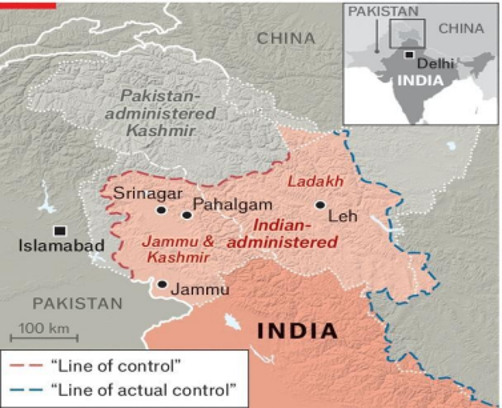
Lastly, local alienation within Indian-administered Jammu and Kashmir acts as an internal catalyst for international escalation. Decades of heavy militarization, digital communication lockouts, and human rights violations have fueled deep resentment among the indigenous populace. This severe alienation creates an environment ripe for spontaneous, localized uprisings or asymmetric resistance operations. When these internal explosions occur, India’s immediate political reflex is to deflect blame onto external actors, rapidly translating domestic political failures into cross-border kinetic retaliations against Pakistan.
Comparative International Frameworks for Conflict Resolution
When analyzing global statecraft, certain comparative frameworks stand as successful models for resolving deep-seated, identity-driven territorial disputes. The Åland Islands Model, arbitrated by the League of Nations in 1921, provides an enduring precedent for resolving sovereignty friction between Sweden and Finland. When the Swedish-speaking population of the islands demanded secession from Finland to join their cultural homeland, international intervention provided a sophisticated compromise: Finland retained sovereign title over the territory, but the islanders were granted absolute domestic autonomy, linguistic protections, and complete demilitarization. The agreement permitted no military installations or personnel on the islands, turning a potential geopolitical flashpoint into a zone of permanent neutrality.
Similarly, the Good Friday Agreement Framework, historically finalized as the Belfast Agreement of 1998, successfully de-escalated decades of violent sectarian and territorial conflict in Northern Ireland through sophisticated Anglo-Irish bilateral statecraft. The agreement bypassed rigid, zero-sum sovereignty arguments by focusing on human-centric structural re-engineering. It completely dismantled the hard, militarized physical border between Northern Ireland and the Irish Republic, replacing it with open, seamless transit corridors for free trade and interaction. Furthermore, it established joint, cross-border institutional bodies to co-manage regional resources like transportation and the environment, while legally validating dual-citizenship options for local populations to protect competing national identities.
Tailored Policy Suggestions for Regional Peace
To move past the zero-sum structural deadlock, Pakistan and India must formulate forward-looking policy suggestions that use these international precedents as structural baselines. First, the two states should focus on implementing phased local demilitarization and self-governance frameworks. Drawing directly upon the demilitarization logic of the 1921 League of Nations decision on the Åland Islands and the regional self-governance dimensions of the historical Musharraf Four-Point Formula, both nations should execute a verified, proportionate pullback of conventional forces from the urban centers of Kashmir. This reduction in the military footprint should be paired with the restoration of robust, indigenous local self-governance, ensuring the protection of local identity and human rights without demanding immediate, destabilizing shifts in international borders.
Second, regional stability requires opening cross-LoC trade and transit corridors to create soft borders. Informed by the open-transit mechanisms of the 1998 Belfast Agreement and the cross-border trade dimensions of past bilateral plans, New Delhi and Islamabad must work to make the Line of Control irrelevant for the local populace. Re-establishing secure, hassle-free travel corridors, cross-border trade markets, and family reunion pathways will lower the political temperature, transform a hostile front line into a zone of economic interdependence, and alleviate the humanitarian costs of partition.
Third, a pragmatic approach must include stabilizing peripheral regions to isolate the core dispute. Drawing on the clear spatial logic of the historical Dixon Plan, both nuclear neighbors should formally recognize that regions like Ladakh, Jammu, Azad Kashmir, and Gilgit-Baltistan possess distinct demographic and administrative realities that are fundamentally stable. By tacitly decoupling these stable peripheral zones from the active conflict, diplomacy can safely isolate and concentrate its finite political capital entirely on resolving the complex, volatile governance issues localized within the Kashmir Valley itself.
Fourth, the policy roadmap should prioritize establishing joint institutional mechanisms for local self-governance. Informed by the shared-management structures of the Kathwari Proposal and the cooperative ministerial councils of the Good Friday Agreement, India and Pakistan should create an institutional, trilateral consultative body consisting of Indian, Pakistani, and Kashmiri representatives. This body would hold no sovereign territorial authority but would be tasked with the collaborative co-management of non-sovereign regional concerns, specifically ecological preservation, tourism infrastructure, and joint climate-mitigation strategies.
Finally, to directly counter the immediate threat of accidental atomic escalation, both states must focus on institutionalizing direct emergency lines via Nuclear Risk Reduction Centers (NRRCs). These centers must be permanently staffed, independent, and equipped with direct digital communication channels operating 24/7 between Islamabad and New Delhi. By establishing real-time verification mechanisms for missile tests, accidental airspace intrusions, or border skirmishes, NRRCs will eliminate critical information asymmetry during crises, ensuring that tactical accidents are never misinterpreted as strategic threats.
Conclusion
The status of Jammu and Kashmir as a nuclear flashpoint is a stark reminder that cold military deterrence cannot serve as a permanent substitute for a sustainable peace architecture. The operational realities of asymmetric doctrines, compressed decision-making windows, and the trilateral security dilemma mean that maintaining the current status quo along the Line of Control is an invitation to accidental catastrophe. True regional security cannot be built upon the complete alienation of the Kashmiri people or the total collapse of bilateral communication.
As evaluated against the grading standards of competitive statecraft, the path forward requires moving past the rigid, unyielding positions of the past. By leveraging the structural logic of global models like the Åland Islands and the Good Friday Agreement, and blending them with the spatial insights of historical bilateral proposals, Pakistan and India can build a functional, step-by-step roadmap. Transforming the LoC into a soft border, ensuring verified demilitarization, and establishing institutional channels for communication will preserve the vital strategic interests of both nations while respecting the fundamental rights of the Kashmiri people. Only through such bold, structurally sound statecraft can South Asia defuse its most volatile nuclear tripwire and usher in an era of lasting peace and regional prosperity.

CSS Solved Past Papers’ Essays
Looking for the last ten years of CSS and PMS Solved Essays and want to know how Sir Kazim’s students write and score the highest marks in the essays’ papers? Then, click on the CSS Solved Essays to start reading them.
CSS Solved Essays
CSS Solved Islamiyat Past Papers
Want to read the last ten years’ Islamiyat Solved Past Papers to learn how to attempt them and to score high? Let’s click on the link below to read them all freely. All past papers have been solved by Pakistan’s top CSS Islamiyat coaches having the highest score of their students.
CSS Solved Islamiyat
CSS Solved General Science & Ability Past Papers
Want to read the last ten years’ General Science & Ability Solved Past Papers to learn how to attempt them and to score high? Let’s click on the link below to read them all freely. All past papers have been solved by Pakistan’s top CSS GSA coachez having the highest score of their students.
CSS Solved General Science & Ability
CSS Solved Pakistan Affairs Past Papers
Want to read the last fifteen years’ Pakistan Affairs Solved Past Papers to learn how to attempt them and to score high? Let’s click on the link below to read them all freely. All past papers have been solved by Pakistan’s top CSS Pakistan Affairs coaches having the highest score of their students.
CSS Solved Pakistan Affairs
CSS Solved Current Affairs Past Papers
Want to read the last fifteen years’ Current Affairs Solved Past Papers to learn how to attempt them and to score high? Let’s click on the link below to read them all freely. All past papers have been solved by Pakistan’s top CSS Current Affairs coaches having the highest score of their students.
CSS Solved Current Affairs