CSS Pakistan Affairs | Strategy for Pakistan on the Kashmir Issue
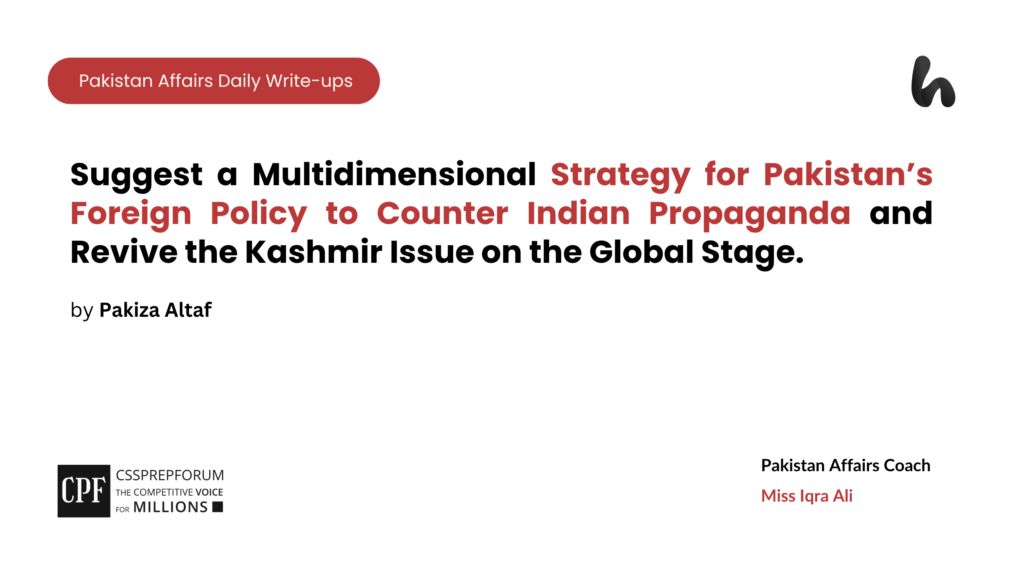
The following assignment question for CSS Pakistan Affairs is solved by Pakiza Altaf under the supervision of Howfiv’s Pakistan Affairs and Current Affairs Coaches: Miss Iqra Ali and Sir Ammar Hashmi. She learnt how to attempt 20 marks question and essay writing from Sir Syed Kazim Ali, Pakistan’s best CSS and PMS English essay and precis teacher with the highest success rate of his students. This solved question is attempted on the pattern taught by Sir to his students, scoring the highest marks in compulsory and optional subjects for years.

Outline
1-Introduction
2-Understanding the Challenge
- Declining international attention
- India’s narrative building
- Lack of proactive diplomacy
- Pakistan’s limited diplomatic influence
3-Multidimensional Foreign Policy Strategy
- Proactive and coalition-based diplomacy
- Stronger multilateral diplomacy
- Strategic communication
- Legal and human rights diplomacy
- Regional and economic diplomacy
4-Coordinated Foreign Policy Approach
5-Way Forward
6-Conclusion
Answer to the question
Introduction
The Kashmir issue is one of the longest-running unresolved conflicts in the modern world. Pakistan has always regarded Kashmir not merely as a territorial dispute but as an unfinished agenda of Partition and a question of self-determination, political rights and regional stability in South Asia. From diplomatic forums to periods of armed confrontation, Pakistan has positioned itself as a principal advocate of the Kashmiri cause. Yet, its approach has been shaped by shifting regional realities, global politics, and internal constraints. Therefore, Pakistan needs to adopt a proactive and multidimensional foreign-policy strategy based on international coalition-building, strategic communication, legal and human-rights diplomacy, and public engagement to counter misleading narratives and keep the Kashmir issue on the global agenda.
Understanding the Challenges
- Declining international attention
The Kashmir issue competes with numerous ongoing global crises for international attention. The global community is occupied with other major crises like the Palestine-Israel issue, conflicts in the Middle East, climate change, and great power rivalry. As a result, Kashmir receives international attention only during major conflicts or issues rather than as a continuous global priority. This creates an issue for Pakistan, as maintaining uniform attention requires continuous effort and active engagement.
- India’s narrative building
India claims to be the world’s largest democracy, but in Kashmir it behaves as a colonial power. It has consistently projected the Kashmir issue on the international platform as a bilateral matter. Its strong economic, strategic, and diplomatic relations with major powers have also increased international influence. For this reason, Pakistan struggles with challenges of securing Kashmir’s position at the international level. Thus, Pakistan needs strategic communication rather than just responding to India’s claims.
- Lack of proactive diplomacy
Pakistan’s Kashmir diplomacy has often been reactive rather than proactive, with diplomatic efforts intensifying mainly after major conflicts or developments. This approach may get temporary attention but does not ensure lasting momentum, particularly when global attention is already occupied with many ongoing conflicts. Pakistan therefore needs a long-lasting diplomatic strategy that ensures continuous global attention and engagement.
- Pakistan’s limited diplomatic influence
Pakistan faces difficulties in building strong international pressure on India because of its relatively limited economic and diplomatic influence. India’s large economy, growing strategic importance, and strong relations with major powers give it a great ability to influence international affairs. Many countries also consider their economic and strategic interests when dealing with India. As a result, Pakistan may find it difficult to gain strong and consistent support for its position on the Kashmir issue. Therefore, Pakistan needs to strengthen its economy, regional relations, and diversify its partnerships and use strategic importance more effectively to increase its diplomatic influence.
Multidimensional Foreign Policy Strategy
- Proactive and coalition-based diplomacy
Pakistan’s Kashmir diplomacy requires a shift from reactive to proactive and coalition-based engagement. Instead of raising Kashmir’s issue only after major developments or conflicts, Pakistan should maintain continuous engagement with world powers, OIC members, and emerging economies. It should build a wider coalition of countries willing to consistently highlight the Kashmir issue at the global level. Such long-term cooperation can transform Kashmir’s diplomacy from occasional statements to continuous global talk. Hence, proactive coalition diplomacy can give Pakistan greater margin and international support on Kashmir.
- Stronger multilateral diplomacy
Multilateral platforms offer Pakistan the most effective space to highlight the Kashmir issue at the global level. Pakistan should regularly raise the Kashmir issue at the United Nations and other international forums by presenting evidence and highlighting human rights concerns. The Palestine example clearly demonstrates that continuous engagement with international bodies and public opinion can keep a long-lasting dispute on the global agenda. Pakistan should not rely on occasional talks but pursue continuously multilateral coalition. As a result, stronger multilateral diplomacy can prevent the overshadowing of Kashmir issues by other global crises.
- Strategic communication
In the modern world, a strong narrative is important for foreign policy. Pakistan should develop a clear strategy to represent itself on the Kashmir issue through international media, social media, diplomatic relations, and other communication sources. It should share its clear evidence and facts against India’s narrative. The experience of Ukraine shows that open communication and digital diplomacy can help maintain international attention. Pakistan should therefore not only respond to India’s false allegations but also actively represent its stance to the world. This can promote the Kashmir issue at the international level and gain the world’s support.
- Legal and human rights diplomacy
Pakistan should enhance the legal and human rights aspects of its foreign policy. Instead of relying on political statements, it should collect evidence and document human rights concerns and present Kashmir issues before the UN and other relevant international organizations. Pakistan should also actively involve international legal and human rights experts to form an evidence-based framework according to international and human rights laws. This would give Pakistan’s Kashmir diplomacy greater legal liability and make its international support more evidence-based.
- Regional and economic diplomacy
Pakistan should connect Kashmir diplomacy with its regional and economic foreign policy. Rather than presenting Kashmir only as a territorial dispute, Pakistan should highlight it in the context of regional peace, security, and stability, along with economic cooperation in South Asia. At the same time, Pakistan’s relations with stronger economic partners can also support Pakistan’s position on the international platform. In this way, Kashmir can become part of Pakistan’s regional diplomacy rather than remaining a foreign policy issue.
Coordinated Foreign Policy Approach
A successful Kashmir policy requires strong coordination among Pakistan’s diplomatic, legal, media, and research institutions. The Ministry of Foreign Affairs should lead overall strategy and coordinate with the work of Pakistani embassies, human rights experts, media professionals, and the Kashmir diaspora. A special Kashmir unit can collect all the evidence and reliable information, follow international developments, and help plan diplomatic efforts. Pakistan should also set clear goals and regularly evaluate the results of its Kashmir diplomacy. Such coordination can turn individual efforts into a consistent and effective foreign policy strategy.
Way Forward
Pakistan needs to develop a long-lasting and continuous approach to keep the Kashmir issue alive at the international level. It should actively engage in diplomatic efforts, strengthen its relations with major powers and rising economies of the Global South, and regularly raise Kashmir’s concerns at international forums. Pakistan should also improve its media strategy and communication, present a reliable and fact-based framework on human-rights concerns, and involve international experts, researchers and the diaspora. Meanwhile, it should link Kashmir diplomacy with regional peace and stability. Pakistan should ensure regular follow-up of diplomatic initiatives instead of limiting its efforts to statements during major crises. It should build wider international coalitions, maintain regular communication with friendly and influential countries, and improve coordination among its diplomatic missions. Moreover, Pakistan should regularly review the success of its diplomatic efforts and adjust its strategy according to changing global priorities. Strengthening economic and political stability at home is also essential for increasing Pakistan’s credibility abroad. A consistent, evidence-based, and peaceful foreign-policy approach can help Pakistan gain greater international attention and support for the Kashmir issue.
Conclusion
The Kashmir issue requires more than diplomatic statements; it demands a consistent and multidimensional foreign policy approach. Pakistan should combine proactive diplomacy, international coalition, multilateral involvement, strategic communication, legal and human rights advocacy, and regional diplomacy. With better coordination among its research institutions and evidence base approach, Pakistan can counter India’s misleading narrative and keep the Kashmir issue alive on international platforms. Ultimately, Pakistan’s success will depend on turning Kashmir’s policy from reactive statements to proactive action that builds international support and keeps the right to self-determination at the center of global talk.
CSS Solved Past Papers’ Essays
Looking for the last ten years of CSS and PMS Solved Essays and want to know how Sir Kazim’s students write and score the highest marks in the essays’ papers? Then, click on the CSS Solved Essays to start reading them.
CSS Solved Essays
CSS Solved Islamiyat Past Papers
Want to read the last ten years’ Islamiyat Solved Past Papers to learn how to attempt them and to score high? Let’s click on the link below to read them all freely. All past papers have been solved by Pakistan’s top CSS Islamiyat coaches having the highest score of their students.
CSS Solved Islamiyat
CSS Solved General Science & Ability Past Papers
Want to read the last ten years’ General Science & Ability Solved Past Papers to learn how to attempt them and to score high? Let’s click on the link below to read them all freely. All past papers have been solved by Pakistan’s top CSS GSA coachez having the highest score of their students.
CSS Solved General Science & Ability
CSS Solved Pakistan Affairs Past Papers
Want to read the last fifteen years’ Pakistan Affairs Solved Past Papers to learn how to attempt them and to score high? Let’s click on the link below to read them all freely. All past papers have been solved by Pakistan’s top CSS Pakistan Affairs coaches having the highest score of their students.
CSS Solved Pakistan Affairs
CSS Solved Current Affairs Past Papers
Want to read the last fifteen years’ Current Affairs Solved Past Papers to learn how to attempt them and to score high? Let’s click on the link below to read them all freely. All past papers have been solved by Pakistan’s top CSS Current Affairs coaches having the highest score of their students.
CSS Solved Current Affairs