CSS Current Affairs | Linkages between the South China Sea Dispute, the Taiwan Question, and the Broader US-China Rivalry
The following assignment question for CSS Current Affairs is solved by Amna Aamir under the supervision of Howfiv’s Pakistan Affairs and Current Affairs Coaches: Miss Iqra Ali and Sir Ammar Hashmi. She learnt how to attempt 20 marks question and essay writing from Sir Syed Kazim Ali, Pakistan’s best CSS and PMS English essay and precis teacher with the highest success rate of his students. This solved question is attempted on the pattern taught by Sir to his students, scoring the highest marks in compulsory and optional subjects for years.

Outline
1-Introduction
2-Evaluating the Case for Strategic Isolation
3-The Interconnected Theater of Confrontation
- Geostrategic Continuity along the First Island Chain
- Military Operationalization and Cross-Strait Interdependency
- The Convergence of Legal Warfare
- Economic Encirclement and Chokepoint Vulnerabilities
4-US-China Rivalry as the Strategic Link between the Two Flashpoints
5-Geopolitical Implications for Global Maritime Diplomacy
- The Transition from Unilateral Hegemony to Contested Multipolarity
- Minilateral Security Pacts as a Challenge to Traditional Multilateral Treaties
- The Weaponization of Interdependent Trade Networks and Global Supply Chains
- The Restructuring of Regional Neutralism and the Breakdown of Non-Aligned Strategic Hedging
6-Pragmatic Pathways for Conflict Mitigation
- To Institutionalize a Comprehensive Regional Maritime Crisis Management System
- To Reinvigorate Inclusive Economic Frameworks to Buffer Security Dilemmas
7-Conclusion
Answer to the Question
Introduction
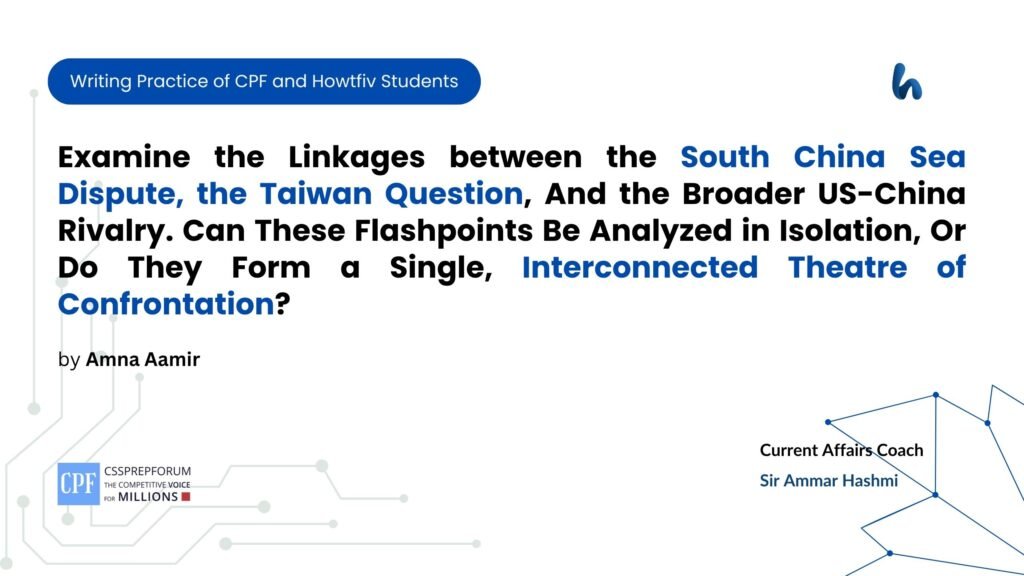
The contemporary maritime security landscape of the Indo-Pacific region is increasingly defined by intensifying geopolitical friction, primarily driven by the systemic competition between the United States and the People’s Republic of China. At the core of this friction lie two critical maritime flashpoints, namely the ongoing territorial disputes in the South China Sea and the historically fraught sovereignty question surrounding Taiwan. While individual historical specificities persist, the contemporary operational, military, and economic realities show that these flashpoints can no longer be evaluated through an isolated lens. Instead, they have fused into a single, interconnected theater of confrontation where tactical movements in one arena directly dictate the strategic stability of the other. To systematically examine this transformation, it is essential to analyze the arguments for isolation before evaluating how the First Island Chain, military assets, legal strategies, and global supply chains bind these zones together. Ultimately, this systemic interconnection transforms local maritime friction into a broader struggle for regional hegemony and the future configuration of the global rules-based order.
Evaluating the Case for Strategic Isolation
The perspective favoring strategic isolation argues that the Taiwan Question, the South China Sea dispute, and the broader US-China rivalry possess distinct historical origins, legal foundations, and strategic objectives. The Taiwan Question is rooted in the unresolved outcome of the Chinese Civil War in 1949, with Beijing treating reunification as a matter of national sovereignty and territorial integrity under the One China Principle. The South China Sea dispute, by contrast, predates the contemporary US-China rivalry and revolves around overlapping maritime claims among multiple littoral states, including Vietnam, the Philippines, Malaysia, Brunei, and China, driven by concerns over maritime jurisdiction, fisheries, hydrocarbon resources, and control of vital sea lanes. Similarly, the broader US-China rivalry originates from the structural redistribution of global power in the post-Cold War era, encompassing strategic competition in technology, trade, military influence, and regional order that extends well beyond these two flashpoints. Each issue appears to possess its own distinct historical, legal, and strategic identity; though, as the following section demonstrates, this separation grows increasingly difficult to sustain given their intensifying interaction in contemporary geopolitics.

The Interconnected Theater of Confrontation
- Geostrategic Continuity along the First Island Chain
Moving from these isolated historical roots to the physical realities on the ground, the First Island Chain forms a continuous, natural geographic barrier stretching from the Japanese archipelago through Taiwan down to the northern Philippines that binds the regional security architecture together. This maritime perimeter serves as the primary defensive line anchoring Western security investments while simultaneously acting as a geopolitical containment barrier for Chinese power projection. To show this geographic reality, historical defense records show that General Douglas MacArthur famously described Taiwan as an “unsinkable aircraft carrier” vital for Western power projection in the Pacific. This classic strategic assessment underscores that should Taiwan fall under the direct military control of Beijing, the People’s Liberation Army Navy would secure unobstructed access to the deep waters of the Pacific Ocean. Ultimately, such a physical breakthrough would completely outflank United States forces in Japan and effectively sever the northern maritime approaches to the South China Sea.
- Military Operationalization and Cross-Strait Interdependency
Furthermore, the militarization of the South China Sea alters the tactical calculus and operational planning of a potential cross-strait conflict. This advanced defensive network is planned by Beijing to create a robust Anti-Access/Area-Denial envelope that actively limits external intervention during a crisis. For instance, satellite intelligence has confirmed the deployment of HQ-9 surface-to-air missiles and YJ-12 anti-ship cruise missiles on militarized outposts like Mischief Reef and Subi Reef. This advanced deployment serves as empirical proof of an operational shield designed to track, deter, or intercept United States naval reinforcements ascending from the Indian Ocean or the Western Pacific. Therefore, the tactical execution of a Chinese military campaign against Taiwan is deeply dependent on these southern maritime fortresses to successfully seal off the southern approaches.
- The Convergence of Legal Warfare
Simultaneously, a unified strategy of legal warfare bridges both flashpoints as Beijing consistently challenges established international maritime norms to create alternative regional legal regimes. This uniform legal push is systematically employed to normalize administrative jurisdiction over international waterways and erode Western freedom of navigation operations. To demonstrate this legal strategy, the People’s Republic of China officially rejected the 2016 Permanent Court of Arbitration ruling in favor of the Philippines, declaring the judgment null and void while simultaneously escalating air and naval patrols across the median line of the Taiwan Strait. This uniform rejection of established legal rulings proves how Beijing employs a singular legal doctrine to transform international waterways into internal waters. Consequently, this convergence of legal strategies demonstrates that the contestation of global maritime norms is a unified campaign spanning across both domains.
- Economic Encirclement and Chokepoint Vulnerabilities
Additionally, the economic dimension provides striking evidence of an interconnected theater, driven by the reality that the South China Sea facilitates the transit of critical industrial inputs and energy resources. Chinese naval planning is heavily influenced by the strategic vulnerability that a hostile naval blockade at the narrow Strait of Malacca could instantly cripple the energy supply lines of the state. To counter this specific vulnerability, China’s massive infrastructure investments and naval dominance over the South China Sea commercial routes ensure a secure maritime transit corridor. This economic leverage provides Beijing with the structural resilience needed to withstand international sanctions or naval blockades during a prolonged cross-strait crisis over Taiwan. Consequently, this economic interdependence renders the two regions strategically inseparable, as maritime control in the south acts as the economic shield for actions in the north.
US-China Rivalry as the Strategic Link between the Two Flashpoints
Evaluating the strength of these combined factors requires a critical analysis of how the overarching US-China structural rivalry treats both geographic spaces. This macro-level geopolitical competition turns local friction points into proxy arenas where the primary goal is systemic regional dominance rather than localized dispute resolution. For example, the United States National Security Strategy explicitly identifies the preservation of peace in both the Taiwan Strait and the South China Sea as a single, unified priority for maintaining a free and open Indo-Pacific. This high-level strategic coupling proves that Washington and Beijing actively use both geographic venues as parts of a singular chessboard to compete for systemic regional dominance. Therefore, attempting to analyze these flashpoints in isolation is an obsolete framework because the geopolitical behavior of the primary superpowers has already indissolubly fused them into a single theater of confrontation.
Geopolitical Implications for Global Maritime Diplomacy
- The Transition from Unilateral Hegemony to Contested Multipolarity
Moreover, the crystallization of this interconnected theater quickens the transition away from the post-Cold War era of unquestioned United States naval hegemony toward a deeply contested multipolar regional order. This structural shift means that the United States can no longer operate with absolute military impunity within the First Island Chain, as the rapid expansion of the PLA Navy alters the balance of power. For example, the official commissioning of China’s third aircraft carrier, the Fujian, equipped with advanced electromagnetic catapult systems, serves as empirical evidence of a rapidly closing technological gap. This structural shift forces regional states to re-evaluate their long-term security assumptions, as the risk of a high-intensity great-power conflict becomes the central variable in Indo-Pacific maritime diplomacy.
- Minilateral Security Pacts as a Challenge to Traditional Multilateral Treaties
Ultimately, the regional security architecture is fracturing into targeted, exclusive minilateral alliances due to the inability of traditional frameworks to manage these interconnected crises. This institutional evolution reveals a calculated move by Washington to build combat-ready coalitions capable of acting across multiple flashpoints simultaneously. This diplomatic shift is clearly shown by the creation of the AUKUS trilateral security partnership and the elevated security coordination of the Quadrilateral Security Dialogue. These high-profile minilateral arrangements serve as proof of a shifting diplomatic paradigm, highlighting that major powers are bypassing traditional, consensus-based treaties in favor of flexible, combat-ready coalitions. Therefore, the rise of these minilateral architectures represents a coordinated, cross-theater containment strategy clearly designed to respond to Chinese assertiveness across both Taiwan and the South China Sea simultaneously.
- The Weaponization of Interdependent Trade Networks and Global Supply Chains
Additionally, the interconnected nature of these flashpoints has triggered an intense shift toward the weaponization of economic interdependencies, transforming global commerce into a tool of strategic coercion. This economic vulnerability arises because critical technological supply chains and trillions of dollars in maritime trade pass directly through these contested choke points. This vulnerability was made obvious by the passage of the United States CHIPS and Science Act, which clearly gives billions of dollars to subsidize domestic semiconductor manufacturing while restricting technology transfers to China. This significant legislative action proves that major powers are actively pursuing strategies of “de-risking” and decoupling to isolate their economies from geopolitical blackmail. Ultimately, this economic decoupling shows that maritime security concerns are now directly dictating global trade policies.
- The Restructuring of Regional Neutralism and the Breakdown of Non-Aligned Strategic Hedging
On the other hand, the consolidation of a single theater of confrontation makes the long-standing regional strategy of non-aligned strategic hedging increasingly weak for smaller states. This traditional balancing act breaks down because superpowers demand absolute political alignment and access to logistics hubs during times of peace to prepare for eventual conflict. The closure of this neutral space is evident in the updated Enhanced Defense Cooperation Agreement between the United States and the Philippines, which granted American forces access to strategic bases directly facing the Taiwan Strait and the South China Sea. This significant military expansion serves as empirical proof that smaller nations are being pulled out of neutrality by the gravity of the great-power struggle. Ultimately, this restructuring demonstrates that the intensity of the rivalry is shrinking the space for regional neutralism, forcing sovereign capitals to align their defense policies with one of the two primary contenders.
Pragmatic Pathways for Conflict Mitigation
- To Institutionalize a Comprehensive Regional Maritime Crisis Management System
Furthermore, the operationalization of a structured crisis communication mechanism is vital to neutralize tactical miscalculations in disputed waters. This proactive de-escalation effort is necessary because voluntary, non-binding agreements fail to address the rapid gray-zone expansion of non-military fleets. To show this deficit, the 2014 Code for Unplanned Encounters at Sea remains legally restricted to official naval forces, effectively ignoring the aggressive activities of coast guards and maritime militias. This structural limitation proves that current communication channels are insufficient, requiring a newly formalized and legally binding protocol that standardizes separation distances and mandatory hotlines across all maritime agencies. Ultimately, embedding these strict protocols within the institutional architecture of the ASEAN Regional Forum provides a viable framework to minimize accidental clashes and preserve stability.
- To Reinvigorate Inclusive Economic Frameworks to Buffer Security Dilemmas
Additionally, deepening regional economic interdependence serves as an effective structural buffer against zero-sum security alignment. This strategy of commercial stabilization operates on the basis that shared economic prosperity raises the immediate national cost of geopolitical conflict. For instance, member states under the Regional Comprehensive Economic Partnership (RCEP) framework actively participate in a unified trade zone that represents roughly 30 percent of global gross domestic product. This massive institutional integration proves that regional actors possess a shared material interest, making the optimization of RCEP trade rules a vital tool to counter exclusive, bloc-based decoupling strategies. Consequently, expanding these inclusive trade frameworks transforms highly competitive maritime zones into integrated economic corridors where regional peace remains the most profitable outcome.
Conclusion
In conclusion, the strategic landscape of the Indo-Pacific has undergone a fundamental transformation, shifting from a collection of isolated regional disputes into a highly integrated, single theater of great-power confrontation. While the historical particularities of the South China Sea disputes and the Taiwan Question remain legally distinct, their contemporary operational, military, and economic realities are indissolubly linked to the broader, overarching US-China structural rivalry. The First Island Chain acts as the physical and strategic bridge binding these friction points together, ensuring that a perturbation in one instantly reverberates through the other. To mitigate these risks and to achieve regional stability, states must institutionalize a comprehensive regional maritime crisis management system modeled on an expanded Code for Unplanned Encounters at Sea to prevent accidental military escalation. Second, regional actors must actively reinvigorate inclusive economic frameworks like the Regional Comprehensive Economic Partnership to buffer escalating security dilemmas and ensure that peace remains the most economically rational choice for all stakeholders involved.

CSS Solved Past Papers’ Essays
Looking for the last ten years of CSS and PMS Solved Essays and want to know how Sir Kazim’s students write and score the highest marks in the essays’ papers? Then, click on the CSS Solved Essays to start reading them.
CSS Solved Essays
CSS Solved Islamiyat Past Papers
Want to read the last ten years’ Islamiyat Solved Past Papers to learn how to attempt them and to score high? Let’s click on the link below to read them all freely. All past papers have been solved by Pakistan’s top CSS Islamiyat coaches having the highest score of their students.
CSS Solved Islamiyat
CSS Solved General Science & Ability Past Papers
Want to read the last ten years’ General Science & Ability Solved Past Papers to learn how to attempt them and to score high? Let’s click on the link below to read them all freely. All past papers have been solved by Pakistan’s top CSS GSA coachez having the highest score of their students.
CSS Solved General Science & Ability
CSS Solved Pakistan Affairs Past Papers
Want to read the last fifteen years’ Pakistan Affairs Solved Past Papers to learn how to attempt them and to score high? Let’s click on the link below to read them all freely. All past papers have been solved by Pakistan’s top CSS Pakistan Affairs coaches having the highest score of their students.
CSS Solved Pakistan Affairs
CSS Solved Current Affairs Past Papers
Want to read the last fifteen years’ Current Affairs Solved Past Papers to learn how to attempt them and to score high? Let’s click on the link below to read them all freely. All past papers have been solved by Pakistan’s top CSS Current Affairs coaches having the highest score of their students.
CSS Solved Current Affairs