CSS Pakistan Affairs | Minto-Morley Reforms and Separate Electorate
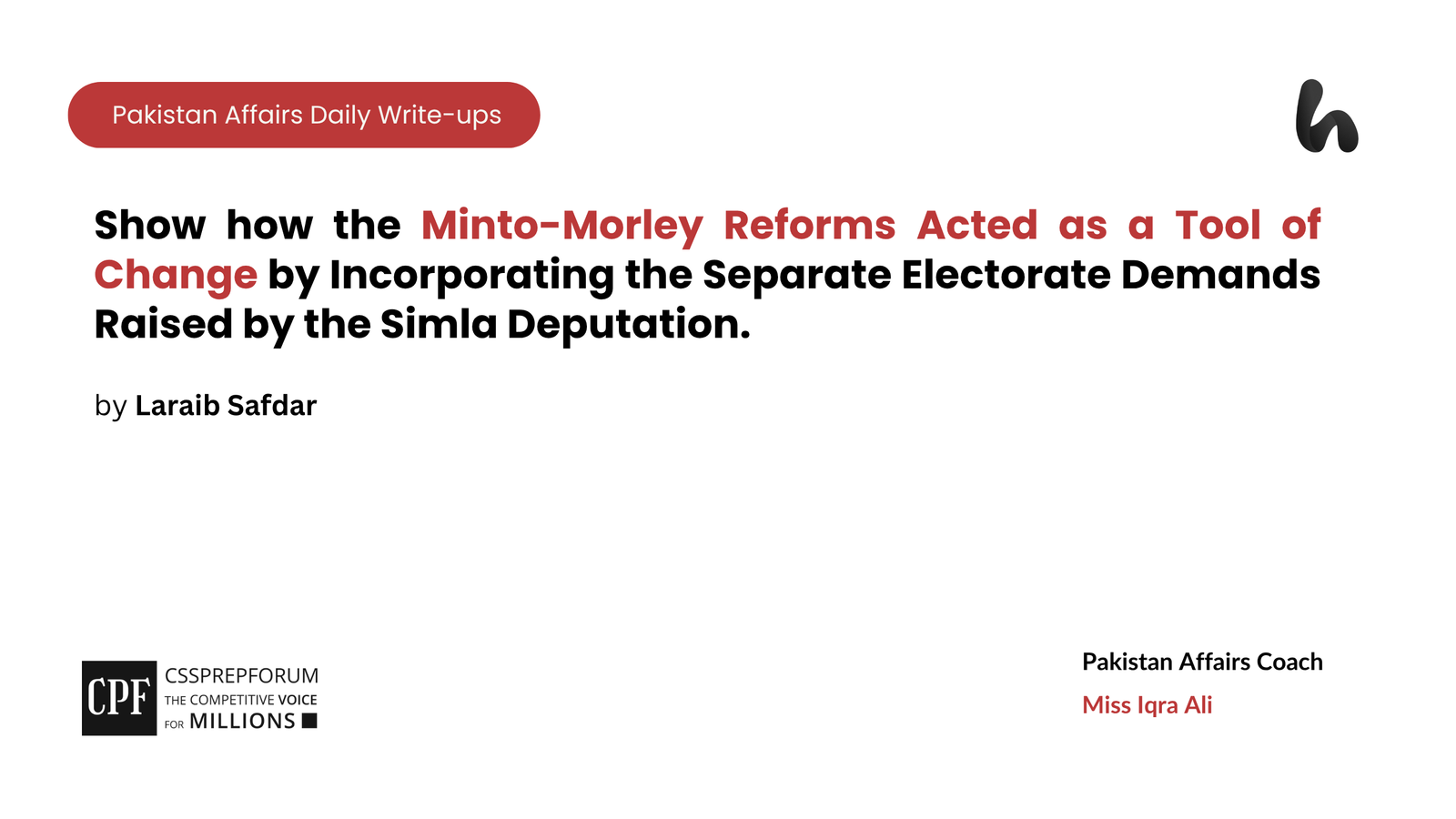
This article explores how the Minto-Morley Reforms served as a catalyst for political change by granting separate electorates, a crucial institutional demand first championed by the Simla Deputation.

Outline
1- Introducton
2- Background of the Simla Deputation (1906)
3- Major Demands of the Simla Deputation
4- Minto-Morley Reforms (1909)
5- Minto-Morley Reforms as a Tool of Change (found this header a repetition)
6- How the Minto-Morley Reforms Incorporated the Demands of the Simla Deputation
- Recognition of Separate Electorates
- Constitutional Recognition of Muslims as a Separate Political Community
- Enhanced Muslim Representation
- Strengthening Muslim Political Confidence
- Foundation for Future Constitutional Development
7-Limitations of the Minto-Morley Reforms
8-Critical Analysis
9-Conclusion

Answer to the question
Introduction
The early twentieth century marked a turning point in the political awakening of Muslims in British India. Growing concerns over political underrepresentation, educational backwardness, and the possibility of Hindu majoritarian dominance encouraged Muslim leaders to seek constitutional safeguards from the British government. Consequently, the Simla Deputation emerged as a landmark event in which a delegation of prominent Muslim leaders, headed by Sir Sultan Muhammad Shah Aga Khan III, presented Muslim political demands to Lord Minto. These demands were largely incorporated into the Indian Councils Act 1909, commonly known as the Minto-Morley Reforms. Therefore, the reforms acted as a significant tool of constitutional change by recognizing Muslims as a distinct political community and institutionalizing the principle of separate electorates.
Background of the Simla Deputation (1906)
Primarily, the Simla Deputation of 1 October 1906 consisted of thirty-five leading Muslim representatives from different parts of British India who met Lord Minto at Simla. The deputation argued that Muslims constituted a separate political community whose interests could not be adequately protected through a purely majoritarian electoral system. Consequently, the delegates demanded separate electorates, adequate representation in legislative councils, and government recognition of the Muslims’ distinct political identity. Lord Minto responded sympathetically, acknowledging the importance of protecting Muslim political rights. Thus, the deputation laid the constitutional foundation for future Muslim political representation.
Major Demands of the Simla Deputation
Furthermore, the deputation presented several constitutional demands safeguarding Muslim interests. The most significant demand was the introduction of separate electorates, allowing Muslims to elect their own representatives. Moreover, the delegation requested representation in excess of their numerical strength, commonly referred to as “weightage,” to compensate for political disadvantages. In addition, Muslims sought greater participation in legislative councils, government services, and public institutions. Consequently, these demands reflected the desire to secure meaningful political participation rather than mere numerical representation.
Minto-Morley Reforms as a Tool of Change
Furthermore, the Minto-Morley Reforms of 1909 represented a significant constitutional turning point in British India by introducing limited representative institutions and formally recognizing communal representation. Unlike previous constitutional arrangements, the reforms expanded legislative councils, increased Indian participation in governance, and, most importantly, institutionalized separate electorates for Muslims. Consequently, they transformed Muslim political demands into constitutional rights, thereby reshaping the political landscape of British India. Thus, the reforms acted as a tool of change by accommodating minority concerns, encouraging constitutional politics, and laying the foundation for subsequent constitutional developments, including the evolution of Muslim political identity and representative governance.
How the Minto-Morley Reforms Incorporated the Demands of the Simla Deputation
- Recognition of Separate Electorates
Firstly, the most significant achievement of the Simla Deputation was fully reflected in the Minto-Morley Reforms through the introduction of separate electorates for Muslims. Consequently, Muslims gained the constitutional right to elect their own representatives without relying on majority support from other communities. This directly fulfilled the principal demand presented before Lord Minto in 1906.
- Constitutional Recognition of Muslims as a Separate Political Community
Furthermore, the reforms acknowledged that Muslims possessed distinct political interests requiring separate constitutional safeguards. Consequently, the British government formally abandoned the principle of a purely territorial electorate and accepted communal representation as part of India’s constitutional system. Thus, the reforms institutionalized the political identity emphasized by the Simla Deputation.
- Enhanced Muslim Representation
Moreover, the reforms increased Muslim representation in legislative councils beyond what had previously existed. Consequently, Muslims acquired greater opportunities to participate in legislative debates and influence government policies. This fulfilled another major objective of the deputation, which had demanded adequate political representation within the colonial administration.
- Strengthening Muslim Political Confidence
Similarly, the acceptance of Muslim demands strengthened political confidence within the Muslim community. Consequently, many Muslim leaders believed that constitutional methods could effectively protect their political rights. This encouragement also contributed to the growing influence of the All-India Muslim League, established in 1906 to safeguard Muslim political interests.
- Foundation for Future Constitutional Developments
Additionally, the reforms established constitutional principles that influenced later political developments, including the Lucknow Pact, the Montagu-Chelmsford Reforms, and eventually the demand for Pakistan. Consequently, the institutionalization of separate electorates transformed the course of Muslim politics in British India.
Limitations of the Minto-Morley Reforms
Nevertheless, despite incorporating the major demands of the Simla Deputation, the reforms remained limited in several respects. Legislative councils continued to possess restricted powers, while executive authority remained firmly under British control. Furthermore, separate electorates reinforced communal politics and widened political divisions between Hindus and Muslims. Consequently, although the reforms expanded political participation, they fell short of granting meaningful self-government or democratic accountability.
Critical Analysis
However, the significance of the Minto-Morley Reforms extends beyond the introduction of separate electorates. While they successfully addressed the immediate constitutional demands of the Simla Deputation and strengthened Muslim political representation, they also institutionalized communal politics within British India. From the British perspective, separate electorates served to accommodate minority concerns while maintaining imperial control through a policy often described as “divide and rule.” Conversely, many Muslim leaders viewed the reforms as an essential safeguard against majoritarian domination and as a constitutional recognition of Muslim nationhood. Therefore, the reforms simultaneously acted as instruments of political empowerment and sources of future communal polarization.
Conclusion
In conclusion, the Simla Deputation of 1906 and the Minto-Morley Reforms of 1909 are closely linked in the constitutional history of British India. The demands presented by Muslim leaders at Simla, particularly the introduction of separate electorates and adequate political representation, were substantially incorporated into the Minto-Morley Reforms. Consequently, the reforms acted as an effective tool of constitutional change by recognizing Muslims as a distinct political community and providing them with institutional safeguards. However, while these reforms strengthened Muslim political participation and laid the foundation for future constitutional developments, they also entrenched communal representation, shaping the political trajectory that eventually culminated in the demand for Pakistan.

Important Note for CSS and PMS Aspirants
For aspirants preparing for competitive examinations, exploring solved past papers is essential to understand examiner expectations, analytical answer writing, and paper trends. Therefore, candidates are strongly encouraged to read the following comprehensive solved papers available on CSSPREPFORUM.
- CSS Solved Pakistan Affairs Past Papers
- CSS Solved Current Affairs Past Papers
- CSS Solved Islamiat Past Papers
- CSS Solved General Science and Ability Past Papers
Moreover, aspirants searching for the most credible and result-oriented teachers for CSS and PMS preparation can benefit from the following detailed guidance articles
- Who is the Best CSS PMS Islamiat Teacher in Pakistan?
- Who is the Best CSS PMS Pakistan Affairs Teacher in Pakistan?
- Who is the Best CSS Current Affairs Teacher in Pakistan?
- Who is the Best CSS GSA Teacher in Pakistan?
- Who is the Best CSS PMS English Essay and Precis Teacher in Pakistan?
- Who is the Best English Grammar Teacher in Pakistan?