CSS Pakistan Affairs | Two Nation Theory and its Foundations
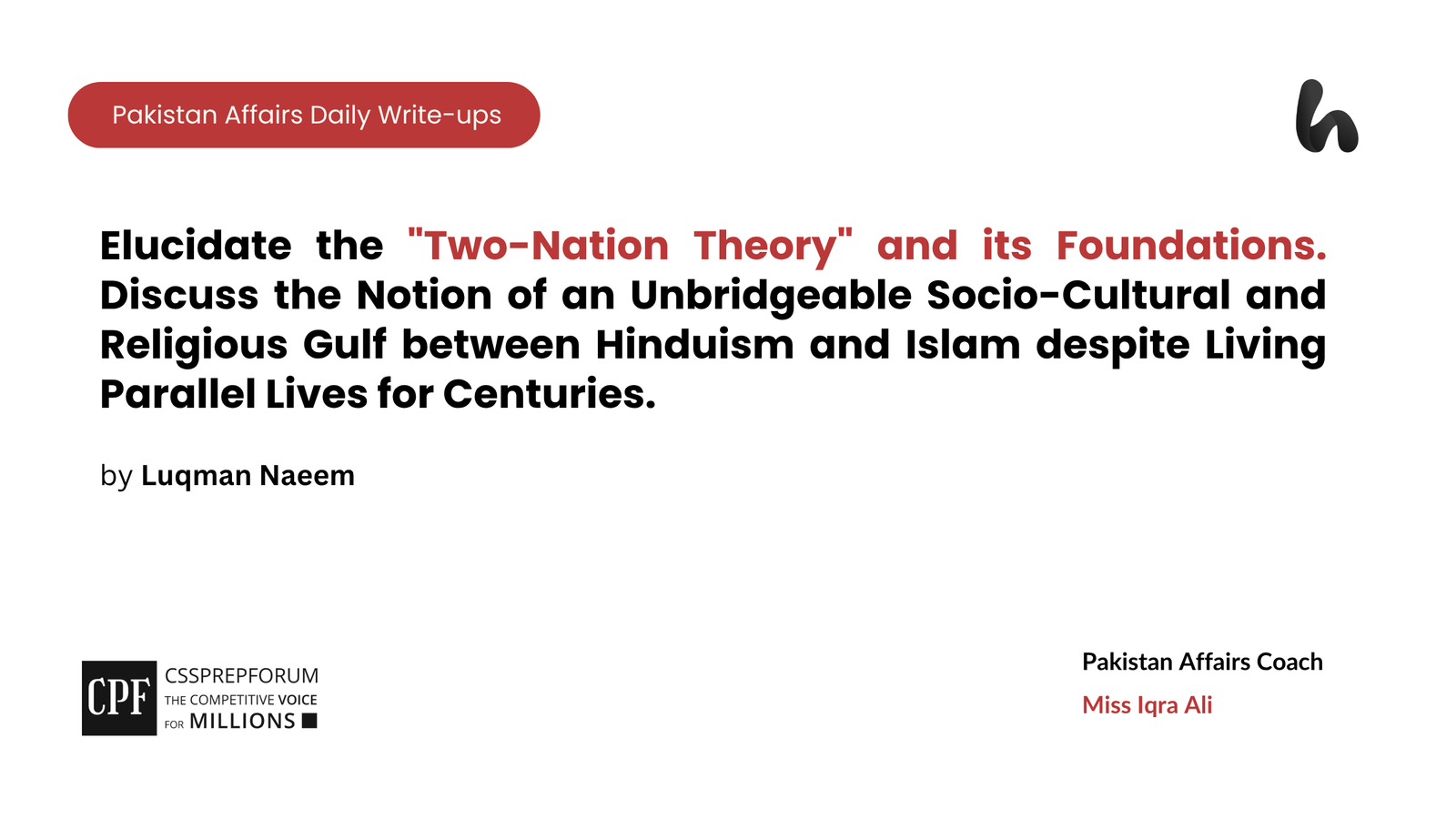
This article explores the Two Nation Theory and its foundational premise: that Hinduism and Islam constitute two distinct civilizational systems, marked by an unbridgeable socio-cultural and religious divide that kept their followers distinct despite centuries of co-existence.

Outline
1-Introduction
2-Historical Trajectory from the Advent of Islam in the Subcontinent to the War of Independence
3-Evolution of Two-Nation Theory Post-War of Independence to 1947
4-Two-Nation Theory and its Foundations
- ✓Religious Basis
- Evidence: Monotheistic vs Polytheistic beliefs
- ✓Political Alienation
- Evidence: Jinnah on 22 March, 1940, “Why does not Mr. Gandhi honestly now acknowledge that the Congress is a Hindu Congress, that he does not represent anybody except the solid body of Hindu people? Why should not Mr. Gandhi be proud to say: ‘I am a Hindu. Congress has solid Hindu backing’?”
- ✓Economic Safeguards
- Evidence: The Pirpur Report 1938 and The Sharif Report 1939, worst conditions of Muslim peasantry in Bengal and Punjab oppressed by Hindu landlords
- ✓Cultural and Social Foundations
- Evidence: Jinnah on 22 March, 1940, “Hindus and Muslims belong to two different religious philosophies, social customs, and literatures. They neither intermarry nor interdine together and, indeed, they belong to two different civilizations which are based mainly on conflicting ideas and conceptions.”
- ✓Conflicting Historical Narratives
- Evidence: “It is quite clear that Hindus and Musalmans derive their inspiration from different sources of history. They have different epics, different heroes, and different episodes. Very often the hero of one is a foe of the other and, likewise, their victories and defeats overlap.” M.A Jinnah, March 1940
- ✓Rigid Hindu Mentality against Muslims as Impurity on Pure Land
- Evidence: In 1937-39, the Wardha Education Policy of Congress forced Muslim children to bow to Gandhi’s portrait.
- ✓Fear of Majority
- Evidence: 1937 election, Congress dominated provincial elections and refused to form a coalition with the Muslim League; Jinnah said, “Hindustan is for the Hindus” in October of 1937
- ✓Political Alienation
- Evidence: Jinnah on 22 March, 1940, “Why does not Mr. Gandhi honestly now acknowledge that the Congress is a Hindu Congress, that he does not represent anybody except the solid body of Hindu people? Why should not Mr. Gandhi be proud to say: ‘I am a Hindu. Congress has solid Hindu backing’?”
5-Socio-Cultural and Religious Divide between Islam and Hinduism
A-Socio-Cultural Gulfs
- ✓Egalitarian brotherhood vs Hindu caste system
- Evidence: Concept of Ummah vs four strata cast system dominated by Brahmins
- ✓Conflicting daily customs and aesthetics, like language, attire, food
- Evidence: Language, Urdu vs Hindi; food, halal food vs pure vegetarian; attire, modest dress vs dress like sari, and opposite life cycle rituals of marriage and death
- ✓Purity taboo and pollution barrier between Hindu and Muslim
- Evidence: Separate colonies, sitting areas, and separate resources like Hindu Water and Muslim Water, treating all Muslims as “Mlechh”: impure
- ✓Economic segregation
- Evidence: Islamic model of Zakat and interest-free society vs heavy reliance on usury by Hindus
B-Religious Gulfs
- ✓Parallel in core religious beliefs of monotheism and polytheism
- Evidence: Muslim’s fixed belief of Tawhid in Surah Ikhlas vs multiple individual forces as gods and deities mentioned in Rig Veda
- ✓Clashing worship environments
- Evidence: Uniform, scheduled, and codified 5 prayers in mosque vs temple with strong influence of bells and idols with varied rituals
- ✓Source of law and authority
- Evidence: Quran, Hadith, Ijma, Qiyas, and Ijtihad vs Vedas and Brahminic authority
- ✓Religious festivals a subtle parallel
- Evidence: Eid ul Fitr, Eid ul-Azhaj vs Diwali and Kumbh Festival
6-Conclusion

Answer to the question
Introduction
The historical evolution of the South Asian sub-continent is an intricate tapestry woven from diverse civilisations. Yet its modern geopolitical reality was ultimately dictated by deep-rooted, irreconcilable divisions. For centuries, Hindus and Muslims shared the same geographical space, interacting in marketplaces and shared imperial administrative structures. However, beneath this surface-level coexistence lay a profound divergence in core religious beliefs, socio-cultural practices, and historical consciousness. While the initial centuries of Islamic rule fostered rich synthesis in architecture and statecraft, the collapse of central Muslim authority and the subsequent rise of British colonial hegemony drastically altered the inter-communal dynamic. The traumatic aftermath of the 1857 War of Independence acted as a critical catalyst, shifting the Muslim community from a position of political dominance to one of severe vulnerability and marginalisation. As British institutional frameworks introduced majoritarian democratic principles, the inherent socio-cultural and religious gulfs between the two communities transformed into a struggle for survival. What began as an elitist push for educational reform and constitutional safeguards under Sir Syed Ahmed Khan gradually evolved into a popular, existential movement for political self-determination. Documented systemic economic oppression, political exclusion by majoritarian regimes, and aggressive cultural assimilation campaigns shattered any remaining illusions of a unified Indian nationhood. From the early administrative conflicts to the formal declaration of the Lahore Resolution in 1940, the Two-Nation Theory provided the definitive ideological and intellectual framework for Muslim identity. Hindus and Muslims constituted two separate, parallel civilisations. Ultimately, these structural, religious, and socio-cultural divisions proved insurmountable, rendering political coexistence unviable and making the partition of the sub-continent in 1947 the only logical conclusion to a long historical trajectory.
Historical Trajectory from the Advent of Islam in the Sub-Continent to the War of Independence
The advent of Islam in the sub-continent marked the dawn of a truly transformative epoch, deeply reshaping the region’s cultural and political landscape. Beginning with early coastal traders and the eighth-century conquests, Islamic influence deepened significantly with the establishment of the Delhi Sultanate. Furthermore, this paved the way for the grand Mughal Empire, a period characterised by remarkable architectural excellence, administrative centralisation, and a unique synthesis of Persian and local traditions. For centuries, this sophisticated civilisation fostered vibrant trade, art, and intellectual exchange, creating a deeply interconnected society. However, the gradual decline of Mughal authority in the eighteenth century left a critical power vacuum that European trading firms, most notably the British East India Company, were eager to exploit. Transitioning rapidly from ambitious merchants to powerful rulers, the Company, unfortunately, formalised its control through strategic alliances and military victories. This dramatic expansion drastically altered local economies, disrupted traditional land rights, and marginalised indigenous authorities, sparking widespread discontent across various social strata. Consequently, the resentment reached a dramatic flashpoint in 1857. Initially started as a desperate mutiny among native soldiers quickly transformed into a widespread war of independence. This momentous uprising united diverse communities against foreign subjugation, marking a tragic yet pivotal end to the historical trajectory of Muslim rule and initiating the era of direct British governance, which later ended at the division of the subcontinent based on religious, socio-cultural, and ideological gulfs.
Evolution of Two-Nation Theory Post-War of Independence to 1947
The evolution of the Two-Nation Theory between 1857 and 1947 marks the historical journey of the subcontinent’s Muslims from a defeated ruling class to a sovereign nation. Following the devastating aftermath of the 1857 War of Independence, Muslims faced severe political and economic marginalisation. Recognising this vulnerability, Sir Syed Ahmed Khan pioneered the Aligarh Movement, urging Muslims to adopt Western education. The Hindi-Urdu controversy of 1867 further convinced Sir Syed that Hindus and Muslims were two distinct nations who could not comfortably share a single political structure, laying the initial ideological groundwork. As the nationalist movement grew, the need for distinct political representation became urgent, culminating in the Urdu-Hindi protection efforts and the eventual foundation of the All-India Muslim League in 1906. While early efforts, such as the Lucknow Pact of 1916, attempted to find constitutional compromises within a unified India, deep-seated communal rifts persisted. By 1930, the philosopher-poet Allama Iqbal elevated the discourse during his Allahabad Address, providing a concrete political vision by proposing a consolidated Muslim state in the northwest of the subcontinent. Later, in 1933, Chaudhry Rahmat Ali published the pamphlet Now or Never, in which he used the term “Pakistan” to articulate the demand for a separate Muslim homeland, giving a new ideological dimension to the movement. The final and decisive phase of the struggle was led by Muhammad Ali Jinnah, whose political leadership transformed the demand for Muslim autonomy into the successful Pakistan Movement. The bitter experience of Congress provincial rule from 1937 to 1939 convinced Jinnah that Muslim rights would never be secure in a Hindu-majority unitary state. Consequently, the Lahore Resolution of 1940 formally transformed the Two-Nation Theory from a protective thesis into an absolute demand for partition. Over the next seven years, intense constitutional deadlock and widespread communal mobilization proved that coexistence was no longer viable, ultimately resulting in the creation of Pakistan in 1947.
Two-Nation Theory and its Foundations
- Religious Basis
The religious basis of the Two-Nation Theory finds one of its clearest expressions in the contrasting theological foundations of Islam and Hinduism, particularly in their differing conceptions of monotheism and polytheism. These opposing spiritual foundations did not merely dictate different forms of worship; they generated entirely distinct social systems, legal codes, and civilizational outlooks. On one hand, Islam is anchored in a strict monotheistic belief in a single, supreme Creator. This absolute monotheism establishes a worldview centered on the ultimate sovereignty of God, which translates into a social doctrine of universal human equality and brotherhood. Within this framework, all individuals stand on an equal spiritual footing, fostering a highly cohesive and unified community structure. Conversely, traditional Hinduism is polytheistic, embracing a vast pantheon of deities representing different aspects of divinity. This polytheistic framework historically coexisted with a structured, hierarchical caste system that organised society into rigid, hereditary layers. Consequently, while Islam’s monotheism fostered horizontal solidarity, polytheistic traditions accommodated a vertical social order. These incompatible religious realities created two parallel civilisations with fundamentally different ideas about justice, authority, and human relationships, providing the primary evidence that Hindus and Muslims constituted two separate nations.
- Political Alienation of Indian Muslims
The political alienation of Indian Muslims became evident and reached a critical turning point during the late 1930s, driven by the majoritarian policies of the Congress provincial governments. This systemic exclusion convinced Muslim leadership that their rights and political identity would be permanently compromised in a unified, Hindu-majority India. Furthermore, the sense of isolation was no longer just about constitutional safeguards; it had become an existential struggle against total political marginalisation. The definitive expression of this deep-seated alienation came from Quaid-e-Azam Muhammad Ali Jinnah during his historic presidential address at Lahore on 22 March, 1940. Challenging the nationalist narrative, Jinnah directly exposed the communal reality of the political deadlock by demanding: “Why does not Mr. Gandhi honestly now acknowledge that the Congress is a Hindu Congress, that he does not represent anybody except the solid body of Hindu people? Why should not Mr. Gandhi be proud to say: ‘I am a Hindu. Congress has solid Hindu backing’?” By using Gandhi’s own position to highlight the representative realities of the sub-continent, Jinnah underscored that the Congress could never safeguard Muslim interests. Therefore, this profound political alienation, backed by the failure of power-sharing arrangements, provided the final, undeniable justification for the Lahore Resolution the very next day under the banner of Two-Nation Theory.
- Economic Safeguards
The quest for economic safeguards became a driving force behind the Two-Nation Theory, as Indian Muslims faced systemic financial marginalisation under Hindu majoritarian influence. This economic anxiety was not theoretical; it was documented in damning detail by the Muslim League through The Pirpur Report of 1938 and The Sharif Report of 1939. These crucial documents meticulously investigated and exposed the severe economic suppression, cultural bias, and administrative discrimination faced by Muslims during the brief period of Congress provincial rule. Moreover, the reports shed a harsh light on the agrarian crisis, particularly highlighting the worst conditions of the Muslim peasantry in Bengal and Punjab. In these Muslim-majority provinces, the rural population was heavily oppressed by powerful Hindu landlords and moneylenders. Consequently, Muslim farmers were trapped in cycles of permanent debt, subjected to unfair agricultural taxes, and denied basic economic mobility. These severe disparities proved that political freedom without economic safeguards would simply mean replacing British rule with Hindu economic dominance. Thus, the evidence compiled in the Pirpur and Sharif reports convinced both the elite and the rural Muslim masses that a separate homeland was the only viable escape from permanent financial servitude.
- Cultural and Social Foundations
The cultural and social foundations of the theory anchored the political movement in the everyday realities of life in British India. Beyond political treaties and economic disputes, the ultimate division between Hindus and Muslims stemmed from their completely parallel lifestyles, social codes, and historical consciousness. For centuries, the two communities lived side by side, yet they remained socially distinct, retaining their individual cultural institutions and social systems. Specifically, the definitive articulation of this civilisational divide was delivered by Quaid-e-Azam Muhammad Ali Jinnah in his landmark presidential address on 22 March, 1940. Jinnah laid bare the permanent sociological boundaries separating the two groups, asserting: “Hindus and Muslims belong to two different religious philosophies, social customs, and literatures. They neither intermarry nor interdine together and, indeed, they belong to two different civilizations which are based mainly on conflicting ideas and conceptions.” This demonstrated that the differences were too deep to be solved by simple political compromises. Because social customs like dining and marriage boundaries prevented the two groups from merging into a single, unified society, they could never form a homogeneous nation. In conclusion, Jinnah’s words proved that Hindus and Muslims were already two separate nations in their daily lives, making the creation of two independent states the only natural outcome.
- Conflicting Historical Narratives
The conflicting historical narratives of the subcontinent formed an insurmountable psychological barrier to a unified Indian nationhood. A nation’s identity is bound to its collective memory; however, Hindus and Muslims possessed entirely opposing views of the past. The historical triumphs of one community almost always represented the tragic defeats of the other, ensuring that their shared geographical space could never translate into a shared emotional allegiance. Furthermore, this profound division was masterfully captured by Quaid-e-Azam Muhammad Ali Jinnah in his monumental Lahore address on 22 March, 1940. Outlining the deep-seated friction in ancestral legacies, Jinnah noted: “It is quite clear that Hindus and Musalmans derive their inspiration from different sources of history. They have different epics, different heroes, and different episodes. Very often the hero of one is a foe of the other and, likewise, their victories and defeats overlap.” These words illustrated that the two groups drew inspiration from completely different historical golden ages, literature, and folklore. For instance, the expansion of Muslim rule was celebrated by Muslims as an era of enlightenment, while viewed by Hindu nationalists as a period of foreign subjugation. Because their foundational memories were in perpetual conflict, they could never build a harmonious, singular nationalism, making separate states the only logical solution to avoid perpetual civil discord.
- Linguistic Rifts
The linguistic rifts within the subcontinent transformed language from a medium of communication into a fierce cultural crusade, deeply solidifying the Two-Nation Theory. This long-standing friction began in earnest during the Hindi-Urdu Controversy of 1867, ignited by the Banaras agitation, where Hindu leaders demanded that Hindi, written in the Devanagari script, replace Urdu as the official court language. Consequently, this aggressive push deeply alarmed Muslims, who viewed the targeted removal of Urdu, a language central to their administrative, literacy, and literary heritage as an existential threat. The hostile shift permanently changed the perspective of Sir Syed Ahmed Khan. Deeply unsettled by the Banaras movement, he responded with his famous prediction: “I am now convinced that these two nations will not join wholeheartedly in anything. At present there is no open hostility between the two communities, but on account of the so-called educated people, it will increase immensely in future.” As predicted, his warnings were soon validated by a series of political manoeuvres that systematically marginalised Urdu. Afterwards, the Bihar School and court movement of 1881 successfully removed Urdu from local administration, a pattern repeated during the Malaviya court agitation, which culminated in the MacDonnell Decree of 1900 in the United Provinces. Furthermore, aggressive Arya Samaj Sanskritisation Campaigns weaponised the language debate, transforming the narrative of promoting Hindi into a sacred religious duty. By framing the purge of Urdu vocabulary as a spiritual cleansing, the controversy escalated from a regional administrative debate into an all-out cultural crusade. Thus, these bitter linguistic struggles proved that the two communities possessed entirely different cultural aspirations, creating an emotional and intellectual divide that made political coexistence impossible.
- Rigid Hindu Mentality against Muslims as Impurity on Pure Land
The rigid Hindu mentality within certain majoritarian factions of the Congress party viewed the Muslim presence as a cultural impurity on what they considered a sacred, pure land. This deep-seated ideological intolerance was translated into state policy during the Congress provincial rule from 1937 to 1939. Through aggressive cultural engineering, the regime sought to systematically erase the distinct Islamic identity of the younger generation and absorb them into a singular, Hinduised nationalist framework. Ultimately, the manifestation of this exclusionary mentality was the implementation of the Wardha Education Scheme in 1937. Under the guise of national educational reform, this policy introduced rituals that deeply violated Islamic theological principles, famously forcing Muslim school children to bow down before portraits of Mahatma Gandhi. This practice, alongside the singing of the controversial Vande Mataram anthem, was seen by Muslims not as a patriotic act, but as forced religious submission and cultural subjugation. By institutionalising majoritarian religious practices in public schools, the Congress governments confirmed the worst fears of the Muslim community. As a result, this aggressive push to treat Muslims as an alien element proved that their religious and cultural survival would be impossible in a unified India, serving as a powerful catalyst for the demand for Pakistan.
- Fear of an Unkind Hindu Majority
The persistent fear of majority rule became an undeniable political reality following the provincial elections of 1937. Under the Government of India Act 1935, the All-India National Congress achieved a sweeping victory, securing clear majorities in several key provinces. Emboldened by this electoral success, Congress high command high-handedly rejected the Muslim League’s proposal to form coalition governments, effectively shutting Muslims out of meaningful power-sharing. This blatant majoritarianism proved that a democratic, unified India would simply mean the permanent political subjugation of the Muslim minority. Moreover, the bitter experience of this political exclusion forced a crucial shift in Muslim leadership. Addressing the Muslim League session in Lucknow in October 1937, Quaid-e-Azam Muhammad Ali Jinnah delivered a sobering assessment of the situation, famously warning the community that, ‘Hindustan is for the Hindus, under the current Congress mindset.’ This critical turning point transformed the fear of a Hindu majority from a theoretical anxiety into a demonstrated reality. The absolute refusal of the Congress to accommodate Muslim political representation convinced the Muslim masses that democratic majoritarianism in a centralized, undivided India would reduce them to a powerless, permanent minority. This profound realization shattered all remaining hopes for constitutional compromises and set the stage for the definitive demand for a separate homeland.
Socio-Cultural and Religious Divide between Islam and Hinduism
A-Socio-Cultural Gulfs
- Egalitarian Brotherhood vs Hindu Caste System
Under the socio-cultural gulfs, the stark contrast between Islamic egalitarian brotherhood and the rigid Hindu caste system illustrates how both communities maintained completely different social structures despite living in the same place for centuries. This social distance prevented the formation of a unified society, as their foundational views on human worth and social organization were fundamentally incompatible. On one side, Islam is built upon the concept of the Ummah, a universal, egalitarian brotherhood that transcends all racial, tribal, and economic divides. In this framework, every individual enjoys equal social and spiritual status, and superiority is judged solely by personal righteousness rather than birth. This horizontal social structure encouraged deep community integration, collective worship, and fluid social mobility among Muslims. In sharp contrast, traditional Hindu society was organized around a rigid, vertical four-strata caste system known as Varna, strictly dominated by the Brahmins at the apex. This hereditary hierarchy strictly fragmented Hindu society, dictating an individual’s profession, social interactions, and marriage options from birth. Because the system relied heavily on notions of ritual purity and pollution, it created permanent social barriers that resisted external integration. Thus, these two opposing social philosophies meant that while Muslims practiced universal equality, the dominant Hindu structure maintained deep, ritualized divisions, ensuring the two communities remained distinct social worlds within the same land.
- Conflicting Daily Customs and Aesthetics, Like Language, Attire, Food
Moving further, the friction in daily customs and aesthetics highlights how deeply divided Hindus and Muslims remained in their everyday lives. Despite sharing the same geographical space for centuries, their parallel choices in language, food, attire, and life-cycle rituals prevented any meaningful cultural assimilation. Furthermore, the linguistic divide created entirely separate intellectual worlds, best illustrated by the clash between Urdu and Hindi. Muslims championed Urdu, written in the Perso-Arabic script and rich in Islamic history, while Hindus advanced Hindi in the Devanagari script, pulling heavily from Sanskrit roots. Similarly, daily attire clearly marked communal boundaries. Muslims preferred modest dress codes, such as the shalwar kameez or sherwani, whereas Hindu attire was typified by traditional garments like the sari or dhoti, reflecting entirely different aesthetic values. Beyond appearance, dietary practices and sacred milestones created severe social barriers. Muslims strictly consumed halal food, which included beef, whereas the dominant Hindu framework prized a pure vegetarian lifestyle that venerated the cow as sacred; a divergence that made regular social dining nearly impossible. Furthermore, their life-cycle rituals were opposite; Muslim marriages were contractual legal ceremonies followed by burial in death, while Hindu marriages were spiritual bonds tied to the holy fire, culminating in cremation. These conflicting everyday choices meant that the two communities operated as two separate civilisations, never blending into a single, cohesive culture.
- Purity Taboo and Pollution Barrier between Hindu and Muslim
The rigid concepts of the purity taboo and the pollution barrier formed an insurmountable social wall between Hindus and Muslims. Despite coexisting in the same towns and villages for centuries, traditional Hindu notions of ritual purity systematically prevented close social contact, establishing a permanent psychological and physical distance between the two communities. Furthermore, this deep-seated segregation was visibly enforced through the creation of entirely separate colonies, restricted sitting areas, and divided public resources. The most striking manifestation of this barrier was the famous division of public drinking facilities into “Hindu Water” and “Muslim Water” at railway stations and marketplaces. Muslim touch was widely believed to ritually pollute food, water, and sacred spaces, forcing a strict policy of physical avoidance in daily life. Moreover, orthodox Hindu society categorized all Muslims as “Mlechh”, a term denoting a spiritually impure or unclean outsider who existed entirely outside the caste hierarchy. This foundational labelling meant that Muslims, regardless of their wealth, education, or political status, were viewed through a lens of inherent ritual impurity. Therefore, these pervasive taboos made genuine social integration impossible, ensuring that the two groups lived as parallel, un-mixable societies within the same geographic space.
- Economic Segregation
Under the socio-cultural gulfs, the stark division in economic models created entirely parallel financial worlds for Hindus and Muslims. Despite sharing the same local marketplaces for centuries, their fundamental approaches to wealth, charity, and commerce were guided by incompatible ethical frameworks, preventing the formation of a unified economic society. On one side, Islam anchored its financial identity in a model of social welfare and ethical commerce, driven by the compulsory Zakat system and a strict prohibition on interest. This Islamic model aimed to create an interest-free society where capital circulated productively, wealth was redistributed to support the vulnerable, and the exploitation of the poor was spiritually forbidden. In sharp contrast, the traditional economic framework of the subcontinent relied heavily on usury, a practice dominated by Hindu moneylenders and financiers. This system thrived on high-interest loans that frequently trapped peasants and artisans in perpetual cycles of debt and land dispossession. While the Islamic financial mindset viewed interest as a destructive social evil, the prevailing majoritarian economic practice treated usury as a legitimate tool for capital accumulation. This profound economic segregation meant the two communities did not merely operate with different currencies, but with opposing moral values regarding wealth, deepening the civilizational divide.
B-Religious gulfs
- Parallel in Core Religious Beliefs of Monotheism and Polytheism
Under socio-cultural gulfs, the most foundational division between Hindus and Muslims stems from their completely parallel and incompatible core religious beliefs. Despite coexisting in the same geographic space for centuries, their opposing theological foundations created entirely separate spiritual and social realities that prevented any possibility of civilizational blending. The Muslim worldview is anchored in the absolute, uncompromising concept of Tawhid, the strict monotheistic belief in the oneness of God. This fixed theological stance is beautifully and decisively captured in Surah al-Ikhlas, which declares that God is One, Eternal, Absolute, and has no partners or equals. This strict monotheism leaves no room for divine manifestations or intermediaries, fostering a social structure built on the absolute spiritual equality of all human beings under one single Creator. However, traditional Hindu theology embraces a vast, polytheistic framework, where the divine is perceived through multiple individual forces, gods, and deities. This worldview is deeply rooted in ancient scriptures like the Rig Veda, which describes a cosmic order maintained by various deities representing different natural elements and spiritual dimensions. While Islam’s Tawhid demands a singular, uniform allegiance that flattens social hierarchies, the polytheistic traditions of the Rig Veda naturally accommodate a highly segmented, diverse, and layered approach to both the divine and human society. These parallel core beliefs meant the two communities did not merely worship differently but operated on fundamentally conflicting ideas about the universe and human existence.
- Clashing Worship Environments
Further in the religious gulf, the stark contrast between their clashing worship environments vividly illustrates the deep religious divide between Hindus and Muslims. These physical spaces did not merely represent different styles of prayer; they embodied opposite spiritual atmospheres, reflecting fundamentally incompatible concepts of devotion and communal life. The Muslim mosque serves as an environment designed for a highly disciplined, uniform, and codified spiritual experience. Five times a day, worshippers gather for scheduled congregational prayers, standing shoulder to shoulder in straight, equal rows behind a single leader. The atmosphere inside a mosque is defined by absolute silence, austere simplicity, and a total absence of visual images or physical distractions. This structured environment reinforces the strict monotheistic focus on an unseen Creator, where every movement and recitation is precisely synchronized across the entire community. However, the Hindu temple presents a dynamic, varied, and sensory-rich worship environment. Dominated by sacred idols that represent different manifestations of the divine, temple devotion relies heavily on visual connection (darshan), individual rituals, and vibrant communal celebrations. The atmosphere is filled with the strong influence of music, the rhythmic ringing of bells, chanting, and burning incense. Unlike the synchronized, silent uniformity of the mosque, temple worship is highly personalized, flexible, and celebratory. These clashing environments meant that the very act of approaching the divine created two entirely different psychological and social worlds, deepening the civilizational gulf within the subcontinent.
- Source of Law and Authority
The most profound structural divergence between Hindus and Muslims lies in their completely separate and conflicting sources of law and authority. This legal and spiritual division meant that both communities operated under entirely different codes of justice, governance, and daily ethics, preventing the formation of a singular, cohesive society. The Islamic legal system, or Shariah, is derived from a highly structured hierarchy of divine and intellectual sources. At its apex sits the Quran, the literal word of God, supplemented by the Hadith, the recorded traditions and sayings of the Prophet Muhammad. To address new and evolving societal issues, Islamic jurisprudence relies on Ijma (commensurate consensus of scholars), Qiyas (analogical reasoning), and Ijtihad (independent analytical exertion). This legal framework establishes a universal, codified, and egalitarian system of law that applies equally to every individual, regardless of their social standing or birth, anchoring authority in divine revelation and systematic scholarly consensus. However, the traditional sources of law and authority in Hindu society are anchored in ancient, sacred texts such as the Vedas, interpreted through a rigid social hierarchy. Rather than a universally applied legal code, authority was heavily mediated by Brahminic authority, where the priestly caste held the exclusive right to interpret scriptures and dictate social duties. Law under this system was inherently tied to one’s position within the hereditary caste structure, creating varying legal obligations and privileges based on birth. These conflicting foundations of authority, one a codified, egalitarian divine law and the other a caste-stratified textual tradition, ensured that Hindus and Muslims lived under two entirely parallel realities of justice and social order.
- Religious Festivals as a Subtle Parallel
The celebration of religious festivals serves as a subtle yet profound parallel, illustrating how both communities expressed their deepest spiritual values through entirely different cultural dimensions. While these sacred occasions brought immense joy to each respective group, their distinct formats, rituals, and underlying philosophies highlighted the deep theological boundaries that kept them apart. On one side, Muslim festivals are structured around strict monotheistic devotion, communal equality, and a linear sense of sacred history. Eid-ul-Fitr is celebrated at the end of Ramadan as a collective thanksgiving, characterized by massive, disciplined prayer congregations that completely flatten all social and economic distinctions. Similarly, Eid-ul-Adha focuses on the concept of ultimate submission to the divine through the ritual slaughter of animals, a communal practice that directly involves charity and the distribution of meat to the less fortunate. These festivals reinforce horizontal solidarity and universal brotherhood under one God. In sharp contrast, Hindu festivals are deeply rooted in rich cosmic symbolism, diverse rituals, and cyclical concepts of purity. Diwali, the festival of lights, focuses on the spiritual triumph of good over evil, celebrated through the lighting of lamps, vibrant artistic expressions, and individual household prayers to deities of prosperity. On a larger scale, the Kumbh Mela represents a massive, unstructured pilgrimage centred on spiritual cleansing through ritual bathing in sacred rivers. While Islamic festivals emphasize disciplined uniformity, egalitarian charity, and sacrifice, Hindu celebrations embrace sensory-rich imagery, individual cosmic alignment, and ritual purification. Even in moments of absolute festivity, these parallel traditions reinforced two distinct spiritual worlds within the same land.
Conclusion
In conclusion, the historical trajectory of the subcontinent from the advent of Islam to the partition of 1947 demonstrates that Pakistan was not an accidental creation, but the logical culmination of deep-seated civilizational divergences. For centuries, Hindus and Muslims shared the same geographical landscape, yet they lived as two parallel societies that never merged into a single cultural or political identity. The shift from a position of historical Muslim governance to the vulnerabilities of post-1857 colonial rule forced a critical awakening. As majoritarian democratic structures threatened to reduce the Muslim population to a permanent, powerless minority, the ideological framework of the Two-Nation Theory became an existential shield for political self-determination. Ultimately, the demand for a separate homeland was justified by a comprehensive array of religious, political, economic, and socio-cultural evidence. The fundamental clash between Islamic monotheism and Hindu polytheism laid down incompatible templates for social organisation, splitting the population into an egalitarian brotherhood on one hand and a rigid caste hierarchy on the other. This theological gulf was further widened by clashing worship environments, separate legal systems, and opposing daily customs, ranging from dietary laws to life-cycle rituals. When these structural differences were exposed to the political alienation of the late 1930s, documented economic suppression, and aggressive majoritarian cultural engineering, any lingering illusions of a unified Indian nationalism completely shattered. In the final analysis, the creation of Pakistan in 1947 was the unavoidable resolution to an unbridgeable civilizational gulf, proving that two distinct nations could only achieve peace and progress within their own sovereign borders.

Important Note for CSS and PMS Aspirants
For aspirants preparing for competitive examinations, exploring solved past papers is essential to understand examiner expectations, analytical answer writing, and paper trends. Therefore, candidates are strongly encouraged to read the following comprehensive solved papers available on CSSPREPFORUM.
- CSS Solved Pakistan Affairs Past Papers
- CSS Solved Current Affairs Past Papers
- CSS Solved Islamiat Past Papers
- CSS Solved General Science and Ability Past Papers
Moreover, aspirants searching for the most credible and result-oriented teachers for CSS and PMS preparation can benefit from the following detailed guidance articles
- Who is the Best CSS PMS Islamiat Teacher in Pakistan?
- Who is the Best CSS PMS Pakistan Affairs Teacher in Pakistan?
- Who is the Best CSS Current Affairs Teacher in Pakistan?
- Who is the Best CSS GSA Teacher in Pakistan?
- Who is the Best CSS PMS English Essay and Precis Teacher in Pakistan?
- Who is the Best English Grammar Teacher in Pakistan?