CSS Current Affairs | Commercial Liberalism: Trade Promotes Peace
Commercial Liberalism is an International Relations theory that argues that trade and economic interdependence reduce the likelihood of conflict by creating mutual benefits and shared economic interests among states. It is an important topic in International Relations, Political Science, and CSS Current Affairs.

Introduction
Within the study of International Relations (IR), Commercial Liberalism stands as a core pillar of liberal institutionalist thought. It posits that economic openness, cross-border trade, and market-driven integration act as powerful structural deterrents to violent conflict. While traditional schools of thought view global interactions through the lens of zero-sum power accumulation, Commercial Liberalism argues that economic interdependence shifts state preferences away from military conquest and toward peaceful, wealth-generating collaboration.
Scholarly Definition of Commercial Liberalism
To understand Commercial Liberalism, it is useful to examine how leading IR theorists define its mechanics in concise terms:
According to Andrew Moravcsik:
“Commercial liberalism asserts that economic interdependence creates incentives for peace and cooperation”
According to Margit Bussmann:
“The peace-through-trade hypothesis, on which commercial liberalism is mainly founded, maintains that economic interdependence in the form of trade or investment between states reduces the risk of conflict between and within states.”
Meaning of the Term
Commercial Liberalism is an explanatory framework stating that a nation’s foreign policy is deeply constrained and shaped by domestic and transnational economic networks. Rather than viewing the state as an isolated, unitary actor pursuing survival through military power alone, this theory focuses on the individuals, corporations, and trading entities operating within civil society.
When states open their markets, they weave a complex web of mutual dependence. Because war disrupts shipping routes, liquidates cross-border investments, and severs supply lines, the material cost of conflict rises drastically. Therefore, the term represents a “peace-through-trade” philosophy where market forces systematically alter state incentives, making cooperation highly profitable and aggression economically self-destructive.
Key Characteristics of the Commercial Liberalism
Commercial Liberalism relies on several core mechanisms to explain state behavior and international stability:
Positive-Sum Dynamics: It rejects the Zero-sum-game view that one nation’s gain is automatically another’s loss, asserting instead that free trade yields mutual economic benefits.
The Interdependence Deterrent: It posits that high levels of bilateral and multilateral trade raise the opportunity costs of war, transforming economic loss into a structural barrier against aggression.
Domestic Vested Interests: Commercial Liberalism highlights that exporters, multinational firms, and financial institutions hold significant political sway, using their influence to steer state foreign policy away from disruptive conflicts.
Focus on Foreign Direct Investment (FDI): It recognizes that modern economic integration goes beyond shifting goods; it relies on capital internationalization, which demands a predictable, peaceful environment to thrive.
Historical Context and Evolution
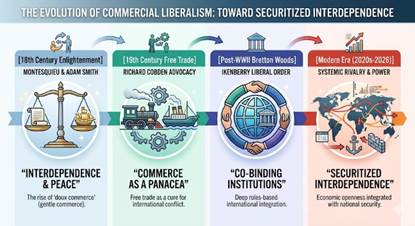
The foundational ideas of Commercial Liberalism date back to Enlightenment thinkers, like Montesquieu and Adam Smith, who celebrated the pacifying effects of “doux commerce” (gentle commerce). In the nineteenth century, British statesmen and theorists, like Richard Cobden championed free exchange as the ultimate antidote to war, earning a reputation for promoting commerce as a civilizing global force.
Following the devastation of World War II, the United States and its allies deliberately built a political and economic architecture designed to prevent another global conflict. This led to the creation of the Bretton Woods system, the General Agreement on Tariffs and Trade (GATT), and eventually the World Trade Organization (WTO). By locking states into open trade and co-binding security arrangements, the post-war liberal international order used commercial integration to stabilize relations between major powers. And the modern era represents “Securitized Interdependence,” where open economic trade is no longer just an engine for peace but is actively managed, restricted, and weaponized as a core element of national security and systemic superpower rivalry.

Current Relevance
In the contemporary landscape, Commercial Liberalism faces intense structural challenges. The modern globalization landscape reveals deep frictions, shifting from simple “peace-through-trade” to strategic state competition:
Weaponized Interdependence: Rather than fostering peace, deep economic ties are exploited as leverage, turning global network chokepoints into tools of state coercion.
Examples: China implementing export licensing constraints on rare-earth elements to choke Western supply chains; the United States and the European Union cutting Russia off from the SWIFT financial network following the invasion of Ukraine.
Geostrategic Control of Maritime Chokepoints: Physical trade corridors are used as direct geopolitical leverage, where geographic control overrides open-market norms.
Example: Iran’s military restrictions in the Strait of Hormuz disrupting 20% of global oil and liquefied natural gas (LNG) supplies, triggering energy shocks across Europe and Asia, highlighting how commercial liberalism has been exploited to force the super-power to come on the negotiating table.
The Return of Aggressive Tariff Wars: Multilateral trade rules are increasingly bypassed by unilateral economic geostrategy, utilizing retaliatory tariffs as explicit means of power and political leverage.
Examples: The United States imposing sharp “reciprocal tariffs” against its main global trading partners, precipitating retaliatory measures from China and the European Union.
Rise of Digital Tech Giants: Transnational technology corporations now wield structural power that rivals traditional state authority, shifting the focus of commercial liberalism from physical goods to digital sovereignty and data streams.
Examples: Global tech firms like Microsoft, Alphabet (Google), and Amazon (USA) driving global cloud infrastructure and AI governance, challenging the regulatory oversight of the European Union and individual sovereign states.
Middle Power Agency: As the traditional liberal international order splinters, middle powers are carving out tactical spaces and building smaller “issue coalitions” to preserve stability and protect their economic interests amid superpower trade wars.
Examples: This included Turkey practicing “calibrated non-exclusivity” by balancing Euro-Atlantic institutional ties with economic maneuvering in Russia and Asia; India pursuing strategic autonomy through bilateral trade and security corridors to avoid over-reliance on a single bloc.
Friend-Shoring and Supply Chain Relocalization: States are abandoning blind cost-efficiency in favor of economic resilience, shifting production nodes exclusively to politically allied nations to safeguard national security.
Examples: The United States implementing targeted export controls and “friend-shoring” initiatives with partners like Taiwan, South Korea, and Japan to insulate advanced semiconductor manufacturing from geopolitical shocks.
Comparative Analysis
| Feature / Theory | Commercial Liberalism | Democratic Peace Theory | Realism (Mercantilism) | Institutional Liberalism |
| How Peace is Maintained | Market integration and trade interdependence | Shared democratic norms and institutional checks | Material power balance and structural deterrence | International laws and multilateral organizations |
| Core Logic of Peace | Trade ties make conflict economically self-destructive | Accountability and transparency constrain leaders from war | Peace is a temporary state managed via military parity | Rules and formal treaties lower friction and manage disputes |
| Core Actor | Transnational businesses, traders, and private consumers | Democratic states, electorates, and domestic institutions | The unitary, survival-driven sovereign state | Intergovernmental organizations (UN, WTO, IMF) and states |
| System Dynamic | Positive-sum | Positive-sum among democracies; wary toward autocracies | Zero-sum | Positive-sum via structured rules |
Conclusion
Commercial Liberalism provides a compelling framework for explaining how market forces and economic integration can suppress conflict. By raising the financial costs of aggression and empowering domestic business interests, trade has historically served as an effective engine for international stability. However, the current era demonstrates that interdependence is a double-edged sword. When geopolitical rivalries intensify, the very economic networks meant to guarantee peace can become arenas for strategic competition and coercion.
Takeaways
- Interdependence Elevates Costs: Commercial Liberalism shows that deep economic integration makes war a financially ruinous choice for rational states.
- Domestic Drivers Matter: Foreign policy is heavily shaped by domestic economic actors who favor stability to protect their investments and market access.
- An Evolving Landscape: The theory must adapt to a modern global economy where digital assets and critical supply chains are increasingly weaponized for geopolitical leverage.
References
- When Globalization Discontent Turns Violent: Foreign Economic Liberalization and Internal War.
- The nature and sources of liberal international order.
- Competing visions, shifting power: key challenges for global development in 2026.
- The decline of the liberal international order and the emergence of middle powers. Hermes Kalamos.
- Liberal Institutionalism: Cooperation through Institutions
- Liberalism and International Relations Theory.
- “Liberty” and “Nationalism”
- Economic Liberalism: Free Trade and Market Efficiency
- Realism: State Survival by Power-Centered Global Politics
- Economic Integration of the European Union: The manifestation of DPT
- Discuss the concept of state sovereignty.
Important Note for CSS and PMS Aspirants
For aspirants preparing for competitive examinations, exploring solved past papers is essential to understand examiner expectations, analytical answer writing, and paper trends. Therefore, candidates are strongly encouraged to read the following comprehensive solved papers available on CSSPREPFORUM.
- CSS Solved Pakistan Affairs Past Papers
- CSS Solved Current Affairs Past Papers
- CSS Solved Islamiat Past Papers
- CSS Solved General Science and Ability Past Papers
Moreover, aspirants searching for the most credible and result-oriented teachers for CSS and PMS preparation can benefit from the following detailed guidance articles
- Who is the Best CSS PMS Islamiat Teacher in Pakistan?
- Who is the Best CSS PMS Pakistan Affairs Teacher in Pakistan?
- Who is the Best CSS Current Affairs Teacher in Pakistan?
- Who is the Best CSS GSA Teacher in Pakistan?
- Who is the Best CSS PMS English Essay and Precis Teacher in Pakistan?
- Who is the Best English Grammar Teacher in Pakistan?